Showing posts with label About. Show all posts

Saturday, July 21, 2018

Should We Be Concerned About The Yield Curve?

On the latest edition of Market Week in Review, Senior Quantitative Investment Strategy Analyst Kara Ng and Sam Templeton, manager, global communications, discuss why we should pay attention to the US yield curve, President Trump"s tariff talk, and the latest corporate earnings reports.

US yield curve getting close to inverting

The slope of the US yield curve has fallen to just 24 basis points and getting close to inverting. Ng says "we should pay attention because an inverted yield curve is historically one of the best predictors of a downturn." She notes over the last 5 economic cycles, an initial inversion preceded an economic recession between 9 and 18 months, while equity markets tend to peak about 6 months before a recession. This means there"s a large negative impact in being defensive in your portfolio too late, but also a cost in being defensive too early, and missing out on the late-cycle gains. Ng says savvy and timely investment strategy is everything. And while the slope of the yield isn"t inverted yet, it has uncomfortably flattened. She is currently expecting a recession in late-2019 or 2020, so believes it"s still too early to go completely defensive.

Should the Federal Reserve be more concerned about the yield curve?

Federal Reserve Chair Jerome Powell testified before the Senate Banking Committee in Washington this week and didn"t express a lot of concern about the flattening yield curve. Ng says Powell was upbeat about the economy and affirmed that gradual rate hikes are appropriate; for now it"s the neutral rate he"s more focused on than the shape of the yield curve. The neutral rate isn"t something you can observe, but is the theoretical rate where interest rates neither hurt nor help the economy. Ng is concerned that the Fed hasn"t paid enough attention to the slope of the yield curve historically and has argued "this time is different" too often. She explained it contains lots of information. For example, when the 10-year rate falls lower than the current short-term rate, it may be that the market expects lower short-term rates in the future, possibly because of a future growth slowdown resulting in the Fed cutting rates to stimulate the economy. Meanwhile, she says the shorter end of the curve is heavily influenced by the current Fed policy. If the Fed raises interest rates too far above sustainable fundamentals, then the restrictive monetary policy might start a recession. Ng says not to ignore the yield curve.

Trump threatens more tariffs on China

Ng says a month ago it looked like a US trade war with China was a risk, but not our central scenario. Now, she says the odds of a full-blown trade war are closer to 50/50. Ng says the tariff announcements are probably a "maximum pressure" negotiation strategy, because the US wouldn"t benefit from closed trade. She notes a lot of the tariff goods are intermediate, not final goods. That means that those goods are an input to some final product that could be made in the US. In the short run, US companies would have trouble finding substitutes for those intermediate parts, which would hurt US businesses. Ng says to keep an eye on how consumer and CEO confidence develops given potential disruptions to global supply chains.

Second-quarter earnings

It"s still early days in the reporting season, but so far Ng says the Q2 earnings season is surprisingly strong. Only 17% of US companies have reported so far, so Ng isn"t extrapolating too much from the small sample size, but of those companies, about 95% have beat expectations. She says that"s high, especially since earnings expectations were optimistic to begin with. However, market response has been relatively muted. Ng expects the Q2 earnings season will be strong, but not as strong as the Q1 season. Some of the macro tailwinds that previously helped Q1 earnings are fading - global growth is moderating and the US dollar strengthened, which impacts US multinational companies" earnings.

Disclosures

Opinions expressed by readers don’t necessarily represent Russell’s views.

Links to external web sites may contain information concerning investments other than those offered by Russell Investments, its affiliates or subsidiaries. Neither Russell Investments nor its affiliates are responsible for investment decisions with respect to such investments or for the accuracy or completeness of information about such investments. Descriptions of, references to, or links to products or publications within any linked web site does not imply endorsement of that product or publication by Russell Investments. Any opinions or recommendations expressed are solely those of the independent providers and are not the opinions or recommendations of Russell Investments, which is not responsible for any inaccuracies or errors.

Investing in capital markets involves risk, principal loss is possible. There is no guarantee the stated outcomes in the presentation will be met.

This is a publication of Russell Investments. Nothing in this publication is intended to constitute legal, tax, securities, or investment advice, nor an opinion regarding the appropriateness of any investment, nor a solicitation of any type. The contents in this publication are intended for general information purposes only and should not be acted upon without obtaining specific legal, tax, and investment advice from a licensed professional concerning your own situation and any specific investment questions you may have.

Russell Investments’ ownership is composed of a majority stake held by funds managed by TA Associates with minority stakes held by funds managed by Reverence Capital Partners and Russell Investments’ management.

Frank Russell Company is the owner of the Russell trademarks contained in this material and all trademark rights related to the Russell trademarks, which the members of the Russell Investments group of companies are permitted to use under license from Frank Russell Company. The members of the Russell Investments group of companies are not affiliated in any manner with Frank Russell Company or any entity operating under the “FTSE RUSSELL” brand.

CORP-10458

Tuesday, June 12, 2018

Three Important Things Non-Programmers Should Know About Programming

Shutterstock

What are the three most important things non-programmers should know about programming? originally appeared on Quora: the place to gain and share knowledge, empowering people to learn from others and better understand the world.

Answer by Ken Mazaika, CTO & Co-founder at thefirehoseproject.com, on Quora:

Early in my web development career I realized that there were three things that were critical for every non-programmer to know before interacting with programmers in a professional setting.

My experience building a single feature with a non-technical product manager taught me these lessons almost immediately.

Let me explain...

I was working with Colin, a non-technical product manager who was responsible for driving the direction of the product and working with my team, the development team, to implement features for our product.

As a developer, Colin was great to work with. The feature requests he created were always really well thought out. He always had all the edge cases accounted for and he drew detailed wireframes, diagrams of what the expected behavior of the feature should look like.

But then, all of a sudden, Colin had a feature request for our team that caused a major problem for our entire development team!

Colin gave our team a wireframe diagram of our application that had an additional checkbox that would allow a user to store their credit card information on the platform.

The feature request seemed simple enough, but because of laws and regulations about credit card information (specifically PCI compliance laws), storage of credit card information is something that is highly complex and regulated.

Despite seeming simple, supporting this one feature in our application would require a complete rewrite of our code.

I brought this issue up to Colin and at first he didn’t get it. "All I’m asking for is a simple checkbox, it can’t be that difficult to add", he said. I explained that adding the checkbox would be super easy, but making the checkbox do what it claimed would be the difficult part.

Colin then did something that proved that he was the type of product manager who got things done.He explained, "Let me explain why I wanted to include the ability to allow a user to save their payment information..." and then Colin explained that after making a certain type of purchase, it was very common for users to make a related purchase shortly after.

Together we realized there was a solution where we could prompt the user to purchase both items at the same time, instead of worrying about storing the payment information. This was a solution that would give Colin everything he wanted and be ten times easier to implement for our team.

Together with Colin, we implemented this solution. This experience taught me that there are only three things that non-programmers need to focus on when working together with other developers.

They’re also easy lessons to learn...

1. Communicate the technical details to developers quickly and efficiently.

There is no more effective way to explain functionality of an application than showing a developer wireframes of proposed changes.

2. Things can appear to be easier to implement than they actually are.

Be open to the idea that things that seem like they should be really easy can be much more difficult to implement in practice.

3. Provide context about why you think things are important.

Explain the why behind the thoughts you have in situations where you’re getting pushback from developers — if you do this you’ll find yourself working together with them to solve problems.

Remember that you are have the same end goal as the developers you’re working with — to provide the best experience possible or the application you’re building.

Follow these steps and the developers you’re working with can focus their energy on being the best developer they can be. And if you’re a developer you can focus on the 29 Behaviors That Will Make You An Unstoppable Programmer.

This question originally appeared on Quora - the place to gain and share knowledge, empowering people to learn from others and better understand the world. You can follow Quora on Twitter, Facebook, and Google+. More questions:


Tech

Thursday, May 24, 2018

After Supreme Court Decision, the Business of Sports Is About to Change Radically. This Expert Explains What You Need to Know.

I’m a baseball fan. When I lived in the Bay Area, I was a season ticket holder to the San Francisco Giants. And every baseball fan knows about Pete Rose, the preternaturally talented player who scandalized his sport when it was revealed he bet on baseball, including games involving his own team. Now, no one is contemplating allowing players or managers to bet on games in their own sport. But the Pete Rose story serves as a grim reminder of what can happen with sports gambling.

The trouble is that sports gambling is fun! The thrill of making some dough on your team just adds to the excitement of the sport. It’s also hugely profitable for business and government. So when the Supreme Court of the United States released their decision on Murphy vs. NCAA last week, the gambling-loving world rejoiced. SCOTUS determined that the 1992 federal law called Professional and Amateur Sports Protection Act (PAPSA) violated the Constitution’s anti-commandeering clause, thus striking down the law.

Mark Conrad is a professor of law and ethics at Fordham University, where he has taught in the School of Law and in the Gabelli School of Business. He’s also the director of Gabelli’s Sports Business Concentration, and is the author of The Business of Sports -; Off the Field, In the Office, On the News. Professor Conrad was kind enough to share with me some of his thoughts on this landmark decision.

1. Nothing’s Actually Changed…Yet.

The Court’s decision caused an avalanche of news and commentary, but, “At the moment, not much has changed,” says Conrad. The decision opened the door to huge change, but nothing is actually different yet. Conrad explains, “The court declared unconstitutional the Federal law that prohibits sports gambling. It did not sanction or permit sports gambling.” So what happens now? Conrad says no one really knows: “It is now up to the states, or the federal government, to decide.” Here’s where it get interesting!

2. The Devil Is in the Details.

“This story is only beginning,” says Conrad, who also has a degree from Columbia’s School of Journalism. “No state has enact a gambling scheme, although New Jersey may soon,” he says. The question is what happens next. For starters, Conrad asks, “Will states legalize it? And if so, which ones, and when?” Next comes the what. Conrad wants to know, “Will it apply to all sports or just pro sports?” And finally, the how. Conrad ponders: “What will be the license fees for companies wishing to do business in the state? Taxes? Anti-corruption measures?” The potential complexities are endless.

3. Congress May Not Be Done.

The Court may have struck down Congress’ PAPSA law, but that doesn’t mean Congress can’t still have the final word. Conrad explains, “The problem with PAPSA was it prevented states from exercising their powers. The law did not mandate a ban on sports gambling - rather, it told the states they were not allowed to enact laws ‘authorizing’ such gambling schemes.” The problem was the way this law was structured, but not the idea behind the law. In fact, Conrad says, “The decision did state that Congress has the power to enact a ban on gambling.” It’s possible Congress could throw some very cold water on all the excitement.

4. Integrity May Be an Issue…Or May Not.

The potential implications for the integrity of sport are fascinating. As with any gambling, there’s risk of corruption. Conrad recalls, “It has occurred in the past, notably in point-shaving in college sports.” But cheating isn’t a given. “In fact, the risk of corruption may decrease with a properly regulated integrity oversight,” Conrad explains. There are examples the US could look to for inspiration. Conrad says, “The UK model has worked well. The betting companies engage in analytics and metric systems to police suspicious gambling patterns and report these anomalies.” The key is not to over-regulate or over-tax it, which may push otherwise legal gambling underground.

5. This Decision Could Have Major Implications for State Versus Federal Authority.

“This is the underlying constitutional issue in this ruling,” Conrad explains. “Ultimately, it is a constitutional law case regarding state powers under the Tenth Amendment.” Here’s his plain-English explanation of the finer constitutional points: “PAPSA was problematic because it ‘commandeered’ states rights. Instead of banning sports gambling, it said could not enact laws authorizing gambling. It’s a subtle difference, but a constitutionally defective one.” This is an important decision in part of a greater shift. According to Conrad, “It continues a trend to give greater deference to state sovereignty.” It will be fascinating to watch as the complexities continue to develop.


Tech

Saturday, May 5, 2018

Cyber Saturday—What Readers Had to Say About My Rejection of DNA Testing

Good morning and happy cyber Cinco de Mayo, dear readers.

I received an abundance of thoughtful responses to my essay on rejecting consumer DNA tests last weekend. In lieu of a column, I’ve reproduced a selection of the several dozen well-considered comments that landed in my inbox. I hope you enjoy the variety of perspectives and insights as much as I did. (I have stripped out the identities of the authors—for privacy reasons, of course.)

KA: “While I understand your reticence, I believe as a human race we need to share genomic and other data to move forward. I’ve been in the precision medicine space for 18 years, and the only way to see it reach maximum potential is if we break down silos for information sharing globally.”

EM: “I think it is likely too late for you to refuse. It is most likely that a relative of yours—whether close or distant—has already chosen to test his or her DNA, and has shared the extended family tree that includes you.”

MP: “I don’t blame you. I do however believe that sooner or later we all will have to do it if only to have access to future healthcare (personalized medicine is coming faster than anyone thought would) and that somewhere a national genetic repository will soon exist.”

KS: “I was a fencesitter veering towards disagreeing until I read your mention of TOS [Terms of Service]. Decoding TOS can often be harder than decoding the DNA. DNA Testing is simply not worth the effort. So, now I agree!”

ML: “I did ancestry.com about a year ago and have had several moments of regret since—especially on the heels of this story. Maybe I’m a little paranoid too but I often think about what things could look like if someone like Hitler had access to our DNA records. Yikes.”

JP: “I can think of no more elegant way for the NSA (or similar group) to collect DNA information on millions of people than to own one of the ‘23 and me’ type companies.”

JR: “Just take the implications of this data in the hands of a totalitarian government, a greedy and maligned corporation, a foreign power. Bad, bad, bad.”

EF: “Everyone keeps asking me why I don’t want to know my ancestry and now I will forward them this newsletter.”

In case you didn’t catch last weekend’s essay (or EF’s forward), you may read the piece here. Thank you to everyone who wrote in and offered an astute viewpoint, personal experience, or opinion. What a pleasure it is to have so many attentive, engaged subscribers to this newsletter. I wonder if there’s a gene behind that.

Have a great weekend.

Robert Hackett

@rhhackett

robert.hackett@fortune.com

Welcome to the Cyber Saturday edition of Data Sheet, Fortune’sdaily tech newsletter. Fortune reporter Robert Hackett here. You may reach Robert Hackett via Twitter, Cryptocat, Jabber (see OTR fingerprint on my about.me), PGP encrypted email (see public key on my Keybase.io), Wickr, Signal, or however you (securely) prefer. Feedback welcome.


Tech

Sunday, April 15, 2018

The Airline Whose Planes Are Said to Break Down In Mid-Air More Often Than Anyone's Is About To Have a Big PR Problem

Absurdly Driven looks at the world of business with a skeptical eye and a firmly rooted tongue in cheek. 

They say you should get out ahead of a bad story.

Present your version before the story hits, so that people can have good feelings about you before aspersions are cast.

I wonder, therefore, what Allegiant Air might do this weekend.

I wrote about this airline a couple of years ago, after it had been accused of having planes that break down four times more often than those of other airlines.

In mid-air, that is.

Of the airline"s 86 planes, it was said that 42 of them had broken down in mid-air the previous year.

The airline fought back and claimed that the accusations were "incendiary." Indeed, its stock went up 24 percent soon after the original Tampa Bay Times article was published.

Now, though, Allegiant might have a bigger PR problem. 

On Sunday, it"ll be featured in a 60 Minutes segment, one that CBS teases will be twice the usual length.

Here"s the teaser.

Just those 48 seconds suggest that Allegiant should brace for something of calm, considered skewering.

I asked the budget airline what it thought of the upcoming exposé. A spokeswoman told me Allegiant would wait until the segment airs before offering a rebuttal.

One of the main issues with Allegiant"s record of breakdowns is that it flies old planes. Very old planes, some 22 years of age.

Recently, though, it has begun to replace these planes with Airbuses. Indeed, last May was the first time that Allegiant enjoyed the experience of fitting out a new(ish) plane.

The question, then, is how much Sunday"s 60 Minutes piece will reflect the whole current scenario.

The problem for the airline"s PR department, though, is that Allegiant will surely come out looking not so good on one of the most respected news programs in America, one that"s watched by 12 million people.

It"s inevitable, then, that it will instantly be associated with the sort of bad reputation that plagued United Airlines over the last year. 

Worse, perhaps, is the idea that instead of a brutal lack of customer sensitivity -- as in the United case -- Allegiant might be tarred with the notion that it"s simply an unsafe airline.

On Friday, the airline"s stock began to drop. What might happen to it on Monday?


Tech

Thursday, April 12, 2018

The Questions Zuckerberg Should Have Answered About Russia

Over the last two days, Facebook CEO Mark Zuckerberg was questioned for more than 10 hours by two different Congressional committees. There was granular focus on privacy definitions and data collection, and quick footwork by Zuckerberg—backed by a phalanx of lawyers, consultants, and coaches—to craft a narrative that users “control” their data. (They don’t.) But the gaping hole at the center of both hearings was the virtual absence of questions on the tactics and purpose of Russian information operations conducted against Americans on Facebook during the 2016 elections.

Here are the five of the biggest questions about Russia that Zuckerberg wasn’t asked or didn’t answer—and why it’s important for Facebook to provide clear information on these issues.

1. What were the tools and tactics used by Russian entities to execute information operations against American citizens, and what were the narratives pursued?

In both hearings, in answering unrelated questions, Zuckerberg began to describe “large networks of fake accounts" established by Russian entities. In both instances, he was cut off. This was a significant missed opportunity to pull back the curtain on the mechanisms of Russian information operations against the American public.

The vast majority of information made available by Facebook—and the focus of questions in response—have been about ads and promoted content from Russian entities like the Internet Research Agency. In fact, this was not the primary means of distributing content, collecting information, identifying potential supporters, and promoting narratives. The main tool for this was fake accounts posting "native" content—plain old Facebook posts—building relationships with real users.

In Wednesday’s hearing before the House Energy & Commerce Committee, for example, Zuckerberg said that tens of thousands of fake accounts were taken down to prevent interference in elections in 2017, implying that this was mostly relating to Russia. But this wholesale removal of accounts obviously went way beyond the 740 accounts that have been identified as buying ads on behalf of the IRA. Zuckerberg focused only on ads bought by Russian accounts, not the regular Facebook posts that were so much more numerous. He testified that the Russian accounts were primarily using “issues ads”—aimed at influencing people’s views on issues rather than promoting specific candidates or political messaging. Asked about the content though, Zuckerberg said he had no specific knowledge.

In the indictment of the IRA, prosecutors highlighted the fact that the agency had used false IDs to verify false personas. So, while Facebook"s announcement that group pages will now require verification with a government ID and a physical address that can be validated, fake IDs and the use of US-registered shell corporations (a point raised by Senator Sheldon Whitehouse) can be used to bypass these security protocols—albeit with a much more significant expenditure of resources.

Zuckerberg said Facebook only identified Russian information operations being conducted on their platform right before the 2016 elections. But in his written testimony, he says they saw and addressed activity relating to Russian intelligence agencies earlier. And from 2014 onward, Facebook was made aware of the aggressive information campaigns being run against Ukraine by Russia.

It wasn"t an accident that Zuckerberg used the term "sophisticated adversaries" in his prepared statement. Facebook, more than anyone, has visibility into what Russia does and why it works. Apparently, no one was interested in hearing what he had to say.

2. What personal data does Facebook make available to the Russian state media monitoring agency Roskomnadzor or other Russian agencies? Is this only from accounts located in or operated from Russia, or does this include Facebook"s global data?

These questions were asked by former fighter pilot and Russia-hawk Rep. Adam Kinzinger—and answered evasively by Zuckerberg, who did not address the fact that the Russian government requires companies like Facebook to store their data in Russia precisely so they can access it (and that the Russians say that Facebook has agreed to comply). Very few companies—including Twitter and YouTube—have provided much transparency on what data they share with the Russian government. This is important because, depending on the scale, Russia doesn"t need to rely on data harvesters if they can just get it themselves. In another instance, a corporate partnership was formed with Uber to force data sharing.

This is also important because Zuckerberg expressed extreme skepticism about sharing data with the US government. Does he feel the same way about foreign entities? When law enforcement or intelligence agencies from more aggressive foreign governments ask for information, does Facebook comply? Is there any instance where they have complied with a foreign government request that they would deny the United States?

In both hearings, Zuckerberg was also asked if Russia or China scrape Facebook data, or used apps like the one used by Aleksandr Kogan, the data scientist who provided Facebook data to Cambridge Analytica. Zuckerberg responded that he didn’t have specific knowledge of that—but, as Rep. Jan Schakowsky pointed out, there were 9 million apps scraping data, so how can they possibly begin to know where the data and all its derivative copies went?

Zuckerberg called Chinese internet companies a “strategic and technological threat”—and whoever asked the question just moved on. This is a huge admission from one of the people best positioned to understand how AI and data tech can be weaponized by adversaries. Next time, maybe let the man talk about what he sees and the threats we are up against?

3. Did Facebook delete data related to Russian information operations conducted against American citizens? Will it agree to make this material available for researchers?

In the House hearing, there was one question relating to data preservation in connection to the Cambridge Analytica case. But not a single member asked if Facebook has preserved all of the data and content connected to Russian information operations conducted against American citizens, or whether that data and content would be made available to researchers or intelligence agencies for evaluation.

Many accounts have been pulled down and deleted, and while some of the advertising clients have been exposed, many of the fake accounts and false identities are not known to the public. It is vital that this information be analyzed by people who understand what the Russians were trying to achieve so we can evaluate how to limit computational propaganda from hostile entities and assess the impact these operations had on our population. Without this kind of analysis, we will never unravel the damage or build realistic defenses against these capabilities.

Zuckerberg got no questions about mitigating the psychological impact of these operations. There were no questions to about Facebook’s own internal research and evaluation of these tools and tactics. And no one asked what Facebook knows about their broader effectiveness or impact on the public.

4. What assistance do Facebook employees embedded with advertising clients provide? Did any Facebook employees provide support to the Internet Research Agency or any other business or agency in Russia targeting content to American citizens?

Facebook dodged a major bullet because this entire line of questioning was left unexplored. There was one question about Facebook employees embedded in 2016 political campaigns; largely Zuckerberg answered sideways. But there are extremely important questions to be raised about the way in which Facebook employees aided and enabled harvesters of data and the targeting of hostile information operations—not only against the American public, but in other countries as well.

If Facebook employees worked with the Russians to define more effective audience targeting, for example, then they had vastly more knowledge than they admit and are vastly more complicit. The same would be true if Facebook embeds were working with third parties like Cambridge Analytica and other companies that help governments and ruling parties target their oppositions and win elections. For example, Cambridge Analytica/SCL’s work in Africa shows how aggressively Facebook was used in elections. Did Facebook know? Were they involved? Do their employees have direct knowledge of or aid “black PR” and coercive psychological operations?

5. Does Facebook have copies of data uploaded to "custom audiences" by any Russian entity?

In many ways, the data will be the fingerprints of the investigations of the Russian operations in the 2016 elections. As part of Facebook"s “custom audiences” feature, you can upload datasets to target Facebook users. If there is overlapping targeting data or instances in which similar data was used by different advertising clients, you can show potential coordination between separate entities—for example, maybe the IRA and the NRA, or the dark money PACs running ads against Clinton. Does Facebook have any known Russian datasets from 2016 that could be compared to Cambridge Analytica and or Trump campaign data?

Senator Amy Klobuchar highlighted the fact that 126 million people saw IRA content and asked if these people overlapped with the 87 million who had their data scraped by Cambridge. Zuckerberg said it was “entirely possible” that they overlapped. If this can be documented, it would make it likely that the Cambridge Analytica data was used by the Russians and by the Trump campaign—and this would mean coordination between the two entities. The question then would be who knew about the shared data?

American privacy is important. But gaining a more expansive understanding of the information operations being targeted against our population by hostile foreign actors like Russia is also critical. In that respect, the Zuckerberg hearings were a huge missed opportunity. We do not have a lot of time to assess and evaluate what happened in 2016 before the 2018 elections are upon us. This is not merely a cybersecurity challenge; it’s not just about protecting voting machines or email servers. There is an information component that is not being addressed, and doing so gets harder when companies like Facebook are erasing and suppressing the data that can help us become more informed and help us develop a new kind of human-led deterrence that will prevent these campaigns from being as effective in the future.

Zuckerberg repeatedly referred to the idea of data “control” that was completely nonsensical to anybody who actually speaks English as a first language. We don"t control our data. Especially not when Facebook is aggressively harvesting data on everyone, not just their 2 billion users, and building internet access globally so they can get even more data. It doesn’t matter that Facebook isn’t “selling data”—an oft-repeated theme. They are using psychographics to profile you and selling advertisers access to the products of those algorithms. This is why there was evasion on questions about predictive profiling—the entire backend of adtech. Facebook knows it works. They use it every day—and they understand exactly how effective it can be for hostile actors like Russia.


Mr. Zuck Goes to Washington


Molly K. McKew (@MollyMcKew) is an expert on information warfare and the narrative architect at New Media Frontier. She advised Georgian President from 2009-2013 and former Moldovan Prime Minister Vlad Filat in 2014-15.


Tech

Saturday, March 31, 2018

4 Things You Need to Accept About Millennials in the Workplace

If I had a dollar every time an older person said something disparaging about a Millennial, I"d be talking to you from my own private island. What I have found, is that working with them (or managing them) can be rewarding as long as you treat them accordingly.

For example, I understand that in managing Millennials I have to offer a flexible work schedule to accommodate their juggling act of responsibilities, such as continuing their education and pursuing entrepreneurial side projects. All employees have different skill sets to offer and work at differing paces, so if in 2018 you"re blanketing how you expect your coworkers to perform, you may be setting yourself up for failure.

A study of nearly 10,000 adults aged 18-67 by Ernest & Young Global Limited, shows that Millennials are having a harder time balancing work and life than their predecessors. It proves that Millennials are as almost twice as likely to have a spouse working at least full-time compared to Boomers. Baby Boomers and Generation Xers don"t actually work harder than Millennials, and studies are showing that younger generations really do face a more difficult time of balancing it all.

Here are three things that might surprise you about Millennials and their older colleagues. 

1. Baby Boomers are finally winding down.

Baby Boomers have the reputation for going at their work hard and fast, but there"s a season for everything and everyone. With Boomers born in the late 1940s to 1950s, they are retiring now. Even if they aren"t retiring, they are slowing down their careers to enjoy the beginning of their twilight years. In the meantime, Millennials are the ones that are hired to take their place. 

2. Millennials are great with technology.

You know that computer program or new app or gadget that"s been giving you trouble? The newer, the more high-tech, and the more out there something is, the better. They"ve grown up with this kind of technology, so they learn fast, and working these kinds of gadgets is just intuitive to them.

3. Millennials are energetic, and want to carve a place for themselves in the world.

Some people say that Millennials are entitled and don"t know the value of a dollar. Not so! The ones I have met are often go-getters who are ambitious, have dreams to pursue, and want to really make a difference. The way they see it, everything has already been said, written and done, so they want to do something different with their lives, even if that means working long hours for it.

Growing up with major FOMO (fear of missing out) has lit a proverbial fire under their butts to be successful enough to live their dreams. In true Millennial fashion, that"s the reason I decided to start my own company four years ago--to be able to afford a lifestyle that would allow me to travel the world and have free time.

4. Gen-Xers and Millennials are better adapted to problem solving.

Everyone has their strengths. While Baby Boomers are known for being independent, goal-oriented and competitive, Millennials are known for their skills in problem solving, technology use and management, and teamwork.

These may be all skills that their predecessors have too, but the reason why Gen X-ers are so great at them is because that was the focus of their education. They were taught to work in teams and they grew up with the technology that they now excel at.

I recall a time in my freshmen year of college when a professor didn"t take too kindly to me problem solving in my own way. One of the tasks on a test called for me to locate a folder on and save a file to it. Having grown up using computers I found a much quicker way to get the task done than by using his detailed instructions, which I patted myself on the back for.

However, the professor didn"t take too kindly to my doing things my own way, and actually deducted points from my final score for doing so. I was blown away, and explained to him that if anything I should earn bonus points for being more efficient and finding a better way to complete the work, which only made the situation worse. 

What this has led to, is my appreciation of employees who are able to think critically on their own and rewarding them for it. As a manager I know that I don"t have the answer to everything, and I look to my team to ensure that collectively we"re doing our best. Do not forget to consider the valuable traits of other employees as well as your team should be well rounded. Don"t get stuck with too many Chiefs and not enough Indians.


Tech

Monday, March 26, 2018

Why The Market Is 'Crashing' And What You Need To Do About It

(Source: imgflip)

The stock market just had its worst week since the correction began, with the S&P 500 (SPY), Dow Jones Industrial Average (DIA), and Nasdaq (QQQ), falling 5.6%, 5.9%, and 7.3%, respectively.

Chart

SPY Price data by YCharts

This means that the market has now retraced to its previous low, something I warned was historically likely to happen.

Chart

SPY data by YCharts

But still investors are understandably worried about the return of such volatility, after 2017"s freakishly calm and bullish year. In fact, according to CNN"s Fear & Greed Index, a meta analysis of seven different market indicators, investors are not just afraid but are petrified right now.

(Source: CNN)

But since the root cause of fear is uncertainty and doubt, let"s take a look at what caused the stock market"s latest freakout. More importantly discover why these fears are likely overblown, and why the you shouldn"t be racing for the exits.

What The Market Is Freaking Out Over Now

On Thursday, President Trump announced that he would be imposing 25% tariffs on $ 50 billion to $ 60 billion worth of Chinese imports covering 1,300 products including: aerospace, information and communication technology, and machinery. This was in retaliation for years of Chinese intellectual property theft against foreign companies, including US firms.

The Chinese responded with calls for America to "cease and desist" and the Chinese embassy said:

"If a trade war were initiated by the US, China would fight to the end to defend its own legitimate interests with all necessary measures." -Chinese Embassy

Thus far, Chinese retaliation has been modest, just $ 3 billion against 128 US imports including: pork, aluminum pipes, steel and wine. However, according to Gary Hufbauer, senior fellow at the Peterson Institute for International Economics, those $ 3 billion in tariffs appear to be in response to Trump"s earlier steel and aluminum tariffs.

Those only affected $ 29 billion in US imports, before Trump began exempting most US allies.

The Wall Street Journal is reporting that China will now ratchet up its own counter tariffs, specifically against, "U.S. agricultural exports from Farm Belt states." Specifically, this means tariffs on U.S. exports of soybeans, sorghum and live hogs, most of which come from states that voted for Trump.

Apparently, the Chinese began planning for a potential US trade dispute last month when the Chinese Commerce Ministry met with major Chinese food importers to discuss lining up alternatives sources of major US agricultural products. For example, China is considering switching its soy imports to Brazil, Argentina and Poland.

The concern that many people have is that during the announcement on the Chinese tariffs, which cover just 10% of all US imports from that country, Trump stated that this was just the first in a series of upcoming tariffs against China.

So many are worried that if the President truly believes that "trade wars are good and easy to win", then he could potentially escalate this trade tiff into a full blown trade war. Something that history shows is never a good thing, and sometimes has disastrous consequences.

How Bad Would A Full Blown US/China Trade War Be?

The White House has stated that it wants to reduce the US/China trade deficit by $ 100 billion a year, or about 20%. Theoretically, that could mean that Trump might impose tariffs on all Chinese goods, in order to make them more expensive and less competitive with either US goods or those from non-tariffed countries.

So what effects would this have on the US? Well, first of all prices will increase initially, since companies like Walmart (WMT) have complex supply chains with contracts for sourcing for its stores. So in the likely case a 25% tariff on $ 50 billion to $ 60 billion in Chinese imports represents a $ 12.5 billion to $ 15 billion increase in US input costs.

Or to put another way Trump"s China tariffs are likely to boost inflation by 0.08%, and drive core PCE from 1.5% to 1.6%. Now that isn"t the total negative affect to the US economy. After all, China has already retaliated in response to steel tariffs, and is likely to now ratchet up its own counter tariffs.

How bad could that be for American exporters? Well, China supplies just 2% of US steel, meaning that the steel tariffs represent a $ 580 million loss of export revenue. In response, they slapped tariffs on US goods (with apparent plans to completely replace them with foreign alternatives) of $ 3 billion. That"s a retaliation tariff ratio of 5.2, meaning for every $ 1 in export revenue threatened by US tariffs, China appears to be willing to cut its US imports by as much as $ 5.20.

However, in 2017, Chinese imports of US goods totaled $ 130 billion, so there is no way this retaliatory ratio could hold. However, theoretically, if the US and China were to get into a full blown trade war, China could cease importing up to $ 130 billion of US products.

That worst case scenario would likely require Trump imposing similar (25%) tariffs on all Chinese imports to the US, which totaled $ 506 billion last year. In the worst case scenario, that could temporarily raise US prices by $ 127 billion.

Worst Case US/China Trade War Costs

Sources: thebalance.com, CNN, Marketplace, Bureau of Economic Analysis

Nominal US GDP would not fall due to rising prices; in fact, it would increase. However, GDP is reported as inflation adjusted, meaning that price increases would not have an measured affect on economic growth since they are by definition excluded.

However, they do represent a true cost to the economy, since it means consumer pay more and have less money to spend on other things. The effect on GDP would potentially be seen via China"s replacement of potentially $ 130 billion in US exports with those from other nations. That would knock off 0.7% from US economic growth. Currently, the Federal Reserve is projecting 2.7% growth in 2018, so in our worst case scenario that would fall to 2.0%.

Meanwhile, the higher US prices would represent about 0.7% increase in inflation, pushing the core, (ex-food & fuel), personal consumption expenditure index to 2.2%. Core PCE is the Fed"s preferred inflation metric because it"s a survey of what people actually buy, taking into account rising prices, (switching to cheaper alternatives).

The bottom line is that a full blown US/China trade war has the potential to do significant damage to America. It could potentially lower economic growth 25% over a year, and raise inflation by nearly 50%. But just above the Fed"s stated 2.0% target. Fortunately, this worst case scenario is unlikely to actually happen.

Trade Wars Are Terrible But This "Tariff" Isn"t Likely To Become One

First understand these tariffs are not immediate. US Trade Representative Robert Lighthizer’s office will have 15 days to publish a list of the goods, which will be followed by a 30-day comment period before they go into effect. Tariffs and retaliatory tariffs are not a light switch, but a slow moving regulatory process.

This means that it will likely be six weeks (early May) before any US tariffs on Chinese imports begin. Chinese retaliation in terms of decreased exports would likely start by late June/early July at the earliest. Or to put another way, half of the impact of the worst case scenario would be eliminated by timing.

And time is our friend here because most trade disputes, even threatened tariffs, are merely negotiating tactics. Most of the time tariffs get called off relatively quickly as both sides seek some kind of resolution.

After all, China potentially could take a 3.8% hit to GDP if it lost its US export market, cutting its economic growth in half. That"s something it has no interest in. Meanwhile, the sharp hit to Trump"s constituency (states that helped elect him), plus slower US economic growth, would certainly not help the President"s re-election efforts in 2020.

We"ve already seen that the President"s threatened tariffs can get walked back. For example, the steel and aluminum tariffs that freaked out the market a few weeks ago. Trump has since "temporarily" exempted: The European Union, Canada, Mexico, Brazil, Australia, New Zealand and South Korea. These countries actually are responsible for 2/3 of all US steel imports while China represents just 2%.

In early March, China"s Supreme Court vowed to strengthen China"s protection of intellectual property rights, something that Chinese tech firms have been calling for. This means that the trigger for these tariffs might already be fading. It also means that both China and the US have a relatively easy way out, in which no one loses face, because each side can claim some kind of victory.

What The Fed Did To Potentially Spook The Markets

The other potential partial factor for this week"s sharp drop is the Federal Reserve"s March meeting in which it hiked the Federal Funds rate by 25 basis points to 1.5% to 1.75%. This was already priced in by the bond market and was a surprise to no one. The Fed said that, "The economic outlook has strengthened in recent months" and boosted its economic growth forecasts:

  • 2018: 2.7% (from 2.5%)
  • 2019: 2.4% (from 2.1%)
  • 2020: 2.0% (from 1.8%)
  • Long-Term: 1.8% - unchanged

The Fed also updated its core PCE projections:

  • 2018: 1.9%
  • 2019: 2.1%
  • 2020: 2.1%

Meanwhile the Fed"s new unemployment forecast is:

  • 2018: 3.8%
  • 2019: 3.6%
  • 2020: 3.6%

Now none of these upgraded projections are significant, since they basically mean the Fed is just more bullish on the economy. But what potentially concerned the market is the Fed"s slightly more hawkish stance on interest rates.

(Source: CME Group)

Basically, this revised plan from the Fed calls for:

  • 2018: two more hikes (same as before)
  • 2019: three hikes (same as before)
  • 2020: two hikes (one more than before)

The Fed basically expects to raise its Fed Fund rate, which is the overnight interbank lending rate, to 3.5% by the end of 2020. Of course, that"s assuming the US economy keeps growing as quickly as predicted.

3.5% is still far below the historical norm (4% to 6%), so why should that have concerned investors? Simply put because it indicates that the Fed might end up triggering a recession.

Yes You Should Fear An Inverted Yield Curve...

While the Fed Funds rate has no direct link to the bond markets that actually control US corporate borrowing costs, most US banks do benchmark their prime rate off it. The prime rate is how much they charge their most creditworthy and favored clients.

The prime rate has now been raised to 4.75%. The prime lending rate is what most non mortgage consumer loans are benchmarked off. So this means that US consumer borrowing costs are rising, and could rise another 1.75% by the end of 2020. That could certainly slow the pace of consumer borrowing, and potentially increase the US savings rate. While a good thing in the long term, it would potentially cause consumer spending to slow. Since 65% to 70% of US GDP is driven by consumer spending that might in turn slow US economic growth and, more importantly to Wall Street, corporate profit growth.

But here is the real reason that investors should worry about the Fed Funds rate potentially rising another 1.75%. Because under current economic conditions, it would almost certainly cause a recession. That"s based on the single best recession predictor we have, the yield curve. This is the difference between short-term and long-term treasury rates.

The yield curve is 5/5 in predicting the last five recessions. If the curve gets inverted, meaning short-term rates rise above long-term rates, a recession follows relatively soon (usually within one to two years).

Why is this? Two reasons. First, if short-term rates are equal to or above long-term rates, the bond market is signaling that it expects little economic growth and inflation ahead.

More fundamentally, it"s because financial institutions borrow short term to lend long term, at a higher interest. This net margin spread is what creates lending profits and is why loans get made in the first place. So if short-term borrowing rates rise higher than long-term rates, it can decrease the profitability of lending, and result in fewer loans. Thus, consumer spending can fall, businesses invest less, and the economy slides into a recession.

And while the Fed Funds Rate has no direct link to the interest rates that companies care about (long-term rates that benchmark corporate bond rates), studies show that the short-term treasury bonds track closely with the Fed Funds Rate. But long-term rates, such as the 10-year Treasury yield, do not, as they are set by the bond market based mostly on long-term inflation expectations.

This is why the market freaked out over January"s labor report that showed wages rising 2.9%. The fear is that if the labor market is too hot, then rising wages trigger faster inflation which forces the Fed to hike rates high enough to trigger a yield curve inversion. This is what occurred before the last three recessions.

Basically, this means that if the Fed were to proceed with its revised rate hike schedule, then short-term rates would likely rise by 1.75% or so. Long-term rates, on the other hand, are set by inflation expectations and the 10-year yield of 2.83% is currently pricing in 2.1% inflation.

(Source: Bureau Of Economic Analysis)

However, inflation has been stuck at 1.5% for the last four months, and so far shows no signs of rising to those long-term expectations. Which means that 10-year yields are not likely to rise 1.75% by 2020, in line with rising short-term rates.

That in effect indicates that seven rate hikes would almost certainly invert the yield curve, heralding the next recession. The good news? The Fed isn"t likely to keep hiking if inflation remains low and threatens to invert the yield curve.

...But The Fed Isn"t Likely To Invert The Curve

So if the Fed"s current forecast calls for low inflation, but enough rate hikes to likely trigger a yield curve inversion and possible recession, why am I not freaking out? Two main reasons. First, Jerome Powell, the new Fed Chairman, is not an economist, but a veteran of Wall Street. Over his career, he"s been:

  • Managing director for Bankers Trust - a US bank
  • Partner at The Carlyle Group - a private equity firm
  • Founded Severn Capital - a private equity fund specializing in industrial investments
  • Managing partner for the Global Environment Fund - a private equity fund specializing in renewable power

Here is why this matters. Economists are big fans of economic models, such as the Phillips Curve. This says that as unemployment falls below a certain, (full employment), wages and thus inflation, must rise.

Powell has indicated that he"s willing to go where the data takes him, and not just assume the models are correct. In other words, Powell doesn"t buy into the fears of the Fed"s more hawkish members.

In fact, take a look at what he said during the last Fed post meeting press conference:

“There is no sense in the data that we are on the cusp of an acceleration of inflation. We have seen moderate increases in wages and price inflation, and we seem to be seeing more of that... The theory would be if you get below the sustainable rate of unemployment for a sustained period, you would see an acceleration of inflation. We are very alert to it. But it’s not something we observe at the present... We will know that the labor market is getting tight when we see a more meaningful upward move in wages... Wages should reflect inflation plus productivity increases ... so these low wage increases do make sense in a certain sense... That is a sign of improvement (rising labor participation rate), given that the aging of our population is putting downward pressure on the participation rate... It"s true that yield curves have tended to predict recessions ... a lot of that was when inflation was allowed to get out of control." -Jerome Powell

What we see in these quotes is a man who understands finance and understands that the world is more complex than simplified models would indicate. He seems to realize that we are NOT at full employment. So until wages start rising there is no reason to assume we are and that inflation is about to accelerate to dangerous levels.

Powell has also indicated that he expects tax cuts to fuel more investment, boosting productivity, which would allow wages to rise without triggering higher inflation. This is something that I expect as well and the key reason that I"m personally so bullish on the economy, and expect the current expansion to continue for many years.

The bottom line is that Powell seems to be a man who will, for the sake of expectations, make a forecast. But he seems more than willing to ultimately alter monetary policy as the economic data indicates is necessary, not raising rates just because the Phillips Curve says to.

And as a former Wall Street banker who is well aware of the yield curve and its importance, I don"t consider it likely that he"ll blindly keep hiking rates based on a plan from a few years ago. When the facts change, Jerome Powell changes his mind.

Which brings me to the biggest reason to shake off and ignore this last terrible week in the stock market.

US Economic Fundamentals Remain Strong And That"s All That Matters

The stock market may be a forward looking instrument, but it"s also prone to fits of violent pessimism whenever anything bad happens. The market often takes a worst case scenario like "sell first, ask questions later" approach.

Trump announces tariffs? It MUST mean we"re headed for a full blown global trade war that will trigger massive inflation, a shrinking economy, and a bear market! Sell everything!

The truth is that while sometimes the worst case scenario happens (such as the Financial Crisis), 99% of the time negative effects of anything are not as bad as people fear. Or to put another way very seldom is it true that "this time is different."

So let"s take a page of out Jerome Powell"s playbook and look at the data. I"ve already covered why the last jobs report was darn near perfect.

Meanwhile, the risk of a recession is the lowest I"ve seen since I discovered Jeff Miller"s excellent weekly economic report 18 months ago.

(Source: Jeff Miller)

Specifically, according to a collection of meta analyses of leading indicators and economic reports, the four- and nine-month recession risk is 0.39% and 15%, respectively. Of course, these can and do change over time as new data comes in. But the point is that based on the most recent evidence there is no reason to fear a recession.

Finally, the New York Fed"s Nowcast (real time GDP growth estimator) is saying that Q1 and Q2 GDP growth is likely to come in at 2.9%, and 3.0%, respectively.

Now that also changes with economic reports as they come in, but if true then this is how US economic growth is trending:

  • 2016: 1.5%
  • 2017: 2.3%
  • Q1 2018: 2.9%
  • Q2 2018: 3.0%

Does this portend doom and gloom for the economy, labor market, or corporate earnings growth? No it does not.

I"m not saying stick your head in the sand and ignore all risks. But rather than freak out over POTENTIAL worst case scenarios to the economy we focus on the facts as best we know them. Right now those facts are:

  • low and stable inflation
  • strong job market but not at full employment (otherwise wages would be rising)
  • accelerating economic growth
  • strong and accelerating corporate profits
  • stock market trading sideways = valuation multiples falling = less risk of a bubble and crash

Bottom Line: Markets Are Driven By Short-Term Emotions, Your Portfolio Decisions Shouldn"t Be

Don"t get me wrong a full blown trade war with China would be a terrible thing. It would undoubtedly significantly increase inflation, slow the economy, and potentially force the Fed to raise rates to dangerous levels. These are things that could certainly trigger a bear market or even a recession.

However while all those risks are real, the probability of such a worst case scenario remains remote and speculative. What we do know for sure is what the economic data shows. Which is that the fundamentals underpinning the current economic expansion and bull market remain strong. More importantly, in an economy this large, it would take a large and protracted negative shock to derail those fundamentals and trigger the kind of market crash that many now fear is imminent.

That doesn"t mean that you shouldn"t protect yourself. I myself am continuing to de-risk my high-yield retirement portfolio with a strong focus on quality, undervalued, low volatility, and defensive stocks. But my point is that I"ve been doing that for several months now, back when the market was still roaring higher, and before fears of a trade war surfaced. That"s because I believe in building a bunker while the sun is shining so you never have to fear any market storm.

My recommendation to investors remains the same. Stay calm, focus on your long-term strategy, and don"t let the market"s knee-jerk reactions to likely overblown speculative fears cause you to make costly short-term mistakes.

Disclosure: I/we have no positions in any stocks mentioned, and no plans to initiate any positions within the next 72 hours.

I wrote this article myself, and it expresses my own opinions. I am not receiving compensation for it (other than from Seeking Alpha). I have no business relationship with any company whose stock is mentioned in this article.


Tech

Impact

Cost To US Economy

% Decrease In Real GDP Growth

Increase In Inflation

Core PCE

Higher US Prices

$ 127 billion

0%

0.7%

Lost US Exports

$ 130 billion

0.7%

0%

Total

$ 257 billion

0.7%

0.7%

2.2%

Friday, March 23, 2018

Spotify says about two million users blocked ads without paying

(Reuters) - Spotify Technology SA (SPOT.N) said on Friday it uncovered 2 million users of its free service who had blocked advertising without paying, highlighting a potential revenue risk for the soon-to-be public company.

FILE PHOTO: Headphones are seen in front of a logo of online music streaming service Spotify, February 18, 2014 REUTERS/Christian Hartmann/File Photo

In an amended version of the share prospectus filed last month, the Swedish company said it continues to be impacted by third-party attempts to gain unauthorized access to its premium service.

The music-streaming company previously included the 2 million users in calculations for some of its key performance indicators, including MAUs, ad-supported users, content hours, and content hours per MAU. More here

Spotify said it currently does not have the data to adjust previously provided key performance indicators, and as a result certain metrics may be ‘overstated’ in its prospectus.

The company had 157 million active users as of Dec. 31, of which about 71 million were paid subscribers who access ad-free versions of the service, according to its website.

Spotify had filed this week for a direct listing of its shares, instead of a traditional IPO.

The direct listing will let investors and employees sell shares without the company raising new capital or hiring a Wall Street bank or broker to underwrite the offering.

Reporting by Arjun Panchadar in Bengaluru; Editing by Saumyadeb Chakrabarty and Shounak Dasgupta


Tech

Wednesday, January 31, 2018

South Korea says uncovered about $600 million in cryptocurrency crimes

SEOUL (Reuters) - South Korea has uncovered illegal cryptocurrency foreign exchange trading worth nearly $ 600 million, a sign authorities are tightening the regulatory screws on the digital asset that many global policymakers consider to be opaque and risky.

The country’s customs service said in a statement on Wednesday that about 637.5 billion won ($ 596.02 million) worth of foreign exchange crimes were detected.

“Customs service have been closely looking at illegal foreign exchange trading using cryptocurrency as part of the government’s task force,” it said, underscoring stepped-up efforts by Seoul to crack down on illegal trade in the digital asset.

Illegal foreign currency trading of 472.3 billion formed the bulk of the cryptocurrency crimes, Customs said, but gave no details on what action authorities were taking against the rule breaches.

South Korea has adopted a tough stance on regulating cryptocurrency trading as many locals, including students and housewives, jumped into a frenzied market despite warnings from policy makers around the world of a bubble.

Effective from Jan. 30, authorities will allow only real-name bank accounts to be used for cryptocurrency trading designed to stop virtual coins from being used for money laundering and other crimes.

Among other breaches, Customs said there were also cases where investors in Japan sent their yen worth 53.7 billion won to their partners in South Korea for illegal currency trade.

It said authorities will continue to monitor for any violations of foreign exchange rules or of money laundering activities.

Seoul previously said that it is considering shutting down local cryptocurrency exchanges, which threw the market into turmoil and hammered bitcoin prices. Officials later clarified that an outright ban is only one of the steps being considered, and a final decision was yet to be made.

Bitcoin stood at $ 9,800.00 as of 0502 GMT on the Luxembourg-based Bitstamp exchange. The heightened regulatory scrutiny around the world, however, has seen bitcoin dive about 31 percent so far this month, on track for its biggest monthly decline since December 2013.

Cryptocurrencies got another jolt last week after Tokyo-based exchange Coincheck said hackers stole over $ 500 million in one of the world’s biggest cyber heists.

($ 1 = 1,069.6000 won)

Reporting by Dahee Kim and Cynthia Kim; Editing by Sam Holmes & Shri Navaratnam


Tech

Saturday, December 30, 2017

General Electric: The Crazy Ex-Girlfriend I'm Now About To Marry

I hate loving General Electric (GE), its like an ex boyfriend/girlfriend that broke your heart.

Each time you go back, you tell yourself it will be different... they have changed! Yet every time you go back, they break your heart again.

This has now happened to me twice with GE. In 2008, I was riding high, having bought GE in the mid 20"s in 2004, with the promise of an industrial revolution. The finance division was booming and I was up a cool 50% and thought I had found the one!

Then I found out they were cheating on me with someone named subprime! It nearly bankrupted the company, and Uncle Warren had to come to the rescue to save it.

I was frankly, lucky to get out when I did, selling mid panic in the low 20"s. The end result was a 4 year investment that returned roughly negative 20%. I vowed to never make that mistake again...

In early 2015, it was as if GE sent me a text saying... "I miss you... lets get lunch to catch up?" and unfortunately for me, I hit reply. And just like that, we were back together.

The stock had been consolidating all year, and Jeff Immelt had on his shiniest used car salesmen hat, singing sweet nothings into my ear of buybacks, the disposal of the finance assets and refocusing on core industrial operations.

Blah, blah, blah! Next thing I know, this pretty little stock I re bought at 24 and had me sitting on 35% gains, gets cut in half... Apparently the company had a nasty secret spending habit they hid for years and years.

Chart GE data by YCharts

So I had a decision to make mid 2017, do I bail again and take another 20%+ loss? Is this stock destined to break my heart again and again until nothing is left?

I did some soul searching... deep in the woods. And had decided again to leave, never to return.

But as I was leaving the door, with my bags packed, and my prized, signed picture of the Jamaican bobsled team in toe, an event made me hit the pause button.

Jeff Immelt had decided to "step down."

This left me in a holding pattern for months, until Nov 13th. When new CEO John Flannery issued 2018 guidance that was, lets be kind and just say disastrous. Lowering even the lowest of bars for 2018 to EPS of $ 1-$ 1.07.

So, why am I still a holder of GE stock?

To squeeze some more juice out of my "ex" metaphor, GE just checked itself into rehab!

It now realizes it has a serious problem, it has overspent and or had disastrous timing on virtually every major deal it has done in the last 10-15 years. Alstrom, check. Oil assets, check. Finance disposal, check. Buyback, check.

Mr Flannery appears to not need a second corporate jet to follow him around "just in case" unlike Mr Immelt. He also seems to be dead set on costs, which with GE in its current structure will keep him busy for a while.

Why not close your position?

You think I am crazy don"t you, why in the world would I consider keeping or perhaps doubling my position in a stock that has done nothing but hurt me?

The reason is pretty simple, all of the dirty laundry appears to be in the open now. No more secret spending accounts or ill researched / timed acquisitions (for now). Mr Flannery has all but told anyone that will listen that the rest of 2017 and all of 2018 will suck, and to not invest.

He didn"t "kitchen sink" an earnings report, he lit the whole house on fire.

Source: Meme Generator | Create Your Own Meme

Mr Flannery has called for a new approach to doing business at GE and more importantly to transparency, apparently not subscribing to Immelt"s pyramid scheme like approach to GE"s cash flow. He has acknowledged the pension shortfall, which I am sure will come up in the comments section of this article. Also shrinking the board from a frat house of 18 to a GE focused 12, preaching honesty (imagine that) and accountability in the new GE.

So far I am digging the new CEO and currently am in tacit agreement with his broad outline.

What was the new CEO given to work with?

I"m glad you asked! GE in my opinion has a very strong set of business"s to work with, below I have outlined the 6 major divisions it currently operates.

Power- GE"s power business is huge, with an installed base in every major country in the world. They claim to produce 1/3rd of the worlds electricity through gas, steam and nuclear turbines. This is a core division for GE, and one that recently has helped drive them directly into a ditch, as overcapacity, technical issues and in my view an ill timed Alstrom acquisition weigh on earnings at the division.

However, GE power does have many redeeming qualities. They are a technology leader in the industry whilst having deep relationships with customers in a field that honestly does not have all that many options. Near term however, look for deep cuts in expectations at the unit until the smoke clears.

Aviation- The companies Aviation segment has been a bright spot in recent results, with continued wins and new product introductions, for example LEAP, its new narrow body engine that from what I can find is truly state of the art, with a 15% fuel improvement, increased reliability, weighs 500 lbs less and is 3D printed (which, lets face it, is just cool!)

This division looks set to continue to preform well in the near term and may be looked at as an example for the rest of the company.

Transportation- The transportation segment is mostly composed of GE"s rail assets and is thought to perhaps be on the chopping block for divestiture. They build locomotives with a large portion of revenue coming from the services side of the business, which is something I like to see. They are a global leader in the industry and the mix of technology and services is impressive.

However the division has been lackluster of late and the strategic fit is questionable and thus may not make sense for them to keep. They did just win a 200 locomotive order from Canadian National Railway (CNI) but it may be prudent to offload this asset to focus on core business.

I sort of hate to see this business go, as it truly is world class. However GE hopefully will use proceeds here to either reduce debt or shore up the oft cited pension shortfall.

Healthcare- GE has a broad and diverse set of healthcare assets, providing imaging, healthcare cloud, cardiology, orthopedics and anesthesia equipment, among multiple other products and services.

This has been a strong performer for the company and what I would consider another core holding of GE, this division looks to be a good fit with its digital offerings and will likely continue to buoy the company during this current slump.

BHGE- This is a division that really makes me mad, and I struggle to remain calm in my writing. Jeff Immelts timing was so bad that it feels like it was on purpose. Immelt decided to buy a bunch of oil services companies, seemingly at the absolute top of the oil market. Grrr.

Anyways, GE Baker Hughes as it is now called is the 2nd largest oil services company in the world and to be fair is actually a very good company, and is a technology leader in the industry along side Halliburton (HAL). So basically it is the second prettiest girl in a leper colony.

Oil services, seem in my opinion to be stuck in a pretty serious long term rut and GE, I believe will look to dispose of this asset likely through a spin off off or divestiture of its stake rather quickly. Perhaps GE could offer Immelt a stake in this spin off in return for the GE stock he so graciously awarded himself during his charade.

Renewables- The renewables division is home to a world class wind energy turbine manufacturer, along with in my opinion is the most valuable part, its services segment. GE has established itself as the worlds number 2 wind turbine company behind Vestas Wind Energy (OTCPK:VWDRY). The company also has an emerging offshore wind and hydro power segment that are lacking scale currently, but hold long term promise.

The wind market this year has suffered from intense competitive pressures thus dragging results, however this also looks to be a core division for GE in the future.

So why am I sticking with GE this time - and may be looking to "pop the question" soon?

The companies potential is just so damn pretty! GE lines up well with my vision of the mega trends of the future.

In my mind, a company must both show an ability for growth, while possessing a solid balance sheet with operating discipline from which to build. Under Mr Immelt, GE, in hindsight obviously stood much closer to the crazy side of Mr Barney Stinson"s famed graph below.

Source: FANDOM

Mr Flannery seems to be dead set on adjusting the results of the above graph.

After the dust settles from the recent house fire Mr Flannery has set ablaze, I am envisioning 4 major divisions of GE remaining. Power, Aviation, Healthcare & Renewables.

All 4 remaining divisions fit into my vision- with 3 qualifying in my mind as mega trends. Power, Aviation & Renewables.

Healthcare I view as a great business as well but does not fit as a mega trend in my book with so many unknowns as to the future in the industry.

Power- Power is (obviously) a key need for the future as more and more countries look to move to gas powered plants and away from coal. With the world estimated to need an additional 50% more electricity in the next 20 years, perhaps adding dramatically to that if the electric car revolution is indeed realized.

GE is in great shape position wise in the industry and once the fat has been cut, along with a renewed focus on execution, this division should prove to be a key driver of profits for decades to come.

The below graph shows an estimate of the worlds need for energy into 2035.

Source: Breaking Energy

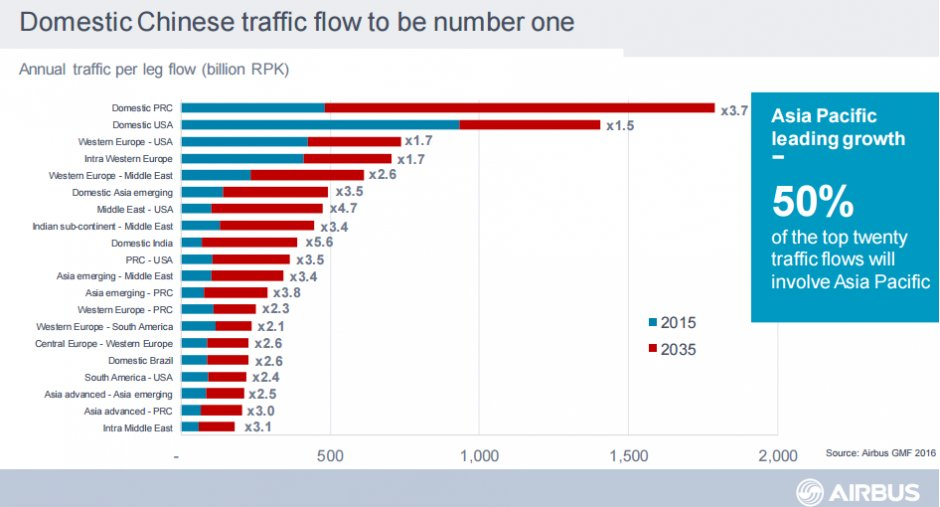
Aviation- This division looks to be in the midst of a multi decade run, as the world continues to be more interconnected. Importantly the Asian travel market is in the early innings of what looks to be a spectacular expansion. GE I believe is in the drivers seat in this industry, both in technology and services.

My one worry is the Chinese looking to enter this market with "homegrown technology" which I believe is code for stealing IP and re packaging it. However manufacturing jet engines is an entirely different animal from copying an iPhone and progress on a Chinese engine that is both safe and accepted is likely a few decades off.

Source: Airbus Home

Healthcare- This industry as a whole, especially preventative medicine in my view will swell massively in the next few decades. I am going to lose a few followers over this i"m certain but I believe universal healthcare in the United States is pretty much a sure bet sometime in the next 20 years. Which would be good news for GE!

Keeping costs down will likely be a key requirement of any future health system, and with GE"s expertise in imaging for preventative medicine and its emerging analytics and software offerings, it may be able to play an important role in the health systems future, however uncertainties do exist as to the nature of cost controls and the potential for margin compression in all things health related.

Committee for a Responsible Federal Budget

Renewables- I am firmly on the alternative energy bandwagon and GE"s positioning in this industry appears very ideal. Wind energy by most measures is already roughly equal in cost per MWh to current fossil fuel plants, this will likely get better with time, and with offshore wind and hydro picking up steam in both efficiency and scale for GE, will open further avenues of growth for this division.

Alternative energy is here to stay, and GE looks to be on a path that requires no subsidies, a major pitfall to solar currently. The downside to wind energy could be the commoditization of wind turbines, however I believe that GE has the technology and service capability to differentiate themselves in this rapidly growing industry for decades to come.

Source: U.S. Energy Information Administration (NYSEMKT:EIA)

So will I say "I do"?

GE has burned me... Badly in the past, and I must say I am rather gun shy about committing to a perhaps multi decade long marriage to the stock.

But she is so damn pretty!

Source: Meme Generator | Create Your Own Meme

My plan "as of today" is to keep my current position, roughly 2.2% of my equity portfolio in GE for the first half of 2018, to test the waters, if you will, of the new CEO. If I continue to like what I am seeing and the valuation seems fair, which I view it to be currently (a forward PE of 17ish) I may step up to the plate and double my position in the company.

Or maybe I won"t, and I will just run like heck and never come back!

GE: "Hey you, what"s up"

Me: ...

Author"s note: If you enjoyed this article and would like to be notified of my future articles, please hit "follow" next to my name at the top of the article to receive notification of future articles I publish.

Disclosure: I am/we are long VWDRY, GE.

I wrote this article myself, and it expresses my own opinions. I am not receiving compensation for it (other than from Seeking Alpha). I have no business relationship with any company whose stock is mentioned in this article.

Editor"s Note: This article discusses one or more securities that do not trade on a major U.S. exchange. Please be aware of the risks associated with these stocks.


Tech