TOKYO (Reuters) - Japan’s Sharp Corp scrapped a plan to issue up to $ 2 billion in new shares, changing its mind in a matter of weeks after the initial announcement prompted investors to dump its shares on fears of earnings per share dilution.
FILE PHOTO: A logo of Sharp Corp is pictured at the CEATEC JAPAN 2017 (Combined Exhibition of Advanced Technologies) at the Makuhari Messe in Chiba, Japan, October 2, 2017. REUTERS/Toru Hanai/File Photo
In a statement on Friday, Sharp cited worries about trade frictions between the United States and China. “Due to increasing market uncertainties, the company decided that carrying on with the plan to issue new shares would not yield maximum benefit for shareholders,” it said.
Sharp shares rose 17 percent by early afternoon as investors cheered the about-face. The plans to issue new shares, announced on June 5, had sparked a sell-off on the market as they would have eroded Sharp’s earnings per share by about 20 percent.
“The shares fell after the announcement, so they decided to quit. It’s that simple,” said Masayuki Otani, chief market analyst at Securities Japan.
“To announce a new share issue, and then say ‘we changed our mind’ because the shares fell... that’s not common but not unprecedented.”
Sharp had previously said it would use funds from the new shares to buy back preferred shares that were issued to banks in return for a financial bailout in 2015. The plan was finalised just a week ago.
FILE PHOTO - A logo of Sharp Corp is pictured at CEATEC (Combined Exhibition of Advanced Technologies) JAPAN 2016 at the Makuhari Messe in Chiba, Japan, October 3, 2016. REUTERS/Toru Hanai/File Photo
The company had tried to persuade investors that the issuance would benefit them in the long run, saying dilution would be more if the preferred shares were converted into regular stock.
Sharp’s shares sank 21 percent since the June 5 announcement until Friday’s open, compared with a 1 percent fall in the broader Tokyo stock market over the same period.
The company said it would continue to discuss with the banks to dissolve the preferred shares.
Sharp has been showing signs of recovery under Taiwan’s Foxconn, the world’s biggest contract manufacturer which is formally known as Hon Hai Precision Industry Co Ltd.
It recently posted its first annual net profit in four years, helped in large part by cost cuts but also by Foxconn’s sales network in China. It has also said it will buy Toshiba Corp’s personal computer business for $ 36 million.
Some analysts said the Osaka-based electronics maker had become more decisive and responsive to shareholders since it was taken over by Foxconn two years ago.
“My impression is that Sharp has really changed as a company,” said Hajime Nakajima, chief strategist at investment advisory firm AsLink, adding the management’s decision on the matter was a speedy one.
Reporting by Makiko Yamazaki; Additional reporting by Chang-Ran Kim, Shinichi Saoshiro and Yoshiyuki Osada; Writing by Ritsuko Ando; Editing by Richard Pullin and Muralikumar Anantharaman
It found that 47 percent of small businesses reported that they had one attack in 2017, and 44 percent said they had two to four attacks.
The invasions included ransomware, which makes a computer"s files unusable unless the device"s user or owner pays a ransom, and phishing, in which emails that look legitimate are used to steals information. The invasions also include what are called drive-by attacks, which infect websites and in turn the computers that visit them.
Despite the prevalence of the data invasions, only about half of small businesses said they had a clear cybersecurity strategy, the report found. And nearly two-thirds said they didn"t bolster their security after an attack.
Hiscox estimates that seven out of 10 businesses aren"t prepared to handle cyber attacks, although they can cost a company thousands of dollars or more and ransomware can shut down operations. Cybersecurity tends to get pushed to the back burner while owners are busy developing products and services and working with clients and employees. Or owners may see it as an expense they can"t afford right now.
Some basic cybersecurity advice:
--Back up all of a company"s data securely. This means paying for a service that keeps a duplicate of all files on an ongoing basis. The best backups keep creating versions of a company"s files that can be accessed in the event of ransomware -- eliminating the need to pay data thieves. Some backups cost just a few hundred dollars a year.
--Install software that searches for and immobilizes viruses, malware and other harmful programs. Also install firewalls and data encryption programs.
--Make sure you have all the updates and patches for your operating systems for all your devices. They often include security programs.
--If you have a website, learn how to protect it from hackers, using software including firewalls. But you might be better off hiring a service that will monitor your site with sophisticated tools that detect and disable intruders.
--Tell your staffers, and keep reminding them, about the dangers of clicking on links or attachments in emails unless they"re completely sure the emails are from a legitimate source. Educate your employees about phishing attacks and the tricks they use. Phishers are becoming increasingly sophisticated and are creating emails that look like they really could have come from your bank or a company you do business with.
--Hire an information technology consultant who will regularly look at your systems to be sure you have the tools you need to keep your data safe.
HONG KONG (Reuters) - Tencent Holdings chairman pledged to advance China’s semiconductor industry, saying the blow to ZTE Corp from Washington’s ban on U.S. firms supplying telecommunications company was a “wake-up” call, local media reported.
FILE PHOTO: Tencent Holdings Ltd Chairman and CEO Pony Ma attends a news conference announcing the company"s annual results in Hong Kong, China March 21, 2018. REUTERS/Bobby Yip
China’s No.2 telecom equipment maker ZTE was banned in April from buying U.S. technology components for seven years for breaking an agreement reached after it violated U.S. sanctions against Iran and North Korea. American firms are estimated to provide 25-30 percent of the components used in ZTE’s equipment.
While the U.S. administration said on Friday it had reached a deal to put ZTE back in business after the company pays a $ 1.3 billion fine and makes management changes, the plan has run into resistance in Congress, indicating ZTE was still far from out of the woods. Also, ZTE is yet to confirm the deal.
FILE PHOTO: A sign of Tencent is seen during the third annual World Internet Conference in Wuzhen town of Jiaxing, Zhejiang province, China November 16, 2016. REUTERS/Aly Song/File Photo
“The recent ZTE incident made everyone more clearly realize that however advanced one may be in mobile payment, without the mobile, the chips and the operating system, you still cannot compete,” Chinese media reports cited Tecent’s Pony Ma as saying at a forum in Shenzhen on Saturday.
FILE PHOTO: A sign of ZTE Corp is pictured at its service centre in Hangzhou, Zhejiang province, China May 14, 2018. REUTERS/Stringer
Tencent, which alternates with Alibaba Group to be Asia’s most-valuable listed company, is the largest social media and gaming company in China and operates the popular WeChat app.
Ma said “even though the ZTE situation was in the process of being resolved, we must not lose vigilance at this time and should pay more attention to fundamental scientific research”.
Tencent is looking into ways it could help advance China’s domestic chip industry, which could include leveraging its huge data demand to urge domestic chip suppliers to come up with better solutions, or using its WeChat platform to support application developments based on Chinese chips, Ma said.
“It would probably be better if we could get in to support semiconductor R&D, but that is perhaps admittedly not our strong suit and may need the help of others in the supply chain.”
China has been looking to accelerate plans to develop its semiconductor market to reduce its heavy reliance on imports and has invited overseas investors to invest in the country’s top state-backed chip fund.
Reporting by Sijia Jiang; Editing by Himani Sarkar
MELBOURNE (Reuters) - National Australia Bank on Saturday suffered what it described as a “nationwide outage” to some of its technology systems, leaving customers unable to access banking services or withdraw money.
FILE PHOTO: A National Australia Bank (NAB) logo is pictured on an automated teller machine (ATM) in central Sydney September 12, 2014. REUTERS/David Gray/File Photo
Customers took to social media to vent their frustrations, with some saying they were left unable to pay for groceries or refuel their cars.
“Loyal member for 15 years and you leave me standing at the supermarket altar with a trolley full of shopping,” said one Twitter user.
The bank tweeted just after midday (0200 GMT) on Saturday that some services were coming back online.
“We’re sorry and it’s not good enough ... but we’ll get it fixed as soon as possible,” Chief Customer Officer Business and Private Banking Anthony Healy said in a video posted on Twitter.
NAB is one of Australia’s four largest retail banks with a customer base of 9 million, according to its website.
The outage follows growing customer discontent with the so-called “Big Four” banks, which have suffered numerous embarrassing disclosures at an inquiry into financial sector misconduct.
A spokesman from the bank told Reuters by telephone that it was a national outage, without elaborating on its cause.
The Bank of New Zealand [BNZL.UL], a NAB subsidiary, also experienced outages on Saturday across New Zealand, but the spokesman was unable to confirm a connection between the two incidents.
Reporting by Will Ziebell in MELBOURNE; Editing by Joseph Radford
I’m a baseball fan. When I lived in the Bay Area, I was a season ticket holder to the San Francisco Giants. And every baseball fan knows about Pete Rose, the preternaturally talented player who scandalized his sport when it was revealed he bet on baseball, including games involving his own team. Now, no one is contemplating allowing players or managers to bet on games in their own sport. But the Pete Rose story serves as a grim reminder of what can happen with sports gambling.
The trouble is that sports gambling is fun! The thrill of making some dough on your team just adds to the excitement of the sport. It’s also hugely profitable for business and government. So when the Supreme Court of the United States released their decision on Murphy vs. NCAA last week, the gambling-loving world rejoiced. SCOTUS determined that the 1992 federal law called Professional and Amateur Sports Protection Act (PAPSA) violated the Constitution’s anti-commandeering clause, thus striking down the law.
Mark Conrad is a professor of law and ethics at Fordham University, where he has taught in the School of Law and in the Gabelli School of Business. He’s also the director of Gabelli’s Sports Business Concentration, and is the author of The Business of Sports -; Off the Field, In the Office, On the News. Professor Conrad was kind enough to share with me some of his thoughts on this landmark decision.
1. Nothing’s Actually Changed…Yet.
The Court’s decision caused an avalanche of news and commentary, but, “At the moment, not much has changed,” says Conrad. The decision opened the door to huge change, but nothing is actually different yet. Conrad explains, “The court declared unconstitutional the Federal law that prohibits sports gambling. It did not sanction or permit sports gambling.” So what happens now? Conrad says no one really knows: “It is now up to the states, or the federal government, to decide.” Here’s where it get interesting!
2. The Devil Is in the Details.
“This story is only beginning,” says Conrad, who also has a degree from Columbia’s School of Journalism. “No state has enact a gambling scheme, although New Jersey may soon,” he says. The question is what happens next. For starters, Conrad asks, “Will states legalize it? And if so, which ones, and when?” Next comes the what. Conrad wants to know, “Will it apply to all sports or just pro sports?” And finally, the how. Conrad ponders: “What will be the license fees for companies wishing to do business in the state? Taxes? Anti-corruption measures?” The potential complexities are endless.
3. Congress May Not Be Done.
The Court may have struck down Congress’ PAPSA law, but that doesn’t mean Congress can’t still have the final word. Conrad explains, “The problem with PAPSA was it prevented states from exercising their powers. The law did not mandate a ban on sports gambling - rather, it told the states they were not allowed to enact laws ‘authorizing’ such gambling schemes.” The problem was the way this law was structured, but not the idea behind the law. In fact, Conrad says, “The decision did state that Congress has the power to enact a ban on gambling.” It’s possible Congress could throw some very cold water on all the excitement.
4. Integrity May Be an Issue…Or May Not.
The potential implications for the integrity of sport are fascinating. As with any gambling, there’s risk of corruption. Conrad recalls, “It has occurred in the past, notably in point-shaving in college sports.” But cheating isn’t a given. “In fact, the risk of corruption may decrease with a properly regulated integrity oversight,” Conrad explains. There are examples the US could look to for inspiration. Conrad says, “The UK model has worked well. The betting companies engage in analytics and metric systems to police suspicious gambling patterns and report these anomalies.” The key is not to over-regulate or over-tax it, which may push otherwise legal gambling underground.
5. This Decision Could Have Major Implications for State Versus Federal Authority.
“This is the underlying constitutional issue in this ruling,” Conrad explains. “Ultimately, it is a constitutional law case regarding state powers under the Tenth Amendment.” Here’s his plain-English explanation of the finer constitutional points: “PAPSA was problematic because it ‘commandeered’ states rights. Instead of banning sports gambling, it said could not enact laws authorizing gambling. It’s a subtle difference, but a constitutionally defective one.” This is an important decision in part of a greater shift. According to Conrad, “It continues a trend to give greater deference to state sovereignty.” It will be fascinating to watch as the complexities continue to develop.
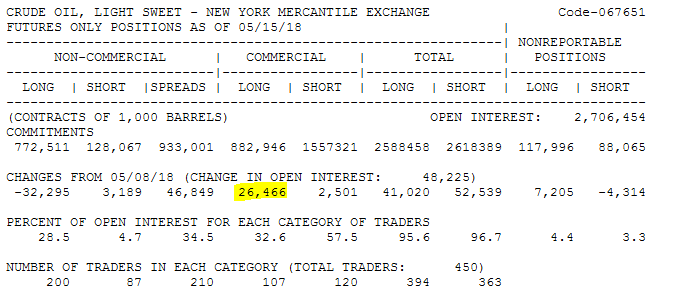
We had previously looked at the positioning of large commercial traders in the oil futures market. While the consensus view had been that this meant that oil prices were due to fall significantly, we basically took the stance that the data implied no such thing.
Since then crude oil prices have risen, with Brent oil futures threatening to break the $ 80 barrier and by our count, at least 4 grades of oil trading above the critical $ 80 mark. With prices firmly entrenched in a long-term upswing, we were surprised to see that the commercial traders had started to actually go long crude oil futures.
While carriers saved hundreds of millions of dollars from oil prices halving since June, they forfeited a large chunk of that gain because of the fuel hedges they bought as protection against oil rising.
The bulk of those hedges - which effectively lock in fuel costs in advance - are set at levels that force airlines to pay more for fuel than current market prices, turning them into a hindrance rather than a help.
As a result, three of the four biggest carriers - Delta, Southwest and United - said this week they were rethinking their hedging tactics. Meanwhile, American, which does not hedge fuel costs at all, is reaping the biggest savings.
Southwest Airlines Co. said on Thursday its outstanding hedges represented a loss of $ 1.8 billion through 2018, at Jan. 15 prices. However, it still expects a fuel bill that is more than 30 cents per gallon lower this year compared to 2015, or a roughly half-billion dollar net benefit.
It was this group"s absence that distorted the futures positioning in the crude oil market and gave the appearance that collectively "the hedgers" were bearish on oil. That logic proved very costly as anyone who went by the commitment of traders report, stayed away from long positions and missed the entire rally.
However, with prices breaching past levels that no analyst thought possible last year, the airlines may be getting religion. Fuel represents the single biggest cost factor for airlines and it is hard to pass on unless capacity utilization is extremely high. While for most part airlines have denied that they will hedge, we believe some in the group are now breaking ranks. There are two likely reasons for this. The first being the certainty of cash flow is likely to assuage investor concerns, even if it is at a much higher price than they should have hedged. The second is this.
Wheel of Fortune is a leading and comprehensive marketplace service dedicated to picking the best risk-adjusted opportunities in stocks, bonds, ETFs and CEFs. We look for securities from an income and capital appreciation standpoint and focus primarily on managing risk in trades. We use options frequently to minimize risk and enhance returns.
We invite readers to have a closer look at our investment strategy and our best current picks. For more information, click here.
Disclaimer: Please note that this is not financial advice. It may seem like it, sound like it, but surprisingly, it is not. Investors are expected to do their own due diligence and consult with a professional who knows their objectives and constraints.
Seeking Alpha has changed its policies. Previously "following" someone required a ritualistic commitment and an offering of not less than 4 oxen or 3 breeding horses. Now, all it takes is one click! If you enjoyed this article, please scroll up and click on the "Follow" button next to my name to not miss my future articles.If you did not like this article, please read it again, change your mind and then click on the "Follow" button next to my name to not miss my future articles.
Disclosure:I/we have no positions in any stocks mentioned, and no plans to initiate any positions within the next 72 hours.
I wrote this article myself, and it expresses my own opinions. I am not receiving compensation for it (other than from Seeking Alpha). I have no business relationship with any company whose stock is mentioned in this article.
Additional disclosure: We are long several energy related plays.
SEOUL (Reuters) - South Korea’s biggest conglomerate, Samsung Group [SAGR.UL], came for fresh criticism about its ownership structure on Thursday, with the country’s antitrust chief saying it was unsustainable.
FILE PHOTO - Samsung Group chief, Jay Y. Lee, is surrounded by media as he arrives at the Seoul Central District Court in Seoul, South Korea, January 18, 2017. REUTERS/Kim Hong-Ji/File Photo
Korea Fair Trade Commission chief Kim Sang-jo took aim at the group’s circular shareholdings between companies such as Samsung C&T, Samsung Life Insurance, and Samsung Electronics.
The structure has enabled the family of Samsung heir Jay Y. Lee to retain control of the companies in the conglomerate, especially crown jewel Samsung Electronics, with minimum investments, critics have said.
“The clear fact is, the current ownership and control structure of Samsung Group, which goes from Vice Chairman Jay Y. Lee to Samsung C&T to Samsung Life Insurance to Samsung Electronics, is not sustainable,” Kim told reporters on the sidelines of a meeting with business leaders.
Samsung Group’s complex ownership structure has come for criticism earlier too, most notably from U.S. activist hedge fund Elliott Management, which proposed as a solution in 2016 that Samsung Electronics split itself into two.
Samsung Electronics rejected that proposal but accepted part of the fund’s proposals by announcing plans to cancel its existing treasury shares worth over $ 35 billion by 2018.
Fair Trade Commission’s Kim said he urges Jay Y. Lee to make a decision concerning the ownership structure, adding that Samsung Electronics Vice Chairman Yoon Boo-keun, who attended the meeting, had told him it will be considered.
A Samsung Electronics spokesman did not have an immediate comment.
Others have also questioned the group’s ownership structure recently.
The country’s top financial regulator said on Wednesday that Samsung Life Insurance must consider ways to lessen the risk of having too much of its assets concentrated in one place, including selling some or all of Samsung Life’s stake in Samsung Electronics.
“Lessening the risk of concentrated assets is key to securing financial stability, which is what we are interested in,” said Choi Jong-ku, Chairman of the Financial Services Commission.
“If there are any concerns about retaining management control (of Samsung Electronics) we are saying, look for ways to keep it while lessening the risk.”
Samsung Life Insurance is at the heart of a cross-shareholding structure in which it owns about 8 percent of Samsung Electronics, which has a market value of about $ 340 billion, according to Thomson Reuters data.
Reporting by Heekyong Yang and Yuna Park; Additional reporting and writing by Joyce Lee; Editing by Muralikumar Anantharaman
(Reuters) - Uber Technologies Inc [UBER.UL] said Monday it has hired a former National Transportation Safety Board (NTSB) chairman to advise the company on its safety culture after a fatal self-driving crash in Arizona.
The Uber logo is displayed on a screen during the Women In The World Summit in New York City, U.S., April 12, 2018. REUTERS/Brendan McDermid
Online news outlet The Information reported Monday that Uber has determined the likely cause of the fatal collision was a problem with the software that decides how the car should react to objects it detects. The outlet said the car’s sensors detected the pedestrian but the software decided it did not need to react right away.
“We have initiated a top-to-bottom safety review of our self-driving vehicles program, and we have brought on former NTSB Chair Christopher Hart to advise us on our overall safety culture,” Uber said Monday. “Our review is looking at everything from the safety of our system to our training processes for vehicle operators, and we hope to have more to say soon.”
A 49-year-old woman was killed on March 18 after being hit by an Uber self-driving sports utility vehicle while walking across a street in Phoenix, leading the company to suspend testing of autonomous vehicles. Arizona’s governor also ordered a halt to Uber’s testing.
Uber declined to comment on the Information report. “We can’t comment on the specifics of the incident,” the company said, citing the ongoing NTSB investigation.
The National Highway Traffic Safety Administration is also investigating the incident.
Uber Chief Executive Dara Khosrowshahi said in April the ride-sharing company still believes in the prospects for autonomous transport. “Autonomous (vehicles) at maturity will be safer,” he said at a Washington event.
Reporting by David Shepardson; editing by Jonathan Oatis
LOS ANGELES (Reuters) - Amazon.com’s Whole Foods Market sparked social media outrage after its newest store in its 365 grocery chain partnered with an Asian restaurant with the racially charged name of Yellow Fever.
A Whole Foods Market store is seen in Santa Monica, California, U.S. March 19, 2018. REUTERS/Lucy Nicholson
The independently owned and operated eatery - whose name is taken from the slang term for a white man’s sexual attraction to Asian women - is located in the 365 store that opened in Long Beach, California, on Wednesday.
“An Asian ‘bowl’ resto called YELLOW FEVER in the middle of whitest Whole Foods — is this taking back of a racist image or colonized mind?” Columbia University professor and author Marie Myung-Ok Lee, wrote on Twitter.
Whole Foods, which has eight stores in its 365 chain that was launched with a no-frills concept to win over millennials, declined comment.
“Yellow Fever celebrates all things Asian: the food, the culture and the people and our menu reflects that featuring cuisine from Korea, Japan, China, Vietnam, Thailand and Hawaii,” said Kelly Kim, executive chef and co-founder of Yellow Fever, which also operates two Los Angeles-area restaurants.
“We have been a proud Asian, female-owned business since our founding over four and a half years ago in Torrance, California.”
Kim, who is Korean-American, in previous interviews said she was aware that the name choice would be attention-getting and controversial.
“One night, we just said ‘Yellow Fever!’ and it worked. It’s tongue-in-cheek, kind of shocking, and it’s not exclusive — you can fit all Asian cultures under one roof with a name like this. We just decided to go for it,” Kim told Asian American news site NextShark six months ago.
A year ago she told the Argonaut, a local Los Angeles news outlet, that Yellow Fever means “love of all things Asian” and that public push back over the name had not been as drastic as expected.
Some people on social media defended the news of the partnership with Whole Foods as part of a broader cultural trend.
“This is no more offensive than @abc naming an Asian sitcom Fresh of the Boat or FOB- which is considered racists [sic],” wrote Lorin Hart, who uses the Twitter handle @CubeProMH.
Reporting by Lisa Baertlein in Los Angeles; Editing by Marguerita Choy
Tesla’s (TSLA) Q1 production update had me singing and dancing with joy. I encourage you to read the whole thing. Or if you prefer, watch this video from HyperChange covering the update:
The top three updates are on Model 3 production, Tesla"s cash flow, and Model 3 quality.
Model 3 production is at a burst rate of 2,000/week
After six months of delays, Model 3 production is finally on track:
In the past seven days, Tesla produced 2,020 Model 3 vehicles. In the next seven days, we expect to produce 2,000 Model S and X vehicles and 2,000 Model 3 vehicles.
If this rate can indeed be sustained into April and even increased, then Tesla is just shy of its goal to produce 2,500 Model 3s/week by the end of March. Bloomberg’s independent model has production about a month behind that target. For Tesla, a month late is basically on time! Moreover, in light of this update, Tesla might only be a few weeks behind.
As always, it bears reminding that this is an arbitrary, self-imposed goal largely designed around motivating employees. It’s not required for any financial, competitive, or technological purpose. A line in the sand just has to be drawn somewhere.
Tesla says it doesn"t need to raise cash this year
Recent alarm about Tesla"s solvency seems to be misplaced:
Tesla continues to target a production rate of approximately 5,000 units per week in about three months, laying the groundwork for Q3 to have the long-sought ideal combination of high volume, good gross margin and strong positive operating cash flow. As a result, Tesla does not require an equity or debt raise this year, apart from standard credit lines.
Boom! That"s what I love to hear! Barring further delays, Tesla is about six months out from achieving massive positive cash flow from Model 3 sales. If targets are met, Model 3 will generate quarterly revenue on the order of $ 3.25 billion and quarterly gross profit on the order of $ 810 million. (That"s assuming a $ 50,000 ASP and 25% gross margin about a quarter after a 5,000/week production rate is achieved.) Previously, Tesla has guided that it will post sustained operating profits starting by the end of 2018, with a possibility of net profit before 2019 as well.
Based on my own review of the numbers, I think that Tesla’s cash “crunch” is being exaggerated. There are aspects of Tesla’s finances that are opaque to outsiders (such as the composition of accounts payable), however, so it is encouraging to get confirmation from Tesla on this. Here’s the basic math: As of the end of Q4 2017, Tesla had a cash balance of $ 3.37 billion. In Q4, it burned $ 277 million. At that rate of cash burn, it wouldn"t run out of cash until the beginning of 2021.
Several one-time factors contributed to cash burn for Q4 being so low, such as customer deposits for the Tesla Semi and next-gen Roadster. However, there were repeatable factors as well, perhaps most notably slowing discretionary capex. Tesla can slow expansionary spending to be in line with growth in revenue and gross profit. This makes particular sense when it comes to the sales, service, and charging infrastructure for the Model 3 fleet. We’ll have more hard data in about a month when Tesla releases its Q1 earnings.
The key here is the threshold beyond which Model 3 production goes from a net cash incinerator to a net cash generator. If all goes according to plan, by the end of this year, Tesla will likely have the ability to have positive free cash flow. However, that doesn"t seem to be the plan.
From the sounds of it, Tesla wants to finance capex for Model Y, Semi, Roadster, Solar Roof, Powerwall, Powerpack, and future products with debt and perhaps even equity, plus other sources of cash like customer deposits and securitizing leases. Note that Tesla says raising cash this year isn"t “required.” That doesn"t rule out raising discretionary cash to fund faster expansion.
Tesla has a total of $ 330 million in debt coming due in 2018. Given Tesla’s end of Q4 cash balance of $ 3.37 billion and ramping Model 3 production, $ 330 million is a manageable amount to repay. Heck, Tesla could probably wipe that debt away by collecting Model Y deposits. Because Elon Musk is a rock star.
Some convertible bonds to the tune of $ 920 million are set to mature in March 2019. The conversion price is $ 359.87. I can"t predict the ebb and flow of the markets, but it seems well within the realm of possibility that Tesla’s share price will exceed that $ 360 a year from now. If not, with approximately $ 810 million in quarterly gross profit from the Model 3, repayment will be no problem.
Tesla’s internal data shows high Model 3 owner satisfaction
Finally, Tesla again shared internal survey data of Model 3 owners:
The quality of Model 3 coming out of production is at the highest level we have seen across all our products. This is reflected in the overwhelming delight experienced by our customers with their Model 3s. Our initial customer satisfaction score for Model 3 quality is above 93%, which is the highest score in Tesla"s history.
Although this is somewhat encouraging, Tesla is of course incentivized to present the Model 3 in the best possible light. Before I consider this matter settled, I want to see data from an independent source like Consumer Reports. Consumer Reports has yet to publish survey data on the Model 3. So, for now, we wait.
What is not particularly informative are anecdotes about Model 3 quality. If you, like me, believe in the Enlightenment values of science and logically rigorous thought, then you’ll agree that anecdotes plucked from large samples seldom reveal the truth and often mislead. Statistics reveal the truth. It is surprising and disconcerting to me that so much investment and media analysis — particularly of Tesla — seems to exist in a pre-scientific, pre-Enlightenment mode of thinking in which fact and conjecture are haphazardly mixed, cherry-picked anecdotes are held up as representative, and rumour and hearsay are credulously accepted. So much of what you’ll read and hear about Tesla is either essentially made up or grossly exaggerated because there is little to no application of Enlightenment criteria of truth.
The way I think about companies is to try to approximate as best I can the scientific method. Any way I can remove my own subjective bias is a relief. Hard data is always a breath of fresh air. So is any other empirical test that can serve to falsify an idea. Without scientific discipline, we will inevitably fool ourselves, and wander around in the darkness.
So, I don’t consider a photo of a Model 3 with egregious panel gaps to be informative. A photo of a Model 3 with seamless panels is equally uninformative. Ignore anecdotes. Find statistics. For now, we simply don"t know the level of quality of the Model 3.
Conclusion
Panic and doomsaying about Tesla may never stop entirely. However, it has taken another step toward demonstrating that it has a sustainable business model capable of long-term growth and profits. A year from now, we will probably be having a very different conversation about this company. I look forward to it.
Disclosure:I am/we are long TSLA.
I wrote this article myself, and it expresses my own opinions. I am not receiving compensation for it (other than from Seeking Alpha). I have no business relationship with any company whose stock is mentioned in this article.
As activists from around the country gather in Washington to march for gun safety regulation, new data shows that the National Rifle Association has been aggressively resisting their message through online ads. In the weeks following the school shooting that triggered Saturday’s protests, the NRA spent more than six times its prior daily average on digital ads – including some that appeared with media intended for children.
The finding came from the digital research firm Pathmatics, as reported by the Chicago Tribune. The NRA briefly suspended its online ad efforts after a February school shooting that left 17 dead at Marjory Stoneman Douglas High School in Parkland, Florida. But Pathmatics found that over the 24 days after the ads resumed, the NRA spent an average of $ 47,300 per day, up from an average of $ 11,300 per day before the murders.
The ad spending was primarily focused on social media, with Facebook pocketing an average of $ 34,000 of it per day. The NRA also climbed the ranks of the biggest-spending YouTube advertisers, and Pathmatics found that some NRA ads were displayed with videos from Kids’ Toys, a very popular channel featuring two youngsters reviewing Barbie dolls and Lego playsets.
A media commentator told the Tribune that this odd placement probably showed the NRA’s desire for broad reach, rather than the targeting of any specific audience. The NRA reportedly continued to use long-running ads after the shooting, most of them aimed at increasing memberships.
(Reuters) - Rocket company SpaceX’s verified Facebook page disappeared on Friday, minutes after its founder and Silicon Valley billionaire Elon Musk promised on Twitter to take down the page when challenged by a user.
Elon Musk at a SpaceX press conference last month. REUTERS/Joe Skipper
"Delete SpaceX page on Facebook if you"re the man?" a user tweeted to Tesla Inc (TSLA.O) chief Musk. His response: "I didn’t realize there was one. Will do." (bit.ly/2pDcu3l)
SpaceX"s Facebook page, which had more than 2.7 million followers, is no longer accessible. (bit.ly/2G8BGWo)
Musk had begun the exchange by responding to a tweet from WhatsApp co-founder Brian Acton of the #deletefacebook tag.
HONG KONG (Reuters) - China’s Tencent Holdings Ltd (0700.HK) saw its shares down 4.51 percent at the midday trading break on Friday after the internet firm’s largest shareholder, Naspers Ltd (NPNJn.J), said it would lower its stake for the first time in 17 years.
A Tencent sign is seen during the fourth World Internet Conference in Wuzhen, Zhejiang province, China, December 4, 2017. REUTERS/Aly Song
The Hong Kong-listed stock opened 7.8 percent lower at HK$ 405, its lowest opening price since Feb. 9, before regaining ground to HK$ 419.6 by noon. The benchmark Hang Seng Index .HSI was down 2.81 percent.
A day earlier, the stock fell 5 percent following Tencent’s late Wednesday report showing quarterly revenue missed estimates as well as expectations of margin pressure, although profit beat forecasts.
Friday’s decline wiped $ 24 billion (17 billion pounds) off Tencent’s market value, though at $ 508 billion, it is still Asia’s most valuable listed company and fifth globally behind Apple Inc (AAPL.O), Alphabet Inc (GOOGL.O), Amazon.com Inc (AMZN.O) and Microsoft Corp (MSFT.O).
South African media and e-commerce group Naspers said on Thursday it planned to sell up to 190 million Tencent shares, or 2 percent of its holding, in a sale that could earn Naspers up to $ 11 billion. It also said it had no plans to further reduce its holding for the next three years.
“The funds will reinforce Naspers’ balance sheet and be invested in classifieds, online food delivery and fintech globally,” said CICC analyst Natalie Wu. “We think it is a good opportunity to buy into dips given Tencent’s solid fundamentals.”
Jefferies analyst Karen Chan said, “Given Naspers’ largest single shareholding and board representation in Tencent, we believe its stake sale is unlikely to be a reaction to Tencent’s quarterly results. Instead of a timed profit-taking move, we believe this is more to improve Naspers’ own free cash flow and allow it higher flexibility in pursuing investment opportunities.”
A Tencent spokeswoman said it was informed and supportive of Naspers’ decision, and that Naspers’ intention to keep its remaining stake for the next three years demonstrated its confidence in Tencent.
Reporting by Sijia Jiang and Donny Kwok; Editing by Paul Tait and Christopher Cushing
SAN FRANCISCO (Reuters) - A woman died of her injuries after being struck by a Uber self-driving vehicle in Arizona, police said on Monday, and the ride hailing company said it had suspended its autonomous vehicle program across the United States and Canada.
FILE PHOTO: Uber"s logo is pictured at its office in Tokyo, Japan, November 27, 2017. REUTERS/Kim Kyung-Hoon
The accident in Tempe, Arizona, marked the first fatality from a self-driving vehicle, which are still being tested around the globe, and could derail efforts to fast-track the introduction of the new technology in the United States.
FILE PHOTO: A fleet of Uber"s Ford Fusion self driving cars are shown during a demonstration of self-driving automotive technology in Pittsburgh, Pennsylvania, U.S. September 13, 2016. REUTERS/Aaron Josefczyk/File Photo
At the time of the accident, which occurred overnight Sunday to Monday, the car was in autonomous mode with a vehicle operator behind the wheel, Tempe police said.
“The vehicle was traveling northbound ... when a female walking outside of the crosswalk crossed the road from west to east when she was struck by the Uber vehicle,” police said in a statement.
A spokesman for Uber Technologies Inc said the company was suspending its North American tests. In a tweet, Uber expressed its condolences and said the company was fully cooperating with authorities.
Reporting by Alexandria Sage; Editing by Jonathan Oatis
SAN FRANCISCO (Reuters) - Facebook Inc faced new calls for regulation from within U.S. Congress and was hit with questions about personal data safeguards on Saturday after reports a political consultant gained inappropriate access to 50 million users’ data starting in 2014.
FILE PHOTO: Facebook logo is seen at a start-up companies gathering at Paris" Station F in Paris, France on January 17, 2017. REUTERS/Philippe Wojazer/File Photo
Facebook disclosed the issue in a blog post on Friday, hours before media reports that conservative-leaning Cambridge Analytica, a data company known for its work on Donald Trump’s 2016 presidential campaign, was given access to the data and may not have deleted it.
The scrutiny presented a new threat to Facebook’s reputation, which was already under attack over Russians’ alleged use of Facebook tools to sway American voters before and after the 2016 U.S. elections.
“It’s clear these platforms can’t police themselves,” Democratic U.S. Senator Amy Klobuchar tweeted.
“They say ‘trust us.’ Mark Zuckerberg needs to testify before Senate Judiciary,” she added, referring to Facebook’s CEO and a committee she sits on.
Facebook said the root of the problem was that researchers and Cambridge Analytica lied to it and abused its policies, but critics on Saturday threw blame at Facebook as well, demanding answers on behalf of users and calling for new regulation.
Facebook insisted the data was misused but not stolen, because users gave permission, sparking a debate about what constitutes a hack that must be disclosed to customers.
“The lid is being opened on the black box of Facebook’s data practices, and the picture is not pretty,” said Frank Pasquale, a University of Maryland law professor who has written about Silicon Valley’s use of data.
Pasquale said Facebook’s response that data had not technically been stolen seemed to obfuscate the central issue that data was apparently used in a way contrary to the expectations of users.
“It amazes me that they are trying to make this about nomenclature. I guess that’s all they have left,” he said.
Democratic U.S. Senator Mark Warner said the episode bolstered the need for new regulations about internet advertising, describing the industry as the “Wild West.”
“Whether it’s allowing Russians to purchase political ads, or extensive micro-targeting based on ill-gotten user data, it’s clear that, left unregulated, this market will continue to be prone to deception and lacking in transparency,” he said.
With Republicans controlling the Senate’s majority, though, it was not clear if Klobuchar and Warner would prevail.
The New York Times and London’s Observer reported on Saturday that private information from more than 50 million Facebook users improperly ended up in the hands of Cambridge Analytica, and the information has not been deleted despite Facebook’s demands beginning in 2015.
Some 270,000 people allowed use of their data by a researcher, who scraped the data of all their friends as well, a move allowed by Facebook until 2015. The researcher sold the data to Cambridge, which was against Facebook rules, the newspapers said.
Cambridge Analytica worked on Trump’s 2016 campaign. A Trump campaign official said, though, that it used Republican data sources, not Cambridge Analytica, for its voter information.
Facebook, in a series of written statements beginning late on Friday, said its policies had been broken by Cambridge Analytica and researchers and that it was exploring legal action.
Cambridge Analytica in turn said it had deleted all the data and that the company supplying it had been responsible for obtaining it.
Andrew Bosworth, a Facebook vice president, hinted the company could make more changes to demonstrate it values privacy. “We must do better and will,” he wrote on Twitter, adding that “our business depends on it at every level.”
Facebook said it asked for the data to be deleted in 2015 and then relied on written certifications by those involved that they had complied.
Nuala O’Connor, president of the Center for Democracy & Technology, an advocacy group in Washington, D.C., said Facebook was relying on the good will of decent people rather than preparing for intentional misuse.
Moreover, she found it puzzling that Facebook knew about the abuse in 2015 but did not disclose it until Friday. “That’s a long time,” she said.
Britain’s data protection authority and the Massachusetts attorney general on Saturday said they were launching investigations into the use of Facebook data.
“It is important that the public are fully aware of how information is used and shared in modern political campaigns and the potential impact on their privacy,” UK Information Commissioner Elizabeth Denham said in a statement.
Massachusetts Attorney General Maura Healey’s office said she wants to understand how the data was used, what policies if any were violated and what the legal implications are.
Reporting by David Ingram; Editing by Peter Henderson and Chris Reese
BEIJING (Reuters) - Chinese telecoms equipment group ZTE Corp hit back on Thursday against concerns from U.S. lawmakers that it is a vehicle for Chinese espionage, saying it was a trusted partner of its U.S. customers, state news agency Xinhua reported.
China is trying to gain access to sensitive U.S. technologies and intellectual properties through telecommunications companies, academia and joint business ventures, U.S. senators and spy chiefs warned on Tuesday.
Republican Senator Richard Burr, chairman of the Senate Intelligence Committee, said he was concerned about the ties to the Chinese government of Chinese telecoms companies like Huawei Technologies Co Ltd and ZTE.
“ZTE is proud of the innovation and security of our products in the U.S. market,” Xinhua cited a ZTE spokesman as saying.
The company takes cybersecurity and privacy seriously, has always adhered to laws and remains a trusted partner of U.S. suppliers and customers, the company added.
“As a publicly traded company, we are committed to adhering to all applicable laws and regulations of the United States, work with carriers to pass strict testing protocols, and adhere to the highest business standards,” it said.
Last week, Republican Senator Tom Cotton and Republican Senator Marco Rubio introduced legislation that would block the U.S. government from buying or leasing telecoms equipment from Huawei or ZTE, citing concern the companies would use their access to spy on U.S. officials.
In 2012, Huawei and ZTE were the subject of a U.S. investigation into whether their equipment provided an opportunity for foreign espionage and threatened critical U.S. infrastructure - something they have consistently denied.
Allegations of hacking and internet spying have long strained relations between China and the United States. In 2014 then FBI Director James Comey said Chinese hacking likely cost the U.S. economy billions of dollars every year.
China has strongly denied all U.S. accusations of hacking attacks.
Reporting by Ben Blanchard; Editing by Stephen Coates
Apple, Inc. (AAPL) stock whipsawed after the company posted quarterly earnings. After initially dropping 2%, shares turned up 3.5% in after-hours trading, only to give up the gains and decline nearly 3% on Friday, February 2nd.
Indeed, there is reason for the market’s mixed reaction. On one hand, Apple sold fewer phones than it did a year ago. And, after a massive 32% rally in the past one year, the stock is trading well above its average valuation.
On the other hand, Apple is still generating strong growth rates. Average iPhone selling prices continue to rise, and the services business is booming. Apple also has appeal for dividend growth investors. Since Apple re-instituted its dividend in 2012, it has increased its dividend by 10% each year. Apple is one of 331 stocks in the technology sector that pays a dividend. You can see all 331 dividend-paying tech stocks here.
There seem to be good reasons for both the bullish and bearish case for Apple. This article will discuss why the tug-of-war could continue.
Earnings Overview
For the fiscal 2018 first quarter ended December 30th, Apple had earnings-per-share of $ 3.89, on revenue of $ 88.3 billion. Earnings-per-share beat analyst forecasts by $ 0.04. Revenue increased 12.7% from the same quarter a year ago, and beat expectations by $ 670 million. Apple sold 77.3 million iPhones in the quarter, which was down from 78.3 million in the same quarter last year. Apple was expected to report 80 million iPhones sold.
At the same time, average iPhone selling price increased over $ 100, from $ 695 last year to $ 796 in the most recent quarter. Analysts were forecasting an average iPhone selling price of $ 737. This could be the reason why Apple stock jumped over 3%, after initially selling off. While Apple sold fewer phones overall, the bigger-than-expected increase in average selling price indicates a more favorable shift to higher-priced models. Stronger demand for upper-end iPhones, such as the iPhone X, would be a very good sign.
Once again, Apple’s cash mountain continued to grow. Cash, marketable securities, and long-term investments hit $ 285.1 billion, which represents an all-time high. Cash and investments totaled $ 268.9 billion in the same quarter last year. Apple’s current cash pile amounts to 33% of its market capitalization. This is a huge amount of cash, which Apple can use to reward shareholders with cash returns, and invest for future growth.
Growth Prospects
Overall, Apple had a good quarter. Revenue and earnings-per-share increased 13% and 16%, respectively. Both measures hit all-time records, and going forward, there is plenty of room for growth to continue. Apple continues to be hugely popular; its active installed base of devices reached 1.3 billion in January, a 30% increase in the past two years.
Earnings growth of 10%+ each year is within reach for Apple. Consumers love their Apple devices, and are willing to pay a premium for them. Apple is the most valuable brand in the world, and as a result, the company holds tremendous pricing power. Since the iPhone business is Apple’s most important by far, the ability to sell higher-priced iPhones is crucial to future earnings growth.
Another catalyst for Apple is its booming services business, which includes iTunes, the App Store, Apple Pay, and more. Services revenue is now a $ 30 billion-a-year business for Apple. In the most recent quarter, services revenue increased 18%, the highest-growth product aside from the “other” category. Services are now Apple’s second-largest segment, behind the iPhone.
Valuation & Expected Returns
Apple is a very high-quality business, with continued room for growth. But even after its strong quarter, the stock fell over 2% after earnings. After a huge gain last year, Apple seems to be taking a breather, which is confusing since the company is still generating strong growth. One reason for the market’s cautious tone toward Apple, could be the valuation of the stock, which has expanded significantly in recent years.
Apple had earnings-per-share of $ 9.73 in the past four quarters. As a result, the stock has a price-to-earnings ratio of 17.8. At first glance, Apple does not seem to be undervalued, relative to the broader market index. The S&P 500 trades for an average price-to-earnings ratio of 26.3.
But in a different context, it is reasonable why investors might be reluctant to bid the stock up even further. In terms of its own historical average, Apple’s valuation is at a multi-year high. Apple has not traded for a price-to-earnings ratio above 18 since 2009. According to ValueLine, over the past five years, Apple has held an average price-to-earnings ratio of just 13.1.
Apple currently trades at a 35% premium to its average price-to-earnings ratio of the past five years. A reversion to the mean would negatively impact the stock. For example, if Apple reverted back to a price-to-earnings ratio of 15-16, the stock would decline approximately 10% to 15%.
To be sure, Apple will generate positive returns, from earnings growth and dividends. In the past 5 years, Apple has increased earnings at a 10% average rate, each year. A potential breakdown of future returns is below:
6%-8% sales growth
3% share repurchases
1.5% dividend yield
The combination of earnings growth and dividends could yield annual returns of 10%-13% each year. But even in this scenario, total returns could still be mediocre, if the valuation multiple declines. For example, if Apple’s price-to-earnings ratio declines to 15 over the next three years, contraction of the valuation multiple would reduce annual returns by 5% per year. In that case, total annual returns would be in the 5%-8% range over that time.
Final Thoughts
Apple is a fantastic business, and the company is growing revenue and earnings at impressive rates. The only significant risk for the stock moving forward, could be the valuation. While Apple is not overvalued relative to the S&P 500, it does trade at a much higher valuation than it has over the past five years. If the stock were to return to its average valuation, it could be a headwind for the stock.
Investors looking for superior returns should consider high-quality dividend growth stocks, such as the Dividend Aristocrats, which have increased their dividends for 25+ consecutive years. The Dividend Aristocrats have outperformed the S&P 500 Index in the past 10 years. Apple is not yet a Dividend Aristocrat, but there are many other high-quality Dividend Aristocrats, with lower valuations and higher dividend yields. Find them with our service Undervalued Aristocrats provides actionable buy and sell recommendations on some of the most undervalued dividend growth stocks around.Click here to learn more.
Disclosure:I am/we are long AAPL.
I wrote this article myself, and it expresses my own opinions. I am not receiving compensation for it (other than from Seeking Alpha). I have no business relationship with any company whose stock is mentioned in this article.
LuLaRoe is no stranger to controversy. But the multilevel marketing women"s clothing company has really stepped in it after a battle with the National Down Syndrome Society (NDSS) over a shocking video that mocked the disabled. Attempts to spin the controversy are challenging at best.
This latest tussle is particularly ugly. For some time, LuLaRoe has been an official supporter of NDSS as DeAnne Stidham, who had a grandchild with the condition. Even that has some questions tied to it, as one promotion that tied a $ 1 donation for sales of two different special items would be more than offset by increased costs to the salespeople.
The latest situation came about when an independent sales agent mocked people with special needs, as reported by KXTV television, in a video posted to YouTube. The specific remark starts at about 55 seconds in.
Within the last 24 hours, it has come to the attention of the National Down Syndrome Society that an online video by a LuLaRoe independent retailer, which mocks a person with a disability, was posted on YouTube. This video is unacceptable and further perpetuates the stigmas we work to fight and end each and every day at NDSS.
While we appreciate the apology from this individual and the previous support from LuLaRoe, we must uphold our mission statement, and end our partnership and any further programming with LuLaRoe immediately.
We are deeply saddened and disappointed to announce our decision to end our relationship with the National Down Syndrome Society. Our company and the Independent Fashion Retailers have embraced the NDSS and its important work, and have enthusiastically supported the organization"s efforts over the past year.
Regrettably, a LuLaRoe Independent Fashion Retailer exhibited unacceptable and insensitive behavior during a live sale, which understandably offended viewers as well as everyone at LuLaRoe. His bad judgment in no way represents the beliefs and character of LuLaRoe or Independent Fashion Retailers.
Immediately after his sale, the Retailer posted an apology. He also reached out to NDSS and said he and his wife have agreed to use the incident as a learning experience and expressed his intention to focus his business on support for the organization and its cause.
After speaking with the Retailer at great length, we believe his apology is sincere and accepted his assurance that this type of behavior would never happen again. We are also using this unfortunate incident as an opportunity to redouble our sensitivity and tolerance training efforts and policies for Independent Fashion Retailers.
Unfortunately, NDSS leadership is unwilling to accept the Retailer"s apology and has informed us that unless we terminate his contract with LuLaRoe, the organization will no longer associate with us. We do not believe the most productive response to his actions, which he has fully apologized for, is to close his business and threaten his ability to provide for his family.
Trying to decide who is "right" can be difficult. LuLaRoe claims that an apology that it thought was sincere should have been enough. At the same time, it would seem that NDSS would be the party to decide whether the apology was adequate, as its cause was the one injured and it has doubtlessly faced analogous situations over the years. Words of contrition in uncomfortable cases often are the result of people trying to avoid the consequences of their actions. Would NDSS essentially support the idea that everyone had one free pass to mock people with Down Syndrome? At a time when there seems to be zero tolerance for sexual harassment, why wouldn"t other concerns receive the same degree of respect?
Aside from those considerations, however, LuLaRoe handled the situation badly in three ways. When you employ independent people as agents of your company, you have tied yourself to them and their actions. By decided that "education" had already been achieved, LuLaRoe effectively handed itself a pass on the issue.
Not only did LuLaRoe forgive itself, it compounded that action by blaming NDSS through its choice of words. By saying, "Unfortunately, NDSS leadership is unwilling to accept the Retailer"s apology," the company shifted responsibility to the organization by implying that NDSS was unreasonable in its approach.
Finally, the company"s navigation of cause marketing is problematic. To partner with an organization and gain some marketing advantage requires the following:
Your company"s values or interests should have an organic connection to the cause.
You need to understand the requirements and implications of partnering with an organization.
To be sincere, you then have to not only support the organization and cause, but meet the requirements going forward.
LuLaRoe should have identified any difference in philosophy with the organization before pledging support, no matter how much its founders believed in the cause. Had it done so, it would have known in advance the necessary course of action should a conflict arise and then known whether or not it could live with the conditions.
The seller in question may have been sincere in having learned a lesson, but NDSS had its own need to see that disrespect carried a penalty beyond momentary embarrassment. Ultimately, it is LuLaRoe"s fault for not having asked the right questions and then deciding that the organization should change its philosophy to accommodate the company"s.
(Reuters) - WhatsApp, a popular messaging service owned by Facebook Inc, suffered a global outage for about an hour on Sunday before the problem was fixed.
“WhatsApp users around the world experienced a brief outage today that has now been resolved”, a WhatsApp spokeswoman said in an emailed statement. The cause of the outage, about an hour long, was not immediately known.
In India, its biggest market with about 200 million of its billion-plus users, the app was down just a few minutes past midnight into the new year.
Users in other countries also complained of outages on social media.
Reporting by Sangameswaran S in Bengaluru; Editing by Jeffrey Benkoe
(Reuters) - Major cryptocurrency exchange Coinbase said on Wednesday it will investigate accusations of insider trading, following a sharp increase in the price of bitcoin cash hours before it announced support for the virtual currency.
Bitcoin cash, a clone of bitcoin, jumped to $ 8,500 on Coinbase’s exchange on Tuesday afternoon, hours before the San Francisco-based exchange launched trading in bitcoin cash.
Trading in bitcoin cash will be suspended until 1200 ET (1700 GMT) Wednesday, a Coinbase status page showed.
Meanwhile, bitcoin, the world’s most popular cryptocurrency, fell more than 10 percent on Wednesday to a one-week low of $ 15,800. Bitcoin has risen some 1,700 percent this year and nearly 80 percent this month alone.
"If we find evidence of any employee or contractor violating our policies — directly or indirectly — I will not hesitate to terminate the employee immediately," Coinbase Chief Executive Brian Armstrong said in a blog post. (bit.ly/2CMbaA3)
Additionally, Coinbase employees have been restricted from trading in bitcoin cash for several weeks, Coinbase said on Twitter.
Earlier on Tuesday, traders on Twitter alleged that news of Coinbase’s launch of bitcoin cash support had been leaked before the official announcement.
Bitcoin cash was created on Aug. 1 when Hong Kong-based exchange Bitfinex said a minority of bitcoin miners would create a new version of bitcoin to make trading faster and easier.
Reporting by Nikhil Subba and Mekhla Raina in Bengaluru; Editing by Amrutha Gayathri and Sai Sachin Ravikumar