Showing posts with label Apple. Show all posts

Wednesday, August 1, 2018

Apple breaks Q3 records, while losing market share to Huawei

Apple has reported record third-quarter revenues of $ 53bn, driven by sales of iPhones and wearable devices.

Its iPhone sales grew by 20% in the quarter, while services revenue increased to $ 9.6bn.

Apple said revenue in its wearables product line, which includes the Apple Watch, Air Pods and Beats, had grown to $ 10bn over the past four quarters.

The company said Apple Pay was now available in 24 markets, supported by 4,900 bank partners, while its services segment, which includes digital content and services, AppleCare, Apple Pay, licensing and other services, reported revenue of $ 9.6bn, up 31% compared with the third quarter of 2017.

“Our Q3 results were driven by continued strong sales of iPhone, services and wearables, and we are very excited about the products and services in our pipeline,” said Apple CEO Tim Cook.

In a transcript of the earnings call posted on the Seeking Alpha financial blogging site, Cook claimed that the Apple App Store for IoS apps was more profitable for app developers than Google’s Android Play store. The Apple App Store, which launched a decade ago with the company’s first iPhone, has earned developers $ 100bn, he claimed.

When asked about how frequently existing customers were replacing their iPhones, especially given that cheap iPhone batteries are now readily available, Cook admitted some replacement cycles were lengthening.

“The major catalyst for that was probably the subsidy plans becoming a much smaller percentage of total sales around the world than they were at one time, so some are lengthening. But I think for us, the thing that we always have to do is come out with a really great innovative product, and I think iPhone X shows that when you deliver a great innovative product, there are enough people who would like that and it can be a really good business, so that’s how to look at that.”

Development efforts to enhance user experience

One of the areas Cook discussed during the earnings call was how Apple was working to make application development on MacOS more closely aligned with iOS, to stimulate application compatibility and support a similar user experience across Macs, iPads and iPhones.

“We want to empower our developers to bring their innovative apps from the iOS ecosystem to the Mac with minimal effort,” he said. “Though iOS and MacOS are different, they’ve shared common foundations from the very beginning, so we’ve taken key frameworks from iOS and adapted them to specific Mac behaviours like using a mouse or trackpad, resizing windows, copy and paste, and drag and drop.”

Cook also highlighted some of Apple’s development efforts to speed up the coding of machine learning (ML) and augmented reality (AR) applications.

“Developers will be able to build even more intelligent apps with just a few lines of code using the power of machine learning with Core ML 2 and Create ML,” he said.

Cook also introduced the third release of its ARKit augmented reality coding framework.

“We believe AR can enable profound experiences. With ARKit 2, iOS 12 will provide an even more powerful platform to make dynamic AR apps, integrating shared and persistent AR experiences, object detection and image tracking,” he said.

Apple introduces third iteration of its augmented reality coding framework, ARKit

Cook claimed Apple was unlikely to be affected by the US trade tariffs on steel and aluminium being put in place by the Trump administration and the risk of a trade war, but he said the company was assessing the potential impact of another proposed tariff.

“The fourth tariff, which includes goods valued at $ 200bn, also focuses on goods that are imported from China. We’re evaluating that one. It’s a tedious process, because you not only have to analyse the revenue products, but you also have to analyse the purchases you’re making through other companies that are not related to revenue,” he said.

Losing market share to Huawei

Although Apple posted a record quarter, analyst Canalys said Apple had dropped to third place in terms of market share. The second largest smartphone maker is now Huawei, while Samsung is the market leader.

Mo Jia, a Canalys analyst based in Shanghai, said Huawei’s strategy had evolved significantly over the past six months. It shipped seven million of its latest flagship products – the P20 and P20 Pro.

“Huawei has accelerated its adoption of new technologies this year, focusing on AI [artificial intelligence] with its NPU chipsets and on imaging with its triple-camera setup,” said Jia. “Its efforts have paid off. The P20 and P20 Pro sold faster than their predecessors in their launch quarter. Outside of China, the P20 and P20 Pro more than doubled the shipments of the P10 and P10 Plus.”


Tech

Wednesday, July 11, 2018

Japan watchdog: Apple may have breached antitrust rules with iPhone

TOKYO (Reuters) - Japanese regulators on Wednesday said Apple Inc (AAPL.O) may have breached antitrust rules by forcing mobile service providers to sell its iPhones cheaply and charge higher monthly fees, denying consumers a fair choice.

FILE PHOTO: A member of Apple staff takes pictures as new iPhone X begins to sell at an Apple Store in Beijing, China November 3, 2017. REUTERS/Damir Sagolj/File Photo

The Fair Trade Commission (FTC) said that Apple had forced NTT Docomo Inc (9437.T) , KDDI Corp (9433.T) and SoftBank Group Corp (9984.T) to offer subsidies and sell iPhones at a discount.

The FTC, which began looking into Apple’s sales practices in 2016, did not punish Apple as the U.S. company had agreed to revise its contracts with the carriers, it said.

Reporting by Makiko Yamazaki and Yoshiyasu Shida; Editing by Ritsuko Ando


Tech

Wednesday, June 13, 2018

Apple: Can Shares Double Again In 2 Years?

Warren Buffett said the following:

I call investing the greatest business in the world … because you never have to swing. You stand at the plate, the pitcher throws you General Motors (NYSE:GM) at 47! U.S. Steel (NYSE:X) at 39! And nobody calls a strike on you. There’s no penalty except opportunity lost. All day you wait for the pitch you like. Then when the fielders are asleep, you step up and hit it.”

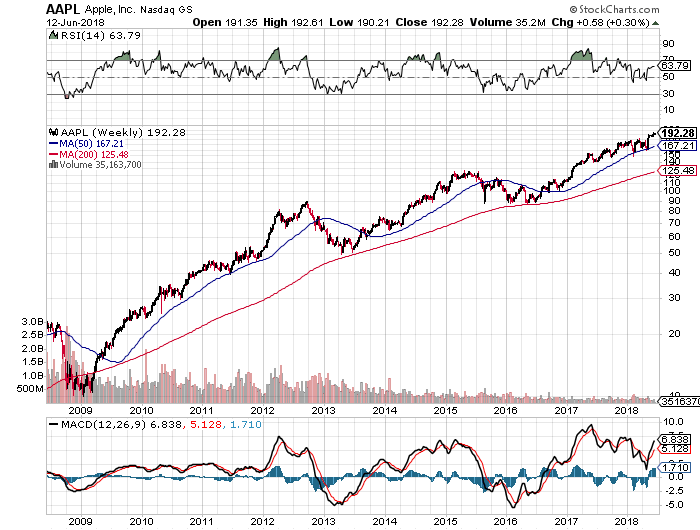
I distinctively remember Apple (AAPL) at around $ 90 a share back in 2016. Sentiment was on the floor, commentary was circulating on mass that iPhone growth was history. Fast forward a couple of years and shares have more than doubled. I suspect few would have thought that AAPL would have recovered so quickly. However as the chart illustrates below, AAPL also suffered a steep decline in 2013 but came roaring back to life soon thereafter. Why didn"t investors "trust" the charts instead of one or two disappointing earnings reports? Hindsight is 20/20, as they say.

Then we have Gilead (GILD). Shares collapsed to close to $ 60 a share last year and have been very slow to gain momentum since then. Granted Gilead"s shares collapsed more than Apple"s and over a much longer time frame, but you can be sure that many investors doubled down on their positions or bought at levels much higher than the present share price. Apple and Gilead before these share price declines relied mostly on one product which was obviously the iPhone in AAPL and HPC cures for Gilead. So why did one stock bounce back strongly whereas the other flattered to deceive?

I think these articles are helpful because it is at these inflection points where the most fortunes are made. With AAPL, for example, you had the likes of Buffett joining the party, but then you had the likes of Carl Icahn who ran for the exit. Now both of these billionaires made a lot of money but Icahn as we can see now sold far too early.

Buffett also has stated.

“Opportunities come infrequently. When it rains gold, put out the bucket, not the thimble.”

The problem though is that everything is so easy in hindsight. AAPL"s top line sales have come roaring back to currently stand at $ 247.41 billion over a trailing 12-month average. Gilead"s top line sales growth has deteriorated to currently stand at $ 24.69 billion (almost $ 8 billion down from its 2015 high).

Many newsletters got Gilead wrong which is why one should always make their own investing decisions. Why? Because an opinion backed by research and hours of study usually means one will stand by the position even if the going gets tough for a while. Gilead never rebounded because it ultimately cured hepatitis C. I wrote more about this here but many were caught out on this at the time.

Here though was the skinny compared to Apple. Although Gilead was generating strong cash flows from the likes of its HCV and HIV divisions, there was absolutely no link between the two segments. These two diseases are totally different and one cannot "lift up" the other, so to speak, when the likes of HCV is struggling.

We cannot though say the same about Apple. I remember its March quarter in 2016 when revenue collapsed by 13% to print the worst top line quarter since 2003. The main culprit was of course iPhone unit sales which were down 16% over a rolling quarter basis. However there were a number of reasons for the decline both in dollar amount sales and iPhone unit sales. Softness in China, currency headwinds plus also a poor product mix led to the disappointing quarter. Shares headed toward $ 90 as investors ran for the exit. However the launch of the iPhone 7 in September kept the purists hopeful.

However it wasn"t that model that turned the tide for AAPL. It was the fact that smartphone growth was still in an uptrend (still is to this day) and Apple was working really hard in the background to both coax customers from Android (through the likes of the iPhone SE) while also tie in customers more and more into its ecosystem of products. Just remember the strength of AAPL"s ecosystem today will dictate the strength of sales in the future. Gilead never had this competitive advantage and its results demonstrated this.

So when the next blip occurs, we will look at the strength of that ecosystem to see how growth rates are faring in other products. It"s all about engagement and loyalty going forward. These metrics are probably the best ones to measure when the inevitable happens and iPhone growth slows once again. As for Gilead, there still seems to be no catalyst in the cards to help growth. AAPL despite its valuation and snap back rally continues to look a far better long contender here.

Disclosure: I/we have no positions in any stocks mentioned, and no plans to initiate any positions within the next 72 hours.

I wrote this article myself, and it expresses my own opinions. I am not receiving compensation for it (other than from Seeking Alpha). I have no business relationship with any company whose stock is mentioned in this article.


Tech

Saturday, June 9, 2018

Apple Loop: Latest Leak 'Confirms' New iPhone, iOS 12 Drops Sexy For Security, WWDC Fails MacBooks

Taking a look back at another week of news from Cupertino, this week’s Apple Loop includes the latest renders of the new iPhone X for 2018, the hardware that wasn’t announced at WWDC, why iOS 12 stands for stability, the renewed focus on iPhone security, the disappointment of no new MacBooks at WWDC, and all the spoof products announced on the internet.

Apple Loop is here to remind you of a few of the very many discussions that have happened around Apple over the last seven days (and you can read my weekly digest of Android news here on Forbes).

First Renders Of The New iPhone X

As part of Apple’s push to expand the iPhone line-up (and increase sales of the iPhone family after years of declining share), the geekerati are expecting a budget version of the iPhone X (not to be confused with an update of the iPhone SE). What will it look like? Forbes’ Gordon Kelly reveals new renders of the budget iPhone X:

What Hemmerstoffer’s images and video (embedded below) show, is a 6.1-inch design which blends the chassis of the iPhone 8 and a single rear camera with the fascia of the iPhone X, complete with Face ID facial recognition module and the distinctive notch. On the flipside, this means no Touch ID fingerprint sensor.

…Hemmerstoffer notes this currently unnamed budget iPhone X (my naming bet is simply ‘iPhone’), will also pack wireless charging, stereo speakers and a new A12 chipset. So this is basically a single-camera iPhone X for over $ 200 less.

More here on Forbes.

OnLeaks/ MySmartPrice

Budget" 6.1-inch iPhone and 6.5-inch iPhone X Plus (OnLeaks/ MySmartPrice)

What Wasn’t Announced At WWDC

Lots of news to come out of this week’s Worldwide Developer Conference from Apple, but before we get to what did appear, it’s important to realise what was not on show. Apple refused the opportunity to show off any new hardware. No iPads, no Macs, no MacBooks, no peripherals, and perhaps most importantly, no mid-range iPhones to replace the iPhone SE. And WWDC was the best time to announce this upcoming smartphone, as I discussed earlier this week:

Assuming Taniyama-Shimura, there are enough signs in the supply chain that an update to the iPhone SE is coming. So the question becomes not of ‘will it arrive’ but ‘when will it arrive.’

…its non-appearance at WWDC tells us a lot about the handset.  iPhone sales this year need a boost. The iPhone X has not delivered the super-cycle it promised and sales are flat to slightly down year-on-year. Market share is approaching single figures, and relying on high-end handsets with high margins may be delivering financial success… but it doesn’t provide for growth or entry into new markets. The iPhone SE 2 can help balance the equation of revenue and market share by offering a low-priced gateway into Apple’s world of smartphones.

More on why Apple hid the SE 2 here.

Twelve Stands For Stability

Almost all of the focus at WWDC was on software, and the vast majority of that focus was on iOS. There have not been any major changes or additions, Apple has focused on the stability of the code to rebuild the bulletproof perception of the iPhone’s operating system. Zach Epstein is glad the new release is just ‘meh’:

It’s no secret that iOS 11 has been a complete mess for Apple. It’s not the travesty that whiny anti-Apple bloggers would have you believe, of course, but there’s no question that Apple made some big mistakes in iOS 11. It has had more security holes, annoying bugs, and performance issues than any version of iOS from recent history, and many of those problems still exist in iOS 11.3 and iOS 11.4 now, more than 8 months after the software’s initial release.

We learned many months ago that performance and overall user experience were going to be Apple’s main points of focus in iOS 12. In fact, insider reports stated that Apple decided to delay the addition of several big new features in iOS 12 and push them back to subsequent releases, or maybe even until next year’s iOS 13 update. This way, Apple’s various iOS engineering teams could focus on improving performance in iOS and on refining the user experience, rather than on integrating complex new features.

More at BGR.

Next: Security is key, a requiem for macOS, and Conan O’Brien’s new iPhone…


Tech

Wednesday, June 6, 2018

North Korea Uses Microsoft and Apple Technology for Cyberattacks, Researchers Say

North Korea has been cited by several governments and organizations for its hacking activities. Now, a new study of network data shows much of the technology North Korea employs for hacking comes from the U.S.

Despite trade sanctions, North Korea’s government has found a way to obtain products from Apple, Microsoft, and Korea-based Samsung to carry out cyberattacks around the world, researchers at cybersecurity intelligence company Recorded Future revealed on Wednesday. The company found that North Korea is using Windows 10, Apple’s iPhone X, and Samsung’s Galaxy S8 Plus, among other technologies, to conduct operations. However, most of the technology North Korea is using is older. For instance, Recorded Future found an iPhone 4S and Windows 7, among other products, still in use.

North Korea has been isolated from the rest of the world for decades. During that time, the country’s economy has suffered and the U.S., among others, has imposed sanctions that limit a company’s ability to export to and sell in North Korea.

To circumvent those sanctions, according to Recorded Future, North Korea has engaged in a variety of activities to obtain access to U.S. and Korean technologies.

In its report, Recorded Future said that North Korea has created fake addresses and names to sidestep sanctions — and also used shell companies and aliases outside of its borders to obtain equipment and bring it back. North Koreans living in countries where equipment from Apple, Microsoft, and Samsung can be obtained legally also play a role in the effort, according to the report.

Get Data Sheet, Fortune’s technology newsletter

“Technology resellers, North Koreans abroad, and the Kim regime’s extensive criminal networks all facilitate the transfer of American technology for daily use by one of the world’s most repressive governments,” Recorded Future wrote in its report.

In other cases, however, North Korea has obtained equipment legally. Since 2002, in fact, the U.S. has exported nearly $ 484,000 in computers and electronics to North Korea.

But, since that’s hardly enough for all of the ruling party, hacking efforts, and “elites” in the country who need the technology, North Korea has employed the other schemes, Recorded Future said.

The data sheds some light on the secretive country and could explain to some degree how it’s been able to pull off some major cyberattacks. North Korea’s hackers have previously been linked to the 2017 WannaCry ransomware attack that affected computers around the world. North Korea was also accused of hacking Sony in 2014.

“Unless there’s a globally unified effort to impose comprehensive sanctions on the DPRK, and multilateral cooperation to ensure that these sanctions cannot be thwarted by a web of shell companies,” Recorded Future wrote, “North Korea will be able to continue its cyberwarfare operations unabated with the aid of Western technology.”


Tech

Thursday, May 31, 2018

Apple cuts smartphone power chip orders from Dialog Semiconductor

FRANKFURT (Reuters) - Dialog Semiconductor said Apple now planned to source the main power management chips (PMICs) for one of its three new iPhone models from two suppliers instead of just from the German chipmaker.

FILE PHOTO: Dialog semiconductor logo is pictured at a company building in Germering near Munich, Germany August 15, 2016. REUTERS/Michaela Rehle

That means that Apple will order 30 percent fewer of the chips from Dialog this year than it had initially expected, Dialog said in a statement on Thursday.

The news sent its shares 3.9 percent lower in late Frankfurt trade. Dialog’s stock has lost more than half of its value over the past year on investor concerns that Apple is working on its own battery-saving chips for iPhones.

Analysts reckon Dialog derives more than half its revenue from supplying Apple with PMICs.

The reduced order volume for the PMICs will shave 5 percent off the chipmaker’s 2018 revenues, but Dialog said it still expected its 2018 revenues to grow year-on-year.

The impact on 2019 revenues is likely to be similar, Chief Executive Jalal Bagherli told analysts on a conference call.

He said Apple had not provided a reason for the change in its sourcing of chips.

“If you think about the fact that we are qualified for all three phones, that means there is no performance-related issue. It might be a statement of intent to reduce risk on having one supplier and have an alternative source,” he said.

He also said Apple had not told him who the second, new supplier of the main PMICs was but said he saw it as very likely that it was an in-house source at Apple.

Apple did not change the projected order volume for the other power management chip that Dialog is supplying for the new iPhone models - the sub-PMIC - nor for all other PMICs, including those for tablets, wearables and notebooks.

Dialog said it would continue to explore new mixed-signal opportunities outside of power management for future Apple products.

Reporting by Maria Sheahan; Editing by Adrian Croft and Alexandra Hudson


Tech

Saturday, May 26, 2018

Apple Promotes Powerful Privacy Tools For iPhone, iPad, Mac Users In GDPR Response

Apple didn’t need to do anything to meet the stringent requirements of the new EU law, called General Data Protection Regulation (GDPR), which came into force on May 25 - it already practised such good privacy hygiene that its existing precautions already passed the new obligations. However, it took the opportunity to comprehensively rethink its privacy standards, as the new privacy page reveals on the Apple website.

Apple

Data and Privacy at the heart of the new Apple privacy management tools.

I mean, it’s no surprise that Apple should take privacy seriously. It’s forbiddingly secretive about its products and internal workings and it has long proclaimed that it believes that privacy is ‘a fundamental human right’.

To make this work, there’s plenty it doesn’t know about us. For each Apple Pay transaction, Apple doesn’t track who you’re paying and has no idea who you’re paying for.  FaceTime conversations, iMessage threads and so on are end-to-end encrypted. Apple had asked itself why it would need to know who was saying what to whom and concluded it was none of its business.

Apple

Apple iPhone X with Apple Pay Cash in the Wallet app.

Even journeys made on Apple Maps are encrypted so that nobody getting hold of information could work out where you go regularly or whatever. It does this by, among other things, dropping the first and last 500 or so yards from each journey once it’s completed to blur the details. And though some data is held for a time, it’s deleted after 30 days or so.

And before these new changes, Apple had recently introduced a recognisable page which warned you when data was being collected, so you were always in the loop. It’s a stark contrast to most other companies and is made easier by the fact that Apple, as it might say, owns all the pieces of the jigsaw from hardware to software.

Anyway, Apple’s response to GDPR is interesting, and sets a standard which others must strive to meet. What’s more, though it only needs to make sure its GDPR response applies to European users, Apple has said it’s going to roll it out worldwide.

David Phelan

How to obtain a copy of your data.

First up, Apple has made it easy to find out exactly what data of yours is on its servers, from purchase history to photos on iCloud to emails and so on. With a few clicks you can download everything (apart from TV shows you’ve bought on Apple TV, for instance). If some sections turn out to be many gigabytes in size, it’ll split them into more manageable bites.

But the more interesting bits come next. First of all, if any of your data is inaccurate, you can request a correction.

You can also delete your account, if you wish. That’s not new. But there’s a new, less drastic course of action you can take where you deactivate your Apple ID account temporarily.

Why would you do this? Well, if you’re going away for a few months, perhaps or, (and please whisper this in the earshot of Apple fans), if you’ve bought an Android phone and so all that Apple data is no longer needed, once you"ve transferred it to your new phone. But, hey, maybe you’ll go back to Apple when the next, irresistible iPhone is released.

Apple

Health records are just one kind of data Apple has for you.

If that’s a possibility, then the temporary suspension, called deactivation, may appeal.

But bear in mind that you won"t be able to download iBooks you"ve bought from Apple while the account is deactivated. Nor can you use services which require your Apple ID like Messages and FaceTime. If you have a repair scheduled at an Apple Store, say, that will stay active but upcoming appointments in an Apple Store will be canceled.

If you pay for iCloud storage, that will continue until the next billing period after which you must review whether to keep paying or not.

Your data is not deleted but nobody, and here’s an important thing, not even Apple, can access it.

With this in mind, you"re sent a reactivation code. Lose it and, well, you"re in trouble because even Apple can"t get it back. So you can"t save it in an iMessage or Apple email. You need somewhere else safe to keep this code. All deactivations are verified, which can take up to seven days.

The Privacy section is live now and provides tools which range from useful to downright fascinating. It"s done with the obsessive detail you might expect from Apple. If you’re in the EU, you can access the new tools now and they’ll be rolled out to all users around the world in the coming months.

If you enjoyed this story, you might also like these:

Week In Wearables: Google Pixel Watch Predicted, Apple-Compatible Headgear, Samsung Watch Tipped

Apple Extends iPhone Battery Replacement Program With $ 50 Credit: Here"s All You Need To Know

Apple WWDC 2018: What To Expect From iPhone To iPad, HomePod To MacBook Air

OnePlus 6 Revealed: 1st Photos, Prices, Dates, Unboxing And All You Need To Know (Updated)

Apple Watch Secrets Revealed, Health A Significant Focus From The First Tick

How A Tech Startup Made Millions Destroying An Apple iPhone X


Tech

Friday, May 25, 2018

Why Did Apple Ban Valve’s Steam Link From Its App Store?

Apple appears to be engaged in a battle of sorts with Valve.

In an interview with technology site Arstechnica, gaming company Valve said that Apple has removed and banned its Steam Link app from its App Store. The company said that Apple originally approved the app but after further review, found that it didn’t meet its approved guidelines.

Valve unveiled its Steam Link app earlier this month. The app allows you to stream your PC games from a computer to another device, as long as they’re both on the same network. The idea is for users to have a game running on one device but be able to play wherever they want in the home. It’s a relatively common feature with remote desktop apps that let users access another computer from their devices.

In its interview with Arstechnica, Valve said that it petitioned Apple’s ruling and pointed to those streaming apps, which are all available in the company’s App Store, as apparent proof that the Steam Link app isn’t in violation of the iPhone maker’s guidelines. Apple stood by its decision and kept the iOS app blocked from its application marketplace.

Get Data Sheet, Fortune’s technology newsletter

For its part, Apple hasn’t publicly disclosed why it removed Steam Link from its App Store. The company also generally makes it a policy to not discuss specific details about why an app was removed or banned from its marketplace.

Apple did not respond to a Fortune request for comment on the Steam Link decision.


Tech

Friday, May 11, 2018

Apple is almost a $1 trillion company, but watch out for Amazon

SAN FRANCISCO (Reuters) - Apple is on the verge of becoming the first $ 1 trillion publicly listed U.S. company, but even if it gets there, it could soon be overtaken as Amazon.com surges from behind.

FILE PHOTO - Tim Cook, CEO, speaks about Amazon during Apple"s annual world wide developer conference (WWDC) in San Jose, California, U.S. June 5, 2017. REUTERS/Stephen Lam/File Photo

Started in the garage of co-founder Steve Jobs in 1976, the iPhone maker’s annual revenue has ballooned to $ 229 billion, greater than the gross domestic product of countries including Portugal and New Zealand.

(Big Tech Rev vs Countries" GDP: reut.rs/2ry9qr6)

Apple’s market capitalization on Thursday topped a record $ 934 billion, following its unveiling last week of a $ 100 billion buyback budget and news that Warren Buffett’s Berkshire Hathaway dramatically increased its stake in the company.

Thanks to a 12 percent rally since its quarterly report last Tuesday, the Cupertino, California company is just 8 percent short of hitting the $ 1 trillion valuation mark.

Pointing to Apple’s recent 31 percent jump in service revenue, including music streaming and online storage, CFRA analyst Angelo Zino on Wednesday upped his target price for the stock from $ 195 to $ 210, which would put Apple’s market capitalization at $ 1.03 trillion. Zino joins at least 12 other analysts with price targets putting Apple’s stock market value at 13 digits.

But Apple is in danger of being beaten to the $ 1 trillion mark - or passed soon after - by Amazon.com, the second largest listed U.S. company by market value, at $ 780 billion.

Saudi Arabian authorities, meanwhile, have said they expect a planned international initial public offering of Saudi Aramco that would value the national oil producer at about $ 2 trillion.

While $ 148 billion smaller than Apple on Friday, Amazon of late has expanded its stock price, and its sales, much more quickly than Apple. Amazon’s stock is red hot, trading recently at over 100 times expected earnings, compared to more-profitable - but slower growing - Apple’s valuation of 15 times earnings.

(Big Tech PEs:reut.rs/2wsd0YU )

Apple’s stock has risen 24 percent over the past year, fueled by optimism about the iPhone X, the company’s latest smartphone. But demand for the $ 1,000 device has underwhelmed investors, and bulls are now focused on Apple’s plan to return more cash to shareholders.

By comparison, Amazon’s stock has surged 70 percent over the past 12 months, bolstered by 31 percent revenue growth as more shopping moves online and businesses shift their IT departments to the cloud, where Amazon Web Services leads the market.

Amazon is also competing more with Apple and Google owner Alphabet as it sells music and video content, its Fire TV device and its Alexa smart home gadget.

(Big Tech Revenue: reut.rs/2wyZaE4 )

At $ 765 billion, Alphabet has the third largest market capitalization on Wall Street, with Microsoft close behind at $ 749 billion. Amazon breezed past both them both in February.

(Long-Term Market Cap:reut.rs/2rzCGxD )

Including Facebook, the five largest listed U.S. companies now account for 15 percent of the S&P 500’s $ 24 trillion market capitalization.

(Big Tech"s Outsized Weight in S&P 500: reut.rs/2rwBTOc)

To be sure, past stock gains are not a reliable predictor of future performance, and the surge in Apple’s and Amazon’s shares in recent years has been exceptional by most standards.

But if Apple’s stock were to keep growing at the pace seen over the past year, the company’s market capitalization would hit $ 1 trillion in September. Amazon would reach $ 1 trillion around October if its stock price continued to rise at the same rate as the past year, and overtake Apple soon after.

Extending forward their own one-year performances, Microsoft would not reach $ 1 trillion until early 2019, and Alphabet would take until 2020.

(Race to $ 1 Trillion Market Cap:reut.rs/2rz4WAJ )

Most Wall Street analysts are less optimistic. The mean analyst price target puts Apple’s stock 6 percent above current levels at $ 200 within the next 12 months, which would elevate its market capitalization to $ 983 billion, according to Thomson Reuters data.

The mean price target of analysts covering Amazon is $ 1,850, a 15 percent premium over its current price, which would give it a market value of $ 898 billion. Analysts target Microsoft to rise 12 percent to reach $ 845 billion, and for Alphabet’s market value to increase 16 percent to $ 884 billion.

(Big Tech Analyst Price Targets:reut.rs/2wv224H )

Reporting by Noel Randewich, Editing by Rosalba O"Brien


Tech

Thursday, May 3, 2018

Apple Watch Credited With Saving a Man’s Life

Apple Watch is being credited for saving a New York man’s life.

While he was working at his family’s bowling alley business Bowlerland last month, 32-year-old William Monzidelis became dizzy and started bleeding all over his body. Soon after, the Apple Watch he was wearing sent him a notification to immediately seek medical help.

On the way to the hospital, Monzidelis started to have seizures and by the time he arrived at the hospital just 30 minutes later, he had lost 80% of his blood, according to NBC New York, which earlier reported on the harrowing story. Emergency personnel discovered he had suffered an erupted ulcer and would need a blood transfusion just to have surgery to correct it. Doctors performed the surgery and he survived.

According to Monzidelis, who was interviewed by NBC New York, the doctors told him that if he didn’t receive the Apple Watch notification, he would’ve died.

Get Data Sheet, Fortune’s technology newsletter

Although the Apple Watch isn’t classified as a dedicated medical device, it has an increasing number of features aimed at monitoring a person’s health. Chief among its health-focused features is a tracker that will monitor a person’s heart activity and alert them when something is off. When Apple Watch identifies a problem, it sends an urgent notification that tells people to seek medical attention.

Monzidelis’ story isn’t unique. Earlier this week, in fact, ABC News reported that the Apple Watch saved the life of an 18-year-old woman after it recognized that her resting heart rate had jumped to 160 beats per minute. She rushed to an urgent care and then an emergency room, where she was told she had kidney failure, according to the report. If not for the Apple Watch, she would have died, doctors apparently told her.

“Stories like Deanna’s inspire us to dream bigger and push harder every day,” Apple CEO Tim Cook tweeted this week in response to the ABC News article.


Tech

Tuesday, May 1, 2018

Qualcomm's patent deals aim to ease Apple, regulator tensions, executive says

(Reuters) - Qualcomm Inc has broadened its use of a lower-cost licensing model for the next generation of mobile data networks, a move that could help in contentious talks with two customers including iPhone maker Apple Inc, the wireless tech company’s patent licensing chief said on Monday.

FILE PHOTO: A sign on the Qualcomm campus is seen in San Diego, California, U.S. November 6, 2017. REUTERS/Mike Blake/File Photo

The patent business traditionally has supplied much of Qualcomm’s profit but has also spurred conflict with Apple, Samsung Electronics Ltd and Huawei Technologies Co Ltd as well as regulators in China, South Korea and the United States.

New deals could lower the licensing rate that Qualcomm receives while making the business more dependable if regulators view the terms favourably and two major customers - Apple and a company widely believed to be Huawei - resolve their disputes and resume paying Qualcomm.

“It’s a good context for dealing with the two licensee issues we have now,” Alex Rogers, the head of Qualcomm’s licensing division, told Reuters in an interview, naming Apple but leaving Huawei unnamed as is the company’s policy when a dispute hasn’t become public through a court proceeding.

Rogers did not comment directly on the likelihood of resolving either customer dispute. Apple and Huawei did not immediately respond to requests for comment.

Qualcomm sells chips for mobile phones but has a second, much older business licensing technology for wireless networks. The licensing business has generated global controversy and resulted in billions of dollars in regulatory fines, some of which remain on appeal.

Handset makers can licence one of two sets of Qualcomm patents: The full suite that costs makers about 5 percent of the cost of a handset or a smaller set of so-called “standard essential patents” for 3.25 percent, which includes only the patents needed for gear to work on mobile data networks.

In the past, most of Qualcomm’s customers licensed both sets of patents to avoid lawsuits. But Qualcomm has been defusing tensions by making it easier for customers to licence just the smaller, lower-cost set of standard patents and by adding patents for the next generation 5G wireless network to the suite at no additional cost.

That essentially extends a 2015 settlement with China’s chief antitrust regulator. Qualcomm began to licence only its standard patents for 3G and 4G networks to Chinese handset makers for a rate of 3.25 percent. More than 100 device makers have signed on for such deals.

“We have not lowered the rate. What we’re doing is including more technology, more (intellectual property) in the offering without increasing the price,” Rogers added.

Qualcomm also announced last week that it would assess its patent fees against only the first $ 400 (£291) of a phone’s net selling price. Rogers said the previous price cap was $ 500, a figure that was well known among industry insiders but that Qualcomm did not make public.

“What we’re doing here is creating a foundation for stability going forward,” Rogers said, describing Qualcomm’s 5G licensing moves as “regulator friendly”.

The question now is whether more handset makers will opt for Qualcomm’s lower-cost standard patents rather than its pricier full portfolio.

“What we perceive here is there will be more of a mix than there was in the past of companies opting for (standard essential patents) only,” Rogers said. “How much more, depends on each individual company.”

While Qualcomm has made no public disclosures about the status of talks with the two major customers in licence disputes, the company’s approach to licensing patents for upcoming 5G networks will look different than its initial approaches for 3G and 4G networks of years past.

“Both of those issues (disputes) are essentially now being handled within the framework of the current programme we’re offering,” Rogers said.

Reporting by Stephen Nellis; Editing by Peter Henderson and Cynthia Osterman


Tech

Monday, April 23, 2018

Apple sensor supplier AMS warns of second-quarter slowdown

ZURICH (Reuters) - Chipmaker AMS reported first-quarter sales toward the lower end of its guidance range on Monday and warned of a downturn owing to weaker orders from one of its main customers.

FILE PHOTO: The logo of the multinational semiconductor manufacturer AMS (Austria Mikro Systeme) is seen during a annual news conference, in Zurich, Switzerland February 6, 2018. REUTERS/Moritz Hager

AMS did not name the customer, but the Austrian company is a big supplier to Apple, making components for the U.S. technology giant’s iPhone.

“We are not able to discuss the specific customer, but we are seeing significantly lower business from a large smartphones program and that is having a strong impact on the consumer business and the company as a whole,” said AMS head of investor relations Moritz Gmeiner.

For its second quarter, AMS said it expected sales to drop to between $ 220 million and $ 250 million, down from the $ 452.7 million in sales it reported for the first three months of 2018.

The downturn was based on weaker orders and lower forecast orders in the months ahead, Gmeiner said.

AMS added that changes in upcoming products, which prevented the pre-production of parts, mean that it also expects reduced utilization of factory capacity, which will hit profit margins.

The company, which also makes sensors used in cars and industrial gear, said the problem would be temporary and that preparations for ramping up production in the second half of the year remain on track.

FILE PHOTO: An iPhone X is seen on a large video screen in the Apple visitor centre in Cupertino, California, U.S., November 17, 2017. REUTERS/Elijah Nouvelage/File Photo

The Swiss-quoted company also confirmed its mid-term growth and profitability guidance, aiming for a 60 percent compound annual growth rate between 2016 and 2019, combined with an adjusted EBIT margin target of 30 percent from 2019 onwards.

First-quarter net profit rose to $ 99.9 million from a loss of $ 19.9 million a year earlier.

AMS shares have gained 8.1 percent this year, outpacing a Stoxx 600 Technology Index that has gained 0.7 percent.

The company’s stock has struggled of late, however, amid fears that Apple increasingly plans to use its own chips rather than buy them from third parties.

Weak results from Taiwan Semiconductor (TSMC) this month also spread concern about softer demand for smartphones.

Analysts have said that AMS obtains about 35 percent of its revenue from Apple, with mobile phone components making up the vast majority of its business with the U.S. company.

AMS supplies optical sensors that play a key role in facial recognition - one of the most distinctive features of Apple’s flagship iPhone X, which was introduced late last year and appears to have helped to drive AMS’s recent results.

Reporting by John Revill; Editing by David Goodman

Our Standards:The Thomson Reuters Trust Principles.

Tech

Thursday, April 19, 2018

TSMC's smartphone warning points squarely at Apple: analysts

(Reuters) - Shares in Apple Inc (AAPL.O) and its suppliers fell on Thursday after a raft of analysts read a prediction of softer smartphone sales from Taiwan Semiconductor Manufacturing Co Ltd (2330.TW) as driven chiefly by concern about demand for iPhones.

FILE PHOTO: A logo of Taiwan Semiconductor Manufacturing Co (TSMC) is seen at its headquarters in Hsinchu, Taiwan October 5, 2017. REUTERS/Eason Lam/File Photo

TSMC, the world’s largest contract chipmaker and a major Apple supplier, revised its full-year revenue target to the low end of its earlier forecast.

“Apple represents nearly 20 percent of TSMC’s revenue so the outlook potentially points to weaker-than-anticipated iPhone demand,” Atlantic Equities analyst James Cordwell told Reuters.

Others, some asking not to be quoted, said baldly that the warning was “exactly” about Apple.

Mizuho Securities USA said in a client note that its checks continue to point to soft demand for iPhone X, the Cupertino-based firm’s tenth anniversary phone released last November, in addition to a steady fall in iPhone 8 and 8 Plus orders.

Apple’s shares were last down 2.5 percent and were the biggest drag on the tech-heavy Nasdaq index.

Shares of Apple suppliers including Qualcomm Inc (QCOM.O), Intel Corp (INTC.O), Qorvo Inc (QRVO.O), Skyworks Solutions Inc (SWKS.O) and Broadcom Inc (AVGO.O) fell by 2 percent to 5 percent.

“Until the new iPhones in the Fall start driving the production food chain in Q3, mobile’s going to be weak,” Elazar Advisors analyst Chaim Siegel said.

TSMC, also a supplier to Qualcomm and Nvidia Corp (NVDA.O), said it expects growth this year of 5 percent for the global semiconductor industry, weaker than an earlier forecast of 5-7 percent.

Data provider TrendForce had earlier estimated 2018 global smartphone production at around 1.5 billion units, 2.8 percent up on 2017 but down from a previously expected 5 percent.

TSMC on Thursday estimated 8 percent growth for contract chipmakers, compared with its previous forecast of 9-10 percent.

U.S.-listed shares of TSMC (TSM.N) were down 6 percent, while other chip equipment makers such as Applied Materials Inc (AMAT.O) and Lam Research Corp (LRCX.O) fell about 5 percent and ASML Holding NV (ASML.O) lost 3.6 percent.

Another big industry bellwether, chip equipment maker Lam Research, said on Wednesday its shipments missed consensus estimates for the first time in five years.

Chipmakers Analog Devices Inc (ADI.O), Micron Technology (MU.O) and Xilinx Inc (XLNX.O) were also down by 3 percent to 4 percent.

Reporting by Sonam Rai in Bengaluru; Editing by Maju Samuel and Patrick Graham


Tech

Saturday, April 14, 2018

Apple Warns Employees to Stop Leaking Information to Media

Apple Inc. warned employees to stop leaking internal information on future plans and raised the specter of potential legal action and criminal charges, one of the most-aggressive moves by the world’s largest technology company to control information about its activities.

The Cupertino, California-based company said in a lengthy memo posted to its internal blog that it “caught 29 leakers,” last year and noted that 12 of those were arrested. “These people not only lose their jobs, they can face extreme difficulty finding employment elsewhere,” Apple added. The company declined to comment on Friday.

Apple outlined situations in which information was leaked to the media, including a meeting earlier this year where Apple’s software engineering head Craig Federighi told employees that some planned iPhone software features would be delayed. Apple also cited a yet-to-be-released software package that revealed details about the unreleased iPhone X and new Apple Watch.

Leaked information about a new product can negatively impact sales of current models, give rivals more time to begin on a competitive response, and lead to fewer sales when the new product launches, according to the memo. “We want the chance to tell our customers why the product is great, and not have that done poorly by someone else,” Greg Joswiak, an Apple product marketing executive, said in the memo.

The crackdown is part of broader and long-running attempts by Silicon Valley technology companies to track and limit what information their employees share publicly. Firms like Google and Facebook Inc. are pretty open with staff about their plans, but keep close tabs on their outside communications and sometime fire people when they find leaks.

Facebook executive Sheryl Sandberg last week talked about her disappointment with leakers. In 2016, Google fired an employee after the person shared internal posts criticizing an executive. The employee filed a lawsuit claiming their speech was protected under California law.

In messages to staff, tech companies sometimes conflate conversations employees are allowed to have, such as complaining about working conditions, with sharing trade secrets, said Chris Baker, an attorney with Baker Curtis and Schwartz, PC, who represents the fired Googler. “The overall broad definition of confidential information makes it so employees don’t say anything, even about issues they’re allowed to talk about,” he said. “That’s problematic.”

Apple is notoriously secretive about its product development. In 2012, Chief Executive Officer Tim Cook pledged to double down on keeping the company’s work under wraps. Despite that, the media has continued to report news on the firm to satisfy demand for information on a company that’s become a crucial part of investment portfolios, many of which support public retirement funds for teachers and other essential workers.

In 2017, Apple held a confidential meeting with employees in another bid to stop leaks. Since then, publications, including Bloomberg News, published details about the iPhone X, a new Apple TV video-streaming box, a new Apple Watch with LTE, the company’s upcoming augmented-reality headset, new iPad models, software enhancements, and details about the upcoming iPhones and AirPods headphones.

Here’s the memo:

Last month, Apple caught and fired the employee responsible for leaking details from an internal, confidential meeting about Apple’s software roadmap. Hundreds of software engineers were in attendance, and thousands more within the organization received details of its proceedings. One person betrayed their trust.

The employee who leaked the meeting to a reporter later told Apple investigators that he did it because he thought he wouldn’t be discovered. But people who leak — whether they’re Apple employees, contractors or suppliers — do get caught and they’re getting caught faster than ever.

In many cases, leakers don’t set out to leak. Instead, people who work for Apple are often targeted by press, analysts and bloggers who befriend them on professional and social networks like LinkedIn, Twitter and Facebook and begin to pry for information. While it may seem flattering to be approached, it’s important to remember that you’re getting played. The success of these outsiders is measured by obtaining Apple’s secrets from you and making them public. A scoop about an unreleased Apple product can generate massive traffic for a publication and financially benefit the blogger or reporter who broke it. But the Apple employee who leaks has everything to lose.

The impact of a leak goes far beyond the people who work on a project.

Leaking Apple’s work undermines everyone at Apple and the years they’ve invested in creating Apple products. “Thousands of people work tirelessly for months to deliver each major software release,” says UIKit lead Josh Shaffer, whose team’s work was part of the iOS 11 leak last fall. “Seeing it leak is devastating for all of us.”

The impact of a leak goes beyond the people who work on a particular project — it’s felt throughout the company. Leaked information about a new product can negatively impact sales of the current model; give rival companies more time to begin on a competitive response; and lead to fewer sales of that new product when it arrives. “We want the chance to tell our customers why the product is great, and not have that done poorly by someone else,” says Greg Joswiak of Product Marketing.

Investments by Apple have had an enormous impact on the company’s ability to identify and catch leakers. Just before last September’s special event, an employee leaked a link to the gold master of iOS 11 to the press, again believing he wouldn’t be caught. The unreleased OS detailed soon-to-be-announced software and hardware including iPhone X. Within days, the leaker was identified through an internal investigation and fired. Global Security’s digital forensics also helped catch several employees who were feeding confidential details about new products including iPhone X, iPad Pro and AirPods to a blogger at 9to5Mac.

Leakers in the supply chain are getting caught, too. Global Security has worked hand-in-hand with suppliers to prevent theft of Apple’s intellectual property as well as to identify individuals who try to exceed their access. They’ve also partnered with suppliers to identify vulnerabilities — both physical and technological — and ensure their security levels meet or exceed Apple’s expectations. These programs have nearly eliminated the theft of prototypes and products from factories, caught leakers and prevented many others from leaking in the first place.

Leakers do not simply lose their jobs at Apple. In some cases, they face jail time and massive fines for network intrusion and theft of trade secrets both classified as federal crimes. In 2017, Apple caught 29 leakers. 12 of those were arrested. Among those were Apple employees, contractors and some partners in Apple’s supply chain. These people not only lose their jobs, they can face extreme difficulty finding employment elsewhere. “The potential criminal consequences of leaking are real,” says Tom Moyer of Global Security, “and that can become part of your personal and professional identity forever.”

While they carry serious consequences, leaks are completely avoidable. They are the result of a decision by someone who may not have considered the impact of their actions. “Everyone comes to Apple to do the best work of their lives — work that matters and contributes to what all 135,000 people in this company are doing together,” says Joswiak. “The best way to honor those contributions is by not leaking.”


Tech

Thursday, April 12, 2018

Apple: Should You Be Worried?

As we approach Apple"s (AAPL) earnings report on May 1st, more and more negative news seems to be piling up. Data points suggest that a couple of key product categories are not doing well, and some are even questioning Apple"s capital return strategy. While I don"t think shareholders should be in all out panic mode just yet, I do think there are reasons to be a bit more cautious.

First of all, Apple"s fiscal Q2 report is the one time a year where management updates its capital return plan. This year, investors are expecting a lot considering US tax reform, repatriation, and the company"s plan to get to a cash neutral position in the future. While I"ll cover an expected dividend raise and buyback hike in the coming weeks, the bear camp seems to think that Apple will use a massive buyback to try to overshadow poor results. A buyback will help earnings per share, but if sales are struggling, some investors might wish the company made some acquisitions as well to help the top line.

Outside of the capital return update, I want to hear from Apple management if the battery replacement program is hurting iPhone sales. In my most recent article on the name, I discussed how one Street analyst discussed weak smartphone data out of China, and another analyst recently suggested that iPhone builds for later this year will be down quite a bit over last year:

Based on our channel checks with suppliers, we think current expectation for new iPhones production is ~80M–90M units for 2H18, below suppliers’ expectation of ~100-120M units for iPhone 8/X in early 2017.

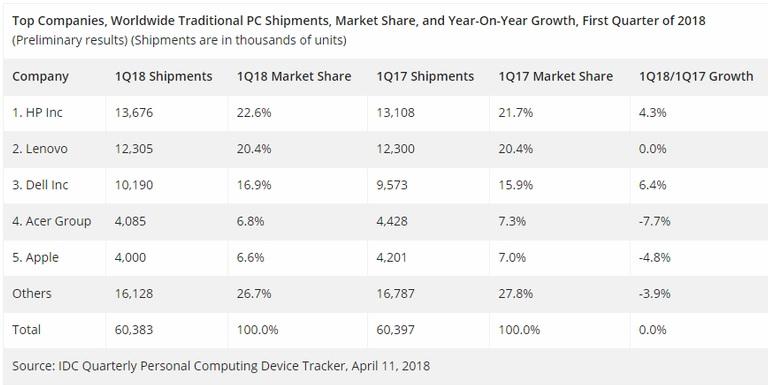
After the bell on Wednesday, we also received the quarterly PC shipment estimate from IDC. As you can see in the table below, the research firm thinks that Apple"s sales were down almost 5% in calendar Q1, resulting in market share loss thanks to overall sales being almost flat. Apple also fell into 5th place for the fiscal Q2 period. While supporters will wait for official results from the company, I"ll note that last year"s Q1 estimate from IDC was nearly dead on to Apple"s result.

(Source: IDC article linked above)

Now I mentioned in a past Apple article that analyst estimates have been coming down, especially for the June quarter that we"ll get guidance for in a few weeks. Currently, analysts call for $ 52.31 billion in fiscal Q3 revenues, the lowest that I"ve seen and down nearly half a billion dollars in the past month. Reports of weak demand for the HomePod isn"t likely to help the situation.

Additionally, if I look at estimates for the March ending period to be reported, analysts are less than $ 200 million from Apple"s guidance midpoint. Don"t forget that guidance was weaker than expected to begin with. As the chart below shows, this is the second most bearish Street stance going into a report in the last two years. Dollar values are in billions, with the difference being the estimate compared to guidance midpoint.

*Current Street estimate, seen here. Guidance taken from quarterly reports on Apple"s financial information page.

While I still think Apple is a good long-term investment, there seems to be some concern building in the short term that could give investors some pause. IDC estimates that the company did not have a good PC sales quarter, and iPhone data might be coming in softer than expected. While an increase to the capital return plan will be nice, will it be enough to overcome potentially bad results?

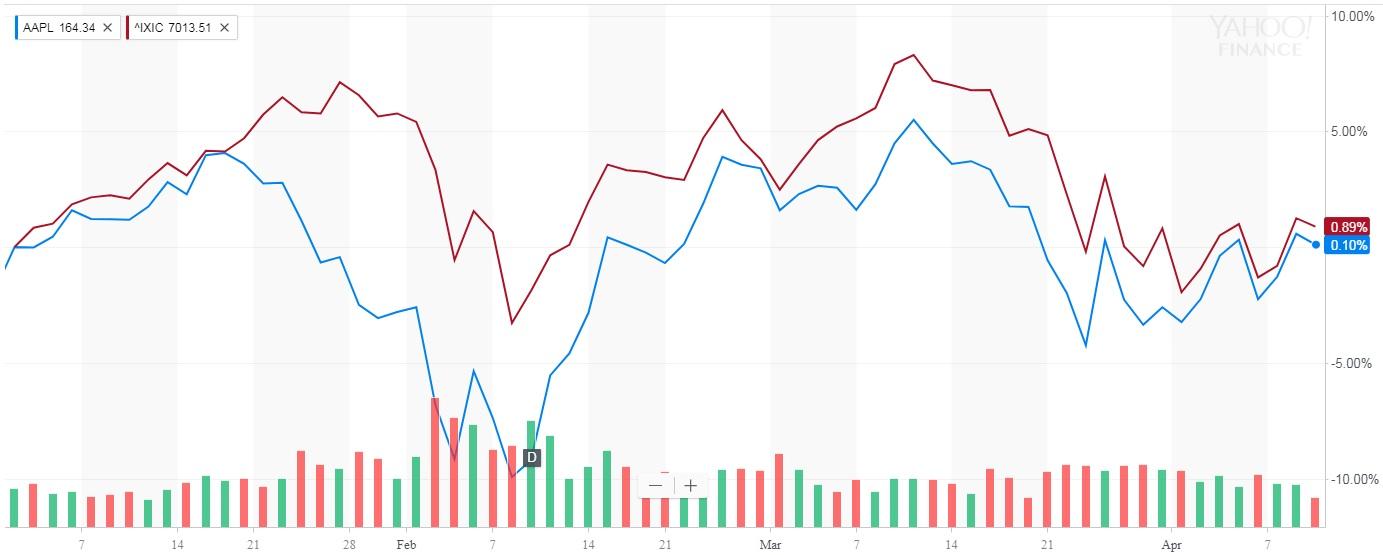
As seen in the chart below, Apple has underperformed the Nasdaq so far this year, a trend that could continue if recent data points show growth is not coming in as hot as originally thought. Apple is less than 1% from its 50-day moving average, so if it breaks below that key level, it could trade down to the 200-day which by next week will likely be around $ 165.

(Source: Yahoo! Finance)

Disclosure: I/we have no positions in any stocks mentioned, and no plans to initiate any positions within the next 72 hours.

I wrote this article myself, and it expresses my own opinions. I am not receiving compensation for it (other than from Seeking Alpha). I have no business relationship with any company whose stock is mentioned in this article.

Additional disclosure: Investors are always reminded that before making any investment, you should do your own proper due diligence on any name directly or indirectly mentioned in this article. Investors should also consider seeking advice from a broker or financial adviser before making any investment decisions. Any material in this article should be considered general information, and not relied on as a formal investment recommendation.


Tech

Wednesday, April 11, 2018

Apple Music appoints new head, hits 48 million subscribers

(Reuters) - Apple Inc on Wednesday appointed a new executive to oversee its Apple Music streaming business and hit 48 million subscribers, the company said.

Apple said it had appointed Oliver Schusser as vice president of Apple Music and international content. Schusser, who joined Apple 14 years ago, will report directly to Apple senior vice president Eddy Cue and will also oversee Apple’s services outside the United States, including the App Store and iTunes.

Apple’s top streaming music rival Spotify Technology SA has 71 million so-called premium subscribers, a figure that includes users who have given the company a credit card number for a free trial. Spotify became a public company earlier this month after holding a so-called direct listing on the New York Stock Exchange.

On a comparable basis, the Apple Music service has 48 million subscribers, 40 million of whom are paying subscribers and 8 million of whom are on a free trial, Apple said. Both firms charge $ 9.99 a month for streaming music but provide discounts for student and family plans.

Variety magazine earlier reported the new subscriber figures and Schusser’s promotion. He previously built up Apple’s services businesses outside the U.S. in 155 markets, including China, Japan and Latin America, Apple said.

Apple’s services business, which includes Apple Music, the App Store and iCloud, is becoming increasingly important to the Apple’s financial outlook because the smart phone market has matured and iPhone sales growth has slowed. In its most recent quarter, Apple’s services business grew 18 percent to $ 8.4 billion, missing analyst expectations of $ 8.6 billion.

(This version of the story corrects paragraph 1 to Wednesday instead of Thursday)

Reporting by Stephen Nellis; Editing by Bernadette Baum


Tech

Monday, April 9, 2018

Apple: Dividend Hike Ahead

Apple (NASDAQ:AAPL) investors have enjoyed many years of nice returns, albeit with some volatility along the way. The company is working hard on establishing itself as a reliable dividend grower as well as offering returns in terms of capital appreciation.

Rock-solid fundamentals, rising earnings and a huge cash hoard which is now being repatriated are all strong arguments for this stock to be part of any conservative dividend growth portfolio.

Chart AAPL data by YCharts

This chart basically behaves pretty much exactly the way you would want it to behave. Apart from a correction from mid 2015 to mid 2016 this stock has moved steadily from $ 61 five years ago until the current $ 168, a multiple of 2.75x. Adding in a dividend yield during that time of approximately 1.5% translates into an average annual total return of about 24%. Considering the sheer size of this company that is nothing short of impressive.

Apple"s Dividend History

Though Apple used to pay dividends back in the early 1990"s, I don"t really consider that relevant as the company was quite different back then. The relevant history starts in the summer of 2012. In August of that year the company started paying dividends again, at a split-adjusted quarterly rate of $ 0.38. The level was increased in May 2013 to a split-adjusted quarterly rate of $ 0.436. Ever since, a new and higher dividend has been paid each May.

Chart AAPL Dividend data by YCharts

The dividend is growing nicely and reliably each and every year. Between May 2013 and May 2017, when the dividend was last hiked, it increased from $ 0.436 to $ 0.63. That is 44% or an annual average increase of 9.6%. If we look at the last couple of years the annual rate of increase has been very close to this - at 10.6% in 2015, 9.6% in 2016 and 10.5% in 2017.

This trend suggests that the board targets a very consistent percentage-wise increase every year, where it sees through temporary ups and downs in its business. Comments from Tim Cook also suggests that consistency is a priority. Raises will continue to come, though probably not special dividends.

The payout ratio is not so consistent. It has always been comfortably low but has oscillated between 30% in 2014 to a low of 21% in late 2015 before reaching its current level of 26%. As payout ratios go this one is nothing to worry about. At triple the current level I would start to be concerned. Even with no earnings growth, they could continue hiking the dividend at 10% per year for many years to come.

Upcoming Dividend Hike

As mentioned above, May is the month the dividend has been hiked every year since 2013. In conjunction with presenting its first quarter results, the company also announces updates to its capital returns program. This year, it will present its first quarter results on May 1. This will be a very interesting day indeed.

First of all, investors will of course be interested in following the results from operations and how the iPhone X is doing. Further, particularly dividend growth investors will be following closely to see what the dividend hike will be. Lastly, people will want to know the size of the buyback program, the size of which will be decided both by the company"s results but also the amount of cash repatriated due to the new tax code.

Apple has said it will pay approximately $ 38 billion in a one-time tax to repatriate overseas cash. After paying that tax it will still have more than $ 200 billion left for either acquisitions, buybacks or dividends.

Considering that the underlying business is going quite well with EPS coming in at $ 9.21 in 2017, up 11% from $ 8.31 in 2016, the board has plenty of room to increase the dividend. With the payout ratio as low as it is I will consider a 10% hike as a floor.

Then we get to the upside. Though the company has tended to go for smooth dividend increases and funneling surplus cash to buybacks instead, the sheer size of the cash hoard now suggests that some of this will be channeled to dividends as well. The board must be comfortable that the new level will be sustainable and not be so high that it"s difficult to continue with 10% hikes in the years down the road. It is therefore unlikely to be a massive increase - it would make the board"s job harder down the line.

However, a hike which corresponds to the highest hike it has offered since reinstating the dividend, is quite possible in my mind. The highest increase it has had in recent history is the May 2013 increase of 15% to a split-adjusted dividend of $ 0.436. I believe such a hike is quite possible for two reasons. First, there is an expectation in the investor community that some of the massive cash hoard will go towards an extra large increase. Two, such an increase will not be so large as to make the board uncomfortable as to the sustainability of the dividend.

I therefore think the dividend will be hiked by 10-16% this spring for a new quarterly dividend of between $ 0.69-$ 0.73. I think it is more likely to be at the high end of that range rather than the low end.

Risk Factors

A constant risk for Apple is that a competitor will come up with a product that is vastly more appealing than its most important product, the iPhone. It has weathered competition very well so far, but in an innovative space like this, you never know when a new player comes along. After all, Nokia displaced Ericsson and Apple subsequently displaced Nokia in the mobile phone space. Another risk, as it is a global company, is fluctuation of currencies. An appreciating U.S. dollar will decrease foreign earnings when reported in dollars. Privacy has been on the agenda for some time and has really come to the forefront in recent weeks due to the Facebook (NASDAQ:FB) scandal. Some people are concerned about the possibility of having your health records on your iPhone. Apple has taken a clear stand on privacy but the risk of an adverse event and hence bad publicity will not go away.

Current Valuation

The analysis so far shows a rock solid company with a huge cash hoard and growing EPS. However, if the multiple is too high when you buy, even such a company may eventually turn out to be a bad investment.

In order to gauge whether Apple is reasonably priced or not, I will compare it to two global competitors, Samsung (OTC:SSNLF) and Microsoft (NASDAQ:MSFT).

Apple Samsung Microsoft
Price/Sales 3.8x 1.4x 7.5x
Price/Earnings 17.7x 8.9x 75.1x
Yield 1.5% 0.3% 1.8%

Source: Morningstar

First of all, Microsoft"s earnings multiple looks really high. The company posted a loss in the fourth quarter of 2017, which obviously skews the earnings multiple quite a bit. Even so, in addition to losing the Price/Earnings category, it also loses the Price/Sales category while actually coming out on top in the yield category.

Apple comes in second on Price/Sales, beaten by Samsung. Second place is apparently where Apple is supposed to be in this competition as that is the spot it lands in the two other categories as well. Considering the enormous cash level of Apple, I consider the stock to be quite attractive at these levels.

The analyst community expects Apple to turn out an average annual EPS growth rate over the next five years of 13.2%. If we assume that the multiple stays the same - not unreasonable as the multiple is at a decent level - and adding in the yield of 1.5%, we arrive at an expected annual total shareholder return of 14.7%. That has to be considered a nice expected return no matter what kind of investor you are.

At these levels this stock should be added by dividend growth investors, with an emphasis on growth. The current yield is not too impressive but the growth rate is solid and will likely be higher than normal this year. Further, given the solid fundamentals of this company, you can sleep well at night knowing the money will keep flowing in.

Conclusion

Apple is working methodically to establish itself as a reliable dividend grower. It has consistently increased its dividend by 10%, giving investors predictability. The strong underlying fundamentals together with a huge cash pile make it an almost certainty that this predictable dividend growth will continue for many more years to come. This year, due to the repatriation of overseas cash, the hike will likely be larger with a potential hike of almost 16% to $ 0.73. If you"re looking for a fat yield, there are probably better opportunities out there. If, on the other hand, you are a dividend growth investor looking for a high long term growth rate of the dividend, this stock should be in your portfolio.

Disclosure: I/we have no positions in any stocks mentioned, and no plans to initiate any positions within the next 72 hours.

I wrote this article myself, and it expresses my own opinions. I am not receiving compensation for it (other than from Seeking Alpha). I have no business relationship with any company whose stock is mentioned in this article.

Editor"s Note: This article discusses one or more securities that do not trade on a major U.S. exchange. Please be aware of the risks associated with these stocks.


Tech

Sunday, April 1, 2018

Best Fitness Trackers (2018): Fitbit, Suunto, Garmin, Nokia, Apple Watch

This stark, minimalist device is a hybrid between an analog watch and a smart one. It looks like an elegant fashion accessory, but connects to the Nokia Health app on your phone to show stats like your heart rate, steps, and distance traveled. It’s simple and slim, with a velvety silicone band, and can transition from surfing to a wedding brunch without skipping a beat. And, at $ 180, it is one of the most affordable fitness trackers out there.
Tech