Showing posts with label Amazon. Show all posts

Thursday, July 19, 2018

Amazon hands goodwill to eBay with move to shut Australians out of overseas sites

SYDNEY (Reuters) - Australian home entertainment installer Paul Boon has relied for years on Amazon.com Inc’s (AMZN.O) U.S. website for cheap wall racks and other parts to keep his costs down.

FILE PHOTO: A web page featuring Amazon"s Australian URL is pictured in this photo illustration April 20, 2017. REUTERS/Jason Reed/Illustration/File Photo

But Amazon’s recent move to stop Australians from shopping on its foreign websites, due to a new law that requires it to collect taxes, is turning away once-loyal customers like Boon.

He’s considering a switch to eBay Inc (EBAY.O), adding that prices for wall mounts were 40 percent higher on Amazon’s Australia site if they appeared there at all.

“I’ll be going somewhere else to get that regular stuff,” said Boon by telephone from the northern city of Brisbane, where he runs his business.

Amazon’s launch of an Australian site in December, followed by last month’s introduction of its Prime service for faster delivery, has been heralded as a game changer for the country’s retail industry. But it has gotten off to a choppy start.

For customers like Boon, the retail giant has lost years of goodwill by forcing shoppers onto a local site with a product range roughly one ninth of the U.S. site and which sells some goods at higher prices.

It has also given online marketplace eBay, Amazon’s bigger and more established rival in Australia, the opportunity to swoop in and capture that goodwill, building its first automatic tax collection and payment system and wooing local customers with discounts.

TAXING ISSUES

Australia is the first market where Amazon, the world’s second-most valuable company worth $ 890 billion, has responded to a sales tax on internet purchases by shutting out customers based on where they live.

An Amazon spokesman said in an email the company would continue to build its range of goods and services through its Australian site, and that it was “thrilled with the reception it has received from Australian customers” since introducing Amazon Prime.

The Australian government extended its 10 percent goods and services tax (GST) to all goods bought online from overseas, effective July 1, requiring online retailers to collect the tax. It was previously applicable only to overseas purchases over A$ 1,000 ($ 745).

Amazon also gave Australians just one month’s notice that they would be shut out of its global network - sales are cut off when an Australian delivery address is entered - even though the government’s plans were announced a year ago.

Critics say the decision was an excuse to drive traffic to its new local site and promote its Amazon Prime service.

“I’ve no doubt that Amazon will be successful here in time, but I don’t believe that this strategy is what’s going to catapult them to success,” said Ryan Murtagh, CEO of Neto, a provider of data and logistics support for about 3,000 online retailers in Australia.

“I think actually it potentially could damage them in the long term.”

Amazon has some 550 million products on its U.S. site including those sold by Amazon and third-party sellers, according to Boomerang Commerce, an artificial intelligence technology firm in California. That compares with the 500-600 million offers from third-party sellers on eBay, which includes duplicate products.

EBAY’S EDGE

Ebay said the decision to build the new tax collection and payment system had paid off with early figures suggesting Australian shoppers were not swayed by the new tax.

“It was a big change and it was a global change that needed to be done,” said eBay’s local managing director, Tim MacKinnon, adding that the effort was led by its California headquarters.

“A lot of people worked on it, a lot of different teams. We’re really proud that we hit the July 1 deadline.”

He added its decision to offer Australian shoppers a 10 percent discount on its local, British and U.S. websites for the first week of July had helped generate business.

“All of our sites have accelerated,” said MacKinnon.

While neither Amazon nor eBay provide data on visitors to their sites and estimating their share of Australia’s A$ 26 billion-a-year online retail market is difficult, customer dissatisfaction with Amazon Australia is not hard to find. Its Facebook page is overrun with negative comments.

Amazon’s move has also prompted non-Amazon freight forwarders who buy items from the U.S. store domestically and mail them to Australia to seize new opportunities. One such firm, New York’s Big Apple Buddy, this week set up a new site for Australian shoppers.

Securities analysts argue, however, that Amazon plays a long game and that given its track record in dominating online retail in many countries, whatever missteps it makes can be fixed over time.

“It is highly likely they will get it right in Australia over the longer term, and prices will be competitive, service will be outstanding, and they will eat eBay’s lunch,” Michael Pachter, managing director of equity research at Los Angeles-based Wedbush Securities, said by email.

Reporting by Byron Kaye and Tom Westbrook; Additional reporting by Jeffrey Dastin in San Francisco and Nicholas Ford in Sydney; Editing by Edwina Gibbs


Tech

Tuesday, July 17, 2018

6 Weird and Awesome Amazon Prime Day Deals

If you"re an Amazon Prime member, it"s likely that you"ve had a shopping list ready for weeks. But if you"re just browsing today through July 18, we have a few Prime Day deals on weird or quirky items that you might not have even considered. From robots you can keep in your home to Japanese-style toilet seats, here are the strangest, coolest discounted items we"ve seen this Prime Day.

Jibo, The Social Robot

JIBO

Jibo is kind of like an Alexa speaker... if Alexa had a body, face, and could dance. When we reviewed Jibo a year ago he brought us joy and creeped us out in almost equal order, but we kept him around. In the year since, he"s learned how to play a couple games, give you a daily report, play the radio, tell slightly better jokes, and communicate back and forth just a little.

He"s nowhere near perfect, but for $ 500, it"s a lot easier to give Jibo a try if you"d like to be one of the first homes with an actual robot. He"s the only product you"ll feel guilty about unplugging.

Buy Jibo for $ 500 (Was $ 900)

Nuraphones

Nuraphone

The Nuraphones are the strangest, and most interesting headphones you can buy, as we discovered when we reviewed them. They"re a hybrid between an earbud and over-ear design, and that"s because of their central feature: they use NASA-grade microphones to scan your ear and map out your hearing. Once the Nuraphones know how sensitive each of your ears is to each of a range of high and low frequencies, it makes a custom sound profile just for your ears.

It takes some time to get used to the probing feeling of earbuds inside headphones, but the sound speaks for itself. We also like that Nura just sent out a free firmware update to all users that adds active noise cancelling, more button functionality, and ambient noise pickup, so you can hear the outside world better, if you want.

Buy the Nuraphones for $ 300 (Was $ 400)

Furbo Dog Camera

Furbo

Is your stay-at-home dog so over frozen dog food in Kongs? We loved the Furbo when we reviewed it. It"s clean, simple, easy to use, and you can also remotely toss Cheerios at your crawling infants in a pinch.

Buy the Furbo Dog Camera for $ 139 (was $ 249).

Walabot In-Wall Imager

Vayyar Imaging

We tried the Walabot at CES 2018. It gives you X-ray vision when you"re remodeling your house, letting you spot studs, wires, or even moving rats (er, objects). Nota bene: It doesn"t work for iPhone users.

Buy the Walabot In-Wall Imager for $ 56 (was $ 70).

PicoBrew Model C Beer Brewing Appliance

PicoBrew

Homebrewing is a lot of fun, but unless you have a lot of friends, it"s hard to drink a full keg of beer every other week. The PicoBrew lets you fine-tune your recipes five liters at a time.

Buy the PicoBrew Model C Beer Brewing Appliance for $ 280 (was $ 400).

Toto Washlet Electronic Bidet

Toto

Do you want a fast and easy way to spruce up your bathroom routine? Toto"s washlet electronic bidet toilet seats are heated, and have customizable washing temperatures and pressure settings. Add your pick (out of many!) to your cart to see the discount.

Toto Washlets are 20% Off, starting at $ 257.

More Prime Day Coverage

When you buy something using the retail links in our stories, we may earn a small affiliate commission. Read more about how this works.


Tech

Friday, July 13, 2018

Cisco sinks on report Amazon wading into networking equipment

(Reuters) - Shares of Cisco Systems Inc and other network equipment makers fell on Friday after a report that Amazon.com Inc’s cloud services business was considering selling its own network switches to business customers at much lower prices.

FILE PHOTO: Amazon boxes are seen stacked for delivery in the Manhattan borough of New York City, January 29, 2016. REUTERS/Mike Segar/File Photo

Cisco’s shares were down 5 percent, wiping off nearly $ 11 billion from its market capitalization. Shares of Juniper Networks Inc and Arista Networks Inc fell 4 percent as investors feared that Amazon’s scale and pricing power could disrupt the sector.

The report comes days after Amazon sent shockwaves across the drug retailing sector with its move to buy small online pharmacy PillPack.

The networking devices will consist of open-source software and unbranded hardware known as “white-box” switches and come with built-in connections to AWS cloud services, such as servers and storage, the Information said.

Amazon Web Services could price its white-box switches 70-80 percent less than comparable switches from networking giant Cisco, the report said, citing one of the people with direct knowledge of the unit’s plan.

“If true, we think this would be a notable negative for the networking equipment space going forward,” RBC Capital Markets analyst Mitch Steves wrote in a note.

AWS expects to launch the switches for sale within the next 18 months, according to the report.

Amazon and Juniper did not immediately respond to a request for comment. Cisco and Arista declined to comment.

Reporting by Arjun Panchadar in Bengaluru; Editing by Arun Koyyur and Saumyadeb Chakrabarty


Tech

Sunday, July 1, 2018

Build it or Buy It: Will Amazon or Walmart Win the Retail Innovation Battle?

Photographer: Bartek Sadowski/Bloomberg

Amazon’s recent news that it will be replacing more humans with yet another algorithmic solution is the latest example of the company’s thrust to innovate through self-built technology. 

With Amazon’s patent count rising again last year, it’s clear the company’s “build it” strategy is largely meant to out-invent, rather than outbid, the next big idea. Amazon received 1,963 patents in 2017 according to the latest data released by the IFI Claims office, and holds more patents than any other retailer in the industry (7,096). In fact, at $ 22.6 billion, Amazon spent more in R&D than any other U.S. company last year (up 41 percent from 2016), topping Microsoft, Intel, Facebook and even Apple according to a recent story in Recode.  

Amazon has a deep history of effectively chasing patents, which stems from lessons learned in the dot-com era. For example, Amazon’s patent for one-click shopping was issued in 1999 and set the norm for the entire retail industry.

Fast forward nearly twenty years. Today we have Amazon Prime and Amazon Marketplace, and the company is still three steps ahead, inventing what is possible by both shaping and anticipating the needs of consumers. According to a recent CNBC article, Amazon was issued patents last year for augmented reality mirrors that would enable users to try on clothes virtually by projecting different outfits onto the user. They’ve also patented a “smart” sensor-studded package delivery air vehicle, an option that would mute the Amazon Echo’s video mode for user privacy and even one that would detect hacked self-driving cars.  

Walmart, by comparison, currently holds only 349 patents, and the company has largely based its innovation strategy around buying the latest and greatest new ideas. 

According to a TechCrunch story late last year, the company considers acquisition core to its innovation model, particularly in the technology, retail and digital native brands categories. Marc Lore, CEO of Walmart eCommerce U.S, who founded Jet.com (bought by Walmart in 2016), noted in recent comments that in Walmart’s view, “specialist positioning is better than mass,” and that the acquisition spree will continue. Recent acquisitions include ShoeBuy, Moosejaw, Bonobos, Parcel, Hayneedle and ModCloth.

Walmart has also started its own incubator, Store No. 8, which aims to “nurture startup businesses,” allowing them to run just like other startups but be "ring-fenced by the rest of the organization and backed by the largest retailer in the world," according to Lore. 


Tech

Sunday, June 24, 2018

Amazon Replaces Merchants with Bots: How Levi's, Wolverine Worldwide and Saks Can Compete

Shutterstock

I came across an interesting article in Bloomberg last week. Amazon has been synonymous with robotics and automation, but for the most part that has been relegated to stocking the shelves and other operational tasks in the warehouse. Interestingly, according to the article, automation is starting to take over the roles of the white collar workforce as well. The article states:

“Machines are beating people at the critical inventory decisions that separate the winners and losers in retail. For the staffers deciding how many books, games or plastic pool toys to peddle, the tradeoff can be stark: Order too little and you miss out. Order too much and you’re forced into costly clearance sales. Amazon’s algorithms, refined through years of monitoring customer behavior, are getting the Seattle-based company out of the guessing game.”

Data-backed decisions are a topic that I discuss a lot on Forbes. It’s something that I firmly believe in. Retailers and brands can no longer rely solely on intuition given the power that the consumer has at his or her fingertips. Customers can find any product they want at the price they want, so how are retailers and brands going to deliver that differentiated product AND keep up with Amazon?

Not all retailers can be as fortunate as Walmart, who has the ability to purchase other companies to keep pace with Amazon. Acquisitions like Jet.com and Flipkart are enabling Walmart to compete on the web and in India, respectively. I will be writing more about this next week on the BUILD vs BUY mentality that Amazon and Walmart are exhibiting. For now though, its partnership with Lord & Taylor and acquisitions of ModCloth and Bonobos are also enabling the company to stake a firm claim in fashion. I expect Walmart is already on the prowl for its next acquisition, which likely would be similar to Amazon’s new technology.

So, while Amazon’s strategy has been to develop technologies internally and Walmart’s is to acquire technologies, how can the rest of retailers and brands like Levi’s, Wolverine Worldwide and Saks Fifth Avenue keep pace? Not everyone’s checkbook can afford a multi-million or even billion dollar investment, but you MUST compete.

It’s the same principle as any other facet of your life. If you’re heading on a trip and you need a GPS system to navigate you there, your first thought isn’t, “I should develop something.” Instead, you log onto the App Store, read reviews and download what you think is the best GPS solution for your needs.

The same is true in this scenario. As I’ve stated before, there are numerous technologies that retailers and brands should be doubling down on to compete with Amazon and position themselves best against their competition. Technologies that aid in critical product development and inventory decisions are just the latest that Amazon has shined a spotlight on.


Tech

Friday, May 11, 2018

Apple is almost a $1 trillion company, but watch out for Amazon

SAN FRANCISCO (Reuters) - Apple is on the verge of becoming the first $ 1 trillion publicly listed U.S. company, but even if it gets there, it could soon be overtaken as Amazon.com surges from behind.

FILE PHOTO - Tim Cook, CEO, speaks about Amazon during Apple"s annual world wide developer conference (WWDC) in San Jose, California, U.S. June 5, 2017. REUTERS/Stephen Lam/File Photo

Started in the garage of co-founder Steve Jobs in 1976, the iPhone maker’s annual revenue has ballooned to $ 229 billion, greater than the gross domestic product of countries including Portugal and New Zealand.

(Big Tech Rev vs Countries" GDP: reut.rs/2ry9qr6)

Apple’s market capitalization on Thursday topped a record $ 934 billion, following its unveiling last week of a $ 100 billion buyback budget and news that Warren Buffett’s Berkshire Hathaway dramatically increased its stake in the company.

Thanks to a 12 percent rally since its quarterly report last Tuesday, the Cupertino, California company is just 8 percent short of hitting the $ 1 trillion valuation mark.

Pointing to Apple’s recent 31 percent jump in service revenue, including music streaming and online storage, CFRA analyst Angelo Zino on Wednesday upped his target price for the stock from $ 195 to $ 210, which would put Apple’s market capitalization at $ 1.03 trillion. Zino joins at least 12 other analysts with price targets putting Apple’s stock market value at 13 digits.

But Apple is in danger of being beaten to the $ 1 trillion mark - or passed soon after - by Amazon.com, the second largest listed U.S. company by market value, at $ 780 billion.

Saudi Arabian authorities, meanwhile, have said they expect a planned international initial public offering of Saudi Aramco that would value the national oil producer at about $ 2 trillion.

While $ 148 billion smaller than Apple on Friday, Amazon of late has expanded its stock price, and its sales, much more quickly than Apple. Amazon’s stock is red hot, trading recently at over 100 times expected earnings, compared to more-profitable - but slower growing - Apple’s valuation of 15 times earnings.

(Big Tech PEs:reut.rs/2wsd0YU )

Apple’s stock has risen 24 percent over the past year, fueled by optimism about the iPhone X, the company’s latest smartphone. But demand for the $ 1,000 device has underwhelmed investors, and bulls are now focused on Apple’s plan to return more cash to shareholders.

By comparison, Amazon’s stock has surged 70 percent over the past 12 months, bolstered by 31 percent revenue growth as more shopping moves online and businesses shift their IT departments to the cloud, where Amazon Web Services leads the market.

Amazon is also competing more with Apple and Google owner Alphabet as it sells music and video content, its Fire TV device and its Alexa smart home gadget.

(Big Tech Revenue: reut.rs/2wyZaE4 )

At $ 765 billion, Alphabet has the third largest market capitalization on Wall Street, with Microsoft close behind at $ 749 billion. Amazon breezed past both them both in February.

(Long-Term Market Cap:reut.rs/2rzCGxD )

Including Facebook, the five largest listed U.S. companies now account for 15 percent of the S&P 500’s $ 24 trillion market capitalization.

(Big Tech"s Outsized Weight in S&P 500: reut.rs/2rwBTOc)

To be sure, past stock gains are not a reliable predictor of future performance, and the surge in Apple’s and Amazon’s shares in recent years has been exceptional by most standards.

But if Apple’s stock were to keep growing at the pace seen over the past year, the company’s market capitalization would hit $ 1 trillion in September. Amazon would reach $ 1 trillion around October if its stock price continued to rise at the same rate as the past year, and overtake Apple soon after.

Extending forward their own one-year performances, Microsoft would not reach $ 1 trillion until early 2019, and Alphabet would take until 2020.

(Race to $ 1 Trillion Market Cap:reut.rs/2rz4WAJ )

Most Wall Street analysts are less optimistic. The mean analyst price target puts Apple’s stock 6 percent above current levels at $ 200 within the next 12 months, which would elevate its market capitalization to $ 983 billion, according to Thomson Reuters data.

The mean price target of analysts covering Amazon is $ 1,850, a 15 percent premium over its current price, which would give it a market value of $ 898 billion. Analysts target Microsoft to rise 12 percent to reach $ 845 billion, and for Alphabet’s market value to increase 16 percent to $ 884 billion.

(Big Tech Analyst Price Targets:reut.rs/2wv224H )

Reporting by Noel Randewich, Editing by Rosalba O"Brien


Tech

Friday, April 27, 2018

This Workaround Could Buy You Another Year of Amazon Prime for $99

Amazon has increased the price on Prime subscriptions. But that isn’t stopping some folks from finding ways around that price bump.

Over at Gizmodo’s deals site Kinja, writer Shep McAllister has come up with a novel way to sidestep Amazon’s $ 20 Prime subscription increase. He suggested you buy an Amazon Prime gift subscription now for the price of $ 99. When it’s time to renew your Prime subscription, simply redeem the gift card and take advantage of the lower price. That said, you’ll need to cancel your subscription ahead of the renewal so you can take advantage of the deal.

Amazon announced on Thursday that it would increase the price of its Amazon Prime subscription from $ 99 per year to $ 119 per year. The change goes into effect on May 11 for new customers and June 16 for those who already subscribe to Amazon Prime. If your subscription is set to auto-renew before June 16, you’ll be able to take advantage of the $ 99 pricing for one more year. If, however, your auto-renewal date is set to after June 16, you’ll need to drop $ 119.

Get Data Sheet, Fortune’s technology newsletter

The workaround McAllister has pitched was used with success the last time Amazon increased its Prime pricing, he said. But it’s unknown whether the company will allow you to take advantage of this loophole this time around or change policies so you can’t use the gift card trick. If it does work, be aware that next year when it’s time to renew your subscription, you’ll be subject to the $ 119.

Fortune has reached out to Amazon to find out whether the gift card trick will be allowed. We’ll update this story when we learn more.


Tech

Tuesday, April 3, 2018

Amazon shares swing as Trump threatens higher shipping rates

WASHINGTON (Reuters) - Shares of Amazon.com Inc (AMZN.O) pared earlier gains on Tuesday after U.S. President Donald Trump repeated his unsubstantiated claim that deliveries for the world’s biggest online retailer cost the U.S. Postal Service money and threatened to raise rates.

FILE PHOTO - The logo of Amazon is seen on a building in San Jose, Costa Rica March 21, 2018. REUTERS/Juan Carlos Ulate

Citing an unnamed report, Trump told reporters at the White House the company is not paying the USPS a fair rate, costing U.S. taxpayers billions of dollars and forcing other retailers out of business.

It was the latest salvo in a string of attacks in recent days as Trump stepped up his criticism of Amazon and its founder and Chief Executive Jeff Bezos, who privately owns The Washington Post.

Amazon shares were down about 0.3 percent in early afternoon trade on the Nasdaq after trading up about 1.8 percent on Tuesday morning before Trump’s latest Amazon-related tweet, making another day of volatility after its shares fell more than 5 percent a day earlier.

Trump attacked the company over its shipping on Monday after criticizing it last week over taxes.

On Tuesday, he said the federal government was subsidizing deliveries for Amazon and the company would need to pay more.

“The post office is losing billions of dollars ... because it delivers packages for Amazon at a very low rate,” Trump told reporters. “If you look at the cost that we’re subsidizing, we’re giving a subsidy to Amazon.”

Trump offered no specific details about the report he cited to back up his criticisms or how he planned to charge the company more through USPS.

Amazon also ships packages through other providers such as FedEx Corp (FDX.N) and United Parcel Service Inc (UPS.N) as well as its own experimental shipping service.

Representatives of Amazon and USPS had no comment on Trump’s tweet on Tuesday, and could not be immediately reached regarding his latest comments to reporters.

Reporting by Steve Holland; Additional reporting by Makini Brice and Lisa Lambert; Writing by Susan Heavey; Editing by Bill Rigby and Chris Reese


Tech

Saturday, March 31, 2018

Trump attacks Amazon, again, over U.S. postal rates

(Reuters) - U.S. President Donald Trump launched his second attack in a week on Amazon.com Inc on Saturday, accusing the world’s biggest online retailer of getting unfairly cheap rates from the U.S. Postal Service and not paying enough tax.

FILE PHOTO: The logo of Amazon.com Inc is seen in Sao Paulo, Brazil October 17, 2017. REUTERS/Paulo Whitaker/File Photo

Trump’s comments on Twitter reiterated criticisms he made on Thursday about the company. He may have been prompted by a report from news website Axios saying he was obsessed with Amazon and considering ways to rein in the company’s power, possibly with federal antitrust or competition laws.

Investor concerns about regulatory action sent Amazon shares down 3.3 percent over Wednesday and Thursday, knocking $ 24 billion off the company’s market value.

“While we are on the subject, it is reported that the U.S. Post Office will lose $ 1.50 on average for each package it delivers for Amazon. That amounts to Billions of Dollars,” Trump tweeted on Saturday.

A Citigroup analysis last year showed that if the U.S. Postal Service (USPS) reallocated costs to account for the growing volume of packages it delivers, it would cost $ 1.46 more to deliver each package. Federal regulators, which review contracts made by USPS, have not raised any issues with the terms of its contract with Amazon.

U.S. President Donald Trump arrives at Palm Beach International Airport, Florida, U.S. for the Easter weekend at Mar-a-Lago in Palm Beach March 29, 2018. REUTERS/Yuri Gripas

“If the P.O. ‘increased its parcel rates, Amazon’s shipping costs would rise by $ 2.6 Billion’,” Trump tweeted, although it was not clear what report he was citing. “This Post Office scam must stop. Amazon must pay real costs (and taxes) now!”

A White House spokeswoman said on Thursday the administration has no Amazon-related action at this time.

Trump also accused the Washington Post, owned privately by Amazon Chief Executive and founder Jeff Bezos, of being a “lobbyist” for Amazon.

The newspaper, a frequent target of Trump’s ire, won a Pulitzer Prize last year for its critical investigation of Trump’s donations to charities.

Amazon declined comment. The Washington Post did not immediately reply to a request for comment.

Reporting by Bill Rigby; Editing by Bill Trott


Tech

Wednesday, March 14, 2018

Amazon Alexa Can Now Get You Breakfast at Midnight With Denny’s On-Demand

If you’re hungry for some pancakes, Amazon’s Alexa has your back.

The restaurant chain Denny’s announced on Wednesday that you can now use Amazon’s Alexa voice assistant to order food through its Denny’s On Demand service. Those who use Amazon’s Alexa on a variety of devices, including the company’s line of smart home Echo devices, can enable the feature for free. Users can then input their Denny’s on Demand account and payment information through the Alexa “skill” and place an order.

Once it’s all set up, users can activate Alexa on an Echo and speak their orders of pancakes, eggs, and anything else they want from Denny’s. Payments will be processed automatically and their orders will be sent to a local Denny’s restaurant. Amazon’s Alexa will alert users to an estimated time when their Denny’s order will be available for pickup.

Get Data Sheet, Fortune’s technology newsletter

Denny’s launched its Denny’s on Demand service last year to boost its digital ordering. Through the service, diners can boot up the Denny’s app to find local restaurants and place orders. All payments can be made through the app, allowing users to simply walk into a restaurant and pick up their food. In a statement on Wednesday, Denny’s said that it’s registered more than 1.3 million orders since Denny’s on Demand’s launch last May.

By launching a new Amazon Alexa skill, Denny’s on Demand is now available to Echo owners in addition to those on a smartphone and tablet. And Denny’s said that users can order via Alexa day and night. The restaurant chain cautioned, however, that the service is available only at participating Denny’s locations. It didn’t list which locations are currently offering the service.


Tech

Saturday, February 24, 2018

Trump's Tax Plan: Bad News For Amazon, Tesla, And Netflix Shareholders

Trump Tax Plan"s Effect on Inflation and Interest Rates

As everyone now knows, President Trump got his corporate tax reduction bill passed in late December, lowering the tax rate on domestic business from 35% to 21%. Thus far, most investors and pundits have focused on how the lower corporate rate is a boon to big companies nationwide. Obviously, lower taxes should lead to higher profits, all else remaining equal. However, what has received a bit less attention is the effect that the tax plan will have on future interest rates and inflation. According to the Congressional Budget Office, the tax plan will add an additional $ 1.4 trillion (yes, that"s $ 14 followed by 11 zeros - or, if one prefers, 1,400 stacks of $ 1,000,000,000 each) to the federal debt over the next decade. Clearly, with the economy already strong and with debt levels already high, the tax bill should almost certainly result in higher levels of future inflation and, hence, higher future interest rates.

Indeed, it took only a month and a half after the tax plan"s passage for investors to feel the first jolts from higher inflation, as CNN reported on February 6th:

Be careful what you wish for.

Wall Street partied hard while President Trump pushed for huge business tax cuts that the economy didn"t really need. Tax cut euphoria carried the Dow a breathtaking 8,000 points to levels never seen before.

Now comes the hangover. Investors are remembering that giving lots of medicine to an already healthy economy can have side effects, namely inflation.

Those inflation fears are suddenly rocking Wall Street. They sent the Dow plummeting 1,800 points in just two trading days. The losses wiped out a quarter of the gains since Trump"s election.

For months, investors basically ignored the threat that the tax cuts might backfire, causing bond yields to spike and raising the likelihood that the Federal Reserve will have to raise interest rates faster to fight inflation.

"We have an infinite capacity for self-delusion as investors," said Bruce McCain, chief investment strategist at Key Private Bank. "When we feel good, we don"t want to be bothered by reality."

How Inflation Swindles the Equity Investor

So, what does all this mean for shareholders? Back in May 1977, Warren Buffett wrote an article for Fortune magazine (full article linked here) entitled "How Inflation Swindles the Equity Investor". Given that we now appear to be heading into an era of higher inflation, it pays to take a look back at Buffett"s thoughts on the subject from nearly 41 years ago. How does Buffett describe the relationship between inflation and equities in the Fortune article? First, he refutes the previously accepted view that equities act as an effective hedge against inflation:

There is no mystery at all about the problems of bondholders in an era of inflation. When the value of the dollar deteriorates month after month, a security with income and principal payments denominated in those dollars isn"t going to be a big winner. You hardly need a Ph.D. in economics to figure that one out. It was long assumed that stocks were something else. For many years, the conventional wisdom insisted that stocks were a hedge against inflation. The proposition was rooted in the fact that stocks are not claims against dollars, as bonds are, but represent ownership of companies with productive facilities. These, investors believed, would retain their value in real terms, let the politicians print money as they might. And why didn"t it turn out that way? The main reason, I believe, is that stocks, in economic substance, are really very similar to bonds. I know that this belief will seem eccentric to many investors. They will immediately observe that the return on a bond (the coupon) is fixed, while the return on an equity investment (the company"s earnings) can vary substantially from one year to another. True enough. But anyone who examines the aggregate returns that have been earned by companies during the postwar years will discover something extraordinary: the returns on equity have in fact not varied much at all.

Basically, Buffett takes the view that equities are disguised bonds that pay around 12% on par value (i.e., book value, or shareholders" equity). Thus, stocks are hurt just as much as bonds when inflation rises because the price-to-book ratio (and, consequently, price-to-earnings and price-to-sales ratios) for stocks must necessarily decrease just as a bond"s price decreases in inflationary times. Conversely, the lower the relative level of inflation, the higher bond prices rise and the more P/B, P/E, and P/S multiples for stock expand (all other things being equal).

Buffett goes on to identify a key additional characteristic of low inflationary environments: they favor companies that reinvest their earnings (versus paying them out via dividends). Why? Because when stocks are trading at 3.4X book value, as they are today, every $ 1 of cash from operations that gets reinvested in said book value should translate into an incremental $ 3.40 in market value for the shareholder (versus worth just $ 1 when paid out as a dividend, or even less after payment of taxes thereon). Buffett explains further:

This characteristic of stocks - the reinvestment of part of the coupon - can be good or bad news, depending on the relative attractiveness of that 12%. The news was very good indeed in the 1950s and early 1960s. With bonds yielding only 3 or 4%, the right to reinvest automatically a portion of the equity coupon at 12% was of enormous value. Note that investors could not just invest their own money and get that 12% return. Stock prices in this period ranged far above book value, and investors were prevented by the premium prices they had to pay from directly extracting out of the underlying corporate universe whatever rate that universe was earning. You can"t pay far above par for a 12% bond and earn 12% for yourself.

But on their retained earnings, investors could earn 12%. In effect, earnings retention allowed investors to buy at book value part of an enterprise that, in the economic environment then existing, was worth a great deal more than book value.

It was a situation that left very little to be said for cash dividends and a lot to be said for earnings retention. Indeed, the more money that investors thought likely to be reinvested at the 12% rate, the more valuable they considered their reinvestment privilege, and the more they were willing to pay for it. In the early 1960s, investors eagerly paid top-scale prices for electric utilities situated in growth areas, knowing that these companies had the ability to re-invest very large proportions of their earnings. Utilities whose operating environment dictated a larger cash payout rated lower prices.

We note here that the 30-year Treasury bond yield has jumped up recently, appreciating about 45 bps over the past six months to the ~3.20% level (source):

30 year Granted, we are not even remotely close today to the ~15% level of the early 1980s, however, for equity investors, we currently appear to be moving in the "wrong" direction, at least if one buys into Buffett"s thesis. Indeed, looking at the very long view, it appears that the ~35-year bond bull market may finally be ending (source):

Now, we know why investors have been in love with so-called "growth" companies (especially big tech companies) during the recent moderate growth, low interest rate, and low inflation environment. These tend not to pay dividends but rather reinvest all their cash flows into existing or new operating businesses. Consider Amazon (AMZN) for a moment. All operating cash flow is plowed back by Jeff Bezos either into the existing retail business or in newer businesses such as Amazon Web Services. Unfortunately, the higher interest rates rise, the lower the relative benefit of the reinvested dollar for shareholders, and the less attractive "growth" stocks look compared to stodgy dividend payers like AT&T (T) or General Motors (GM) (again, other things being equal).

Buffett notes that a "reversal" phenomenon took hold in the mid-to-late 1960s just after major institutional investors had stampeded into growth stocks at nosebleed valuations:

This heaven-on-earth situation [regarding the superiority of growth stocks in low interest rate environments] finally was "discovered" in the mid-1960s by many major investing institutions. But just as these financial elephants began trampling on one another in their rush to equities, we entered an era of accelerating inflation and higher interest rates. Quite logically, the marking-up process began to reverse itself. Rising interest rates ruthlessly reduced the value of all existing fixed-coupon investments. And as long-term corporate bond rates began moving up (eventually reaching the 10% area), both the equity return of 12% and the reinvestment "privilege" began to look different.

Are we on the precipice of a new downward revaluation of stocks, given looming inflation? Today, stocks trade around 3.4X book value, compared to 2.0X book value in 2009 and just 1X book value in 1980. Let"s take an extreme scenario where interest rates are rising significantly and investors are only willing to pay book value for the S&P 500 again, as they did at the conclusion of the last bond bear market. Obviously, a growth company that trades today at 10X book value pays no dividends and earns 15% return on equity has much more potential downside than a dividend payer trading at 1.5X book value also earning 15% return on equity, since, even if the former were to trade at a consistent 3X the market multiple of book value (as it does now), it would still lose 70% of its value in the adverse scenario (i.e., its valuation would be reduced from 10X book to 3X book). In comparison, the dividend payer now trading at 1.5X book value might trade down to 1X book in the adverse scenario, meaning it would only have 33% downside, or less than half that of the growth stock.

Wither Tech Stocks Post-Trump Tax Reform?

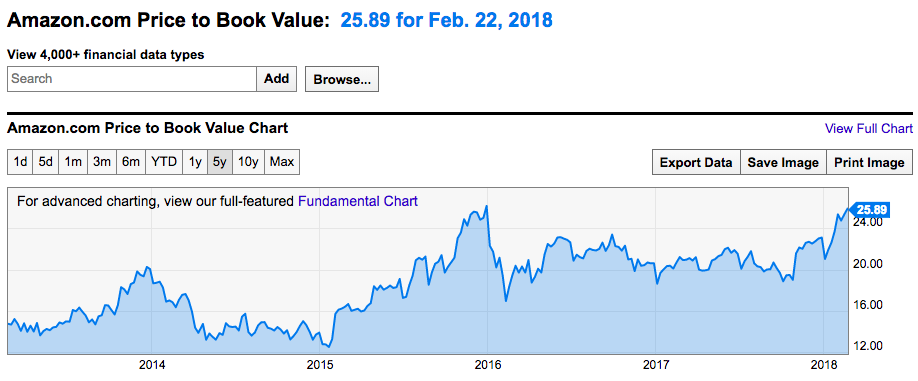
So, how do some recent market darlings trade versus book value? Below are 5-year price-to-book charts for Amazon, Tesla (TSLA), and Netflix (NFLX):

PB 1 PB 2 PB 3

We find that Amazon trades at 26X, Tesla trades at 14X, and Netflix trades at 34X book, or an average for the three of about 25X book value. This represents a multiple of over 7X the overall market"s (already historically high) P/B ratio. Moreover, none of these companies pays a dividend, so they receive maximum credit from investors for the fact that all cash (including cash sourced from incremental debt) gets reinvested in the underlying business at book value. As interest rates have relentlessly fallen during the current 9-year bull market, investors have logically marked up the equity valuations of these three to higher and higher multiples of book value. If Buffett is correct, however, these will be the very companies whose valuations contract the most when inflation and interest rates rise, as should occur in an era of higher and higher government spending and deficits.

Moreover, the likes of Amazon, Tesla, and Netflix are also the type of companies helped the least by the Trump tax cuts. For one thing, they are either unprofitable or marginally profitable, so cutting their tax rate yields minimal to no gain for them in terms of immediate earnings and cash flow. Second, the value of any deferred tax assets on their balance sheets is lower, since going forward, the amount of taxes they will be able to offset with their DTAs will be lower under a 21% tax regime than a 35% tax regime (for example, Tesla had $ 2.4 billion in DTAs on its balance sheet as of the end of 2017). Finally, the current market valuation for all three companies is largely based on investors" expectations of massive profits many years down the line (under typical sell-side analyst DCF analyses, near-term profits for these companies remains subdued to nonexistent and then explodes to the upside in the out years, similar to a hockey stick effect). Yet if the tax cuts lead to higher interest rates, the present value of these out-year profits will necessarily be less, as the discount factor applied to them will be higher. Thus, we find that the Trump tax cut has a triple negative effect on companies such as Amazon, Tesla, and Netflix.

Indeed, media outlets noted the initial negative tech investor reaction to the tax bill:

CNBC Tax

Of course, certain highly profitable large-cap tech players such as Apple (AAPL), Google (GOOG) (NASDAQ:GOOGL), and Microsoft (MSFT) should benefit from the Trump tax plan, as their cash taxes should decrease significantly going forward. In addition, they will be able to repatriate billions of overseas profits at favorable rates. Thus, not all tech companies should be put into the same boat.

Conclusion

The passage of the Trump tax plan looks to be a major negative for companies like Amazon, Tesla, and Netflix. Not only do they fail to benefit immediately from the lower corporate tax rate (since they generate minimal to no profits), the present value of their future profits is less if higher government deficits lead to higher long-term interest rates (a process which seems to be already well underway). Not only that, but if Warren Buffett"s analysis is to be believed, higher rates will necessarily cause price-to-book multiples to contract market-wide from the current (historically high) 3.4X level. As a group Amazon, Tesla, and Netflix trade at a massive 7X the overall market"s P/B ratio, indicating that the downside risk from such a contraction could be significant. To be sure, the valuation of any individual company depends on many variables, including the quality of management and products, revenue versus expense growth, market share dynamics, etc. However, the truly scary thing for Amazon, Tesla, and Netflix shareholders about the Trump tax bill is that the negative knock-on effects for these companies, as outlined in this article, are completely outside their and their company managements" collective control.

Disclosure: I am/we are long GM, AAPL.

I wrote this article myself, and it expresses my own opinions. I am not receiving compensation for it. I have no business relationship with any company whose stock is mentioned in this article.

Additional disclosure: We are also short TSLA and NFLX.


Tech

Friday, February 9, 2018

Exclusive: Amazon eyes new warehouse in Brazil e-commerce push - sources

SAO PAULO (Reuters) - Amazon.com Inc (AMZN.O) is looking to lease a 50,000-square-meter warehouse just outside Sao Paulo, people familiar with the matter told Reuters, as it steps up its push into Latin America’s biggest retail market, Brazil.

The logistics investment, which would be four times the size of its current book-shipping operation in the country, is a sign the online retailer may soon handle distribution of electronics and other goods sold on its Brazilian website.

That would be the first step of its kind for Amazon in Latin America’s largest economy, where it currently relies on third parties to ship their own goods sold on its marketplace, and it underscores the seriousness of the e-commerce giant’s renewed push into Brazil.

Amazon declined to comment to questions about leasing a warehouse.

While an estimated two-thirds of Brazil’s 209 million people have internet access, online retail was slow to take off at first, amid concerns over security and complications with tax and logistics in the continent-sized country.

E-commerce accounts for around 5 percent of Brazil’s roughly $ 300 billion retail market — about half its share in the United States — but it has doubled in the past four years and is forecast to keep growing annually at a double-digit pace.

Now Amazon, which expanded its Brazil business from books to electronics in October, is gearing up to fight rivals such as Latin Ameria’s homegrown e-commerce champion Mercado Libre Inc (MELI.O) and B2w Cia Digital, (BTOW3.SA) which is indirectly controlled by partners of private equity group 3G Capital.

“You obviously can’t underestimate a company like Amazon,” said Pedro Guasti, CEO of Brazilian online consultancy Ebit. “It has huge capacity to invest and it’s obviously taking a bigger bite of the cake than it did last year.”

Mercado Libre Inc, B2w and local retailer Magazine Luiza SA (MGLU3.SA) have stolen a march on Amazon by storing and shipping goods appearing on their websites even when offered by third-party sellers, to ensure speed and customer satisfaction.

Amazon, by contrast, has been slow to tackle the challenges of shipping in a country where tricky logistics and tax issues have long made online retail an unprofitable venture.

MEXICAN CONTRAST

In Mexico, Amazon launched its third-party marketplace coupled with its own shipping service, called “Fulfillment by Amazon,” in 2015.

The contrast has been stark. Nearly 20 percent of reviews on Amazon’s Brazilian marketplace are negative, compared with 10 percent in Mexico and just 4 percent in the United States, according to e-commerce analytics firm Marketplace Pulse.

Complaints in Brazil often focus on delayed or canceled orders - a problem dramatically reduced in other countries when Amazon itself packs and posts orders of third-party goods stored at its warehouse facilities.

In an early sign of Amazon’s Brazilian logistics push, the company posted more than a dozen listings for distribution jobs in the country to LinkedIn last year, including “Site leader, Fulfillment Center”.

The new warehouse site outside of Sao Paulo, in the municipality of Cajamar, looks to be a step in that direction.

There San Francisco-based logistics company Prologis Inc (PLD.N) has offered a 50,000-square-meter space to Amazon in a new industrial park that hosts DHL and Samsung, according to sources, who said adaptation of the warehouse had not begun.

Prologis, which also partnered with Amazon on a mega-warehouse north of Mexico city last year, declined to comment.

The preparations in Brazil come as Luft, the local logistics operator for Amazon’s book business, readies a move into another Prologis site nearby in Cajamar, sources said, leaving its current 12,000-square-meter facility in the city of Barueri.

Amazon registered in October to conduct operations in Cajamar, according to municipal records seen by Reuters.

The new logistics investment could spell trouble for rivals.

Mercado Libre has been a success story among Latin America tech start ups: its shares have nearly tripled since 2014, bringing its market capitalization to more than $ 15 billion.

Magazine Luiza’s stock has risen sixfold in each of the past two years as it shifted its rolled out an ambitious e-commerce strategy built on its brick and mortar stores.

Reporting by Gabriela Mello; Writing and additional reporting by Brad Haynes; Editing by Daniel Flynn and Alistair Bell


Tech

Wednesday, February 7, 2018

Canada's Trudeau to meet Amazon CEO Bezos during U.S. visit

OTTAWA (Reuters) - Canadian Prime Minister Justin Trudeau will meet Amazon.com (AMZN.O) Chief Executive Jeff Bezos on Thursday during a tour of three major U.S. cities this week to bolster support for the North American Free Trade Agreement, which is being renegotiated.

Amazon is in the process of identifying a location to build a massive new second headquarters and has shortlisted 20 cities, including Toronto, the only non-U.S. city to make the list.

Trudeau will meet Bezos in San Francisco, the government said on Wednesday.

During his trip, Trudeau will also meet with other technology executives, including eBay Inc (EBAY.O) chief executive officer Devin Wenig.

Amazon founder and CEO Jeff Bezos gives some closing comments after opening the new Amazon Spheres with some help from Alexa during an opening event at Amazon"s headquarters in Seattle, Washington, U.S., January 29, 2018. REUTERS/Lindsey Wasson

“The point of those meetings is to portray Canada as a good place to invest ... and to explore opportunities related to job growth with those prominent business leaders who may be interested in expanding their operations in Canada,” said spokesman Cameron Ahmad.

Ahmad declined to comment specifically on the meeting with Bezos.

Amazon’s decision on where to locate its second headquarters is expected this year. The tech giant has promised to invest $ 5 billion and create 50,000 jobs in the city it chooses. The 19 U.S. cities on the list include Chicago, Boston and New York.

Trudeau’s trip also comes as Canada and Mexico strive to address U.S. demands for NAFTA reform, with the fate of the trade pact uncertain. Last week, Trudeau reiterated a tough stance, saying Canada could walk away if he was not happy with talks to modernize the agreement.

Trudeau is due to give a speech in Chicago on Wednesday to sell the merits of bilateral trade.

Reporting by Leah Schnurr and David Ljunggren; Editing by Bernadette Baum


Tech

Tuesday, January 23, 2018

Google gets into audiobooks as rivalry with Amazon heats up

SAN FRANCISCO (Reuters) - Alphabet Inc’s Google introduced audiobooks to its online store on Tuesday, making its smart speakers and virtual assistant more competitive with Amazon.com Inc’s Echo devices and Alexa voice assistant.

Listening to audiobooks is among the most popular nighttime uses for smart speakers, a burgeoning type of home appliance that provides audio streams of music, news and other data based on user commands to an embedded virtual assistant.

But Google’s Home speakers have lagged Amazon Echo in terms of audiobook features. Amazon-owned Audible, the top provider of audiobooks, has not been supported on Home and other speakers with Google Assistant.

Google launching an audiobooks store widens the battle, which has also seen Google’s YouTube unit stop supporting an Amazon product.

Greg Hartrell, head of product management for Google Play Books, listed subscription-less buying as the top selling point for the new audiobooks store.

“You can buy a single audiobook at an affordable price, with no commitments,” he said in a blog post on Tuesday.

Audible offers one-off purchases, but promotes a $ 14.95 monthly subscription that includes one free download and 30 percent off further purchases. Amazon and Audible did not respond to requests to comment.

Google began selling ebooks in 2010. Hartrell told Reuters in a statement that audiobooks are being added because “our users are asking for them.”

About 16 percent of U.S. adults own a smart speaker, according to an Edison Research survey conducted in late 2017. The firm in conjunction with Triton Digital also found last spring that 30 percent of frequent audiobook listeners had used a smart speaker to take in an audiobook in the previous 12 months.

Audiobook sales surged nearly 20 percent annually for three consecutive years, reaching $ 2.1 billion in 2016, according to the latest Audio Publishers Assn. data.

Thad McIlroy, an online book industry consultant, said audiobooks represent the only publishing category with “strong growth” so it makes sense for Google to challenge Amazon despite having a weak ebooks business.

Google-purchased audiobooks can be accessed through Google Play Books on the web, apps for Android and iOS devices or through Google Assistant in speakers, Android smartphones and “soon” cars with Android Auto, Hartrell wrote.

Reporting by Paresh Dave; Editing by Susan Thomas


Tech

Friday, January 19, 2018

Amazon boosts monthly fee for Prime by $2, maintains yearly rate

(Reuters) - Amazon.com Inc (AMZN.O) raised the monthly fee for the U.S. version of its fast-shipping and video-streaming service Amazon Prime by $ 2 on Friday, making the case for subscribers to upgrade to an annual plan.

It was the first increase of Prime fees in almost four years and comes at the end of another bullish year and holiday season for Amazon’s dominant online shopping platform.

The move also follows a rise in fees by video streaming rival Netflix Inc (NFLX.O) in October.

Amazon increased the fee for its monthly plan to $ 12.99 from $ 10.99, while maintaining the annual fee at $ 99. It also hiked the monthly subscription fee for college students to $ 6.49 from $ 5.49.

“That’s good value, over time they’ve raised the price. I don’t think they will lose many members,” Tigress Financial Partners analyst Ivan Feinseth said.

“Those who use it the most get the most value and won’t mind the higher price and those who don’t use it are not the best customers, so even if they drop off it is not a big loss to Amazon,” he said.

As of September, Amazon had about 90 million Prime members in the United States, according to research firm Statista. The company itself does not disclose the number. bit.ly/2Dwhqjw.

Netflix has 52.77 million subscribers in the U.S. and its global tally is 109 million.

Existing monthly Prime and Prime Student members will pay the new price for renewals after Feb. 18, Amazon said on its website. amzn.to/2mRHs6C.

Amazon, which along with Netflix faces competition from Hulu and Alphabet Inc’s (GOOGL.O) YouTube, has been spending heavily to make original shows.

Only Prime has the added dimension of offering subscribers discounts and other benefits from its shopping platform, which help the company lure more buyers.

The company shipped over 5 billion items worldwide via the subscription service in 2017 and revenue from subscription fees that include Prime jumped 59 percent to $ 2.4 billion in the quarter ended Sept.30. The company reports its fourth quarter on Feb. 1.

“We only expect to see 2 percent churn from this price increase with many customers moving to the yearly subscription which is the ‘golden goose’ for Bezos & Co as once on the annual plan customers rarely churn,” GBH Insights analyst Daniel Ives said.

Amazon’s shares rose 0.5 percent to $ 1,300 on Friday.

Reporting by Aishwarya Venugopal and Arjun Panchadar in Bengaluru; Editing by Sriraj Kalluvila


Tech

Saturday, December 23, 2017

Don’t leave your Amazon S3 buckets exposed

As long as you know the right URL, anyone with access to the internet could retrieve all the data that was left online by marketing analytics company Alteryx. This is the second major exposure of data stored and improperly managed in the Amazon Web Services S3 storage service.

In the Alteryx case, it was apparent that the firm had purchased the information from Experian, as part of a data set called ConsumerView. Alteryx uses this data to provide marketing and analytics services. It put the data in AWS S3—and forgot to lock the door.

In November, files detailing a secret US intelligence collection program were leaked in the same manner, also stored in S3. The program, led by US Army Intelligence and Security Command, a division of the National Security Agency, was supposed to help the Pentagon get real-time information about what was happening on the ground in Afghanistan in 2013 by collecting data from US computer systems on the ground. Much as in the Alteryx case, the data was exposed by a misconfigured S3 bucket.

Here’s the deal: AWS defaults to closing access to data in S3, so in both cases someone had to configure S3 to expose the data. Indeed, S3 has the option to provide data over the web, if configured to do so. So, this is not an AWS issue, but one of stupidity, naïveté, or ignorance by people running their S3 instances.

Public cloud providers often say that they are not responsible for ineffective, or in these cases nonexistent, security configurations that leave data exposed. You can see why.

In these cases, white hat hackers informed those in charge about the exposure. But I suspect that many other such mistakes have been uncovered by people who quietly collect the data and move on into the night.

The fix for this is really common sense: Don’t actively expose data that should not be exposed. You need to learn about security configurations and processes before you bring the public cloud into your life. Otherwise, this kind of avoidable stuff will keep happening.


Tech