Showing posts with label Trump&#039s. Show all posts

Sunday, March 18, 2018

Trump's Call to Start a Space Force Tops This Week's Internet News Roundup

People look for inspiration and happiness in a vast array of places. Some see school kids walking out of class across America to take a stand for gun control and find hope. Others note that 7-Eleven now has customizable tater tots and are filled with joy. What do they get when they look at the internet? All that and a lot of bickering and tweets about calzones. Here, dear friends, is what everyone was talking about online last week when they weren"t talking about the new Avengers: Infinity War trailer.

Rex-It

What Happened: President Trump announced Rex Tillerson was being replaced as secretary of state on Twitter.

What Really Happened: Folks like to make jokes about Donald Trump running America via Twitter, but last week he announced an executive decision on the platform that was definitely not funny—at least not to the head of the State Department.

Yes, the change in Secretary of State—one of the most important, if not the most important, cabinet positions—was announced via social media, as if Trump was every parody of himself imaginable. For those who wanted more than just a tweet of notice about the new state of affairs, that was forthcoming … also via Twitter, of course.

Those around Tillerson, who had just arrived back in the country, were surprised by the news, suggesting that Tillerson himself wasn’t entirely prepared for what had just happened.

There might, it turns out, have been a reason for that, if one response from the State Department is to be believed.

OK, perhaps it was a little disingenuous to say that no one saw this coming, as some pointed out.

Unsurprisingly, the White House has a different take on the way everything went down.

Except, it turned out, chief of staff John Kelly’s message might not have been entirely clear.

There really is something to be said about Twitter’s role in all of this, isn’t there? Still, things couldn’t have been that bad, because Tillerson did make an appearance later that day to talk about his firing and smooth everything over.

OK, maybe it was kinda bad. (Tillerson’s failure to thank the president did not go unnoticed by, well, anyone.) Still, perhaps the split between Trump and Tillerson was for the best.

This is worth noting, as well. The State Department aide who put out the earlier statement saying that Tillerson didn’t know why he’d been fired? Yeah, there was a price to pay for saying that.

The Takeaway: Quick, we need a catchy way of talking about former Exxon CEO Tillerson now that he’s been ousted!

That"ll do.

Move Along, Nothing to See Here

What Happened: House Republicans announced they were closing their investigation into collusion between the Trump campaign and Russia during the 2016 election, saying there was no evidence of such actions.

What Really Happened: Last week, with little warning, the House Intelligence Committee"s investigation into Russian interference in the 2016 election just ... stopped.

"Case closed"? Sure, if you say so. And, it turns out, they really did say so.

There are others who might disagree with that take, of course…

As news of the surprise closure started to go wide, it was perhaps worth turning to the ranking Democrat on the committee to see if he had anything to say about the whole thing.

That would be a yes, then. And, sure, it seems suspicious to say the least that the Republicans just shut down the investigation unfinished with so much still out there unanswered, but surely the Democrats on the committee were given adequate warning that the investigation was being closed, right?

OK, but at least all the Republicans are agreed that this move was the smart one?

Well, fine, yes, that’s a little awkward. Still, at least one of the leading Republicans on the committee didn’t disagree.

Oh, come on. As the week continued, it eventually started to become clear even to the Republicans that this had been a mistake, with this headline putting it best: "Republicans Fear They Botched Russia Report Rollout." Gee, you think?

The Takeaway: In what could only be described as a spectacular piece of timing, the Republicans announced that there was nothing Russians had done in regards to the 2016 election in the same week that the Trump administration finally signed sanctions into law against 16 Russians for their efforts to interfere with the 2016 election. There’s nothing like being consistent.

Meanwhile, Over at the Department of Justice...

What Happened: Special counsel Robert Mueller"s investigation took aim at the Trump Organization.

What Really Happened: Meanwhile, you might be thinking, “I wonder how special council Robert Mueller’s Russia collusion investigation is going? I’m sure that, if the House Republicans were right and there’s certainly nothing going on, he’ll be wrapping everything up too, right?” Funny story: He’s not wrapping everything up.

Yes, in what is pretty much the opposite of wrapping things up, Mueller is subpoenaing the Trump Organization"s records, which is … kind of a big deal, to say the least. Certainly, that’s what people on social media seemed to think.

But what could it all mean? Some people had theories.

And how is this going down with those targeted?

Somewhere, Devin Nunes is wandering around the halls of Congress, muttering to himself, "But I said nothing happened…!"

The Takeaway: It’s worth pointing out that the Mueller news dropped on March 15, which amused certain people online.

Oh, Canada

What Happened: Forget "Commander in Chief," perhaps President Trump"s title could be "Gaslighter in Chief." Or, maybe, "Man Who Should Perhaps Never Talk in Front of a Tape Recorder Ever."

What Really Happened: This might sound like the kind of old-fashioned, unnecessary posturing of people stuck in the past, but once upon a time it was widely expected that the President of the United States wouldn"t be the kind of person who would boast about lying to the head of state of a friendly nation.

Those days, dear readers, are long gone.

Yes, the Washington Post obtained audio from a fundraising speech in which Trump boasted that he’d made up information that he used in an argument with Canadian Prime Minister Justin Trudeau over whether or not the US runs a trade deficit with Trudeau’s country. (It doesn"t.) "I had no idea," Trump can be heard to say on the tape. "I just said, "You’re wrong." You know why? Because we’re so stupid." As you might expect, people were thrilled about this display of, uh, political maneuvering? Sure, let’s go with that.

As the media struggled to understand what was happening, the White House press secretary attempted to smooth out the situation by, well, repeating the lie.

There is, also, a surreal second story to this audio of Trump that has nothing to do with lying to Justin Trudeau. Instead, it had to do with the "bowling ball test."

As multiple outlets looked into the matter, it slowly emerged that it was probably all made up. Not to worry, though; according to the White House, it was just a joke.

The Takeaway: There’s really only response to this entire exchange, isn’t there?

Space Force? Space Force!

What Happened: When it comes to America’s manifest destiny, there’s only one direction left to go: To infinity… and beyond?

What Really Happened: With all the bad news going around the the White House, you can’t blame the president for wanting to change the narrative somehow. And you only get to do that, he knows, by thinking big and reaching for the stars. Last week, Trump gave a speech that showed just how literally he took that advice.

Sure, going to Mars is definitely thinking big, but is it thinking big enough? Not to worry, however; Trump was right there with the next big thing.

Space Force! Just the very idea got the media excited, and asking questions like, “For real?” and “What does that even mean?”, not to mention “Do we have to?” Sure, not every outlet took the idea seriously, but that’s the lamestream media for you. Everyone else was into the idea, or calling the president a laughingstock. It’s hard to be a leader. But at least Twitter understood the potential of Space Force.

SPACE FORCE!

The Takeaway: Make no mistake, people may joke now, but Space Force is the future.


Tech

Saturday, February 24, 2018

Trump's Tax Plan: Bad News For Amazon, Tesla, And Netflix Shareholders

Trump Tax Plan"s Effect on Inflation and Interest Rates

As everyone now knows, President Trump got his corporate tax reduction bill passed in late December, lowering the tax rate on domestic business from 35% to 21%. Thus far, most investors and pundits have focused on how the lower corporate rate is a boon to big companies nationwide. Obviously, lower taxes should lead to higher profits, all else remaining equal. However, what has received a bit less attention is the effect that the tax plan will have on future interest rates and inflation. According to the Congressional Budget Office, the tax plan will add an additional $ 1.4 trillion (yes, that"s $ 14 followed by 11 zeros - or, if one prefers, 1,400 stacks of $ 1,000,000,000 each) to the federal debt over the next decade. Clearly, with the economy already strong and with debt levels already high, the tax bill should almost certainly result in higher levels of future inflation and, hence, higher future interest rates.

Indeed, it took only a month and a half after the tax plan"s passage for investors to feel the first jolts from higher inflation, as CNN reported on February 6th:

Be careful what you wish for.

Wall Street partied hard while President Trump pushed for huge business tax cuts that the economy didn"t really need. Tax cut euphoria carried the Dow a breathtaking 8,000 points to levels never seen before.

Now comes the hangover. Investors are remembering that giving lots of medicine to an already healthy economy can have side effects, namely inflation.

Those inflation fears are suddenly rocking Wall Street. They sent the Dow plummeting 1,800 points in just two trading days. The losses wiped out a quarter of the gains since Trump"s election.

For months, investors basically ignored the threat that the tax cuts might backfire, causing bond yields to spike and raising the likelihood that the Federal Reserve will have to raise interest rates faster to fight inflation.

"We have an infinite capacity for self-delusion as investors," said Bruce McCain, chief investment strategist at Key Private Bank. "When we feel good, we don"t want to be bothered by reality."

How Inflation Swindles the Equity Investor

So, what does all this mean for shareholders? Back in May 1977, Warren Buffett wrote an article for Fortune magazine (full article linked here) entitled "How Inflation Swindles the Equity Investor". Given that we now appear to be heading into an era of higher inflation, it pays to take a look back at Buffett"s thoughts on the subject from nearly 41 years ago. How does Buffett describe the relationship between inflation and equities in the Fortune article? First, he refutes the previously accepted view that equities act as an effective hedge against inflation:

There is no mystery at all about the problems of bondholders in an era of inflation. When the value of the dollar deteriorates month after month, a security with income and principal payments denominated in those dollars isn"t going to be a big winner. You hardly need a Ph.D. in economics to figure that one out. It was long assumed that stocks were something else. For many years, the conventional wisdom insisted that stocks were a hedge against inflation. The proposition was rooted in the fact that stocks are not claims against dollars, as bonds are, but represent ownership of companies with productive facilities. These, investors believed, would retain their value in real terms, let the politicians print money as they might. And why didn"t it turn out that way? The main reason, I believe, is that stocks, in economic substance, are really very similar to bonds. I know that this belief will seem eccentric to many investors. They will immediately observe that the return on a bond (the coupon) is fixed, while the return on an equity investment (the company"s earnings) can vary substantially from one year to another. True enough. But anyone who examines the aggregate returns that have been earned by companies during the postwar years will discover something extraordinary: the returns on equity have in fact not varied much at all.

Basically, Buffett takes the view that equities are disguised bonds that pay around 12% on par value (i.e., book value, or shareholders" equity). Thus, stocks are hurt just as much as bonds when inflation rises because the price-to-book ratio (and, consequently, price-to-earnings and price-to-sales ratios) for stocks must necessarily decrease just as a bond"s price decreases in inflationary times. Conversely, the lower the relative level of inflation, the higher bond prices rise and the more P/B, P/E, and P/S multiples for stock expand (all other things being equal).

Buffett goes on to identify a key additional characteristic of low inflationary environments: they favor companies that reinvest their earnings (versus paying them out via dividends). Why? Because when stocks are trading at 3.4X book value, as they are today, every $ 1 of cash from operations that gets reinvested in said book value should translate into an incremental $ 3.40 in market value for the shareholder (versus worth just $ 1 when paid out as a dividend, or even less after payment of taxes thereon). Buffett explains further:

This characteristic of stocks - the reinvestment of part of the coupon - can be good or bad news, depending on the relative attractiveness of that 12%. The news was very good indeed in the 1950s and early 1960s. With bonds yielding only 3 or 4%, the right to reinvest automatically a portion of the equity coupon at 12% was of enormous value. Note that investors could not just invest their own money and get that 12% return. Stock prices in this period ranged far above book value, and investors were prevented by the premium prices they had to pay from directly extracting out of the underlying corporate universe whatever rate that universe was earning. You can"t pay far above par for a 12% bond and earn 12% for yourself.

But on their retained earnings, investors could earn 12%. In effect, earnings retention allowed investors to buy at book value part of an enterprise that, in the economic environment then existing, was worth a great deal more than book value.

It was a situation that left very little to be said for cash dividends and a lot to be said for earnings retention. Indeed, the more money that investors thought likely to be reinvested at the 12% rate, the more valuable they considered their reinvestment privilege, and the more they were willing to pay for it. In the early 1960s, investors eagerly paid top-scale prices for electric utilities situated in growth areas, knowing that these companies had the ability to re-invest very large proportions of their earnings. Utilities whose operating environment dictated a larger cash payout rated lower prices.

We note here that the 30-year Treasury bond yield has jumped up recently, appreciating about 45 bps over the past six months to the ~3.20% level (source):

30 year Granted, we are not even remotely close today to the ~15% level of the early 1980s, however, for equity investors, we currently appear to be moving in the "wrong" direction, at least if one buys into Buffett"s thesis. Indeed, looking at the very long view, it appears that the ~35-year bond bull market may finally be ending (source):

Now, we know why investors have been in love with so-called "growth" companies (especially big tech companies) during the recent moderate growth, low interest rate, and low inflation environment. These tend not to pay dividends but rather reinvest all their cash flows into existing or new operating businesses. Consider Amazon (AMZN) for a moment. All operating cash flow is plowed back by Jeff Bezos either into the existing retail business or in newer businesses such as Amazon Web Services. Unfortunately, the higher interest rates rise, the lower the relative benefit of the reinvested dollar for shareholders, and the less attractive "growth" stocks look compared to stodgy dividend payers like AT&T (T) or General Motors (GM) (again, other things being equal).

Buffett notes that a "reversal" phenomenon took hold in the mid-to-late 1960s just after major institutional investors had stampeded into growth stocks at nosebleed valuations:

This heaven-on-earth situation [regarding the superiority of growth stocks in low interest rate environments] finally was "discovered" in the mid-1960s by many major investing institutions. But just as these financial elephants began trampling on one another in their rush to equities, we entered an era of accelerating inflation and higher interest rates. Quite logically, the marking-up process began to reverse itself. Rising interest rates ruthlessly reduced the value of all existing fixed-coupon investments. And as long-term corporate bond rates began moving up (eventually reaching the 10% area), both the equity return of 12% and the reinvestment "privilege" began to look different.

Are we on the precipice of a new downward revaluation of stocks, given looming inflation? Today, stocks trade around 3.4X book value, compared to 2.0X book value in 2009 and just 1X book value in 1980. Let"s take an extreme scenario where interest rates are rising significantly and investors are only willing to pay book value for the S&P 500 again, as they did at the conclusion of the last bond bear market. Obviously, a growth company that trades today at 10X book value pays no dividends and earns 15% return on equity has much more potential downside than a dividend payer trading at 1.5X book value also earning 15% return on equity, since, even if the former were to trade at a consistent 3X the market multiple of book value (as it does now), it would still lose 70% of its value in the adverse scenario (i.e., its valuation would be reduced from 10X book to 3X book). In comparison, the dividend payer now trading at 1.5X book value might trade down to 1X book in the adverse scenario, meaning it would only have 33% downside, or less than half that of the growth stock.

Wither Tech Stocks Post-Trump Tax Reform?

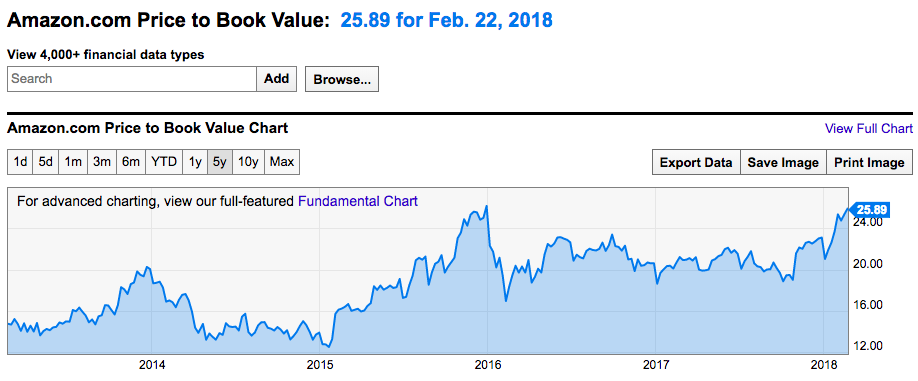
So, how do some recent market darlings trade versus book value? Below are 5-year price-to-book charts for Amazon, Tesla (TSLA), and Netflix (NFLX):

PB 1 PB 2 PB 3

We find that Amazon trades at 26X, Tesla trades at 14X, and Netflix trades at 34X book, or an average for the three of about 25X book value. This represents a multiple of over 7X the overall market"s (already historically high) P/B ratio. Moreover, none of these companies pays a dividend, so they receive maximum credit from investors for the fact that all cash (including cash sourced from incremental debt) gets reinvested in the underlying business at book value. As interest rates have relentlessly fallen during the current 9-year bull market, investors have logically marked up the equity valuations of these three to higher and higher multiples of book value. If Buffett is correct, however, these will be the very companies whose valuations contract the most when inflation and interest rates rise, as should occur in an era of higher and higher government spending and deficits.

Moreover, the likes of Amazon, Tesla, and Netflix are also the type of companies helped the least by the Trump tax cuts. For one thing, they are either unprofitable or marginally profitable, so cutting their tax rate yields minimal to no gain for them in terms of immediate earnings and cash flow. Second, the value of any deferred tax assets on their balance sheets is lower, since going forward, the amount of taxes they will be able to offset with their DTAs will be lower under a 21% tax regime than a 35% tax regime (for example, Tesla had $ 2.4 billion in DTAs on its balance sheet as of the end of 2017). Finally, the current market valuation for all three companies is largely based on investors" expectations of massive profits many years down the line (under typical sell-side analyst DCF analyses, near-term profits for these companies remains subdued to nonexistent and then explodes to the upside in the out years, similar to a hockey stick effect). Yet if the tax cuts lead to higher interest rates, the present value of these out-year profits will necessarily be less, as the discount factor applied to them will be higher. Thus, we find that the Trump tax cut has a triple negative effect on companies such as Amazon, Tesla, and Netflix.

Indeed, media outlets noted the initial negative tech investor reaction to the tax bill:

CNBC Tax

Of course, certain highly profitable large-cap tech players such as Apple (AAPL), Google (GOOG) (NASDAQ:GOOGL), and Microsoft (MSFT) should benefit from the Trump tax plan, as their cash taxes should decrease significantly going forward. In addition, they will be able to repatriate billions of overseas profits at favorable rates. Thus, not all tech companies should be put into the same boat.

Conclusion

The passage of the Trump tax plan looks to be a major negative for companies like Amazon, Tesla, and Netflix. Not only do they fail to benefit immediately from the lower corporate tax rate (since they generate minimal to no profits), the present value of their future profits is less if higher government deficits lead to higher long-term interest rates (a process which seems to be already well underway). Not only that, but if Warren Buffett"s analysis is to be believed, higher rates will necessarily cause price-to-book multiples to contract market-wide from the current (historically high) 3.4X level. As a group Amazon, Tesla, and Netflix trade at a massive 7X the overall market"s P/B ratio, indicating that the downside risk from such a contraction could be significant. To be sure, the valuation of any individual company depends on many variables, including the quality of management and products, revenue versus expense growth, market share dynamics, etc. However, the truly scary thing for Amazon, Tesla, and Netflix shareholders about the Trump tax bill is that the negative knock-on effects for these companies, as outlined in this article, are completely outside their and their company managements" collective control.

Disclosure: I am/we are long GM, AAPL.

I wrote this article myself, and it expresses my own opinions. I am not receiving compensation for it. I have no business relationship with any company whose stock is mentioned in this article.

Additional disclosure: We are also short TSLA and NFLX.


Tech