Showing posts with label Years. Show all posts

Wednesday, July 4, 2018

Small Cap CEF Yields 7.7%, Deep Discount Of 9.2%, Outperformed The Index The Past 32 Years

This research report was jointly produced with High Dividend Opportunities authors Julian Lin and Philip Mause.

Royce Value Trust (RVT) is a legendary closed-end fund ("CEF") started by a giant fund manager in the small-cap investing world, "The Royce Funds". In fact, RVT is the first small-cap CEF ever created 32 years ago.

RVT recently traded at $ 15.76 per share, representing a 9.2% discount to its net asset value ("NAV") of $ 17.80 and a 7.7% dividend yield based on its trailing 12 months distributions. RVT is a solid pick for those wanting exposure to both the high alpha small-cap space as well as a high dividend yield.

Small Caps Have A Little More Alpha

Stocks of small-cap companies are well known to potentially have higher return potential than their larger cap counterparts. This is generally due to the fact that smaller companies have more room to grow, they tend to grow more quickly, leading, of course, to share price appreciation.

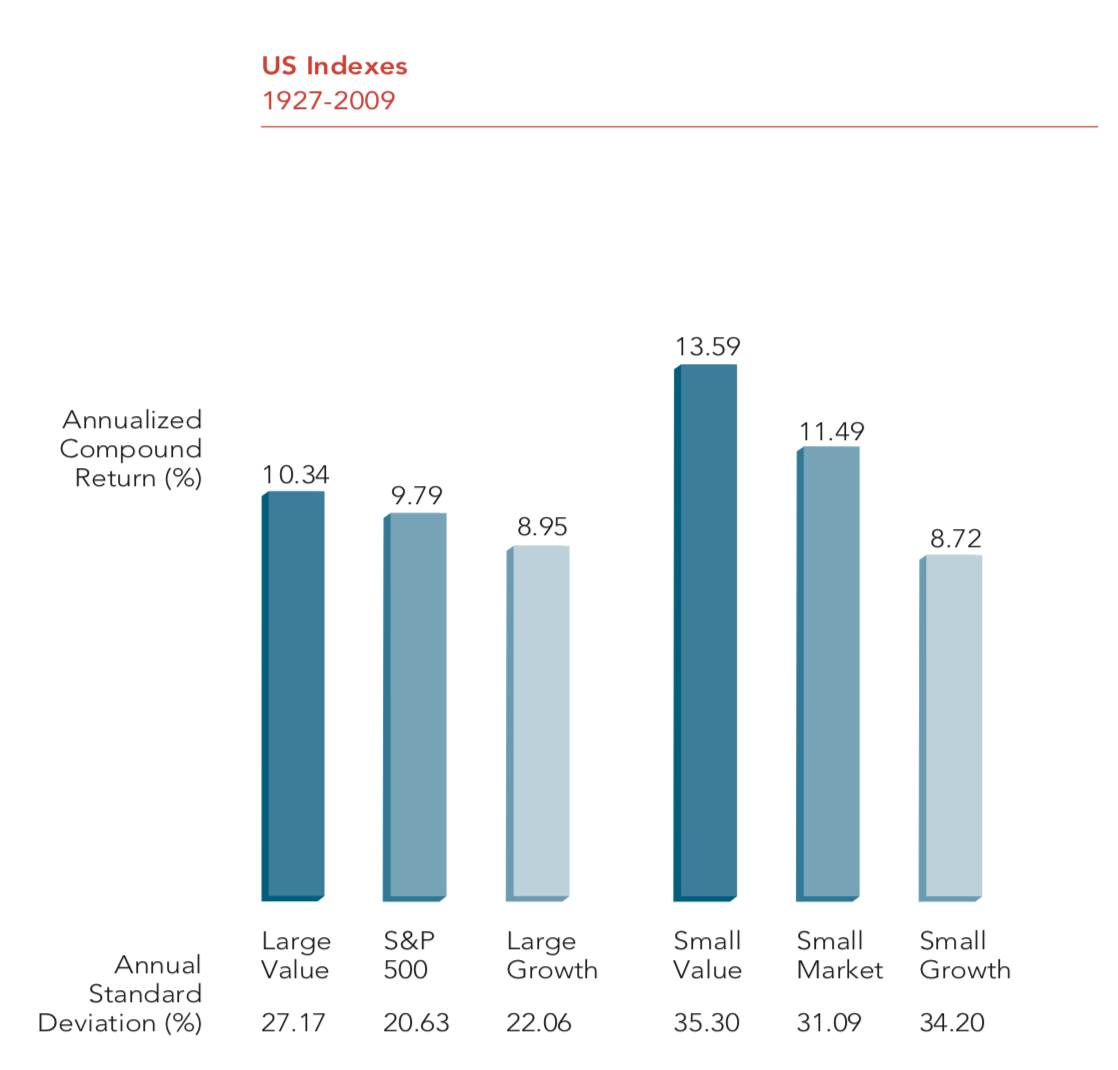
In fact, from 1927 to 2009, small-cap stocks greatly outpaced large-cap stocks by a wide margin.

(Dimensional Fund Advisors)

In 2018, small-cap stocks are taking the leadership position compared to their large-cap counterpart with the small-cap Russell Index (IWM) returning 10.3% year-to-date compared to the S&P 500 index returning only 3.8% for the same period.

One Of The Best Time To Have Exposure To Small Caps

It is one of the best times to be invested in small-cap stocks. Small-cap companies will be the biggest beneficiaries of the recently enacted corporate tax cuts. Larger companies will also benefit, but not as much, because they usually hire expensive tax accountants and use complex strategies to reduce their effective tax rate down; so the biggest tax impact will be felt in smaller cap stocks. According to a recent Invesco study, the companies in the S&P 600 Small Cap Index had an average effective tax rate 4.3% higher than that of the S&P 500 companies. This means that small-cap stocks have been more positively impacted by the recent corporate tax cuts because they will be able to save more taxes.

U.S. stocks are set to strongly outperform their foreign counterparts. With the U.S. economy being the healthiest large economy on the globe, it provides a "safe haven" for investors. Small-cap stocks on average generate more than 78% of their revenues from the U.S. compared to 70.9% for the S&P 500 companies. Since their revenues are mainly generated domestically, they are set to grow faster.

Despite the recent rally, small-cap stocks continue to have PE ratios which are very attractive relative to the S&P 500.

At current ratio levels, the increased potential for growth inherent in small-cap stocks is not really "priced in." As a result, in addition to earnings growth potential, there is also significant potential for multiple expansion - this is a recipe for strong shareholder returns. No wonder small-cap stocks are seeing such a strong outperformance.

Getting To Know RVT

RVT was the first small-cap closed-end fund ever at its inception in 1986, and its manager, Chuck Royce, has managed it for its 32 years of existence since inception. Royce is naturally known as a legend in the small-cap investing universe. The focus is on small-cap stocks generally with market capitalization up to $ 3 billion. The fund has about $ 1.46 billion in net assets and 437 total holdings, and employs a tiny bit of leverage, with its leverage ratio at around 3.7%. This is relatively modest for an equity CEF.

A Solid Management

The managers of RVT, "The Royce Funds", are pioneers in small-cap investing. It"s been their specialty for 40+ years. What sets them apart is their depth of small-cap knowledge, experience, and a single focus in their area of expertise.

The core approach of management is to combine multiple investment themes through small-cap companies that are set to generate high returns on invested capital or those with strong fundamentals and/or prospects trading at what management believes are attractive valuations.

This strategy has paid off well over the years. RVT has seen 10.7% average yearly returns since inception (through March 31, 2018).

The Portfolio

Their top ten holdings are seen below (as of 3/31/2018):

RVT mainly focuses on U.S. based stocks with 87% invested domestically. It has 18.1% in international exposure out of which 7.7% in Canadian stocks. So, RVT has an overwhelmingly North American exposure.

(CEFConnect)

This Isn"t Just The Index

There are substantial differences in sector representation between RVT and the Russell 2000, the typical small-cap index. In particular, RVT has dramatically greater exposure to the industrial, materials, and information technology sectors and considerably lower exposure to health care and utilities:

In our opinion, this allocation makes a lot of sense in the current economic environment. We have previously discussed reasons for the industrials and materials sectors to outperform, namely in the form of a near-term catalyst in a large infrastructure bill in Washington, backed by long-term tailwinds of incessant demand for infrastructure spending. Furthermore, industrials and materials tend to do much better during periods of economic growth, inflation, and rising interest rates than other sectors such as utilities.

The information technology sector, despite the recent rally, is still quite attractively priced because of the potential for growth and major innovations. The recent tax reform which has allowed companies (especially large-cap tech companies) to repatriate foreign cash at lower tax rates greatly increases the potential Merger & Acquisition activity. Small-cap companies, such as the ones that RVT holds, have market caps which look like mere "pocket change" to companies like Apple (AAPL) which has over $ 200 billion in cash.

The weighted average price to earnings ("P/E") multiple of RVT portfolio companies was 22 and the price to book ratio ("P/B") was 2.2, versus 20.4 and 2.3, respectively, for the Russell 2000. The slight premium in valuation reflects management"s decision to emphasize positions with strong growth potential:

Share Price Performance

RVT has outperformed the Russell 2000 over almost every time frame, including by over 50 basis points since inception 32 years ago.

In addition to producing superior returns over time, RVT has also had less volatility ("risk") as well.

This management team clearly has a long track record of outperformance and also has the experience of managing through multiple economic cycles.

Low Expense Ratio

Whereas many CEFs have high expense ratios around 1.5% of assets, RVT is different and in a good way. RVT has an expense ratio of only 0.65% of net assets. This includes 0.54% in inclusive management expenses plus 0.11% in interest expenses. This low expense ratio is a significant plus because high expense ratios tend to eat away at shareholder returns over time and are considered an important reason why many funds underperform indices over the long run.

Dividend Policy

RVT uses a "managed distribution policy" in which they pay quarterly distributions at an "annual rate of 7% of the average of the prior 4 quarter-end "net asset values", with the 4th quarter being the greater of these annualized rates or the distribution required by IRS regulations."

RVT last paid an average of $ 0.305 in quarterly dividends and for the past 4 quarters paid a total of $ 1.22 per share in dividends, for an annualized yield of 7.7%. The fund has historically distributed dividends out of long-term capital gains and dividend income.

(Chart by Author)

While it is definitely a plus that RVT has rarely had to give distributions in form of "return of capital" ("ROC"), we would like to remind readers that ROC is not necessarily a bad thing when it comes to equity CEFs. While ROC for fixed income CEFs is usually always destructive, in the case of equity CEFs, this is not always the case. Often, equity CEFs decide to distribute ROC as a tax advantaged way to return capital to shareholders.

Valuation

Aside from trading at a 7.7% dividend yield, RVT also trades at a 9.2% discount to its NAV of $ 16.24 per share. With a 1-year Z-Score of 0, RVT is currently trading within its normal NAV discount. Note that during the bull market of 2002 through 2007, RVT traded mostly at a Premium to NAV.

(CEFConnect)

We would not be surprised if RVT will start trading again at its NAV or a premium to NAV in the current bull market cycle. In all cases, the shares do not deserve such a steep discount to NAV considering management"s track record to outperform the index.

Risks To Consider

  • Small-cap stocks tend to carry a higher risk and price volatility than their large counterparts. That said, this risk is mitigated by RVT through a high diversification among both sectors and companies through 437 stock holdings. While there may be some losers in the mix, these have been more than offset by very big winners.
  • In the event of a market downturn, RVT, like all equity funds, will see its price decline. However, it has very low leverage which may make it comparatively stable. In addition, there are many reasons to believe that the outlook for equities is positive, considering the extra firepower for growth-related capital expenditures and investments being afforded as a result of corporate tax cuts.

Bottom Line

RVT is possibly the best equity CEF with a focus on small-cap stocks. It has a proven track record of outperformance through its 32 years of existence. Because of its exposure to value small-cap stocks with growth potential, the fund is set to strongly outperform in the current economic cycle. RVT is recommended for income investors who are looking for a portfolio diversification in addition to a generous yield which is currently at 7.7%. RVT has also the potential to also generate a high level of capital appreciation. We rate RVT as a strong buy.

If you enjoyed this article and wish to receive updates on our latest research, click "Follow" next to my name at the top of this article.

Note: All images/tables above were extracted from the Fund"s website unless otherwise stated.

Disclosure: I am/we are long RVT.

I wrote this article myself, and it expresses my own opinions. I am not receiving compensation for it (other than from Seeking Alpha). I have no business relationship with any company whose stock is mentioned in this article.

Tech

Monday, June 18, 2018

How This Keynote Speakers Bureau Hit The Inc 5000 And Nearly Doubled Its Revenue In Just Four Years

Executive Speakers Bureau is one of the most successful speakers bureaus in the U.S. and one of the only speakers bureaus to ever hit the Inc. 5000. Founded by Angela Schelp in Memphis in 1993 (husband and partner Richard Schelp joined as president and co-owner in 2001), Executive Speakers Bureaus offers and books hundreds of keynote speakers nationally and internationally and continues to grow at a pace rarely approached in this competitive industry, nearly doubling its overall revenue and number of bookings in just the last four years, while maintaining a reputation for customer service and community involvement that is widely viewed as second to none.

Micah Solomon, Inc.com: You"ve spoken in passing about the importance of your vision of success.  Can you explain what this means specifically as it relates to commercial success?

Richard Schelp, President and Co-Owner, Executive Speakers Bureau: In order to succeed in a competitive marketplace, you need a true plan or strategy.  Our ability to anticipate some of the challenges we have had to face in the industry and our understanding of how to address those challenges has kept us ahead of our competitors and driven our success in revenue and profitability.

Solomon: I"ve heard you and Angela speak about the power of your company"s culture and the pride you take in your employees.  Can you speak a bit about this? 

Schelp: From the beginning the culture of Executive Speakers Bureau has been built around respect for each other, a true sense of team, and the fact that both what we do within our business and in our community affects many people"s lives.  Very few work environments can promise its employees this kind of value.  

Our employees are some of the best you will see in any industry, and certainly in ours.  It is not just a job to them.  They are proud of where they work, and they truly feel responsible for the success of Executive Speakers Bureau.  This is the reason why they want to stay.  They want to see this thing through to the end.  

Solomon: What in your and Angela"s prior background led you to be able to take this approach and succeed with the culture of your company and your relationship to your employees?

Schelp: Both Angela and I have a wealth of corporate experience (IBM, AT&T, and other big firms) in which we have both managed and worked for a number of people.  When you have seen a lot of examples of great and terrible management, you start to get a feel for what works and what doesn"t.  All of the previous managers that I respected established environments in which I felt comfortable going to them, and they were the primary reason for me enjoying my job

 Solomon: Your bureau has grown quite quickly. How is life different now that you are an agency of significant size and pull?

Schelp: Life at Executive Speakers Bureau is definitely a little bit different now that we are much bigger.  With that does come a level of responsibility and respect.  Because of our increased size, we now have a larger role within our industry association.  As a matter of fact, I will become the president of the association next Spring. 

Also, in the early years of our bureau we used to base our decisions about processes, documents, fee recommendations, etc. on what the larger bureaus were doing.  Now we don"t check with others.  We make our decisions based on what we know and what we think makes the most sense.  Surprisingly many bureaus are following our lead, and they are calling us to ask how we do things. 

Solomon: Many of my readers are entrepreneurs and business leaders themselves. It"s very helpful and enjoyable (!) for them to hear about mistakes you"ve made or tricky situations you"ve endured in the past, what went sideways and how you either dealt with it or learned from it.

Schelp: A few years ago I faced an extremely tricky situation that taught me so many lessons as a business owner in our industry. A high-profile sports figure was supposed to speak for me at a large convention in New York.  He decided to fly in on his private plane the morning of the event.  However, there was a terrible electrical storm that morning, and his plane was grounded, leaving me without a speaker.  I received the call at 6:30AM and the speaker"s presentation was at 10:30AM.  I had four hours to find a replacement for a great speaker and get him to the event on time.  Immediately I went to work by calling all of the speakers and agents who were high quality and could get there-and, ultimately, I was fortunate enough to find a speaker who my client absolutely loved.

The lessons from this incident were numerous, but most importantly I realized just how crucial it is to have access to many resources, so that an emergency situation becomes doable, otherwise it is impossible.  Also, I learned that as long as you are determined and efficient any task can be accomplished.


Tech

Wednesday, June 13, 2018

Apple: Can Shares Double Again In 2 Years?

Warren Buffett said the following:

I call investing the greatest business in the world … because you never have to swing. You stand at the plate, the pitcher throws you General Motors (NYSE:GM) at 47! U.S. Steel (NYSE:X) at 39! And nobody calls a strike on you. There’s no penalty except opportunity lost. All day you wait for the pitch you like. Then when the fielders are asleep, you step up and hit it.”

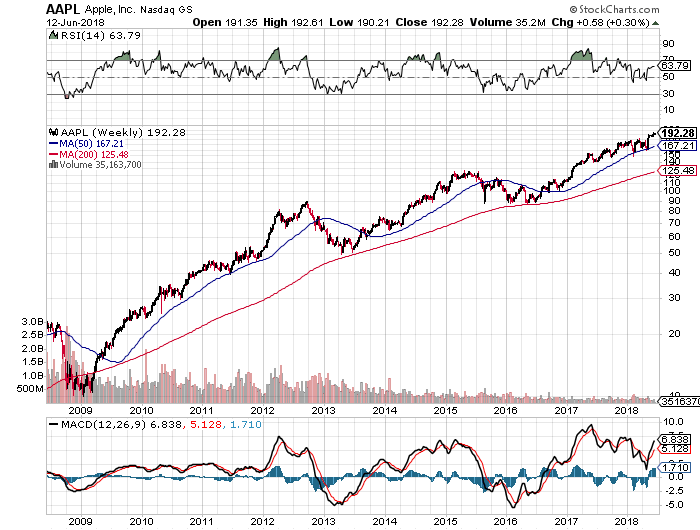
I distinctively remember Apple (AAPL) at around $ 90 a share back in 2016. Sentiment was on the floor, commentary was circulating on mass that iPhone growth was history. Fast forward a couple of years and shares have more than doubled. I suspect few would have thought that AAPL would have recovered so quickly. However as the chart illustrates below, AAPL also suffered a steep decline in 2013 but came roaring back to life soon thereafter. Why didn"t investors "trust" the charts instead of one or two disappointing earnings reports? Hindsight is 20/20, as they say.

Then we have Gilead (GILD). Shares collapsed to close to $ 60 a share last year and have been very slow to gain momentum since then. Granted Gilead"s shares collapsed more than Apple"s and over a much longer time frame, but you can be sure that many investors doubled down on their positions or bought at levels much higher than the present share price. Apple and Gilead before these share price declines relied mostly on one product which was obviously the iPhone in AAPL and HPC cures for Gilead. So why did one stock bounce back strongly whereas the other flattered to deceive?

I think these articles are helpful because it is at these inflection points where the most fortunes are made. With AAPL, for example, you had the likes of Buffett joining the party, but then you had the likes of Carl Icahn who ran for the exit. Now both of these billionaires made a lot of money but Icahn as we can see now sold far too early.

Buffett also has stated.

“Opportunities come infrequently. When it rains gold, put out the bucket, not the thimble.”

The problem though is that everything is so easy in hindsight. AAPL"s top line sales have come roaring back to currently stand at $ 247.41 billion over a trailing 12-month average. Gilead"s top line sales growth has deteriorated to currently stand at $ 24.69 billion (almost $ 8 billion down from its 2015 high).

Many newsletters got Gilead wrong which is why one should always make their own investing decisions. Why? Because an opinion backed by research and hours of study usually means one will stand by the position even if the going gets tough for a while. Gilead never rebounded because it ultimately cured hepatitis C. I wrote more about this here but many were caught out on this at the time.

Here though was the skinny compared to Apple. Although Gilead was generating strong cash flows from the likes of its HCV and HIV divisions, there was absolutely no link between the two segments. These two diseases are totally different and one cannot "lift up" the other, so to speak, when the likes of HCV is struggling.

We cannot though say the same about Apple. I remember its March quarter in 2016 when revenue collapsed by 13% to print the worst top line quarter since 2003. The main culprit was of course iPhone unit sales which were down 16% over a rolling quarter basis. However there were a number of reasons for the decline both in dollar amount sales and iPhone unit sales. Softness in China, currency headwinds plus also a poor product mix led to the disappointing quarter. Shares headed toward $ 90 as investors ran for the exit. However the launch of the iPhone 7 in September kept the purists hopeful.

However it wasn"t that model that turned the tide for AAPL. It was the fact that smartphone growth was still in an uptrend (still is to this day) and Apple was working really hard in the background to both coax customers from Android (through the likes of the iPhone SE) while also tie in customers more and more into its ecosystem of products. Just remember the strength of AAPL"s ecosystem today will dictate the strength of sales in the future. Gilead never had this competitive advantage and its results demonstrated this.

So when the next blip occurs, we will look at the strength of that ecosystem to see how growth rates are faring in other products. It"s all about engagement and loyalty going forward. These metrics are probably the best ones to measure when the inevitable happens and iPhone growth slows once again. As for Gilead, there still seems to be no catalyst in the cards to help growth. AAPL despite its valuation and snap back rally continues to look a far better long contender here.

Disclosure: I/we have no positions in any stocks mentioned, and no plans to initiate any positions within the next 72 hours.

I wrote this article myself, and it expresses my own opinions. I am not receiving compensation for it (other than from Seeking Alpha). I have no business relationship with any company whose stock is mentioned in this article.


Tech

Thursday, May 31, 2018

If Elon Musk Had Lived 500 Years Ago, This Is The Audacious (and Profitable) Venture He Probably Would Have Launched

In the early 1500s, England faced an existential economic crisis: Demand for their most lucrative export, woolen cloth, was plunging in Europe. They needed to find new markets for their product --and fast.

So a group of merchants set their sights on the vast market of Cathay --the word used at the time to refer to China --then the largest economy in the world, with nearly 30 percent of global GDP. (By comparison, India during this period produced roughly 20-25 percent of global GDP. England was peripheral to the world economy, producing an inconsequential 1 percent of global GDP.)

These English merchants sent expeditions in search of a new overland sea route that, they hoped, would take them over the European continent to China, enabling them to avoid having to sail through waters controlled by the Spanish and the Portuguese, their arch rivals.

After failing to reach Cathay (though they did make it as far as Moscow), they decided to turn westward, eventually reaching the shores of America, where they established small trading outposts and, eventually, full-fledged colonies. 

This is how the tale begins in a captivating new book by Simon Targett and John Butman, New World, Inc.: The Making of America by England"s Merchant Adventurers. Through meticulous research and a flair for bringing a colorful cast of long-deceased characters back to life, Targett and Butman tell the story of the founding of one of history"s most successful startups: America.

"It"s the "prequel" to the Pilgrims," Targett told me in a recent podcast conversation. "You can"t really understand America today if you only go as far back as the Pilgrims. Of course they are an important part of the founding. But there were many trips for 70 years before the Pilgrims, who eventually arrived in Plymouth, Massachusetts in 1620. As we delved further, we tracked and traced an unbroken chain of voyages. And we felt the story of these merchant adventurers --what we call the "forgotten founders" -- provide a better narrative."

Targett and Butman relate the fascinating and largely untold story of the earliest days of globalization, of innovation and entrepreneurial risk-taking, and of the creation of some of the earliest venture-financed companies in the world.

"What they did initially was to setup a company," explains Targett. "This we think of as perhaps the forefrunner of all modern corporations. It was called "The Mysterie, Company, and Fellowship of Merchant Adventurers for the Discovery of Regions, Dominions, Islands, and Places Unknown.""

This was a period when the newly-coined word, "company," was just starting to become a part of the English language. In a fascinating bit of etymology, Targett explains how the word was formed through the conjunction of the Latin words, "com," meaning "together," and "panis," meaning, "bread." Together, the word loosely means, "the breaking of bread together."

Of course, English merchants had supported and funded voyages for decades, and these had often been funded either by private individuals or private syndicates. "But the idea of going across the world required a higher level of organization and financing, so they set up this company which not only allowed them to pool their resources, but also allowed them to attract their resources from people who didn"t want to get involved in the mundane running of company."

Like the startups of today, most of which are statistically prone to flop, failure was very much a part of the story. "It"s remarkable how many setbacks these people experienced and yet they continued to believe there was a pot of gold or a fortune to be made at the end of it," observes Targett. "And, in a way, that driving spirit was key to these people. It"s another feature of a modern America that we feel needs to be traced back to before the Pilgrims." 

Targett compares these risk-taking, adventurous "forgotten founders" of 16th and 17th-century England to one of the boldest entrepreneurs of our era, Elon Musk. "To some extent the people that we write about, these "forgotten founders," were venture capitalists. They were very much the Elon Musks of their day. Just as he is dreaming of new worlds, in his case Mars, their new world was America. And he"s pulling together some of the best minds to help him design some of the rockets and the spaceships that will be needed. Likewise, the merchants pulled together the very best minds of their days, the scientists, the navigators, the buccaneers, the marketers."

"These "forgotten founders" and the people they sent across were the first people to really experience and live the American dream. These were the people that often went across with nothing but made their place and made their home. They didn"t all make fortunes but they found a life, they found a place in society."


Tech

Wednesday, January 31, 2018

Failing Your New Years Resolutions? Tony Robbins Has the Perfect Quote to Get You Back on Track

By late January, most of us have abandoned our New Year"s resolutions. It"s a statistical fact. Resolutions can get a bad rap. The problem isn"t making resolutions, but rather the resolutions we make. They require too much growth and, often, too much pressure for us to handle in a short period of time.

It"s like signing up for a marathon before you even learned how to jog.

In making my own resolutions (yes, I did, too), I have leaned on a great quote from Tony Robbins"s documentary I Am Not Your Guru:

Sound familiar? Here is why it resonates.

Focus on the long game

Concentrating on long-term growth has two immediate benefits: It emphasizes strategy and it gives flexibility.

If you resolve to become a healthier weight in the next 30 days, then your mind will automatically start looking for the hack: What is the latest diet trend? How can I lose as much as possible as quickly as possible?

It becomes about speed rather than strategy.

By stretching out your goal to, say, a three or five year plan, then you"re focusing on methods that are sustainable rather than quick.

The other benefit is that you are much gentler on yourself in the process, making it much more likely that you will actually reach your goal. Going after a goal is much like the stock market: It never moves in a straight line but, through the ups and downs, it almost always ends higher than where it started. Obsessing on short-term gains is akin to being a modern-day Bitcoin investor. The dramatic emotional toll may outweigh any real gains.

Balance the short and the long

One good method is to set your long-range goal, then work backwards to figure out what increments you need to hit at what time. The increments create the milestones and those become the metrics that you measure.

The good part? Those milestones feel more achievable, which means you"ll be more likely to stay motivated to reach them - and celebrate with victories and gratitude when you do.


Tech

Monday, November 27, 2017

20 Years Ago, Steve Jobs Revealed the Single Word That Led to Apple's Great Success

The power of focus.

Without it, you"re doomed to a life of distraction. A life in which others" priorities dictate on what you spend your time. As you move from one shiny object to another, you may get lots of things done--but few things ever get done well.

Or, you may find your life is ruled by procrastination, where doing great work is derailed by social media and YouTube videos.

But how can you learn to achieve focus, in a world that is built to distract?

20 years ago, Steve Jobs answered that question.

In 1997, Steve Jobs had just returned to Apple, the company he had been ousted from over a decade before. He was answering questions from developers at Apple"s Worldwide Developers Conference when someone raised the topic of "OpenDoc," a software engineering framework that Jobs decided to kill upon his return.  

In addressing the question about OpenDoc, Jobs took opportunity to drop some major wisdom.

"I know some of you spent a lot of time working on stuff that we put a bullet in the head of," begins Jobs. "I apologize. I feel your pain." The audience laughed appreciatively.

He continued:

"But Apple suffered for several years from lousy engineering management. And there were people that were going off in 18 different directions--doing arguably interesting things in each one of them. Good engineers. Lousy management.

And what happened was, you look at the farm that"s been created, with all these different animals going in different directions, and it doesn"t add up. The total is less than the sum of the parts. And so we had to decide: What are the fundamental directions we"re going in? And what makes sense and what doesn"t? And there were a bunch of things that didn"t. And microcosmically they might have made sense; macrocosmically they made no sense.

...When you think about focusing, you think, well, focusing is about saying yes. No. 

Focusing is about saying no."

Boom drops the dynamite.

Focusing is about saying no.

This ability to say no was arguably Jobs"s greatest skill. When Apple brought Jobs back, his first order of business was to shrink the product line--and make sure whatever Apple made, it made extremely well.

"Steve was the most remarkably focused person I"ve ever met in my life," said Jony Ive, Apple"s design chief and the man Steve Jobs once described as his "spiritual partner." Ive went on to explain why achieving focus isn"t as easy as it appears on the surface.

Jobs would regularly ask him: "How many things have you said no to today?" Ive says he would have "sacrificial" things he turned down. "Well, I said no to this. And no to that," he would tell his boss. "But he knew that I wasn"t vaguely interested in doing those things anyway."

"What focus means is saying no to something that you [think]--with every bone in your body--is a phenomenal idea," he continues. "And you wake up thinking about it. But you say no to it because you"re focusing on something else."

Putting It Into Practice

Whatever your role or position, you"re faced with choices about your work on a daily basis. Should I join this meeting? Do I really want to take on this client or project? Should I focus on this task at the expense of that one?

For many, it"s not easy to say no. You may try to rationalize: "I don"t want to hurt anyone"s feelings. They won"t understand. I"ll find a way to get it all done."

No, you won"t.

Learning to say no begins by sharpening your emotional intelligence--the ability to make emotions work for you, instead of against you. By refusing to let temporary emotions lead to permanent decisions, you"ll realize that lack of focus easily leads to regret.

Then, instead of trying to do it all...

You can simply do it right.

So, choose wisely.

Because every time you say yes to something you don"t really want, you"re actually saying no to the things you do.


Tech