Showing posts with label Electric. Show all posts

Sunday, May 20, 2018

Charging Electric Scooters Is a Profitable, Fun—and Occasionally Dangerous—Youth Trend

The newest big trend in tech startups is in turn fueling an emergent youth culture, as teenagers and young adults spend their free time collecting and charging electric scooters. Some compare it to a game—one that they’re getting paid pretty well for playing, but also comes with some real-world risks.

As reported by The Atlantic, the part-time gig is sometimes called ‘Bird hunting.’ That name comes from Bird, the most prominent company in a wave of new “dockless” scooter and bike rental startups, which use smartphone apps to both rent and track light vehicles.

The systems offer a potentially innovative solution to urban transportation, particularly what’s known as the “last mile” problem: how to get users of public transit from stations to their doorsteps. Because they can be dropped off anywhere, the rental vehicles can be more convenient for riders than personal scooters or bikes (though they can also, according to some city officials, create a “public nuisance”).

Get Data Sheet, Fortune’s technology newsletter.

The apparent convenience of those systems, though, is created by a lot of behind-the-scenes work, much of it done by contractors, known as “chargers,” who collect and charge the scooters. Several young chargers described their work to The Atlantic as a fun side-hustle—one even compared it to playing Pokémon GO, since it involves using an app to find the GPS-tagged scooters. The “prizes” for finding scooters are also game-like, with chargers paid more for retrieving scooters that are harder to find. Young chargers report teaming up to do the work faster, starting what amount to small businesses with some socializing thrown in for good measure.

Rewards can range up to $ 20 for a single scooter, and chargers described making up to several hundred dollars per night. Those rewards are likely to decline, assuming that Bird and other startups are following the standard tech-industry model of sacrificing revenue for market share early on (at least $ 250 million in venture capital supports Bird and similar companies). But the game-like aspects of charging may make workers less price sensitive.

That said, just as Uber has become a primary source of income for many of its drivers, it’s clear that recharging scooters is not a game for everyone. Chargers interviewed by The Atlantic describe occasional conflicts over scooter bounties, manipulation of the reward systems, and outright theft of the scooters, which criminals have been known to chop up for parts. Perhaps worst of all, some report that criminals are hunting the hunters—using scooters as bait, then mugging the chargers who arrive to retrieve them.


Tech

Monday, May 14, 2018

Electrified roads: Swedish project could slash cost of electric vehicles

OSLO (Reuters) - An electrified road in Sweden that is the first in the world to charge vehicles as they drive along is showing promise and could potentially help cut the high cost of electric cars, project backers Vattenfall [VATN.UL] and Elways told Reuters.

The state-funded project, named eRoadArlanda and costing about 50 million crowns ($ 5.82 million), uses a modified electric truck that moves cargo from Stockholm’s Arlanda airport to Postnord’s nearby logistics hub to test the technology.

A electrified rail embedded in the tarmac of the 2-km-long (1.24 miles) road charges the truck automatically as it travels above it. A movable arm attached to the truck detects the rail’s location in the road, and charging stops when the vehicle is overtaking or coming to a halt.

The system also calculates the vehicle’s energy consumption, which enables electricity costs to be debited per vehicle and user.

Elways’ chief executive Gunnar Asplund said the charging while driving would mean electric cars no longer need big batteries — which can be half the cost of an electric car — to ensure they have enough power to travel a useful distance.

“The technology offers infinite range — range anxiety disappears” he said. “Electrified roads will allow smaller batteries and can make electric cars even cheaper than fossil fuel ones.”

Asplund said the Swedish state, which is funding the project, was happy with the results so far, with the only issue — now resolved — having been dirt accumulating on the rail.

Elways has patented the electric rail technology and is part of a Swedish consortium backing the eRoadArlanda project that also includes infrastructure company NCC and utility Vattenfall, which provides power from the national grid to the rail.

“Such roads will allow (electric vehicles) to move long distances without big, costly and heavy batteries,” said Markus Fischer, a Vattenfall spokesman, adding that installing the arm in new cars would be cheaper than retrofitting current models.

Vattenfall said in a statement electrified roads could reduce carbon dioxide emissions from lorries, which account for about 25 percent of total road traffic emissions.

“The investment cost per kilometer is estimated to be less than that of using overhead lines, as is the impact on the landscape,” it added.

Testing at eRoadArlanda started in April and will last at least 12 months so that the electric truck can use it under different weather conditions.

Editing by Catherine Evans


Tech

Tuesday, May 8, 2018

Audi eyes 800,000 electric and hybrid car sales in 2025

BERLIN (Reuters) - German premium brand Audi on Tuesday said it plans to sell about 800,000 battery-electric and hybrid powered cars in 2025, as it seeks to catch up with electric car rival Tesla and emerge from a damaging emissions-cheating scandal.

The logo of the German car manufacturer Audi is pictured at the training center during a media tour in San Jose Chilapa, Mexico April 19, 2018. REUTERS/Henry Romero

Audi’s image has been tarnished by regulatory probes investigating what role its engineers may have played in designing engine management software to cheat modern emissions tests.

Audi will launch more than 20 electrified vehicles by 2025 thanks to an ability for using parent Volkswagen’s (VOWG_p.DE) new MEB modular platform and vehicle underpinnings jointly developed with premium sibling Porsche, it said.

That’s slightly more ambitious than the 20 electrified vehicles Audi had previously guided for. Audi said it would launch the cars without undermining its 8-10 percent operating margin target.

Audi declined to provide details about how many fully battery electric, and how many hybrid cars it will sell by 2025. Last year, it sold about 16,000 semi-electric vehicles and it still lacks a fully electric model in its lineup.

The Ingolstadt, Germany-based brand, which delivered 1.88 million cars globally in 2017 currently offers three plug-in hybrid vehicles.

In August, Audi will launch the e-tron sport utility vehicle, its first serial all-electric model.

Demand for large sports utility vehicles has helped make Audi Volkswagen’s main profit driver.

On Tuesday Germany’s Transport Ministry said the KBA vehicle authority was investigating a further 60,000 diesel-engined Audi cars for suspected illegal manipulation software which may have helped the carmaker cheat emissions tests.

To fund its electric-vehicle offensive through to the middle of the next decade, Audi has extended by three years until 2025, an investment program worth about 40 billion euros ($ 47.42 billion), it said.

To free up funds for its electric-car push Audi is ceasing production of some models, including two-door versions of its A1 and A3 vehicle lines, as well as cutting component and administration costs. It now aims to save at least 10 billion euros by 2022.

($ 1 = 0.8435 euros)

Reporting by Andreas Cremer; Editing by Edward Taylor


Tech

Monday, April 23, 2018

General Electric: Finally, It's Over


Image Source

So far, the word “unpredictable” seems to be one of the most-used descriptive choices when characterizing the events of 2018. And, broadly speaking, this appears to be an accurate term. Just a few months ago, if you were to suggest that the NASDAQ would be seeing “flash crash” activity while General Electric (NYSE:GE) was forming a long-term bottom in a multi-year decline, you might have been laughed out of the room. But this appears to be where we are, given the market’s positive reaction to GE’s April 20th announcements and the generalized lack of certainty in almost every aspect of this current financial environment. We have been saying that the stock declines below $ 13 per share would be the worst of it for holders of GE and we maintain this view in light of the company’s recent strategic moves. We are long GE with a bullish stance on the stock as a long-term hold for portfolio strategies.

Chart: CNN Money

Many analysts have argued that there are fundamental earnings problems within the company itself. But, since this is the most “mega” of the “mega-conglomerates” it is critical to assess the trends over at least three years before drawing any drastic conclusions. The earnings performance at GE has been erratic since 2015. But the revenue side of the equation has been much more stable over the same period.

This implies that GE’s problems are internal (fixable) rather than external (not fixable). This is good news, as long as the company is able to reduce operations and focus on the businesses. Currently, jet engines, power plants, and healthcare machines are GE’s biggest money-makers - and we would prefer to see more of the company’s attention (and resources) focused on streamlining these segments.

Earnings Trend Chart: Yahoo Finance

On the other side of the ledger, the power, oil, and gas markets are still presenting major challenges for General Electric, with revenue in those segments showing significant weakness in Q1. Operating losses in the power unit were lower by 38%, but the company has said that improvements have been made in service operation and cost execution for the segment. Operating losses in oil and gas fell by 30%. Other negatives were seen in the GE Capital unit, as it continues with its weaker trends.

For the first quarter, net losses came in at 14 cents per share (roughly in-line with last year’s performance for the period). On a continuing basis, net incomes came in at 4 cents per share (a solid increase from the in the 1 cent per share seen a year ago). On an adjusted basis, the company posted earnings of 16 cents per share (well above analyst estimates calling for 11 cents per share). Total revenues for the quarter gained by 7% (to $ 28.66 billion against expectations of $ 27.45 billion). In the accompanying statement, Flannery highlighted the fact that margins, industrial earnings, and free cash flows are all gaining on an annualized basis - and this is all good news for dividend investors.

What really matters here is the strategic direction, and the willingness within those in management to cut the fat and become a more modern company. There are still very real questions with respect to whether or not Flannery & Co. will be able to address those needs. But we do know that many of the correct moves have already been made. This includes the decisions to sell NBC, Universal Studios, and its real estate portfolio.

These were areas where the company could not reasonably hope to compete, and sacrifices needed to be made in order to preserve as much of the dividend as possible. Another example of a strategic move in the “right” direction was deal to sell GE’s appliance division for $ 5.6 billion. GE is still in recovery-mode, and this is the short-term outlook that should define the long-term outlook for quite some time.

GE Chart Analysis: Dividend-Investments.com

The key point here is that the word “recovery” implies gradual strengthening. In market terms, that equates to positive price movement, and we view GE as a long-term hold with an attractive yield offering for investors. GE cut industrial structural costs by $ 805 million, and they expect to beat prior goals to reduce costs by $ 2 billion for all of 2018. This is strong evidence of progress, and it has not yet been reflected in share prices.

Shorter-term, we have seen some upside and this is an indication that the market is liking what it sees (so far, at least). Since aviation, healthcare, and transportation divisions all experienced double-digit profit growth, these moves should be viewed as valid. Prior resistance under $ 14 should now be expected to act as price support and we believe that a long-term bottom has likely formed at $ 12.80.

What is your position on GE? We look forward to reading your comments. Stay tuned to Dividend Investors and receive our next alerts by clicking the "Follow" button at the top of the page.

Disclosure: I am/we are long GE.

I wrote this article myself, and it expresses my own opinions. I am not receiving compensation for it (other than from Seeking Alpha). I have no business relationship with any company whose stock is mentioned in this article.


Tech

Tuesday, April 17, 2018

Electric Scooter Startups in Battle with San Francisco 

This is a guest post by Applico CTO and Principal Tri Tran. Prior to joining Applico, Tri was the co-founder and CEO of Munchery. 

After years of public battles with Uber, San Francisco has learned some valuable lessons. 

This time around, three electric scooter rental companies - Bird, Lime and Spin - are trying to roll out their service in downtown San Francisco. But the city is fighting back. As I happen to live in San Francisco and work in downtown, I"ve been able to witness this battle first hand.

Fast Rollout

As a startup entrepreneur, I quickly recognized the strategies that these three companies have taken to maximize business traction in as short a time as possible:

  • Flood a certain limited geography (such as downtown San Francisco) with a lot of scooters.
  • Get as many people as possible using them, very quickly. Once certain critical mass is reached, perhaps leverage them and their loyalty to fight off any regulations.
  • The default is seeking forgiveness afterward instead of seeking permission prior to operating. Let the city take any actions it needs to, assuming it"s historically very slow to react anyway.

I would not be surprised if these three companies also employ "fake" users and have them ride the scooters around town to create buzz, and thus word of mouth referral.

The City Fights Back

To my surprise, the city worked quickly and City Attorney Dennis Herrera issued cease-and-desist orders to all three companies.

The city wants the scooter companies to take actions to:

  1. Keep users from riding scooters on sidewalks
  2. Keep scooters from blocking sidewalks when parked
  3. Ensure that riders use helmets

It"s all in the name of public safety. Until then, the city will impound these scooters and may issues fines of a minimum of $ 125 for each violation. That is unless the companies can abate the problem within 30 days or prevail in an appeal hearing.

What Will Happen Next

It is not clear what these companies would do next, but here"s my take:

  • These three companies don"t have the operations to meet the city"s demand for the above described points
  • Limiting riders from sidewalks and ensuring unused scooters not block sidewalks is too tall of an order

Technically, it"s entirely possible to track riders on where they ride and whether they had left the scooters on sidewalks. They can even issue fines to riders who disobey such rules. But these rules would be a direct conflict to the convenience of ride-wherever and park-wherever, and thus would greatly reduce the attractiveness of using their scooters in the first place.

So what should they do? San Francisco has clearly established that it can move fast to regulate AND has created a repeatable process to impound these scooters.

Not complying will simply be too costly. More importantly, San Francisco also provides a model for all other cities to copy if/whenever the service rolls out to their cities. That"s bad news for Bird, Lime and Spin.

Ultimately, the service that these scooter companies provide is convenient, but not nearly as convenient as Uber was when it first arrived and replaced the painful taxi experience.

Additionally, the immediate public disruption of a horde of unfamiliar vehicles taking over sidewalks is much more apparent. Scootering on the streets has its own dangers as well when mixed with automobile traffic. The bike accident rate in San Francisco hasn"t changed much in the past few years. Relatively few people will brave their lives for that convenience.

Thus, these scooter companies will not have similar leverage nor political power from their small user bases to what Uber had when it fought against regulation attempts.

Based on the above, my prediction is that this service will go down into history as a fail, at least in major U.S. cities. It"s not necessarily a bad thing as these entrepreneurs will have learned a lot from the experience. They may find better, more sustainable businesses as a result. Cities are still grappling with what the future of transportation looks like, as are entrepreneurs. Scooters may not be it.


Tech

Monday, April 16, 2018

Indian ride-hailing firm Ola to launch 10,000 electric vehicles over 12 months

NEW DELHI (Reuters) - Indian ride-hailing firm Ola, backed by Japan’s SoftBank Group will launch 10,000 electric three-wheelers in the country over the next 12 months as part of a broader electrification plan, the company said in a statement on Monday.

FILE PHOTO: An employee speaks over his phone as he sits at the front desk inside the office of Ola cab service in Gurugram, previously known as Gurgaon, on the outskirts of New Delhi, India, April 20, 2016. REUTERS/Anindito Mukherjee/File photo

The move is part of a broader push by Ola to launch 1 million electric vehicles on its platform by 2021, it said in the statement, adding that it will work with various state governments, vehicle manufacturers and battery companies to meet its target.

Reporting by Aditi Shah; Editing by Swati Bhat


Tech

Monday, March 12, 2018

Tesla's electric motor shift to spur demand for rare earth neodymium

LONDON (Reuters) - Tesla’s shift to a magnetic motor using neodymium in its Model 3 Long Range car adds to pressure on already strained supplies of a rare earth metal that had for years been shunned because of an export ban by top producer China.

FILE PHOTO: A Tesla Model 3 is seen in a showroom in Los Angeles, California U.S. January 12, 2018. REUTERS/Lucy Nicholson/File Photo

Efforts by governments around the world to cut noxious emissions produced by fossil fuel-powered cars is driving demand for electric vehicles and the metals used to make them, such as lithium and cobalt which are key ingredients for batteries.

Now the spotlight is on neodymium. Several auto makers already use permanent magnet motors that rely on the metal because they are generally lighter, stronger and more efficient than induction motors that are based on copper coils.

But it is the switch to neodymium by Tesla, an auto maker that has staked its future solely on the electric vehicle, that is showing the way the industry is moving and the direction of demand for the rare earth metal.

Research group imarc estimates the market for the neodymium-iron-boron magnet used in the motors is now worth more than $ 11.3 billion, with demand for the magnets rising at a compound annual growth rate of 8.5 percent between 2010 and 2017.(For a graphic of Neodymium market balance click reut.rs/2FD6bUb)

“Some electric car motors use the permanent magnet technology, probably the most famous is the Tesla Model 3 Long Range. All the other Tesla models — Model X and Model 3 standard — use induction motors,” said David Merriman, a senior analyst at metals consultancy Roskill.

Global demand of 31,700 tonnes for neodymium last year already outstripped supply by 3,300 tonnes, he said. Demand was expected to climb to 34,200 tonnes this year and 38,800 tonnes in 2018, leaving larger deficits.

“Tesla’s decision to switch to permanent magnets has completely changed the dynamics of the market,” said a source at a fund manager that specializes in metals.

The price of neodymium is now about $ 70 a kg, well below the $ 500 hit after China held back shipments to Japan in 2010 during a row over disputed islands but it is still 40 percent higher than at the start of 2017.

(For a graphic of neodymium prices click reut.rs/2DlOHtE)

China, which resumed neodymium exports in 2015, imposed strict export quotas across a range of rare earth metal in 2010, saying it wanted to curtail pollution and preserve resources.

COSTLY PROCESS

“People seem to have forgotten China’s export ban. It could happen again. China is really the main producer, no one else has invested as much in rare earths,” a rare earth trader said.

Despite their name, rare earths are found in many places around the world, but the process of extraction is difficult and expensive, as it requires separating multiple different metals from a single deposit. This is unlike the much simpler process, for example, of recovering copper from ore.(For a graphic of Rare Earth Producers click reut.rs/2Fu5HnE)

China has invested heavily in the rare earth metals process but its crackdown on mining, smelting and other polluting industries is forecast to slow supply. It already helped push the neodymium price to a two-year high of $ 96 in September.

“Rare earth production is as bad as you can get in terms of environmental damage,” the trader said. “China used its dominant position before, what’s to stop it doing so again?”

Such supply concerns are encouraging automakers to search for ways of cutting down neodymium use. Toyota Motor Corp (7203.T) said last month it had found a way to cut use of the metal in electric motors by about a fifth.

The Japanese firm said it had developed a magnet which replaced some of the neodymium with more abundant and cheaper rare earths — lanthanum and cerium. Toyota aims to use the magnets in electric vehicle motors within the next 10 years.

Other manufacturers of electric vehicles that use permanent magnets include BMW BMWG, Nissan (7201.T) and Geely (0175.HK).

Several companies produce rare earth metals outside China, including London-listed Rainbow Rare Earths (RBWR.L), Canada-listed Namibia Rare Earths (NRE.V) and Australia’s Spectrum Rare Earths (SPX.AX).

But, for now, auto makers making permanent magnet motors remain heavily reliant on China, which according to Roskill accounted for 85 percent of global output of rare earth oxide estimated at 161,700 tonnes in 2017.

Morgan Stanley analysts estimate electric vehicles will total 50,000 units in 2020 or 2.3 percent of the total, rising to 400,000 in 2025 or 17.4 percent, and 975,000 in 2030 or 40.9 percent.

Reporting by Pratima Desai; Editing by Veronica Brown and Edmund Blair


Tech

Saturday, December 30, 2017

General Electric: The Crazy Ex-Girlfriend I'm Now About To Marry

I hate loving General Electric (GE), its like an ex boyfriend/girlfriend that broke your heart.

Each time you go back, you tell yourself it will be different... they have changed! Yet every time you go back, they break your heart again.

This has now happened to me twice with GE. In 2008, I was riding high, having bought GE in the mid 20"s in 2004, with the promise of an industrial revolution. The finance division was booming and I was up a cool 50% and thought I had found the one!

Then I found out they were cheating on me with someone named subprime! It nearly bankrupted the company, and Uncle Warren had to come to the rescue to save it.

I was frankly, lucky to get out when I did, selling mid panic in the low 20"s. The end result was a 4 year investment that returned roughly negative 20%. I vowed to never make that mistake again...

In early 2015, it was as if GE sent me a text saying... "I miss you... lets get lunch to catch up?" and unfortunately for me, I hit reply. And just like that, we were back together.

The stock had been consolidating all year, and Jeff Immelt had on his shiniest used car salesmen hat, singing sweet nothings into my ear of buybacks, the disposal of the finance assets and refocusing on core industrial operations.

Blah, blah, blah! Next thing I know, this pretty little stock I re bought at 24 and had me sitting on 35% gains, gets cut in half... Apparently the company had a nasty secret spending habit they hid for years and years.

Chart GE data by YCharts

So I had a decision to make mid 2017, do I bail again and take another 20%+ loss? Is this stock destined to break my heart again and again until nothing is left?

I did some soul searching... deep in the woods. And had decided again to leave, never to return.

But as I was leaving the door, with my bags packed, and my prized, signed picture of the Jamaican bobsled team in toe, an event made me hit the pause button.

Jeff Immelt had decided to "step down."

This left me in a holding pattern for months, until Nov 13th. When new CEO John Flannery issued 2018 guidance that was, lets be kind and just say disastrous. Lowering even the lowest of bars for 2018 to EPS of $ 1-$ 1.07.

So, why am I still a holder of GE stock?

To squeeze some more juice out of my "ex" metaphor, GE just checked itself into rehab!

It now realizes it has a serious problem, it has overspent and or had disastrous timing on virtually every major deal it has done in the last 10-15 years. Alstrom, check. Oil assets, check. Finance disposal, check. Buyback, check.

Mr Flannery appears to not need a second corporate jet to follow him around "just in case" unlike Mr Immelt. He also seems to be dead set on costs, which with GE in its current structure will keep him busy for a while.

Why not close your position?

You think I am crazy don"t you, why in the world would I consider keeping or perhaps doubling my position in a stock that has done nothing but hurt me?

The reason is pretty simple, all of the dirty laundry appears to be in the open now. No more secret spending accounts or ill researched / timed acquisitions (for now). Mr Flannery has all but told anyone that will listen that the rest of 2017 and all of 2018 will suck, and to not invest.

He didn"t "kitchen sink" an earnings report, he lit the whole house on fire.

Source: Meme Generator | Create Your Own Meme

Mr Flannery has called for a new approach to doing business at GE and more importantly to transparency, apparently not subscribing to Immelt"s pyramid scheme like approach to GE"s cash flow. He has acknowledged the pension shortfall, which I am sure will come up in the comments section of this article. Also shrinking the board from a frat house of 18 to a GE focused 12, preaching honesty (imagine that) and accountability in the new GE.

So far I am digging the new CEO and currently am in tacit agreement with his broad outline.

What was the new CEO given to work with?

I"m glad you asked! GE in my opinion has a very strong set of business"s to work with, below I have outlined the 6 major divisions it currently operates.

Power- GE"s power business is huge, with an installed base in every major country in the world. They claim to produce 1/3rd of the worlds electricity through gas, steam and nuclear turbines. This is a core division for GE, and one that recently has helped drive them directly into a ditch, as overcapacity, technical issues and in my view an ill timed Alstrom acquisition weigh on earnings at the division.

However, GE power does have many redeeming qualities. They are a technology leader in the industry whilst having deep relationships with customers in a field that honestly does not have all that many options. Near term however, look for deep cuts in expectations at the unit until the smoke clears.

Aviation- The companies Aviation segment has been a bright spot in recent results, with continued wins and new product introductions, for example LEAP, its new narrow body engine that from what I can find is truly state of the art, with a 15% fuel improvement, increased reliability, weighs 500 lbs less and is 3D printed (which, lets face it, is just cool!)

This division looks set to continue to preform well in the near term and may be looked at as an example for the rest of the company.

Transportation- The transportation segment is mostly composed of GE"s rail assets and is thought to perhaps be on the chopping block for divestiture. They build locomotives with a large portion of revenue coming from the services side of the business, which is something I like to see. They are a global leader in the industry and the mix of technology and services is impressive.

However the division has been lackluster of late and the strategic fit is questionable and thus may not make sense for them to keep. They did just win a 200 locomotive order from Canadian National Railway (CNI) but it may be prudent to offload this asset to focus on core business.

I sort of hate to see this business go, as it truly is world class. However GE hopefully will use proceeds here to either reduce debt or shore up the oft cited pension shortfall.

Healthcare- GE has a broad and diverse set of healthcare assets, providing imaging, healthcare cloud, cardiology, orthopedics and anesthesia equipment, among multiple other products and services.

This has been a strong performer for the company and what I would consider another core holding of GE, this division looks to be a good fit with its digital offerings and will likely continue to buoy the company during this current slump.

BHGE- This is a division that really makes me mad, and I struggle to remain calm in my writing. Jeff Immelts timing was so bad that it feels like it was on purpose. Immelt decided to buy a bunch of oil services companies, seemingly at the absolute top of the oil market. Grrr.

Anyways, GE Baker Hughes as it is now called is the 2nd largest oil services company in the world and to be fair is actually a very good company, and is a technology leader in the industry along side Halliburton (HAL). So basically it is the second prettiest girl in a leper colony.

Oil services, seem in my opinion to be stuck in a pretty serious long term rut and GE, I believe will look to dispose of this asset likely through a spin off off or divestiture of its stake rather quickly. Perhaps GE could offer Immelt a stake in this spin off in return for the GE stock he so graciously awarded himself during his charade.

Renewables- The renewables division is home to a world class wind energy turbine manufacturer, along with in my opinion is the most valuable part, its services segment. GE has established itself as the worlds number 2 wind turbine company behind Vestas Wind Energy (OTCPK:VWDRY). The company also has an emerging offshore wind and hydro power segment that are lacking scale currently, but hold long term promise.

The wind market this year has suffered from intense competitive pressures thus dragging results, however this also looks to be a core division for GE in the future.

So why am I sticking with GE this time - and may be looking to "pop the question" soon?

The companies potential is just so damn pretty! GE lines up well with my vision of the mega trends of the future.

In my mind, a company must both show an ability for growth, while possessing a solid balance sheet with operating discipline from which to build. Under Mr Immelt, GE, in hindsight obviously stood much closer to the crazy side of Mr Barney Stinson"s famed graph below.

Source: FANDOM

Mr Flannery seems to be dead set on adjusting the results of the above graph.

After the dust settles from the recent house fire Mr Flannery has set ablaze, I am envisioning 4 major divisions of GE remaining. Power, Aviation, Healthcare & Renewables.

All 4 remaining divisions fit into my vision- with 3 qualifying in my mind as mega trends. Power, Aviation & Renewables.

Healthcare I view as a great business as well but does not fit as a mega trend in my book with so many unknowns as to the future in the industry.

Power- Power is (obviously) a key need for the future as more and more countries look to move to gas powered plants and away from coal. With the world estimated to need an additional 50% more electricity in the next 20 years, perhaps adding dramatically to that if the electric car revolution is indeed realized.

GE is in great shape position wise in the industry and once the fat has been cut, along with a renewed focus on execution, this division should prove to be a key driver of profits for decades to come.

The below graph shows an estimate of the worlds need for energy into 2035.

Source: Breaking Energy

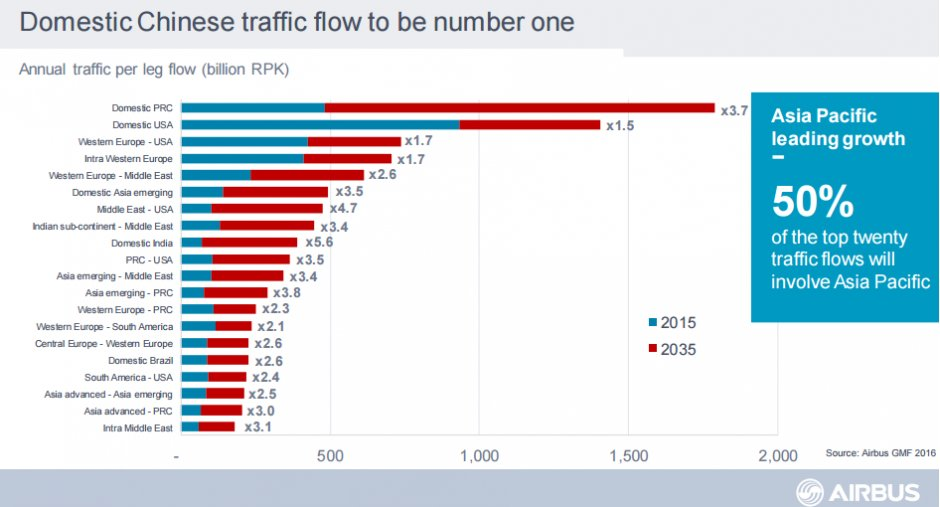
Aviation- This division looks to be in the midst of a multi decade run, as the world continues to be more interconnected. Importantly the Asian travel market is in the early innings of what looks to be a spectacular expansion. GE I believe is in the drivers seat in this industry, both in technology and services.

My one worry is the Chinese looking to enter this market with "homegrown technology" which I believe is code for stealing IP and re packaging it. However manufacturing jet engines is an entirely different animal from copying an iPhone and progress on a Chinese engine that is both safe and accepted is likely a few decades off.

Source: Airbus Home

Healthcare- This industry as a whole, especially preventative medicine in my view will swell massively in the next few decades. I am going to lose a few followers over this i"m certain but I believe universal healthcare in the United States is pretty much a sure bet sometime in the next 20 years. Which would be good news for GE!

Keeping costs down will likely be a key requirement of any future health system, and with GE"s expertise in imaging for preventative medicine and its emerging analytics and software offerings, it may be able to play an important role in the health systems future, however uncertainties do exist as to the nature of cost controls and the potential for margin compression in all things health related.

Committee for a Responsible Federal Budget

Renewables- I am firmly on the alternative energy bandwagon and GE"s positioning in this industry appears very ideal. Wind energy by most measures is already roughly equal in cost per MWh to current fossil fuel plants, this will likely get better with time, and with offshore wind and hydro picking up steam in both efficiency and scale for GE, will open further avenues of growth for this division.

Alternative energy is here to stay, and GE looks to be on a path that requires no subsidies, a major pitfall to solar currently. The downside to wind energy could be the commoditization of wind turbines, however I believe that GE has the technology and service capability to differentiate themselves in this rapidly growing industry for decades to come.

Source: U.S. Energy Information Administration (NYSEMKT:EIA)

So will I say "I do"?

GE has burned me... Badly in the past, and I must say I am rather gun shy about committing to a perhaps multi decade long marriage to the stock.

But she is so damn pretty!

Source: Meme Generator | Create Your Own Meme

My plan "as of today" is to keep my current position, roughly 2.2% of my equity portfolio in GE for the first half of 2018, to test the waters, if you will, of the new CEO. If I continue to like what I am seeing and the valuation seems fair, which I view it to be currently (a forward PE of 17ish) I may step up to the plate and double my position in the company.

Or maybe I won"t, and I will just run like heck and never come back!

GE: "Hey you, what"s up"

Me: ...

Author"s note: If you enjoyed this article and would like to be notified of my future articles, please hit "follow" next to my name at the top of the article to receive notification of future articles I publish.

Disclosure: I am/we are long VWDRY, GE.

I wrote this article myself, and it expresses my own opinions. I am not receiving compensation for it (other than from Seeking Alpha). I have no business relationship with any company whose stock is mentioned in this article.

Editor"s Note: This article discusses one or more securities that do not trade on a major U.S. exchange. Please be aware of the risks associated with these stocks.


Tech

Sunday, December 24, 2017

General Electric Winning Multiple Contracts Is A BUY At 6-Year Lows

Yesterday"s contract win by General Electric (NYSE:GE) from Canadian National Railway Co (NYSE:CNI) for 200 locomotives went mostly unnoticed by the market and the news media outlets as the country geared up for the Christmas Holiday. This is one of many recent positive developments that have been ignored by the market as year end tax selling has kept downward pressure on GE along with the doom and gloom that has the stock trading at a 6 year low.

The demise of GE (NYSE:GE) in my opinion is to say the least overblown. Yes the company is having issues with their energy division. Yes they cut the dividend by 50%, Yes the stock is down 46% YTD. Yes there is year end tax selling.

Is there any reason to buy GE at all? I guess that all depends on your tolerance for risk and ability to handle a possible 10% downside from capitulation level lows reached a month ago at $ 17.46 and the recent low on Thursday of $ 17.36, the same day the tax reform bill passed.

GE is out of favor and in the dog house, this is a secret to no one. However it is my belief that GE will be turning the corner much sooner than the market is forecasting. The last six weeks have seen the stock trade in a tight range as the market searches for the ever elusive multi year bottom.

I bought more Friday at $ 17.41,adding to a heavily long position in the stock.

Here are a few headlines that you may have not heard about or seen over the last 30 days that should have moved the stock in a positive direction.

General Electric: CN (CNI) says will acquire 200 new locomotives over the next three years from GE Transportation to accommodate future growth opportunities and drive operational efficiency across its system

From briefing.com TODAY

The locomotives will be produced at the GE Manufacturing Solutions facility in Fort Worth, Texas beginning in 2018. CN"s order is the largest among class I railways since 2014. The first units are expected to be delivered in 2018 with the balance delivered in 2019 and 2020.

GE scores its largest Renewable Energy order in Thailand

  • Agreements to build three 90 MW clusters for the Theparak Wind farm in Central Thailand
  • 270 MW of total capacity to provide enough electricity to power the equivalent of 120,000+ local homes
  • Win supported by the GE Store; strong collaboration between GE Renewable Energy and GE Power.

Bangkok, 13 December 2017 – GE Renewable Energy and GE Power recently announced agreements to provide 270 MW of wind energy capacity to Wind Energy Holding (a member of Thailand"s KPN Group) for the Theparak Wind Farm in Central Thailand.

GE Renewable Energy is set to provide a total of ninety 3.0-137 wind turbines with 156.5m hybrid towers, making those the tallest turbines it has ever installed outside of Europe. Read full details by clicking here.

One third of 66 GE Haliade 150-6MW nacelles depart for Merkur Offshore windfarm

  • Complex logistical dance needed to complete project by 2018 remains on-track
  • When completed Merkur will be one of Germany"s largest offshore wind farms
  • Project will power around 500,000 homes and cut CO2 emissions significantly.

Paris, December 12th 2017 – GE Renewable Energy announces the depart of the last set of nacelles to be shipped this year to Merkur"s Offshore Windfarm logistical hub in Eemshaven Netherlands. By the end of the month this hub will have received 24 nacelles, 24 blades, and several other tower fragments and transition pieces. With all these component in-place, local teams will perform some pre-assembly works while getting prepared for the installation phase that is set to begin mid-February 2018. Click here for more for more details.

GE Power, Egypt’s EETC to connect 120 MW of wind power to national grid through extension of the Gabal El Zayt substation

  • Extension of the Gabal El Zayt substation will help connect up to 120 MW of wind power to the national grid from one of the region’s largest wind farms
  • GE will also provide local project management, engineering, design, fabrication, the erection of power transformers, site management, testing and commissioning services on a turnkey basis as part of the agreement

Cairo, Egypt; December 11, 2017: GE Power (NYSE: GE) today announced that it has signed an agreement with the Egyptian Electricity Transmission Company (EETC) for the extension of the Gabal El Zayt 22/220 kilovolt (kV) Gas Insulated Substation, connecting an additional 120 megawatts (MW) of power to the national grid by the end of 2018.

The extension will leverage GE Power’s Grid Solutions portfolio, which includes GE’s B105 220 kV gas-insulated switchgear (GIS), in addition to medium and low voltage systems, control and protection systems and auxiliary services. GE will also provide local project management, engineering, design, fabrication, the erection of power transformers, site management, testing and commissioning services on a turnkey basis. You can get more details from the company website at ge.com.

GE Renewable Energy Receives Full Maintenance contract for Alsleben Wind Farm in Germany

November 30, 2017

  • 9-year agreement to oversee full maintenance needs for the 54MW Alsleben wind farm
  • More than 20 years of services experience in Europe

Salzbergen, 30 November 2017 – GE Renewable Energy today announced it was awarded a Full Maintenance contract for the Alsleben wind farm in Germany by Dortmunder Energie- und Wasserversorgung (DEW21), a subsidiary of the municipal utility of the city of Dortmund in North Rhine-Westphalia, who currently operates the site and its 36 turbines.

The agreement includes the implementation of remote monitoring and regular maintenance intervals as well as the preventive maintenance and replacement of large components when needed. GE Renewable Energy will be responsible for the full maintenance of the facilities over a period of nine years. The agreement was tendered by DEW21 in the framework of a European procurement procedure. More details available at ge.com

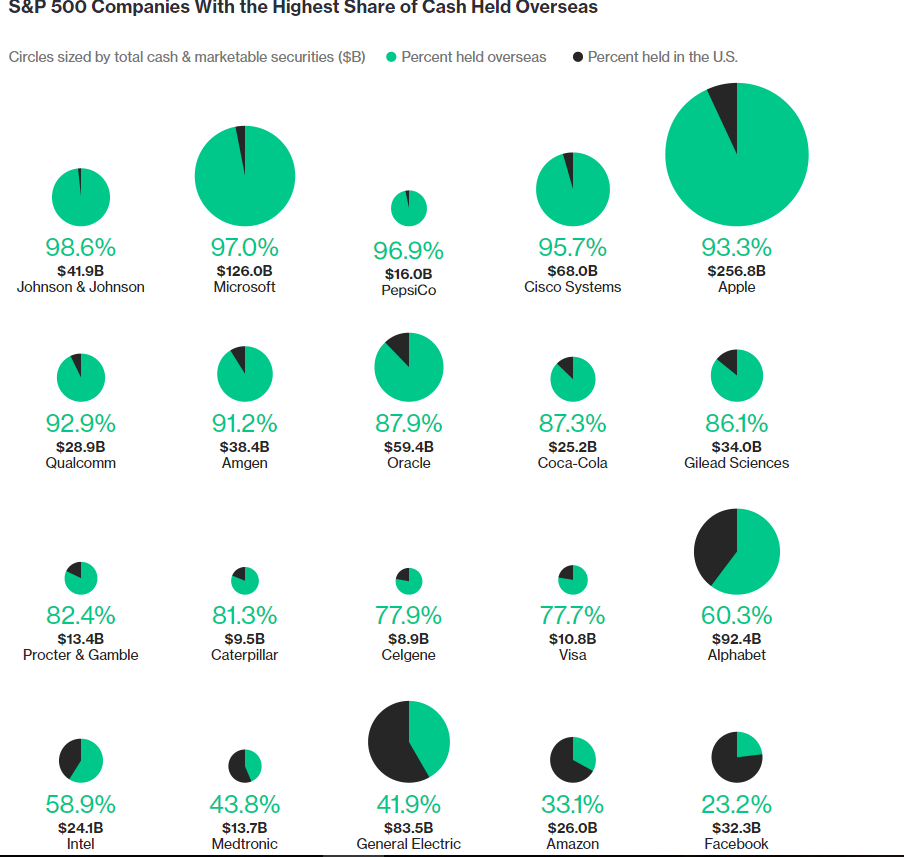
A list of large companies to benefit from tax repatriation

source: Bloomberg

GE has 41.9% of their cash overseas, how much they will bring back is unknown but I believe it will be substantial.

Tax Reform Passes!

In a month where stocks rallied on tax reform, GE has GONE NOWHERE.

Today it is testing a yearly low that equals the low in Dec. 2011. Where does it end? Not sure, maybe here. The tax selling is coming to an end and some deep pockets may be stepping in to buy these levels the last several days. I have been buying while knowing it may get a little cheaper.

Tax reform will benefit GE although their tax bill is minimal, repatriation and corporate structure going forward stand to give great benefit to the company. I estimate a minimum of $ 2 to $ 3 a share in value from the new tax structure, we will have to wait until experts confirm my thesis.

To be clear, in my opinion GE should have rallied on the announcement of 12K job cuts or the largest renewable energy deal in Thailand. The stock should have rallied on the 200 locomotive deal with Canadian National railway but it didn"t. It barely showed up in the news.

The art of the shakeout

This is a real phenomenon that is going on as we speak, One negative article after another calling for a frightening drop from the current level of down 45% on the year and years of turnaround.

Yesterday"s headline

Deutsche Bank analyst John Inch, who rates GE a Sell with a $ 15 price target. Says they could exit Baker Hughes.

Great, just great, John Inch of Deutsche Bank(NYSE:DB) puts a sell with a target of $ 15? Of course the stock can go to $ 15, any human with a stock chart could see that as a possibility. These type of comments are made all the time at multiyear lows, it does not mean it is going to happen.

Deutsche bank wants to buy GE on the cheap along with everyone else. So here is my take: They could sell Baker Hughes, or keep Baker Hughes and ride the rebound in oil that is coming this spring. I think they should keep it and make it work.

John Inch is a person working for Deutsche Bank, speculating to the downside with his own agenda. GE could trade to $ 15 or also trade to $ 20 next month, place your bets accordingly. Investors should consider using options to hedge the downside if needed.

Perspective from experts

One need look no further then one of my favorite calls by Goldman Sachs (NYSE:GS) a couple years ago calling on iron ore to stay at $ 35 to $ 40 for the next 5 years. Vale (NYSE:VALE) was trading at a multi year low around $ 2.30 a share then. It now trades around $ 12. Maybe Goldman will make the next downside call that marks the bottom for GE.

I was pounding the table when Bank of America, (one of my favorite stocks) (NYSE:BAC) was $ 12.50 in June of last year 2016, it now trades near $ 30. GE will be fine and those buying this level will likely see a 50% upside or more in the next 12 to 18 months. IT pays to ignore the doom and gloom and backward looking forecasting as we move into a new age of corporate and global growth.

In a world where Riot Block chain (RIOT) can rally from $ 6 in November to $ 45 in a month on a name (like dotcom) and no earnings gives me serious pause. RIOT down 50% in a few days by the way should tell you something. Stay away for now from bitcoin unless you are prepared to lose 50% to 98% or more of your money.

A look at the charts.


Here is a 10 year weekly to show the path of GE. Believe it or not I owned GE at $ 8.60 on the day the market bottomed in March of 2009. I bought the bankruptcy rumor that plunged the stock to $ 5.72 in a 30 minute period of time on fake news. It should have been investigated by the SEC, in my view it was straight up mayhem in action. That whole drop from $ 11 to $ 5.72 should have been eliminated from the stock chart and never happened, but it did.

The lesson: keep enough reserve to stay liquid in the event of a catastrophe. At a multi year bottom anything can happen.

One more intraday 60 minute chart showing a solid entry point if you believe in buying low and selling high.

Interested investors can see this intraday 60 minute snapshot of GE from early October which covered the earnings call miss and the November 13th conference call.

Important note: there was capitulation; the stock was bought by insiders, it then sold off on great economic news and tax reform that was not totally expected. The stock made a new low by $ .10 cents on the day tax reform passed, testing the will of those long the stock.

Look for more Insider purchases in the next 30 days.

I will be watching closely and keeping readers apprised of any new insider purchases in the coming weeks as more insiders step up to purchase shares. My last report on insider buying of GE showed the CEO of LOEWS buying 3 million shares on behalf of the company. Interested investors can read the full article by clicking here.

Conclusion

GE is in the dog house, down 45% on the year. The market has so far been ignoring many recent positive developments that would other wise cause a nice relief rally. Year end tax selling is pressuring the stock but I believe many are buying GE right now and not publicly talking about it.

In a world of news dominated by bitcoin and block chain, one could do a lot worse than putting some money to work in GE with a 12 to 24 month time horizon.

The 200 locomotive deal is a great win For GE, the Largest renewable energy order in Thailand is a positive and signal of more to come in SE Asia. All of these events are going unnoticed at the moment which is a good way to get a stock on sale.

At some point in the the near future the narrative will change and it will be all about global growth, and tax reform benefits to corporations. Until then buckle up and buy any weakness from here. The bottom may be in right now or there may be a little more pain but GE has some really exciting things going on including 3D printing that could be amazing for future growth.

I am a buyer of GE at this level and am excited about the digital revolution within the company. Flannery is making the right moves at the right time and it is my belief GE will turn the corner much quicker than the market is forecasting at year end.

As always, do your own research and always have an exit strategy in place before putting your hard earned dollars to work.

If you found this article interesting, please follow me and consider joining my site Bargain Hunter for my timely trade ideas in real time.

Disclosure: I am/we are long GE,CHK,LYG, BP,NBR.

I wrote this article myself, and it expresses my own opinions. I am not receiving compensation for it (other than from Seeking Alpha). I have no business relationship with any company whose stock is mentioned in this article.


Tech