Apple’s shares were down almost $ 2, or 0.9% on Friday to $ 191.70 while the NASDAQ was up 10 or 0.14%. At the low point, the company’s shares were down almost $ 4 or 1.9%. The main driver for the stock’s weakness was a report from Nikkei Asian Review that the company would order 20% fewer new iPhones to be built vs. last years 100 million iPhone 8, 8 Plus and X orders.
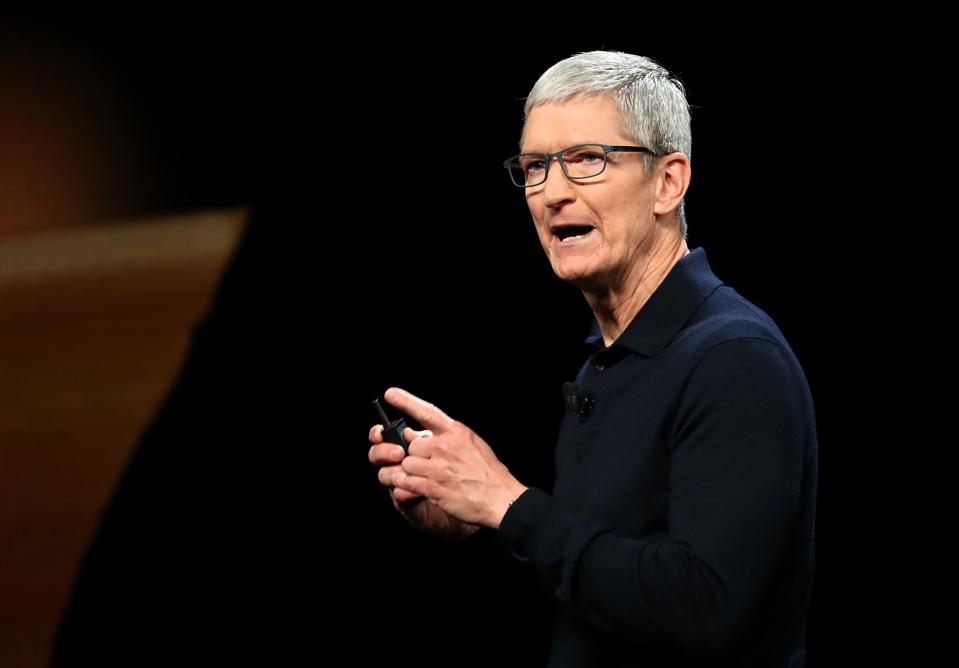
Apple CEO Tim Cook speaks during the 2018 Apple Worldwide Developer Conference (WWDC). Photo by Justin Sullivan/Getty Images
The report from Nikkei says “For the three new models specifically, the total planned capacity could be up to 20% fewer than last year"s orders" and “The U.S. company last year placed orders to prepare for production of up to 100 million units of the new iPhone 8, iPhone 8 Plus and iPhone X, but this year Apple currently expects total shipments of only 80 million units for new models, two people said.”
There are a few unknowns from the report, which could make for an apples to oranges comparison.
- Does the order timeframe match the same months as last years?
- Does the 80 million match what was initially ordered for the 8, 8 Plus and X (which was reported to be decreased) or the final tally?
- The report also says “could be up to 20%”
There are a few reasons to be skeptical of this report .
- Over the years many production cut rumors have turned out to be false
- Earlier this year there were multiple reports, including from Nikkei, that the production for the iPhone X had been cut, which turned out to be incorrect or misleading to Apple’s results
- Depending on what new models are introduced, demand for older models including the 8, 8 Plus and especially the X could still be strong enough to make up for what is being implied as lower total sales
I don’t believe Nikkei has the best track record scooping Apple’s iPhone production and eventual sales . It was just on January 30 this year, two days before the company announced its December quarter results, that it predicted that iPhone X production would be cut by half for the March quarter.
When Apple announced its December quarter results the iPhone inventory levels were at the low-end of its 5 to 7 weeks target, and the March quarter revenue guidance of $ 60 to $ 62 billion bracketed the $ 61 billion estimate. The stock initially fell but after a week rallied and climbed above the price when Nikkei came out with its article.
Add to that Tim Cook saying the X had been the best selling iPhone “each and every week in the March quarter, just as they did following its launch in the December quarter.” These didn’t match well with an iPhone X cut.
All new iPhone models could be available in September
The Nikkei report included “Apple"s supply chain was told to prepare earlier for the two OLED models, in hopes of avoiding a delay similar to last year"s, two industry sources said.”
This actually makes sense. I’m not surprised that the iPhone X’s availability was later than the 8’s due to incorporating an OLED screen. Just because the iPhone’s cadence has essentially been every 12 months doesn’t mean that production systems can meet that timeframe when new technology is introduced. Now that Apple’s production partners have experience with manufacturing tens of millions of OLED iPhones, moving to the next version shouldn’t be as challenging.
Tim Cook’s warning
Even back in 2013, Tim Cook warned investors about putting too much credence into supply chain checks. On the January 2013 financial results conference call, he said, “I suggest its good to question the accuracy of any kind of rumor about build plans. Even if a particular data point were factual, it would be impossible to interpret that data point as to what it meant to our business. The supply chain is very complex and we have multiple sources for things. Yields can vary, supplier performance can vary. There is an inordinate long list of things that can make any single data point not a great proxy for what is going on.”
StockCharts.com
3 year Apple stock chart
Tech
