Thomas Paine, the English-born revolutionary who became one of the founding fathers, like many today, had a different response to the idea that "great minds think alike;" that is, "No, they don"t". He expressed that opinion in the 1792 political pamphlet The Rights of Man, edition 2:
I do not believe that any two men, on what are called doctrinal points, think alike who think at all. It is only those who have not thought that appear to agree.”
So maybe the title for my article today is a tad misleading, and perhaps I should have used this version,
These REIT Investors Think Alike”
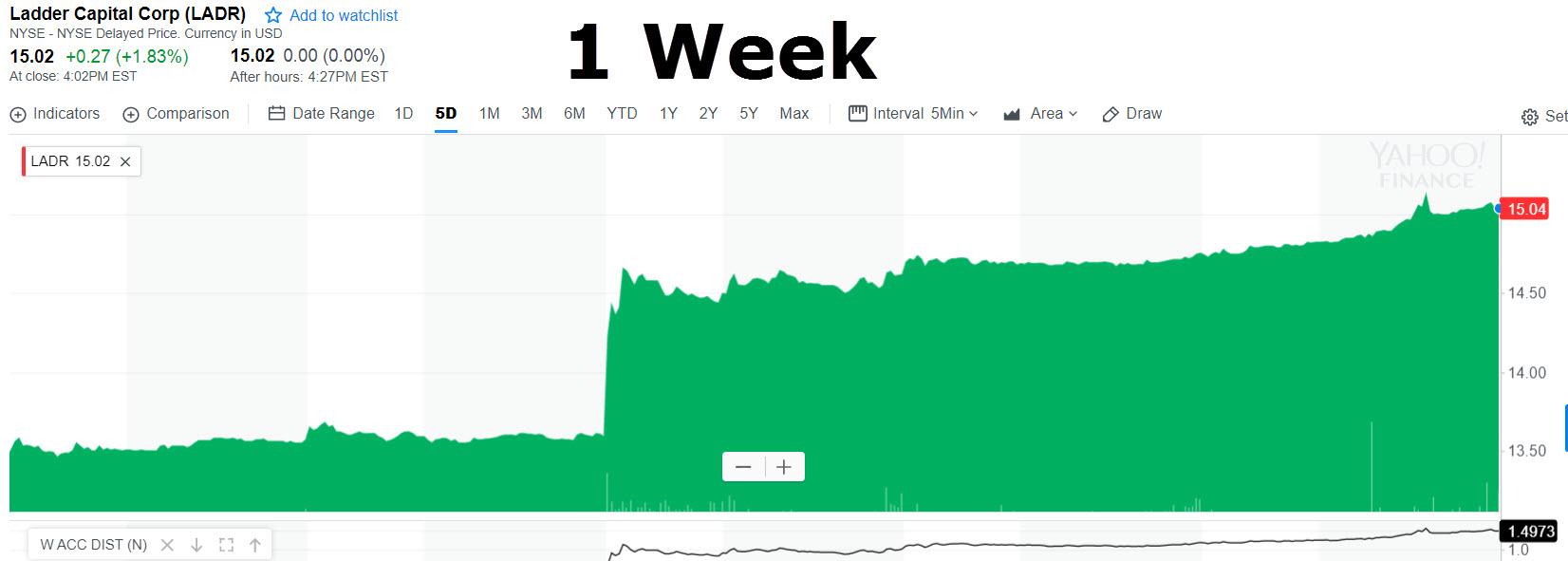
Of course I am referring to the recent news that Ladder Capital (LADR) has received an unsolicited non-binding proposal letter from Related Fund Management, LLC, proposing to acquire all of the outstanding shares of Ladder for $15 per share through a two-step tender offer and merger process, subject to certain conditions.
As you may recall, I have been covering LADR for quite some time and back in March 2017 I explained the Ladder and Related’s “strategic" investment in which Related purchased $80 million of LADR stock from certain pre-IPO shareholders, including affiliates of TowerBrook Capital Partners and GI Partners.” At the time I wrote,
Related’s investment should provide LADR with much needed float and further diversify the base of shareholders in the commercial mortgage REIT. I am particularly happy to see Related make this investment, given the company’s deep experience in commercial real estate and success as a global luxury residential, retail, and mixed-use developer.”
I added,
I guess Ladder is no longer the “best kept secret” in New York City, at least as far as REIT investors are concerned. Related’s investment in the internally-managed commercial mortgage REIT should elevate the status of the REIT while also adding a new Board member with tactical alignment of interest.”
As stated, Related paid $14.00 per share (around $80 million) and at the time of the announcement, Justin Metz, Managing Principal of Related Fund Management, said:
Ladder’s strong and seasoned management team operates a disciplined and differentiated mortgage-focused lending platform and we believe the Company is undervalued by the public marketplace. The ability to acquire a significant stake, as well as join the Board, makes this investment an ideal fit for Related Fund Management and we look forward to a long-term partnership with Ladder.”
Jeff Blau, CEO of Related Companies, said:
Ladder’s core earnings have been positive each quarter since their inception and they have never had a credit loss. We saw a strategic investment opportunity because we believe that the Company’s reported depreciated book value is a conservative representation of Ladder’s actual value.”
Of course, I agree with the sentiment, Ladder does have “strong and seasoned management” and the company is “undervalued by the public marketplace” and “earnings have been positive each quarter since the inception.” So REIT Investors do think alike, except…
Related Hoping To Buy Its Own Piggybank
I"m not a big fan of externally managed REITs, but I do own a few, namely Blackstone Mortgage (NYSE:BXMT), Starwood Property Trust (NYSE:STWD), and Preferred Apartment Communities (NYSE:APTS).
I dumped New Senior (SNR) recently - see my latest article here.
Whether internal or externally advised, governance is essential for REIT performance, and the only reason I own these externally managed REITs is because I believe they have a strong commitment to corporate governance. In addition, there are other benefits of external management.
An external manager has larger scale than the individual REIT, so it can provide services at a more economical cost than managing the REIT internally. With regard to management succession, externally managed REITs have a broader set of employees from which to select senior executives, thereby broadening the skills and experiences available to the REIT.
When external manager service agreements are specific and outline strict performance criteria, boards of REITs are better placed to oversee the manager"s performance (Source: Moody"s).
My biggest issue with externally managed REITs, however, is the influence that the manager has over the REIT to further his or her interests over those of the REIT"s shareholders. External management representation on boards limits the board"s capacity to independently oversee the external manager, and this often puts the manager in a highly conflicting role.
I like the fact that Ladder"s management and directors own $189 million of equity in the company (around 11.8%), a validation that there is a strong alignment of shareholder interests.
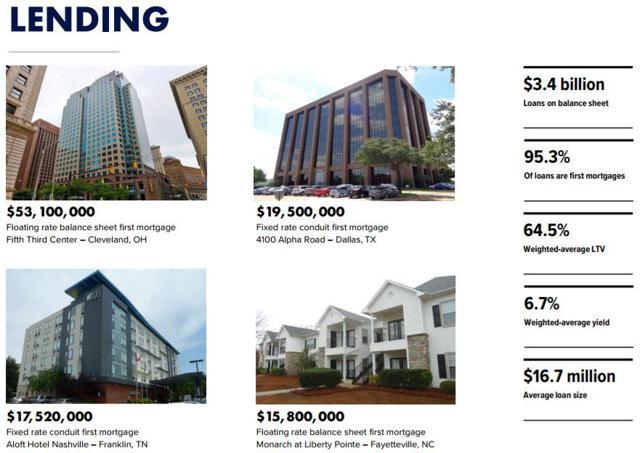
All of the other commercial mortgage REITs are externally managed. However, Ladder has intentionally chosen to be highly aligned with shareholders so the company can focus on the middle‐market, an average loan size of $17 million. This provides Ladder with more diversity and the opportunity for higher margins than the now crowded $100 million+ loan market.
A growing number of REITs are joining other institutional investment players in providing financing to CRE (commercial real estate) borrowers by originating mortgage loans as an alternative investment choice.
The trend is most evident in the public REIT arena, where several new companies focused on commercial real estate financing have held IPOs this year, including the three largest: KKR Real Estate Finance Trust Inc. (KREF) raising $242 million, Granite Point Mortgage Trust, Inc. (GPMT) raising $224 million, and TPG RE Finance Trust (TRTX) raising $212 million.
Recently, Colony NorthStar (CLNS) announced plans to roll up a portfolio of investments together with those of affiliates NorthStar Real Estate Income Trust and NorthStar Real Estate Income II, a pair of public, non-traded REITs, to form a new commercial real estate finance REIT.

One of the attractions with Ladder is the fact that this commercial mortgage REIT is internally managed. This means that Related is hoping to buy the Ladder piggy bank, including the experienced management team.
Since the initial $80 million investment, Related has been accumulating more shares via block trades and in the recent 13D filing Ladder has stated its intention to buy all shares outstanding (for $15.00), including the management team. I reached out to Related’s management team and there was no reply, but if you take a look at Related’s website you can see that the company has a well-developed equity shop, but no significant exposure on the debt side.

Inside Ladder
Ladder Capital is a diversified commercial real estate company that was formed in 2008 and went public in 2014 (as a C-Corp). The company"s primary business strategy is to originate and securitize first mortgage loans on stabilized, income-producing, commercial real estate properties. LADR is one of the largest non-bank contributors of loans to CMBS securitizations in the U.S.
However, LADR has a unique model in which the company does not rely exclusively on securitization for its revenue and has other diversified sources of revenue, including earning a significant portion of its revenue from first mortgage balance sheet loans and property rentals as well as expanding its market share in the commercial mortgage loan origination market.
In 2014, LADR commenced the necessary steps to convert from a C-Corp into a REIT structure, and during the first quarter of 2015, the company received shareholder approval to convert to a REIT (On March 2, 2015, LADR said that shareholders had approved the plan to restructure as a REIT).
LADR has maintained a disciplined credit culture throughout the organization with zero credit losses since inception. The company operates as an internally-managed REIT (the other peers referenced are externally managed) that originated first mortgages secured by commercial real estate and invests in commercial properties and highly-rated CMBS (commercial mortgage-backed securities).
LADR has stable and diverse income streams from Commercial Real Estate; the company"s tactical approach to the mREIT sector is rooted in the flexible manner in which it can interact in periods of change. The company has three main business lines - lending, investment‐grade rated securities, and real estate equity (mostly net lease) - adding up to over $6 billion of assets. This multi‐cylinder approach is inherently safer than a mono‐line approach and better able to produce profits through cycles and a wide range of market conditions.
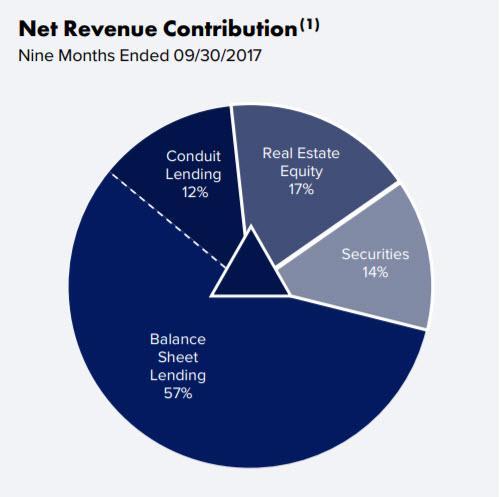
As you can see, the "dark blue" shaded slices represent the lending segment, the "light blue" shaded slices represent owned real estate, and the "gray" shaded slices represent CRE securities.
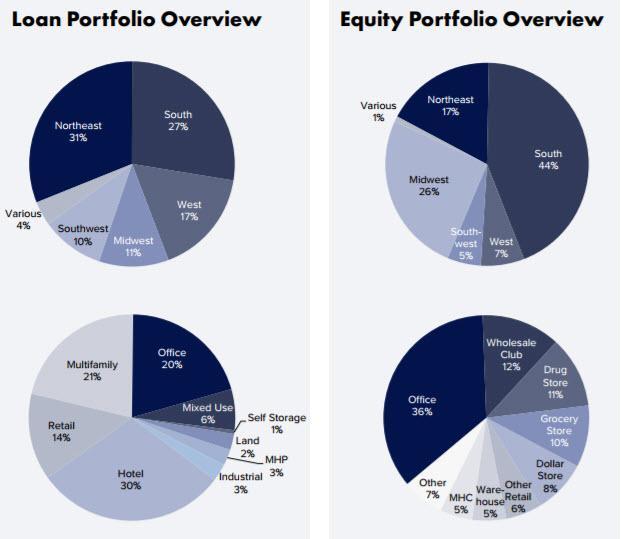
As illustrated below, LADR invests in predominantly Senior Secured Asset Base of Commercial Real Estate-Related Investments and the portfolio is diversified geographically and across property sectors.
The Lending Segment
LADR"s Senior Secured Balance Sheet business represents around 57% of revenue and this business is similar to Blackstone Mortgage Trust and Starwood Property Trust. Generally, LADR"s loans are for 2-5-year terms.
In the third quarter, LADR originated $630 million of loans comprised of $307 million of floating rate bridge loans and $323 million of loans with the intent to securitize. The portfolio of balance sheet loans grew to over $2.8 billion at the end of the quarter.
With growth in LADR"s bridge loan portfolio and favorable market conditions, the company decided to execute its first CLO (collateralized loan obligation) in October. LADR contributed $457 million of bridge loans at an advanced rate of 81.5% and then all-in net cost of fund assuming no credit losses of LIBOR plus 192 to 232 basis points depending on the timing of pay-offs and expansions.
LADR retained an $85 million interest in the CLO, which allows the company to continue to provide optimal service to borrowers by maintaining control over the special servicer and major decisions on the loans.
LADR"s expected return on the retained position, assuming no credit losses, is 15.5% to 19.5%, again depending on the timing of pay-off and expansions. The transaction allowed LADR to further diversify its funding base with additional non-recourse, non-mark to market, match term-funding source from CLO debt investors, while also increasing liquidity by almost $100 million.
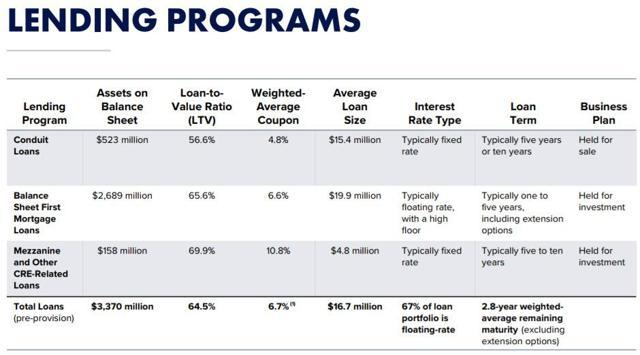
The lending business is an important driver of returns for Ladder. It can be a little inconsistent in any quarter or two but when looked at over the longer time horizon, it is a very attractive business line. LADR is experiencing an active fourth quarter for loan closings; in the month of October, the company closed $589 million of loans, including $215 million intended to hold on balance sheet.
The Securities Segment
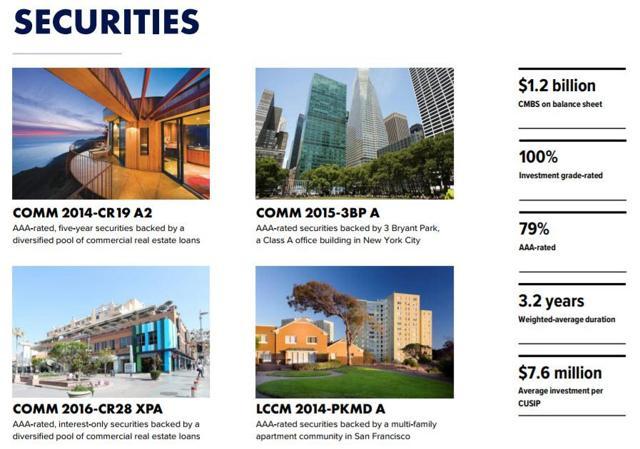
The CMBS business is the "bread and butter" for LADR and represents around 14% of revenue and almost all of LADR"s CMBS product is investment grade (focused on senior secured). LADR takes advantage of market disruptions - when it"s hard to lend, LADR invests in CMBS.
LADR contributed $431 million of loans into three CMBS securitizations in the fourth quarter, and the company expects to participate in additional transactions through year end. The results of the CMBS securitizations will be reflected as gains on sales in the fourth quarter.
LADR"s portfolio of CMBS and U.S. agency securities investment has decreased by approximately $1.5 billion over the course of the past 12 months. And it stood at $1.2 billion at the end of the third quarter as LADR continues to reallocate equity capital toward attractive balance sheet loan and real estate equity investments.
Given the flatness of the yield curve and the preference by the Fed to raise short-term interest rates, LADR expects to rely less and less on the securities portfolio for earnings.
Real Estate Segment
The final leg to the stool is Ladder"s equity platform - representing around 17% of revenue.
Around 50% of the equity investments are Net Lease properties representing around 3.6 million square feet. LADR owns 22 free-standing Walgreens (NASDAQ:WBA) and 7 Hy-Vee grocery stores. In addition, LADR owns several office buildings and several condo deals in Las Vegas.
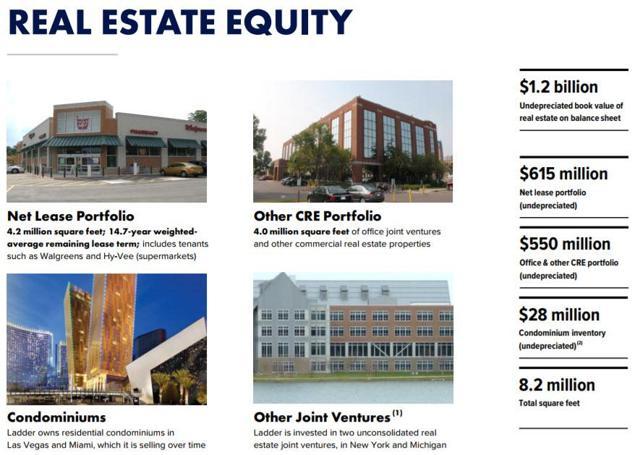
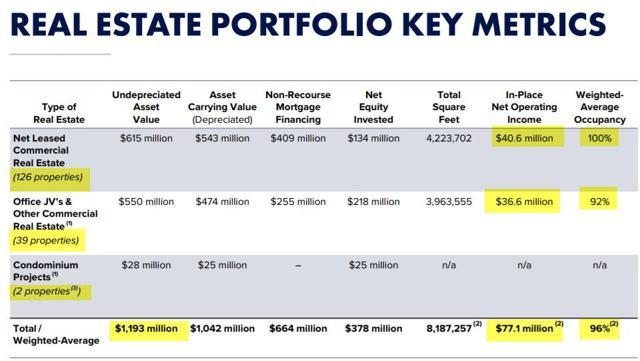
LADR likes the net lease and other real estate equity portfolio for the long and predictable cash flow it"s been producing as a key part of the company"s core loans & leases portfolio. LADR has over $1.1 billion of undepreciated book value invested in direct real estate equity with nearly 8 million square feet of holdings.
Of that, around $613 million is invested in 125 net leased properties with an average remaining lease term of over 14 years. LADR focuses on long leases, solid real estate fundamentals, and strong credits in defensive, necessity‐based industries. These assets are financed with long-term, typically 10‐year, fixed-rate non‐recourse mortgage financing.
Investments based on long-term leases which are structured to benefit from inflation, combined with long-term fixed rate financing, create durable recurring cash flows from inflation‐protected investments. LADR has over $378 million of equity invested in this segment, and the company continues to believe this is an underappreciated component of holdings with embedded value in excess of book.
So Why the REIT Structure?
As referenced above, LADR converted to a REIT and the structural benefits allow the company more efficiency of capital flow. Accordingly, the REIT structure appears to fit more squarely (no pun intended as it relates to the triangle) into LADR"s business model, given the compelling profits and enhanced potential for growth (in normalized book value).
What makes LADR uniquely positioned (in my opinion) is the fact that the company is able to consistently generate industry-leading ROE that is the result of a solid base of REIT earnings. Here"s a snapshot of LADR"s balance sheet that includes assets predominantly held for investment:
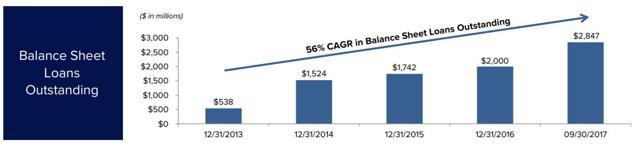
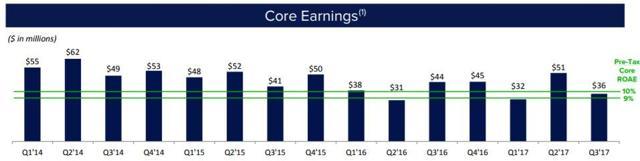
What makes LADR unique is the solid baseline REIT ROE plus potential TRS upside. LADR"s core earnings in Q3-17 were $35.6 million. This amount compares to $44.5 million in the same quarter of 2016. Core earnings in the first nine months of 2017 were $118.4 million compared to $113.6 million for the first three quarters of the prior year.
Core EPS for Q3-17 was $0.35 compared to $0.40 for the same quarter last year. Core EPS for the first nine months of 2017 was $1.08 compared to $1.10 earned in the comparable period in 2016.
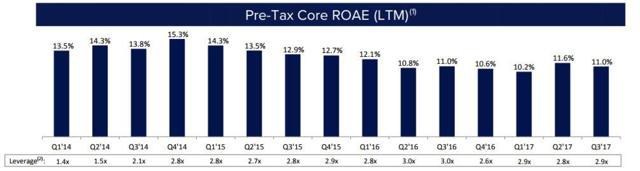
On an after-tax core basis, LADR generated 10.5% return on average equity during Q3-17 and a 10.7% return over the first nine months of 2017. This is based on an average equity balance, excluding non-controlling interest of consolidated JVs, of approximately $1.5 billion.
During Q3-17 LADR"s core earnings were primarily derived from net interest income generated by securities and held for investment loan portfolios and net rental income from the real estate portfolio. These lines of business generated recurring income in excess of LADR"s total corporate expenses.
Compared with the select peer group, LADR"s REIT structure optimizes after-tax earnings, paving the way for strong ROE combined with meaningful cash dividends. LADR minimizes reliance on access to capital markets and facilitates "offensive" capital deployment. While the dividend is well covered, LADR"s capital recycling business drives attractive ROE and book value growth.
The Balance Sheet
In terms of key balance sheet metrics, Ladder"s balance sheet statistics are in line with historical results, 96.5% of the company"s debt investments were senior secured, including first mortgage loans and commercial mortgage-backed securities secured by first mortgage loans, which is consistent with the senior secured focus of the company.
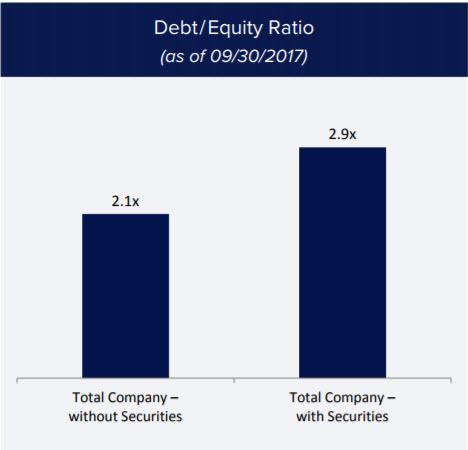
Senior secured assets plus cash comprise 76% of the total asset base. Excluding loans transferred but not sold to GAAP, LADR ended the quarter with total assets of $5.8 billion and total equity of $1.5 billion. The core debt to equity ratio increased slightly during the quarter to 2.9:1.
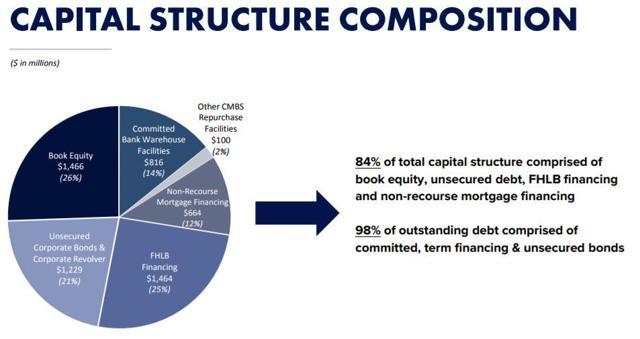
Total unencumbered assets, including cash, were $1.6 billion at quarter end. The quarter-over-quarter increase on encumbered assets exceeded the increase in unsecured, which now includes the new issued $400 million of corporate bonds, bringing the unencumbered assets to unsecured debt ratio to 1.39:1.
The average coupon on loans held for sale originated in the third quarter was 4.55%, while the average coupon on loans held for investment originated during the quarter reflected a weighted average spread of approximately 5.95% over one-month LIBOR. The weighted average loan to value ratio of the commercial real estate loans on the balance sheet at quarter end was approximately 64.4%, which is in line with the weighted average LTVs in recent quarters.
LADR continues to enhance the maturity profile, while maintaining a diverse set of funding sources. At Q3-17, LADR had $4.3 billion of core debt outstanding and committed financing ability of over $1.9 billion for additional investments. The FHLB borrowing stood at $1.46 billion at the end of the quarter.
Finally, during the quarter, Moody"s Investors Service revised its outlook for LADR"s ratings to positive from stable and S&P Global ratings raised its long-term issuer credit rating to BB from BB-. At the same time, S&P raised the ratings on LADR"s senior unsecured notes to BB- from B+.
LADR intends to continue to strengthen the core financial foundation of the firm by emphasizing the addition of more committed funding that is longer term, unsecured or secured, but non-recourse.
Great Minds Think ‘Somewhat’ Alike
As you see, Ladder is executing on all cylinders and I give credit to the senior management team that has an average of 28 years of commercial real estate finance.
When I reflect on Related Companies $15.00 per share offer (non-binding) you can see that it is clearly undervalued. This is what Related said last March 2017,
…we believe the Company is undervalued by the public marketplace.”
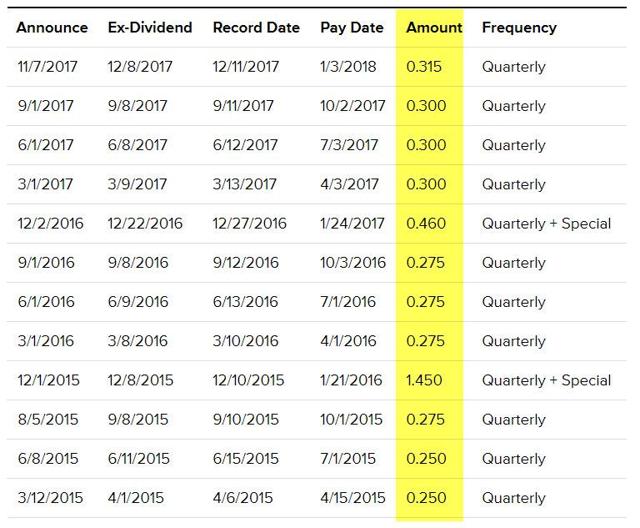
Not only is Ladder undervalued, the company has maintained an exceptional job at growing its dividend – increasing the dividend by ~26% since the beginning of 2015 (~9% annual dividend growth).
LADR has consistently delivered industry‐leading levels of ROE with senior secured assets and moderate leverage. The strength of the operation is the multi‐cylinder approach in which LADR has successfully navigated many market cycles.
Most importantly, LADR has strong alignment of interest with shareholders, including the highest internal ownership amongst the larger REITs in the sector, and the company’s keen focus on credit underwriting has helped this REIT steer clear of pitfalls that have befallen other less disciplined operations in the past.
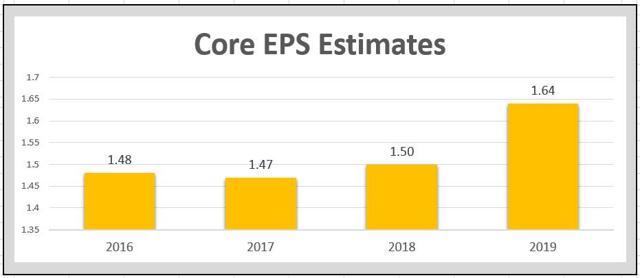
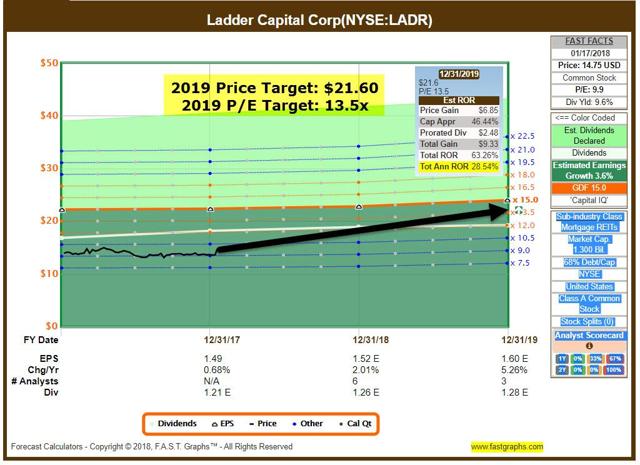
Using F.A.S.T. Graph estimates, it appears that LADR will continue growing core earnings.
In December I upgraded LADR from a Buy to a Strong Buy. I explained,
LADR"s cost of capital is as good as or better than most of the peers and this validates the fact that LADR has great flexibility and match‐funding that positions the company well to seize on opportunities that arise (regardless of market conditions)…high inside ownership fosters a strong alignment of interests with shareholders ‐ at over 11% or approximately $175 million. So absolutely: Management Does Matter, Here"s Why I Love Ladder”
So yes, REIT investors do think alike, but Related needs to take a closer look at the value of the management team, as well as the value that can be unlocked in the owned portfolio. Recognizing that the 13D filing is intended to enhance discovery, hopefully this article provides clear evidence that the “true value” behind Ladder is the management team. If you’re going to buy a bank, you must also buy the experienced bankers.
Note: Brad Thomas is a Wall Street writer, and that means he is not always right with his predictions or recommendations. That also applies to his grammar. Please excuse any typos, and be assured that he will do his best to correct any errors if they are overlooked.
Finally, this article is free and the sole purpose for writing it is to assist with research, while also providing a forum for second-level thinking. If you have not followed him, please take five seconds and click his name above (top of the page).
Source: F.A.S.T. Graphs and LADR Filings.
In a few weeks we plan to publish (exclusively for Marketplace subscribers) all of our property sector data weekly, including our recommendations and highly sought-after Rhino REIT Ratings.
REITs should be part of your daily diet and we would like to help you construct an Intelligent REIT portfolio, utilizing our portfolio modeling strategies.
The Intelligent REIT Investor is the #1 REIT Research site on Seeking Alpha. Brad Thomas and Rubicon Associates have a combined 40 years of investing experience. We publish exclusive research content on over 100 REITs, and our Durable Income Portfolio has returned over 12% YTD. We recently announced that the Small Cap REIT Portfolio has returned over 20% YTD.
Our service includes weekly property sector updates and weekly BUY/SELL picks. We provide most all research to marketplace subscribers and we also provide a “weekender” report and a “motivational Monday” report. We stream relevant real-time REIT news so that you can stay informed.
There is absolutely no reason to chase yield... let us do all of the heavy-lifting so you can "sleep well at night." Subscribe here
Disclosure: I am/we are long ACC, APTS, ARI, BRX, BXMT, CCI, CHCT, CIO, CLDT, CONE, CORR, CUBE, DDR, DEA, DLR, DOC, EPR, EXR, FPI, FRT, GEO, GMRE, GPT, HASI, HTA, IRET, IRM, JCAP, KIM, LADR, LAND, LMRK, LTC, MNR, NXRT, O, OFC, OHI, OUT, PEB, PEI, PK, QTS, REG, RHP, ROIC, SKT, SPG, STAG, STOR, STWD, TCO, UBA, UMH, UNIT, VER, VTR, WPC.
I wrote this article myself, and it expresses my own opinions. I am not receiving compensation for it (other than from Seeking Alpha). I have no business relationship with any company whose stock is mentioned in this article.

No comments:
Post a Comment