The question arises as to how many Southern backlog additions will equal one Trans Mountain Pipeline Expansion Project for Kinder Morgan (KMI). There had been some comments about the lack of Southern projects in the backlog.
"Kinder Morgan Texas Pipeline LLC (KMTP), a subsidiary of Kinder Morgan, Inc. (NYSE: KMI), DCP Midstream, LP (NYSE: DCP) (DCP Midstream) and an affiliate of Targa Resources Corp. (NYSE: TRGP) (Targa) today announced a final investment decision to proceed with the Gulf Coast Express Pipeline Project (GCX Project) after having executed definitive joint venture agreements and having secured sufficient firm transportation agreements with shippers."
The December 21, 2017, press release announced a very significant addition to the project inventory. This project is expected to be online in less than two years. That includes the permitting process.
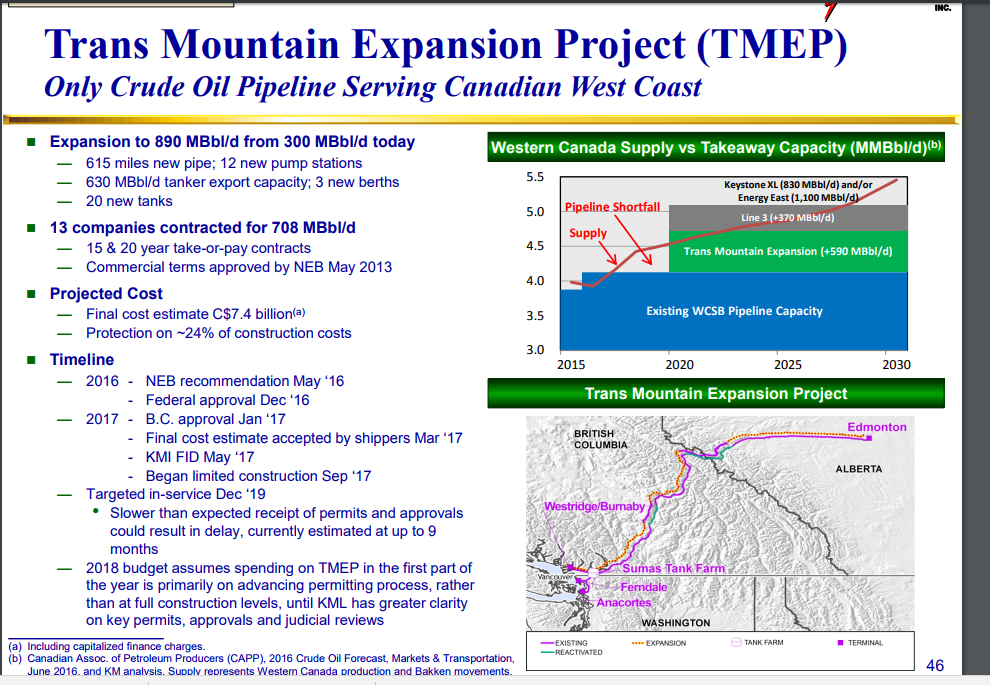
Contrast this to the TMP project.
Source: Kinder Morgan December 6, 2017, Investor Presentation
This project is now facing probable delays due to the lack of receipt of some key permits. The project has already been part of the backlog for sometime. Kinder Morgan Canada is now responsible for much of the construction costs. But the planning, the court disputes, and the backlog potential have occupied center stage for quite some time. It may be 2020 or longer before this major project becomes operational.
In that time period many Gulf Coast Express Pipeline Projects can be planned and completed. Intrastate projects, especially when they are in a business friendly state, require far less time than does a big project like TMEP. Maybe the opposition cannot cancel the project, but the delays can be costly and change the profitability of the project. Yet the market pays far more attention to the TMEP.
Kinder Morgan management is not sitting still though.
"Generate $2.05 DCF per share and $7.5 billion of Adjusted EBITDA, up 3 percent and 4.5 percent, respectively, compared to 2017, primarily due to projects placed into service during 2017 and 2018. Generating that level of DCF, after covering the planned 2018 dividend and budgeted discretionary spend (both discussed below) will leave in excess of $500 million to invest in additional high return projects or to repurchase shares."
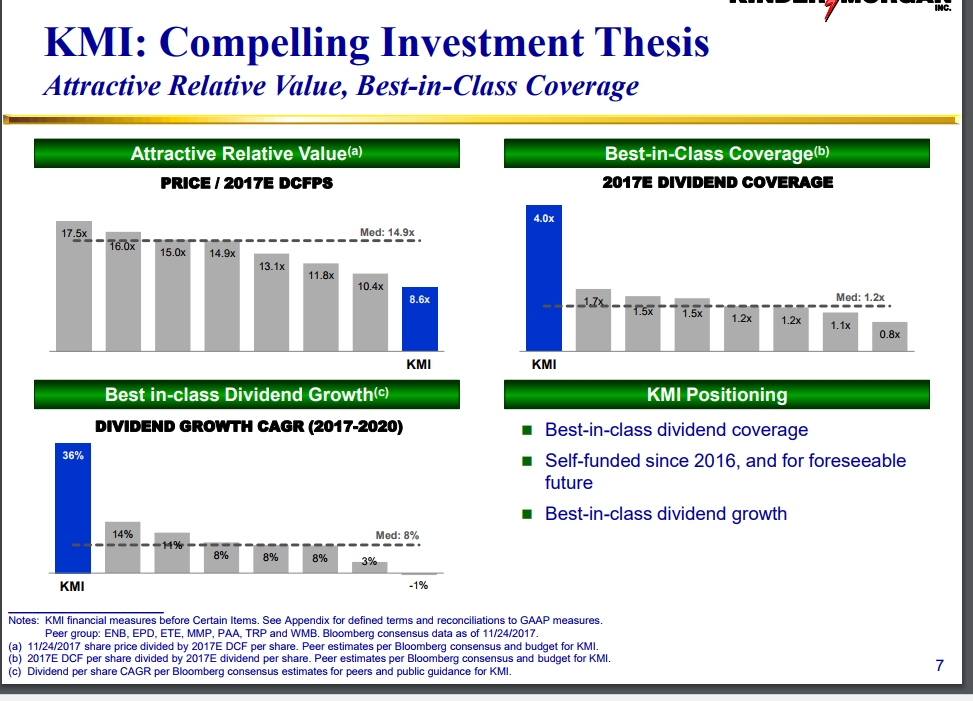
The December 4, 2017 press release may have surprised the market somewhat because management will begin the share repurchase program in December. The share repurchase program could repurchase about 5% of the outstanding shares. If that were to happen, then the EBITDA would rise about 8% per share instead of the 3% shown above with the lower shares outstanding. When combined with the increased dividend next year the total return exceeds 12% at current stock price levels. Kinder Morgan is growing again. This stock has been so thoroughly punished that further price decreases are highly unlikely. The returns in the future are much more likely to be positive.
Source: Kinder Morgan December 6, 2017, Investor Presentation
Ironically, the comparison is not nearly as important as the plans demonstrated by the slide. Management appears to have budgeted dividend growth of roughly 10% per year. The announcement, of course has already been made of some very specific plans. More specifically, those shareholders that have waited for a distribution recovery now have a very definite signal that the recovery is in the works.
The top right-hand side of the slide shows that the money for the old payout has always been there. The distribution was not cut because business was terrible. Instead the distribution was cut to decrease debt levels in relation to cash flow. A wild card would be the relaxation of the debt markets to pre-commodity price crash levels. Should that happen and management decides to go back to higher leverage levels, then recovery of the distribution could happen faster.
On the other hand, self-funding of projects leads to the compound increase of income EBITDA, and future dividend increases. The income may be lower at the present time, but as these new projects take effect, income grows faster because of self funding. That increasing growth would be reflected in future dividend increases. Therefore, the long term outlook for future distribution increases is better with self-funding. It is very possible that a long term significant level of self-funding would treat shareholders much better in the future than the old model because earnings per share would grow faster without the periodic share sales to fund growth.
Source: Kinder Morgan December 6, 2017, Investor Presentation
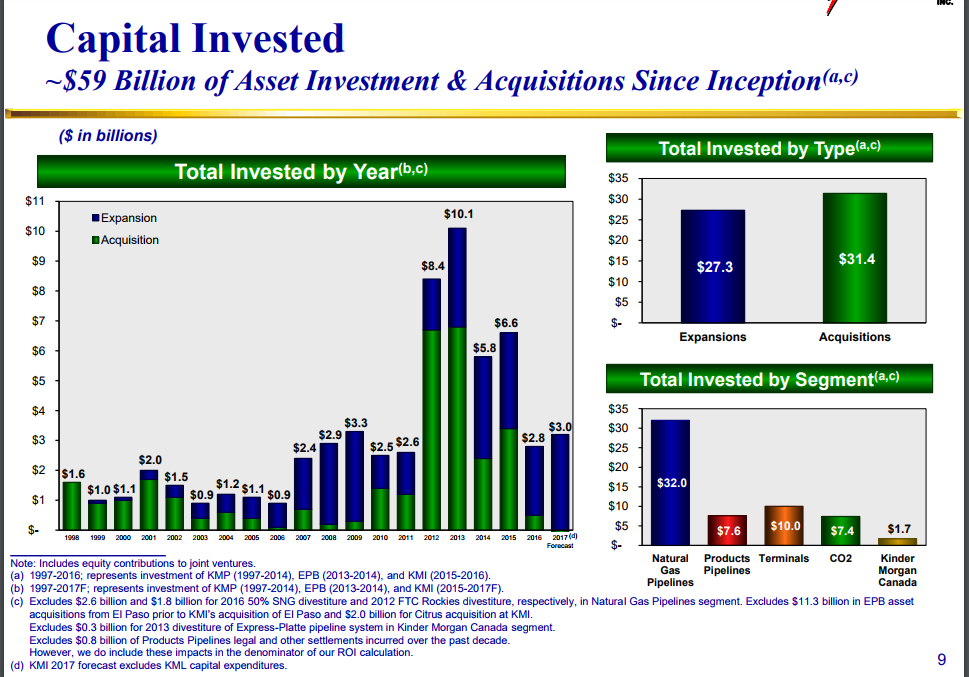
One of the things clearly missing in most long term forecasts is the very significant history of acquisitions. This company traditionally makes acquisitions every year (as shown above). Investors need to expect a return to that pattern in the near future. Most likely those acquisitions will be accretive. A pattern of successful small acquisitions could easily add a couple of percentage points to the annual growth rate.
"
Source: Kinder Morgan December 6, 2017, Investor Presentation
Another thing not budgeted is the recovery of some markets served such as the carbon dioxide division. Kinder Morgan has a lot of fee based and take-or-pay contracts. But what little bit does fluctuate appears set to recover from the big commodity price decline a few years back. That recovery will probably add a couple more percentage points to the immediate return from current profitability levels. Mr. Market has assumed that business will remain at previously depressed levels. So the stock has been punished accordingly. Kinder Morgan is extremely well placed for a recovery of the carbon dioxide market.
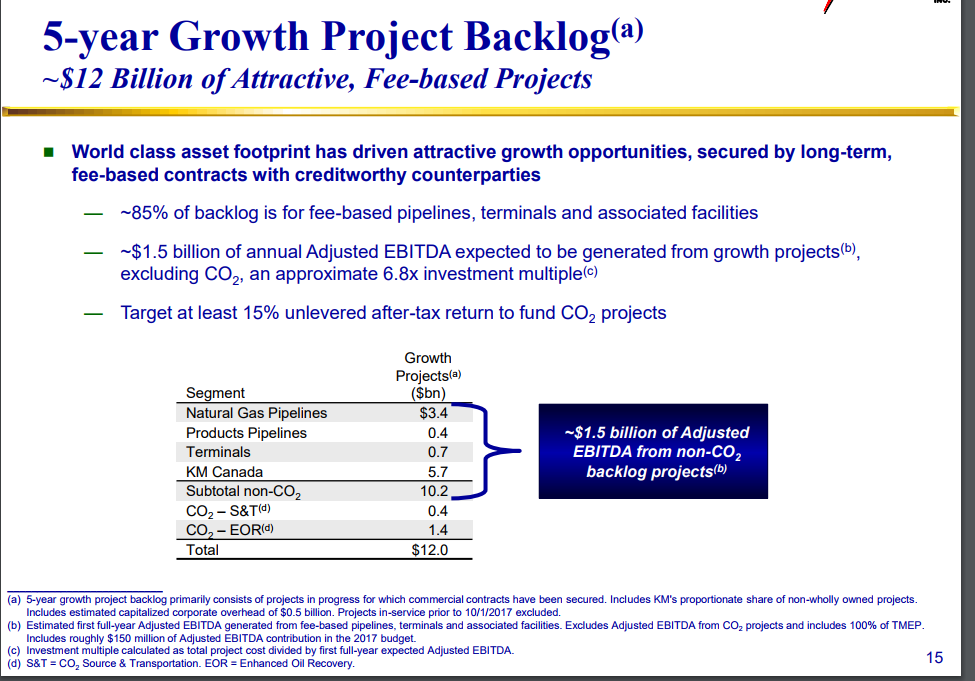
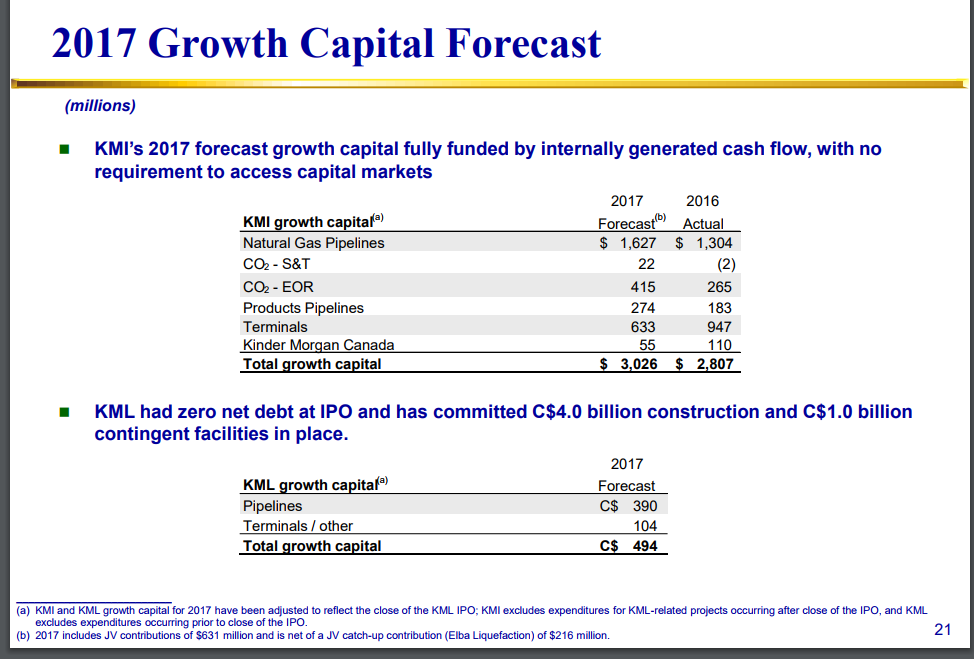
The other very big deal is the lack of exposure to the TMEP project as shown above. The way the market reacts to every last TMEP court battle and newspaper headline, one would think there were billions at stake. As shown above, the budget for KML is fairly modest at the current time. If the worst nightmare were to happen and the TMEP was cancelled it would affect KML greatly.
But KML has an enterprise value of less than 10% of the parent company. A full 10% reduction in value would hurt the parent company, but it would not be fatal. Kinder Morgan Canada would probably have some residual value without the TMEP project and would have the ability to grow through other projects in the future. So the full 10% reduction is unlikely. Kinder Morgan stock is currently so depressed, that cancellation of the TMEP project is really unlikely to affect the stock significantly. The market is simply too worried about a dire as well as unlikely outcome.
Source: Kinder Morgan December 6, 2017, Investor Presentation
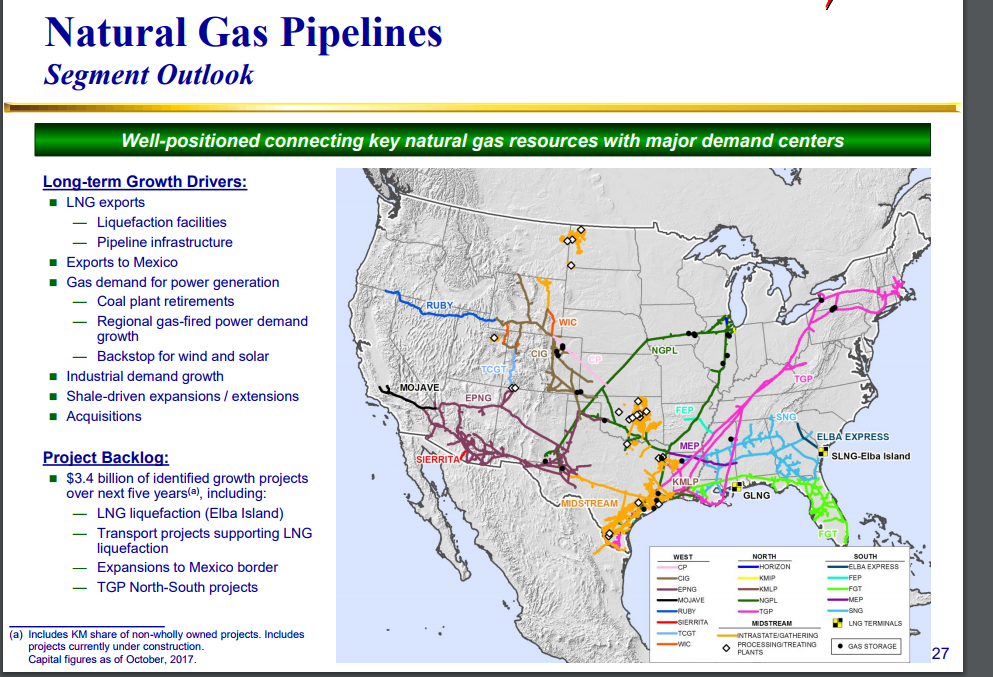
Instead the market needs to focus on all that potential exposure to the Permian as well as Mexican business. This company has exposure to many rapidly growing areas. Notice the company has facilities located near the growing Scoop and Stack area too. Each individual project to adjust to the shifting demand patterns may not be as big as the TMEP project. But together they will most likely far outweigh the importance of the TMEP project.
So while the market worries about the outcome of the TMEP. Investors may want to notice management doing a share repurchase program that starts now. Management is buying back shares at a very depressed price. That may benefit shareholders more than any large project. Management is also exploring more growth projects like the one announced at the beginning of the article. Should TMEP be cancelled, then there is more money for more of the other projects not yet in the backlog.
The new dividend rate of $.20 per share each quarter begins soon. Shareholders already know the plans to increase the distribution in the near future. Management is signaling as loud as it can that the stock is cheap.
The fact is that the large part of the business is very predictable. Many expansion and growth projects are done on time and at budget. One highly publicized project is not going to make or break this company. Even more importantly, the company already has the mandatory permits and permission needed for the TMEP project. Realistically, the opposition can delay and increase the cost of the project only. As much as the opposition would wish otherwise, canceling the project is not realistic.
Once investors realize that this stock could easily head towards $30. Much of the material fighting over the TMEP should be over within six months. In the meantime, a steady string of non-controversial projects in the United States should gradually wean away the attention of the market to where the majority of the business really is. Kinder Morgan is well diversified and financially strong. It is about time that the market understands the implications of that strength and diversification.
Disclosure: I am/we are long KMI.
I wrote this article myself, and it expresses my own opinions. I am not receiving compensation for it (other than from Seeking Alpha). I have no business relationship with any company whose stock is mentioned in this article.
Additional disclosure: I may expand my position in KMI at any time and may initialte a position in TRGP

No comments:
Post a Comment