General Electric (GE) has had a tumultuous year, yet should not be dismissed as an investment, despite the plunge its share price has undergone.
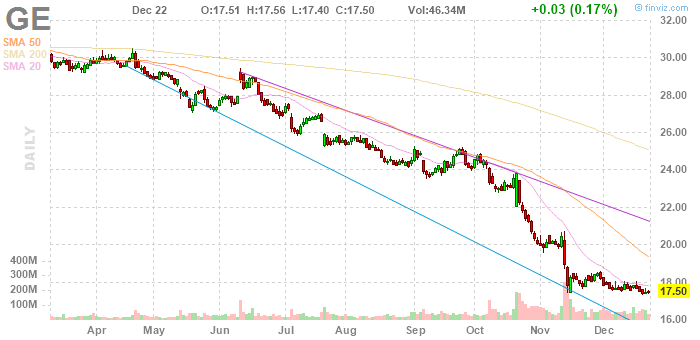
How has this venerable blue-chip stock fallen 45.39% from its 52-week high of $32.04? A number of factors have hit General Electric in the past few months. The first major issue was the third quarter performance report showed that EPS was projected to be $1.05-1.10, down from the estimated $1.60-1.70 that was reported in the second quarter. While most of General Electric"s segments were actually performing well, the power generation segment was weak, and the oil and gas segment was compromised by weakness in its markets, and this weakness led to the earnings outlook being slashed.
The second major issue was the 50% dividend cut that took effect from December, which was implemented to address the fact that General Electric"s free cash flow had contracted to $7 billion, falling from roughly half its normal level. This is the second time in less than a decade that General Electric has had to cut its dividend, and it is clear that management was aware of how badly this announcement would be received. CEO John Flannery stated that:
We understand the importance of this decision to our shareowners and we have not made it lightly... We are focused on driving total shareholder return and believe this is the right decision to align our dividend payout to cash flow generation... Fundamentally, that dividend was predicated on us growing to a certain level that we just did not see happening in terms of industrial cash flow.
General Electric"s public perception has not been helped by the Wall Street Journal"s report about Flannery"s predecessor, Jeff Immelt, allegedly having an empty business jet trail his corporate plane on various international trips that he made. The resulting perception of self-indulgent management cutting costs that adversely affect shareholders has been a black eye for the firm too. All of these factors account for the bearishness surrounding General Electric. Indeed, Mad Money"s Jim Cramer has apologized for recommending the stock as its price went down:
Sometimes, you just get had, and I got had. I was wrong about GE. That"s my fault. I shouldn"t have recommended it on the way down... We"ve got a new guy in town, Flannery. I think he"s trying to put it together, trying to get it together, so I would not sell it. But I cost people money because I believed, and I"m ashamed.
Cramer may be remorseful about recommending the stock, but he does not see it as a sell. Nor do I, and I see several good reasons for optimism about General Electric going forward. The major issue that General Electric has had over the past decade is the following: the sheer size and diversity of its operations (Aviation, Capital, Energy Connections and Lighting, Healthcare, Oil and Gas [merged with Baker Hughes (BHGE) in mid-2017], Power, Renewable Energy, and Transportation) provides it with the expertise and resources to take on large contracts that most companies simply could not contemplate; this size and diversity, however, makes for a sprawling, difficult-to-manage conglomerate.
That is the key reason why a great deal of streamlining has occurred with respect to General Electric in recent years. The Capital segment has undergone significant reduction since the Great Recession, with the separation of Synchrony Financial (SYF) from the company in 2015. Flannery has also stated that his restructuring will see further divestments for low-performing segments such as Lighting and Transportation. The 62.5% stake in Baker Hughes also may be divested as early as 2018, according to Deutsche Bank (DB) analyst John Inch.
Going forward, General Electric will make their core focus on the Aviation, Healthcare, and Power segments - despite concerns on the weakness of the last of these, these three segments are the type of industries which typically generate long-term growth. However, the key term is long term: Flannery is focused on long-term restructuring, not on quick fixes:
I"m not trying to run the company for the reaction on Monday and Tuesday or Wednesday of this week... We have a long-term plan. We have a lot of work to do. We"ve reinvented ourselves many, many, many times.
Flannery is putting his money where his mouth is, having acquired $1 million worth of General Electric stock on November 15. Three other members of the Board also made sizable investments in the firm: Qualcomm (QCOM) CEO Steven Mollenkopf ($100,000+ on November 16); Cognizant Technology Solutions (NASDAQ:CTSH) CEO Francisco D"Souza (under $1 million on November 20); and Loews Corporation (L) CEO James Tisch (almost $54 million on November 21). That these insiders are acquiring General Electric stock in these quantities suggests faith in the company long term.
Looking at the figures for revenue and net income over the past five years give grounds for confidence going forward:
| Year | Revenue ($) | Net Income ($) |
| 2012 | 144.91 billion | 14.66 billion |
| 2013 | 144.27 billion | 15.16 billion |
| 2014 | 117.24 billion | 9.52 billion |
| 2015 | 115.92 billion | 1.68 billion (*) |
| 2016 | 119.87 billion | 9.77 billion |
*Figure has to take into account the Synchrony Financial separation.
Despite its issues with free cash flow - leading to the earnings forecast slash and the dividend cut - and the unwieldy, sprawling structure, General Electric has still been a very profitable company over the past five years. And it is likely to become even more profitable after Flannery"s restructuring plan has been completed.
In summary, the current bearishness surrounding General Electric provides an opportunity for value investors to either start or add to a position with one of the most venerable American blue-chip companies, a multinational conglomerate with a market capitalization of $151.64 billion after having suffered a 45.39% share price drop. Long term, the transition to being more of a purely industrial firm will play to General Electric"s strengths, and benefit its shareholders in due course.
DISCLAIMER: The author is not a financial professional and accepts no responsibility for any investment decisions a reader makes. This article is presented for information purposes only. Furthermore, the figures cited are the product of the author"s own research and may differ from those of other analysts. Always do your own due diligence when researching prospective investments.
Disclosure: I am/we are long GE.
I wrote this article myself, and it expresses my own opinions. I am not receiving compensation for it (other than from Seeking Alpha). I have no business relationship with any company whose stock is mentioned in this article.

No comments:
Post a Comment