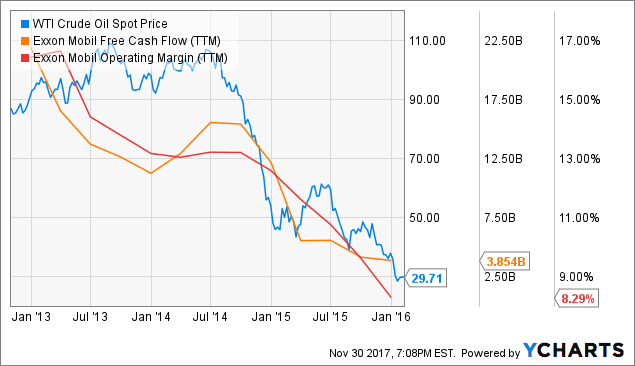
The oil industry was roaring after the turn of the millennium saw oil prices skyrocket to triple figures. After the recession of 2008 killed the price of oil, it rebounded to once more cross over the $100 mark. Thanks to a supply glut caused by a trio of increased global production, decreased demand in key markets, and nobody wanting to cut their production to stabilize prices, oil prices again plummeted all the way down to just under $30 by early 2016, where they have slowly begun to climb since.
This downturn in prices shook the oil & gas industry, with numerous small-time players closing their doors, some major players such as ConocoPhillips (NYSE:COP) cutting their dividend, and the integrated oil majors such as Exxon Mobil (NYSE:XOM) being forced to make massive changes to stay financially stable.
Luckily, XOM"s dividend was never cut, but this did come at a cost. Debt skyrocketed, dividend growth came to a standstill, and share buybacks stopped. This has bogged down shares from going much of anywhere for some time. A combination of recovering oil prices and financial remodeling via strategic divesting of assets has cash flows back on the rise. Let"s take a look at where the new look Exxon Mobil is headed.
Financial Effects Of The Downturn
The plunge of oil prices was severe and sent shock waves through the industry and markets.
WTI Crude Oil Spot Price data by YCharts
With the downturn in oil went Exxon Mobil"s free cash flow and operating margin. Exxon was able to weather this storm of low oil prices, while many small companies had to close their doors, and some upstream-oriented companies such as COP had to cut their dividends.
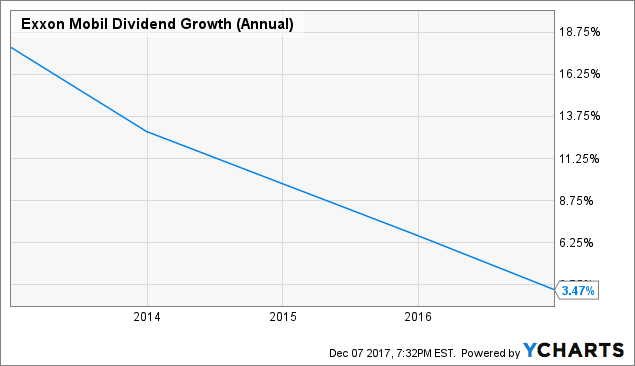
However, Exxon Mobil did not emerge from the oil crisis unscathed. It had to scale every aspect of its operation back to conserve cash as profits plummeted. This was especially true for shareholder returns. The dividend was not cut, but growth has slowed to a pace that only matches inflation.
XOM Dividend Growth (Annual) data by YCharts
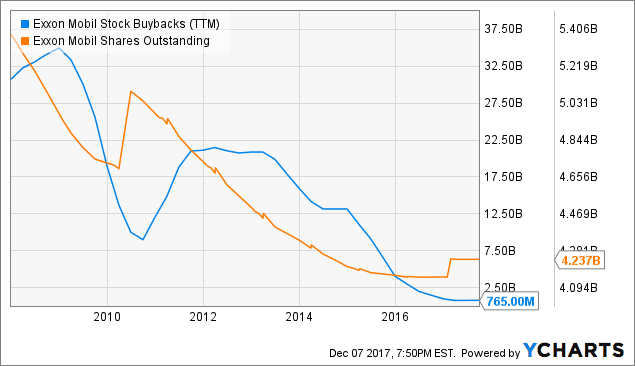
In addition, it had to scale back buying back shares to boost earnings. With a company as massive as Exxon Mobil, share repurchases are a key driver of earnings growth.
XOM Stock Buybacks (TTM) data by YCharts
Without the share buybacks throughout the decade, Exxon Mobil"s current TTM earnings of $3.09 per share would only be $2.49 per share, or about 20% lower.
Despite management taking these measures to conserve cash, Exxon still had to take on quite a bit of debt throughout the oil downturn in order to fund its dividend. This has left the balance sheet with more debt than is typical for the oil major.
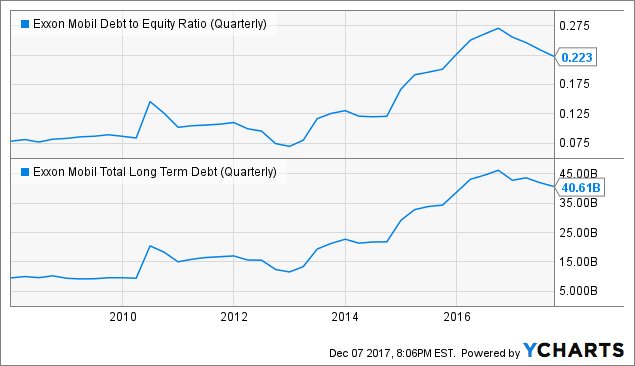
XOM Debt to Equity Ratio (Quarterly) data by YCharts
A New, Lower-Cost Oil Environment
The downturn has forced energy companies such as Exxon Mobil to alter its approach, as we seem to have entered a world of lower oil prices. While not a fortune teller, it looks like we are a long ways off from $100 oil. During the past few years, Exxon has sold off what it considered "non-strategic" assets ($21 billion in proceeds from 2012-2016) to raise cash during the downturn, and shifted its focus to North American shale assets.
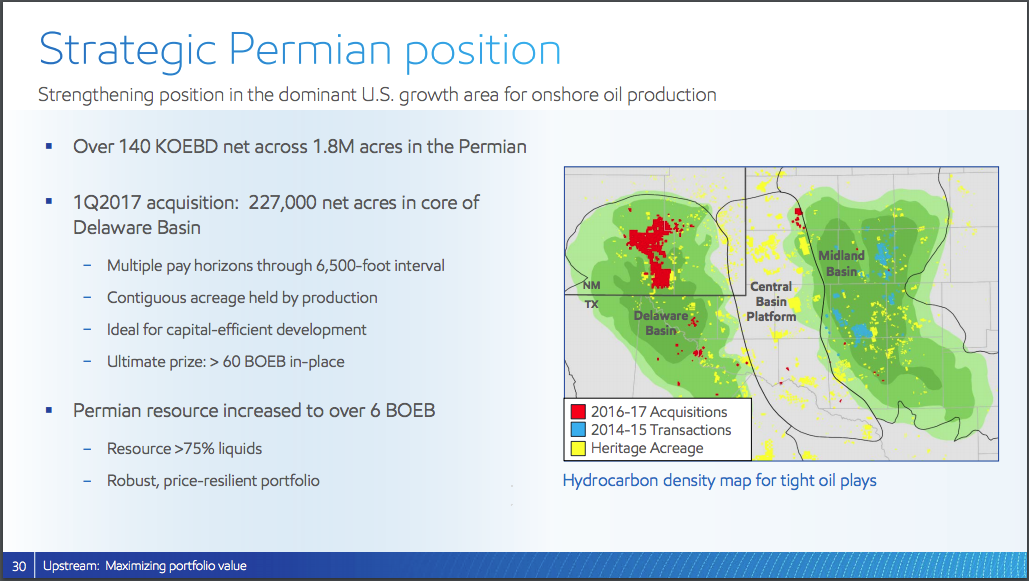
Earlier this year, Exxon Mobil acquired 275K acres in the Permian basin. These shale assets are "short-cycle" projects which have much shorter cost capture time frames than major offshore projects, and are generally much less capital-intensive.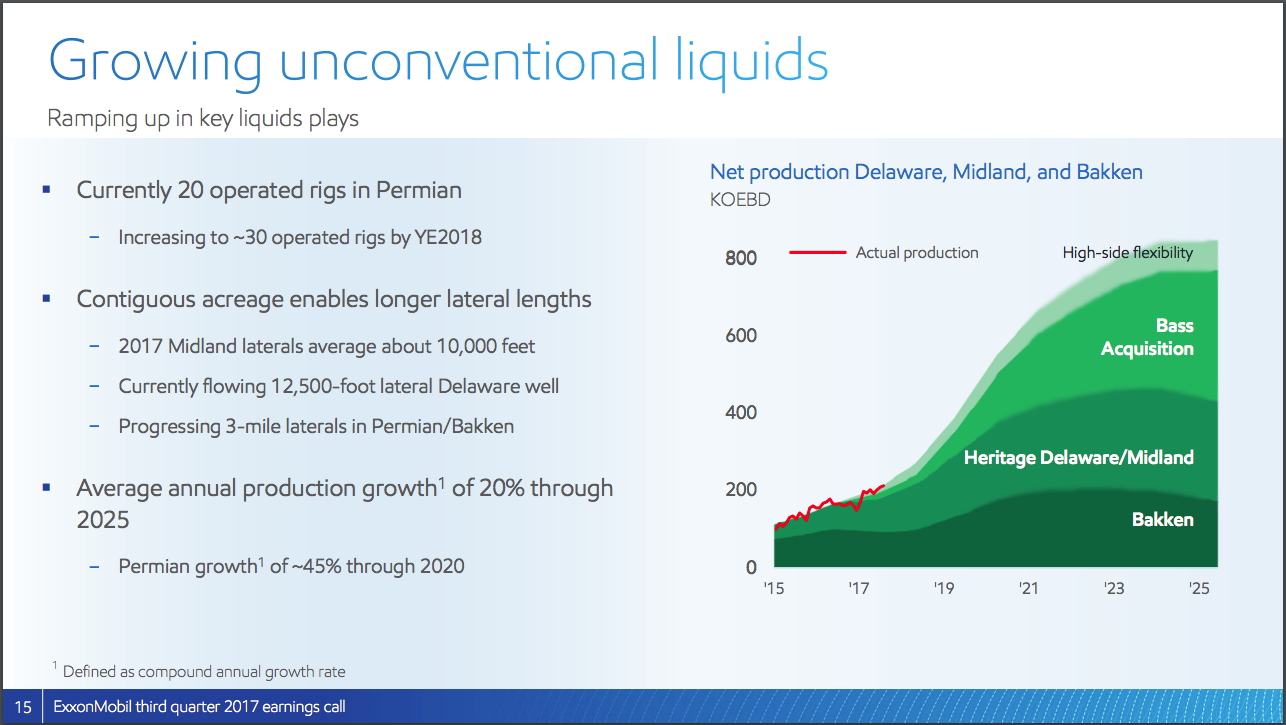
Operations are ramping up in the Permian, with a 50% increase in rig operation planned for 2018, which will total 30 operated rigs in the Permian region. The Permian region will be a production growth driver for the company over the next few years, with Permian output estimated to more than double the pace of overall production growth. Exxon Mobil"s cost position should improve due to the higher make-up of its resource portfolio consisting of less capital-intensive assets such as shale.
While major exploration will never "die", the company needs to be very careful about the capital it employs towards these types of projects moving forward. The immediate path to cash flow growth that will get the Exxon Mobil "ship" back moving in the right direction seems to be in shale. I am interested to continue following the development of shale efforts in the intermediate future.
Long-Term Optimism For Natural Gas
Exxon Mobil"s 2010 acquisition of XTO Energy made it a titan in the natural gas industry. Unfortunately, natural gas prices have struggled, stuck in a slow and modest downtrend over the past decade.
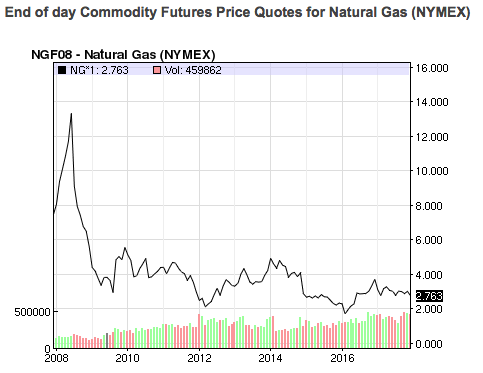
(Source: Nasdaq)
Prices have been pushed lower by a combination of mild weather and plentiful supply. Still, natural gas consumption growth is estimated to outpace traditional fuel sources over the very long term.
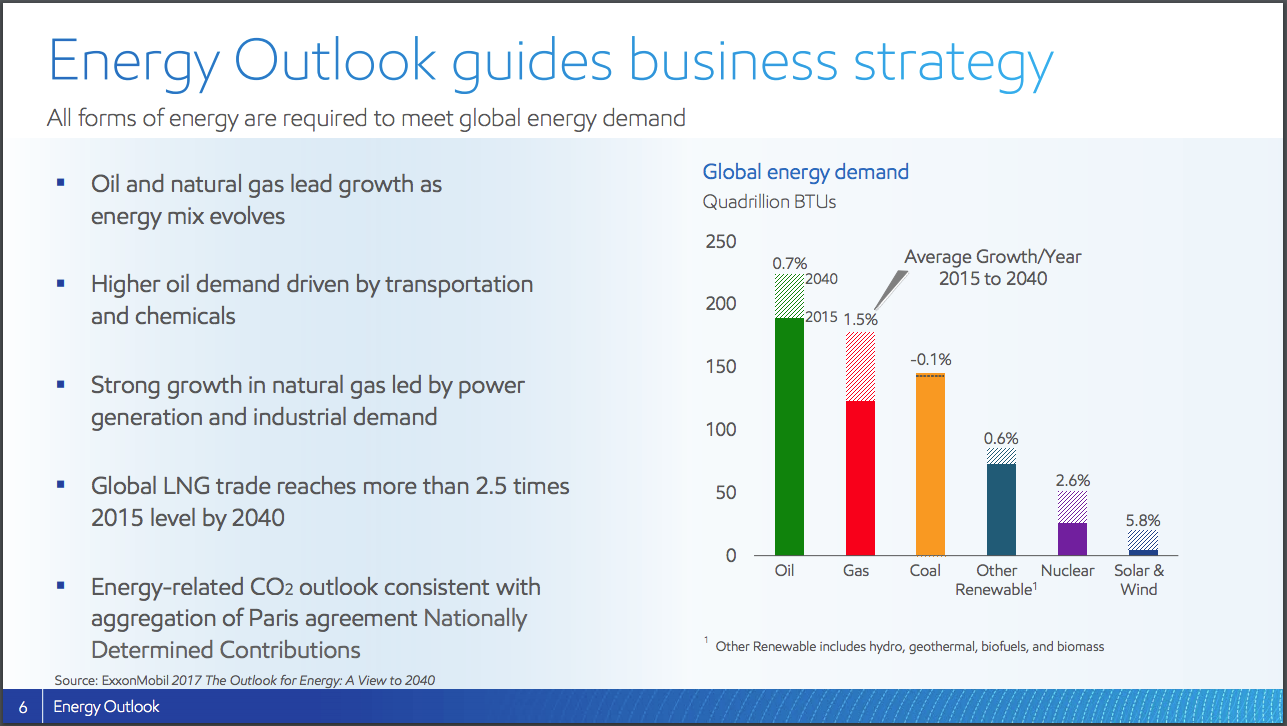
Exxon Mobil could have opportunities as a natural gas exporter over the long term. The United States is currently the largest natural gas-producing nation in the world, and Exxon Mobil"s XTO Energy business makes it a leading presence in that field. As the United States looks to focus on exports, Exxon will benefit from this given its position in the industry.
The largest driver moving forward for natural gas prices may end up being potential demand spurred from the eventual attempts by nations to phase out the use of coal as an energy source. Climate change is slowly becoming more important across the world, and as emission standards tighten over time, I see natural gas as the "next man up" on the energy source roster.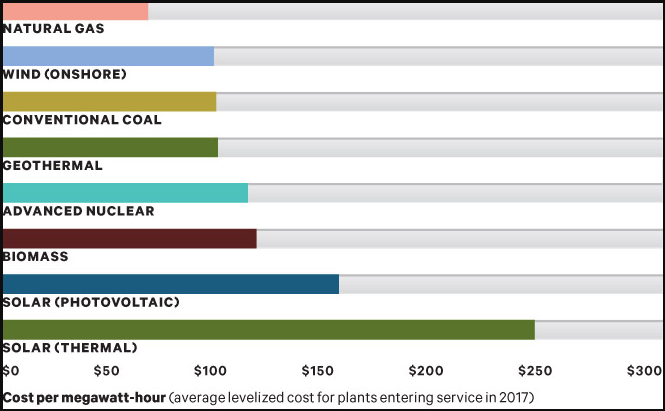
(Source: Wired)
Renewable energy faces challenges in scaling to a size suitable to fill the giant hole traditional fuels like coal would leave. Renewable energy can be adversely affected by weather. There are also efficiency and energy storage issues, especially with solar. Lastly, natural gas also currently enjoys a cost of production advantage over renewable sources - which may be the most important factor of all.
Improving Cash Flow Signals "Good Things" To Come
As Exxon Mobil gears itself for this new age of low-cost energy production, there are early signs of results - even if they have a lot to do with a modest rebound in oil prices.

The dividend has been funded throughout the past year, and YTD cash from operations has covered all shareholder distributions and investments. At this point, Exxon is only looking "up" from here. With just under $41 billion of debt, there is still a bit of digging to do for management. It is hard to tell how long it will take to return the debt to a more manageable level, as that will highly depend on oil prices in the short term boosting cash flows.
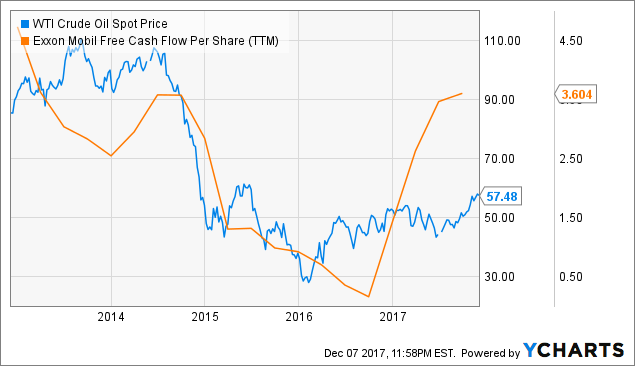
The good news is that OPEC recently extended its agreement on production cuts, which has the industry a bit more bullish on oil prices for 2018. After averaging around $53 per barrel in 2017, oil prices in the $58-60 range for 2018 would drastically boost cash flows.
WTI Crude Oil Spot Price data by YCharts
Sustained prices in this range should pick up free cash flow per share well past this point, which currently results in an 85% payout of free cash flow towards the dividend. Again, Exxon Mobil is positioning itself for lesser reliance on these commodity prices, but in the short term, oil prices will determine how soon the company can "dig itself out" of the debt it is now in.
Accumulation Stage
Shares have been hanging out in the low $80s for some time now, to the disappointment of a lot of long-term shareholders.
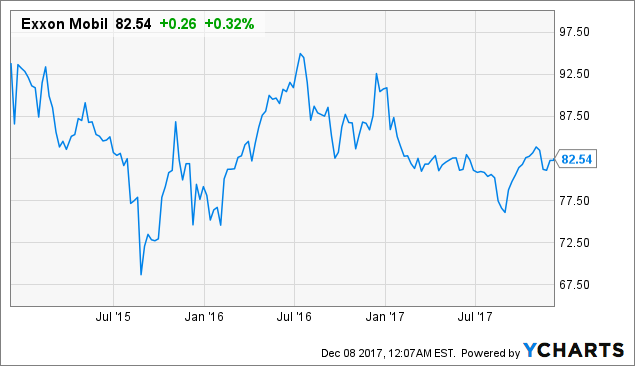
Those patient enough have lucked out with the occasional opportunity to purchase shares under $80. Now that Exxon Mobil is cash flow-positive and trending in the right direction, I cannot say in confidence that price dips like those seen in late 2015, early 2016, and mid-2017 will happen again anytime soon - barring a major event in the market.
Income investors get a juicy dividend that is way above its 2.48% historical yield at 3.71% (drip, drip, drip).
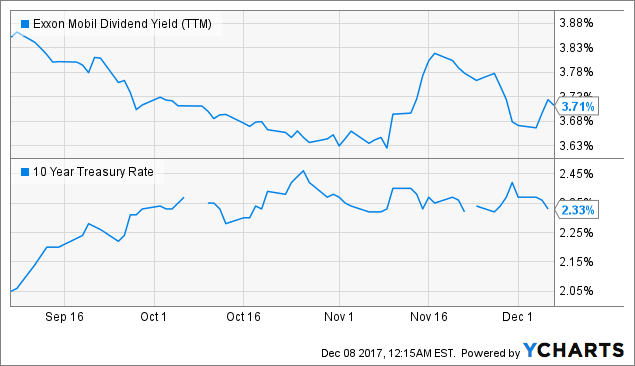
XOM Dividend Yield (TTM) data by YCharts
Meanwhile, free cash flows are yielding as high as they have in almost five years (meaning cash flows are the cheapest they have been in a long time). Exxon Mobil"s cyclical nature can skew traditional valuation metrics, so I want to focus on how much cash flow I can get for my money. As Exxon increases its cash flows in 2018, either the cash flow yield will go up (making it an even better value) or shares will go up with cash flows.
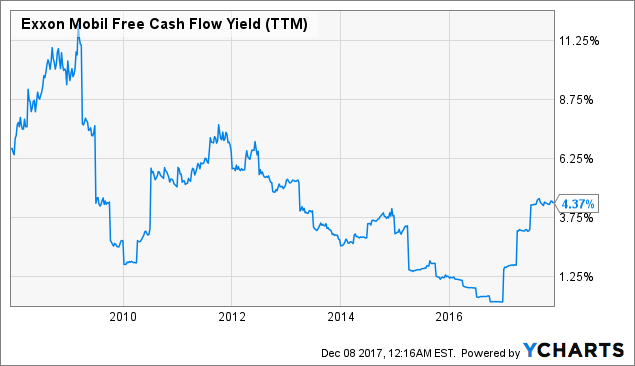
XOM Free Cash Flow Yield (TTM) data by YCharts
Given Exxon Mobil is on the "up and up", and the high dividend and cash flow yields, a price as close to $80 per share as possible makes a great entry point for long-term oriented investors. Oil prices are stabilizing in the high $50s, and the financial metrics for the company will only look better by the quarter.
Not a finished product, Exxon Mobil has nice positioning for the long term in an oil & gas environment that is likely to feature lower commodity prices than we have seen in the past. Nobody knows exactly where oil prices will be 1, 5, or 25 years from now, but I am confident that the company"s position in the industry will enable it to generate sufficient cash flows in the near future. Once Exxon Mobil turns on the faucet for share buybacks, the share price should float higher.
Note: Charts sourced from YCharts. Unless noted, graphics sourced from Exxon Mobil.
Disclosure: I am/we are long XOM.
I wrote this article myself, and it expresses my own opinions. I am not receiving compensation for it (other than from Seeking Alpha). I have no business relationship with any company whose stock is mentioned in this article.

No comments:
Post a Comment