New York Mortgage Trust (NYMT) has several major problems.
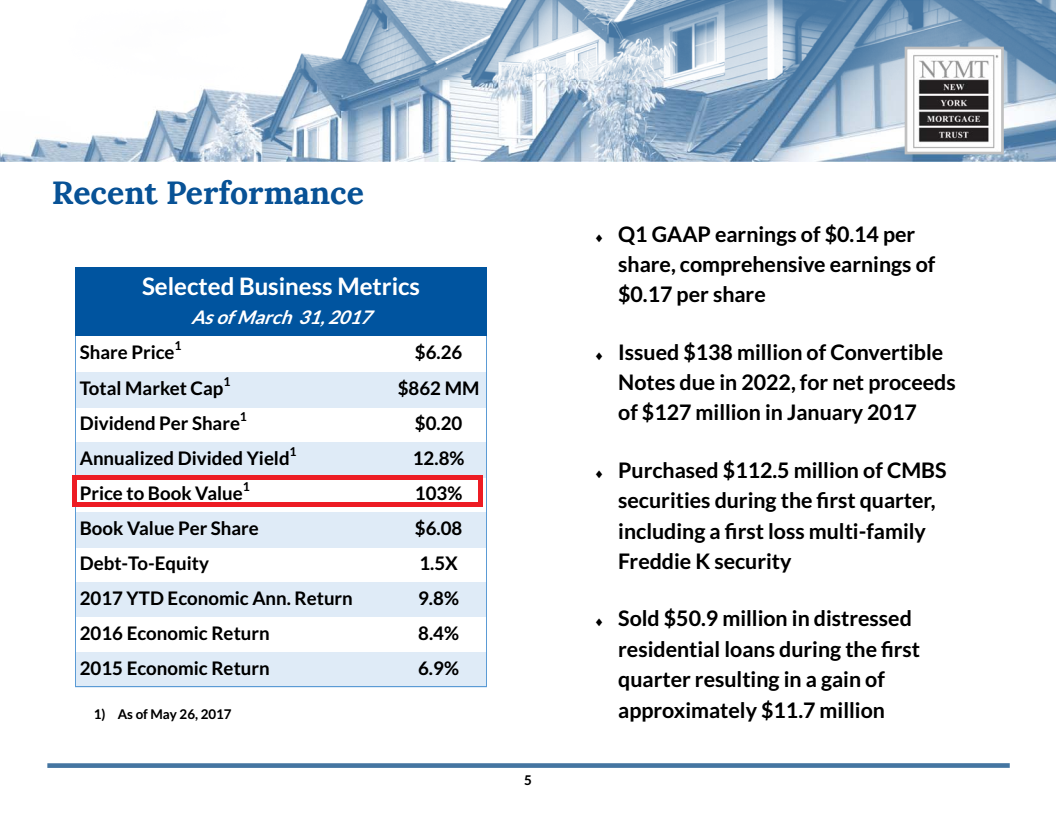
The first problem is a very high price to book ratio:
Source: NYMT investor presentation
Premium to book value
By my estimates, NYMT is trading around 103% to 104% of their current estimated book value. That estimate includes the intangible book value coming from goodwill (the second problem). One of the reasons this matters is because across the mortgage REIT sector I’m seeing an average price to rough estimated book of 95%. That doesn’t include every mortgage REIT, but it includes a pretty large sample. It is very strange for me to see NYMT carrying such a large premium to the sector average. I don’t believe that this large premium is warranted and it gives us 2 issues.
The first is simply that the price to book on NYMT is too high in isolation. It just shouldn’t be that expensive.
The second is the lower price to book ratios across the sector means investors who are interested in entering the sector are going to have several superior alternatives. If the entire sector was simply overvalued, then it might be easier to look past this issue. I still wouldn’t want to, but it would be more understandable. In this case, NYMT is overvalued on an absolute basis and a relative basis.
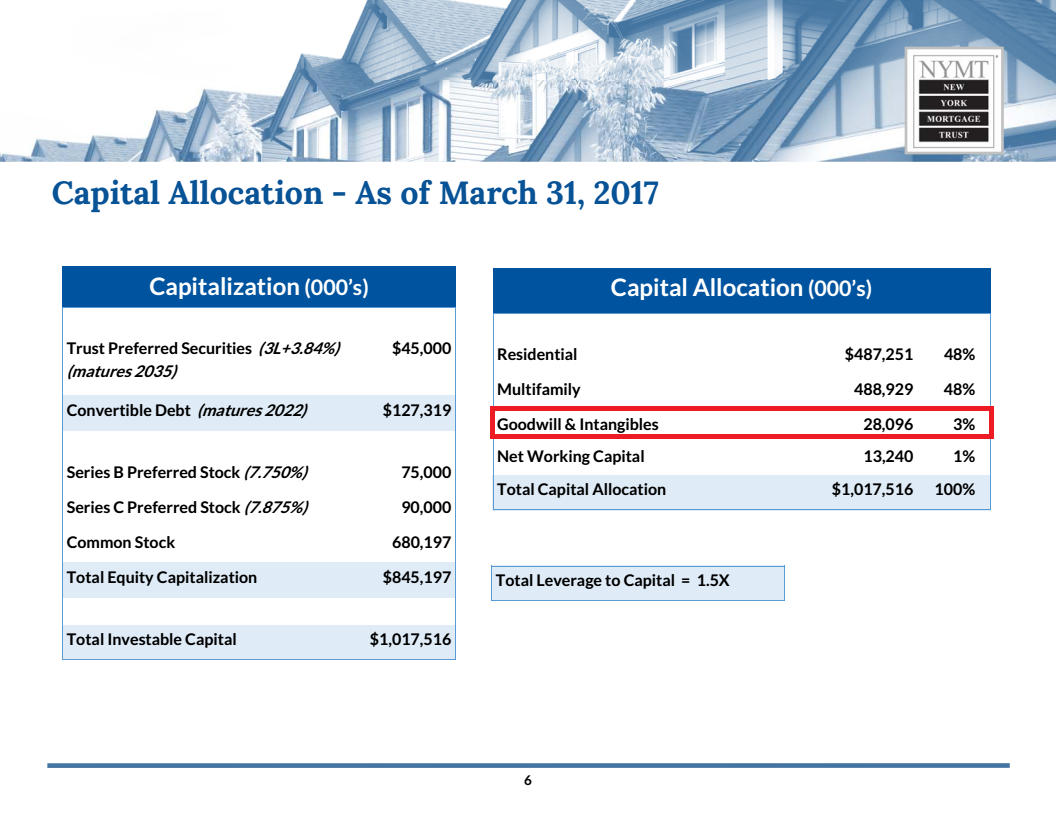
Goodwill
The second problem is a material amount of goodwill on the balance sheet:
Source: NYMT investor presentation
Goodwill on the balance sheet increases the book value per share, but goodwill cannot be used to finance any assets. It cannot be used to earn net interest income. And it cannot be used to secure a repurchase agreement.
Flattening yield curve
The third problem is the flattening of the yield curve:

Source: Federal Reserve Bank of St. Louis
This is an issue that faces most mortgage REITs and it makes it more difficult for the mortgage REITs to continue earning net interest spread income as the yield curve flattens. When the mortgage REIT has a higher cost of borrowing to fund their operations, it materially decreases how much net interest income they can have for shareholders.
NYMT price during a panic
The final issue is that NYMT can be more susceptible to a decline in share price during periods of market stress. If investors are trying to reduce the volatility of their portfolio and also hold a significant exposure to the S&P 500 (SPY), it makes NYMT less attractive for any space the investor is dedicating to mortgage REITs. The investor would be better served by a mortgage REIT that demonstrates lower volatility and less exposure to having assets marked down based on changes in fair value.
Dividend sustainability
I believe NYMT will find their dividend to be unsustainable. Even after the dividend was trimmed, it still represents a yield of nearly 13% on book value. Again, that book value includes goodwill. Goodwill does not produce net interest income. Therefore, NYMT needs to produce even more net interest income with each dollar of equity.
Operational expenses
NYMT has relatively high operational expenses compared to the total value of common equity. Because those operational expenses are paid before any dividends can be sent to either preferred or common shareholders, it creates another challenge. NYMT needs to earn materially more than 13% on book value to sustain the dividend. They need 13% on book value + they need to cover the operational expenses. That is where things go from hard to terrible. If we factor in operational expenses, the level of return that NYMT needs to earn on an annual basis is simply not reasonable in this environment. Facing the flattening yield curve and the relatively thin credit spread for credit sensitive assets, I do not see any options where NYMT can invest their capital with an expectation to earn enough net interest income to pay all of their operating expenses and still have enough left over to pay the preferred dividends and the full level of the common dividends. The preferred dividends should not be seen as being in any immediate jeopardy. I do view the preferred shares as riskier than the preferred shares of most other mortgage REITs. However, they should not face any dividend related pressure in the near future. The common stock dividend, on the other hand, should be forced to absorb the entire shortfall between what the portfolio can earn over the longer term and the cost of financing and operating the portfolio.
Preferred shares
Due to NYMT being riskier than most mortgage REITs, I generally don’t recommend their preferred shares for buy-and-hold strategies. However, the preferred shares do occasionally offer excellent trading opportunities. I am particularly interested in NYMTN. Subscribers have access to a longer analysis on NYMTN in the weekly series on preferred shares. I recently purchased NYMTN and published an article on NYMT’s three preferred shares.
Conclusion
NYMT is way too expensive. The company runs around 103% to 104% of BV (including interest accrual). There is $0.225 per share in Goodwill from buying one of their external managers. Adjust for that and the P to estimated BV ratio gets even worse. Anyone want to explain paying 108% of tangible BV for this mREIT? I think their strength in this environment is aided by investors confusing mortgage REITs with growth stocks. Their consolidation of positions and recent purchase of another first-loss tranche means total revenues and total assets are growing rapidly due to the impact of consolidation. Those factors could continue to help the share price, but the fundamentals do not justify this in any way. The sell rating on NYMT is for a 13% yield on book combined with high operating expenses. Since goodwill can’t actually be leveraged in repo agreements, this just isn’t viable for the long term. It could last a few quarters or even a few years with BV gradually grinding lower (assuming no big credit risk scare).
Sign up to The REIT Forum before January 1st, 2017 to lock in at $390/year. You’ll find actionable buy and sell targets prices, the best research on preferred shares and mortgage REITs, and instant actionable SMS alerts. I cover sectors with stable dividends yields over 7%. Best reviews on the site – 305/305 stars:

Disclosure: I am/we are long NYMTN.
I wrote this article myself, and it expresses my own opinions. I am not receiving compensation for it (other than from Seeking Alpha). I have no business relationship with any company whose stock is mentioned in this article.
Additional disclosure: No financial advice. Investors are expected to do their own due diligence and consult with a professional who knows their objectives and constraints. CWMF actively trades in preferred shares and may buy or sell anything in the sector without prior notice. Tipranks: Sell NYMT.

No comments:
Post a Comment