
Source: USAToday.com
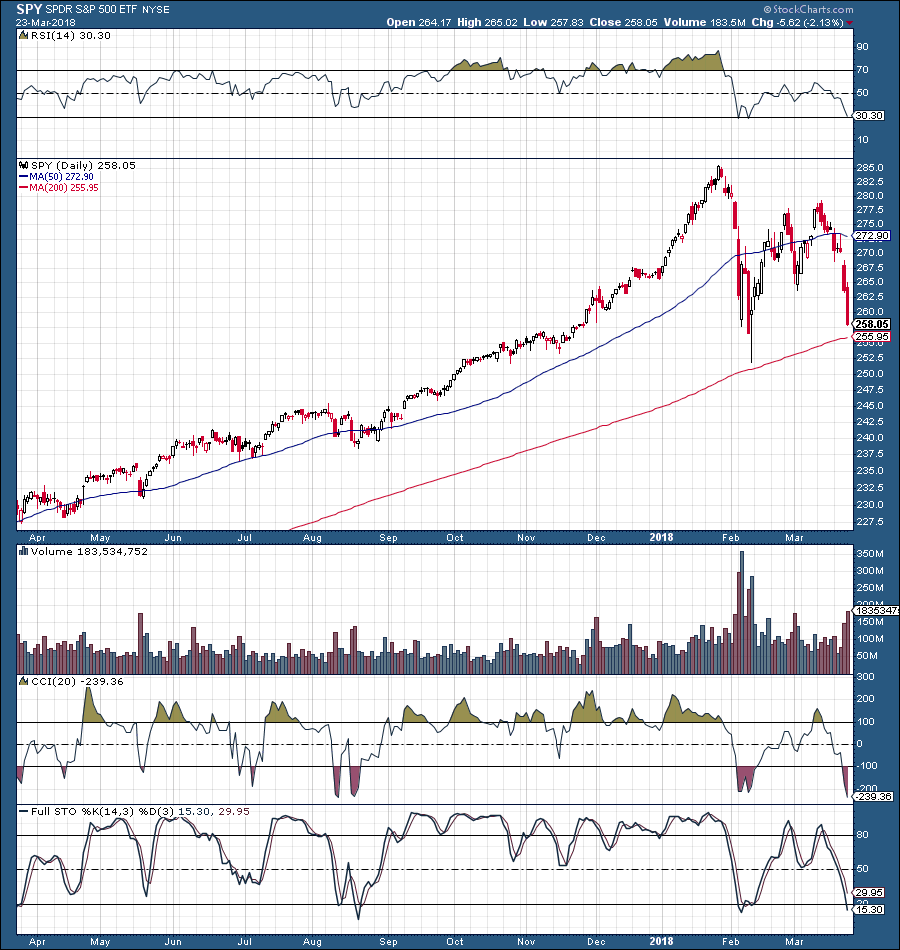
What a week for stocks, the worst in over two years to be exact. More than a 5% drop for the S&P 500/SPDR S&P 500 Trust ETF (SPY), the world’s most closely watched stock index. The S&P 500 now sits at the 200 – day moving average, a level essentially on par with the closing low reached during the height of the recent correction. It’s becoming apparent that markets are taking the threat of a potential trade war with China very seriously.
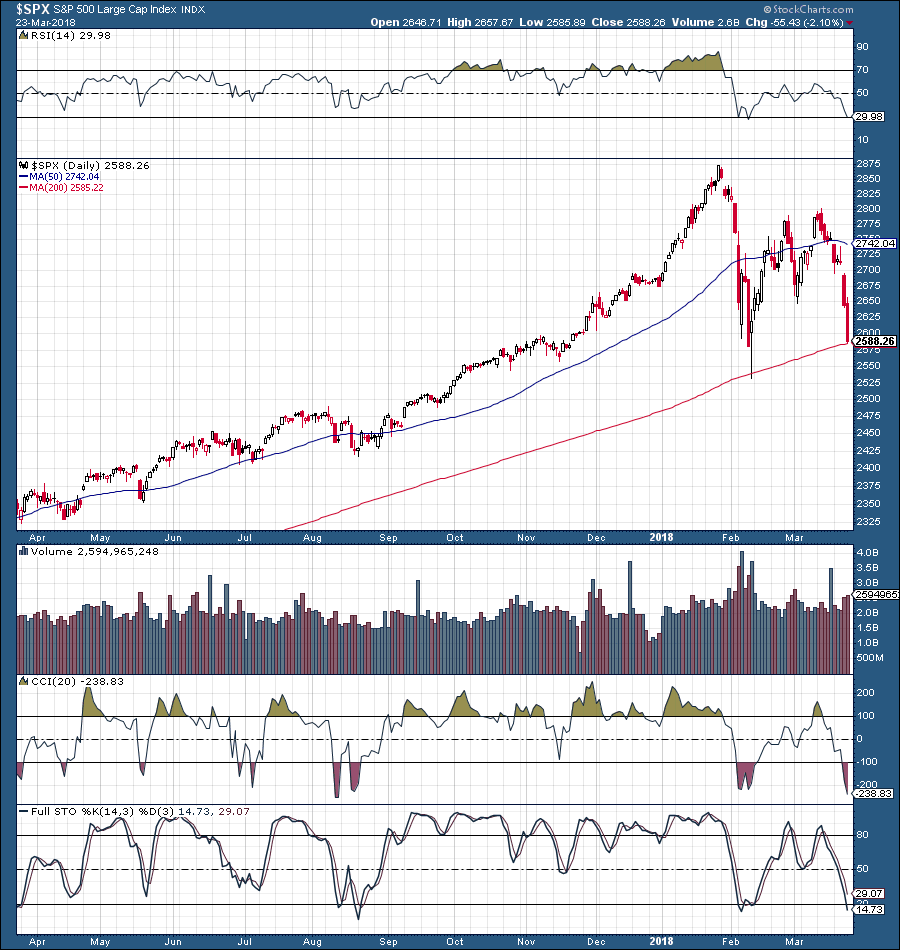
Source: StockCharts.com
So, what is likely to happen next? Are the fears overblown? Will stocks recover, or will the correction deepen? And could this be the beginning stages of a bear market instead?
About SPY
SPY is the first major and most popular ETF in the world. It"s designed to mimic the exact movement of the S&P 500. The SPY Index fund has roughly $275 billion in net assets, and each share in the fund represents a fraction of the holdings. SPY provides investors with exposure to the S&P 500 index, which is widely regarded as the most significant stock market average for U.S. equities. Since SPY tracks the exact movements of the S&P 500, I will use SPY and the S&P 500 interchangeably throughout the article.
Trade: U.S. Vs China
If you think the heightened trade talk rhetoric is only effecting U.S. stocks you’re mistaken. Chinese and other Asian stocks are getting pummeled as well. On Friday alone Hong Kong’s HSI Index lost 2.5%, Shanghai’s Index gave up 3.4%, China’s Shenzhen Index cratered by 4.1%, and Japan’s Nikkei lost over 4.5%. I think it’s clear, as much as a potential trade war could hurt certain U.S. companies and industries it would hurt China much more.
The U.S.’s trade deficit with China was over $375 billion last year. In other words, China swamps the U.S with everything from machinery, to textiles, to plastics, to furniture, to computers and electronics, and so on.
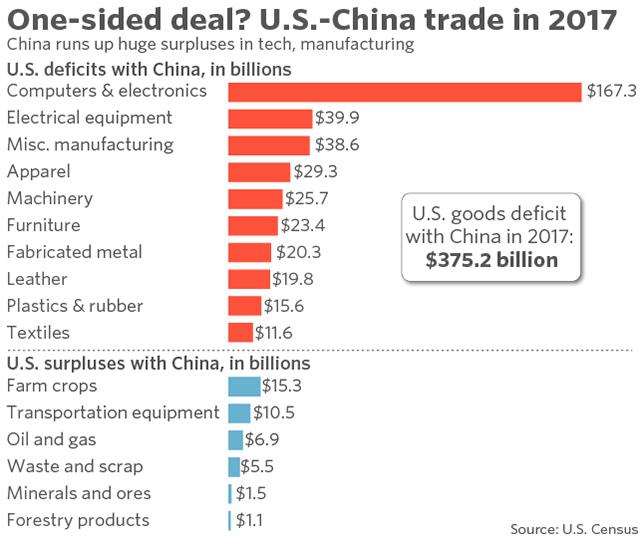
Source: MarketWatch.com
Free trade does not necessarily mean fair trade. In fact, when it comes to trade with China it’s anything but fair. One of the reasons the U.S. has such a massive trade imbalance with China is because in addition to China being able to manufacture goods much cheaper, the Chinese have a far easier time bringing their products to the U.S. market.
For example, it costs the U.S. 25% to bring a car into China, while it costs the Chinese just 2% to bring a car into the U.S. And this doesn’t affect only cars, this is a widespread phenomenon. To avoid the huge tariffs, U.S. companies must “partner up” with Chinese firms who then proceed to strip their American counterparts from their valuable intellectual properties. This allows Chinese companies to catch up much faster and then effectively compete in global markets. This is only a small taste of how the U.S./China trade relationship is skewed much more towards China’s favor.
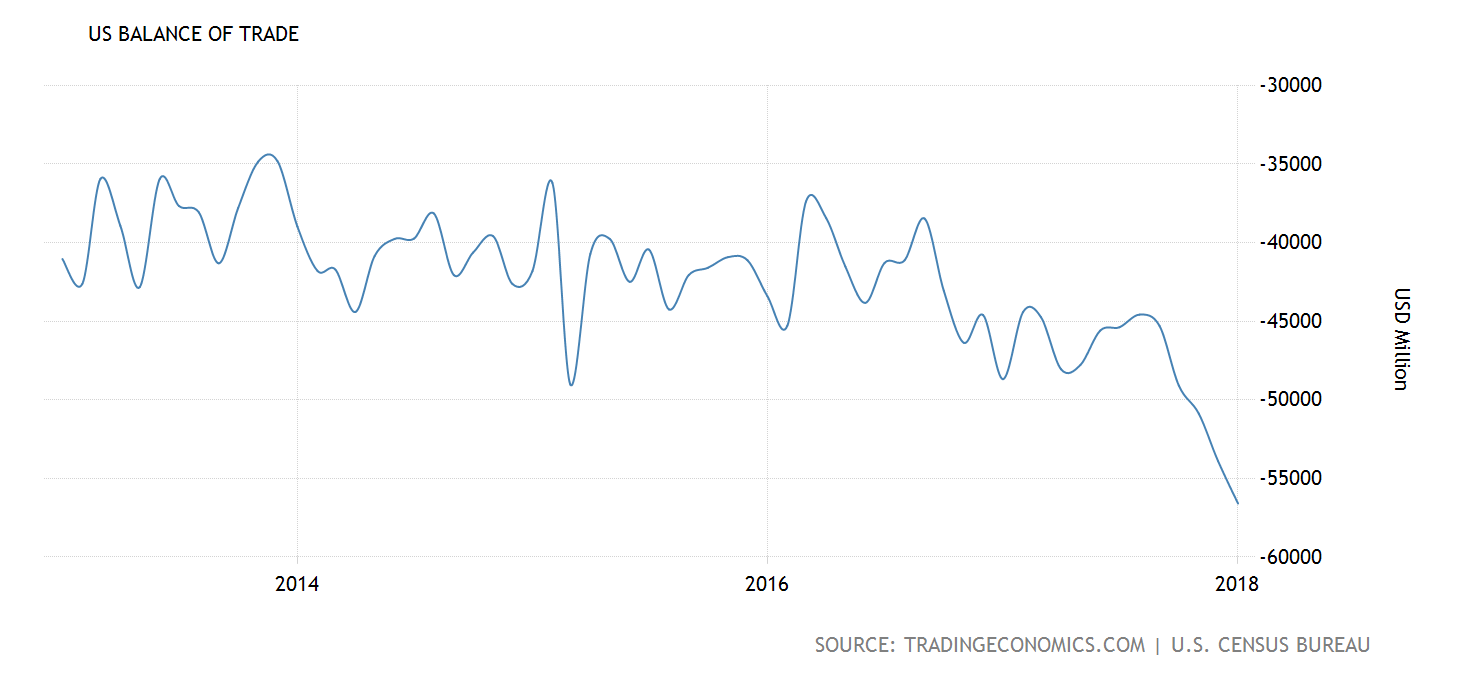
Source: TradingEconomics.com - As you can see the U.S."s trade picture is not looking good, and since the majority of the imbalance comes from China, it is the logical place to start.
So, why should the U.S. remain at a perpetual disadvantage to China when it comes to trade? Right, it shouldn’t. Therefore, when President Trump talks about reciprocal, or mirror trade between the two countries it makes perfect sense. Maybe not to the Chinese, because who would want to give up such massive unfair advantages? But the bottom line is if the Chinese don’t like a more balanced trade relationship that is just too bad.
It’s like pulling off a band aid. Yes, it may be painful at first, but in the end, it simply must be done. Of course, the Chinese are going to make a fuss in the media. The strong man communist regime can’t simply stand by and do nothing while a U.S. president takes the punch bowl away. So, expect more economic saber rattling, and possibly some more volatility in the short term. But with a $375 billion trade imbalance, and the rules hugely geared towards China’s favor, it is ultimately China that has the most to lose here, not the U.S.
Possible Scenarios
There are several possible scenarios that could play out from here in relation to stocks.
Scenario 1: This is the correction retest. This could be a delayed retest of the correction bottom. In which case, we can expect an intraday move to around the 2,525 level in the S&P 500. Following the retest, we can expect a sharp rebound and a gradual move back towards the highs. The retest would probably occur within the next few trading days.
Scenario 2: The correction will deepen. We could be in for a more serious decline. Rather than the current 12% correction we could easily see something like a 15-18% decline. A correction of 18% from the highs would bring the S&P down to around the 2,350 level. Such a decline would essentially wipe out all the gains from the prior year.
Scenario 3: The correction will morph into something worse. It is possible that a bear market in stocks has begun. There is no denying it that stock valuations became lofty in recent months, and the current economic and political instability may be triggering a bear market in stocks to ensue. If this downturn transitions into a bear market, depending on its severity we can expect a decline of about 20-50% from the highs. This would take the S&P down to the 2,300 – 2,150, 20% - 25% in case of a mild bear market. And all the way down to the 1,437 level in case of a severe 50% bear market pummel.
Technical View
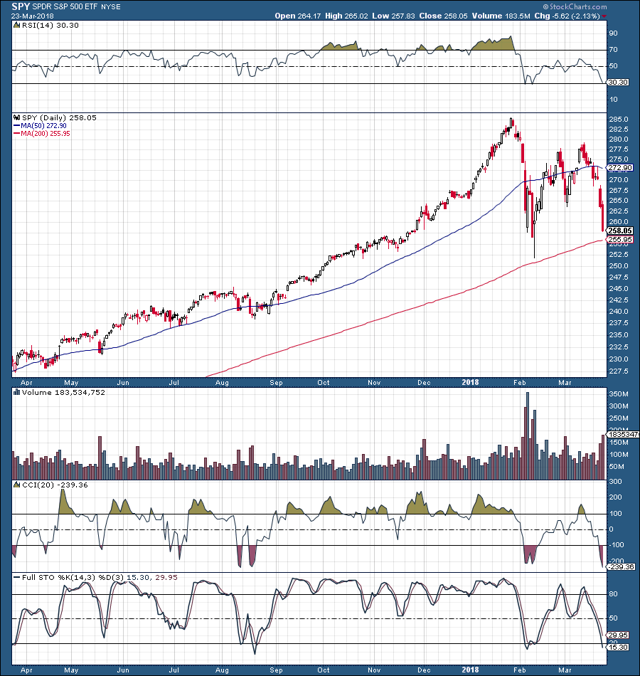
We can see that SPY has declined by roughly 7% since the recent high 2 weeks ago. The selling has increased in recent days and SPY now appears quite oversold in the short term. The RSI is at the extremely oversold 30 level, on par with the correction low. The CCI at -239 is also suggesting a very oversold environment. The technical image indicates that any further selling is likely to be met with a reflex of buying. We appear to be close to what will likely at least amount to a tradeable short term bottom. But if this correction is destined to turn into something worse the selling will resume once a short-term bounce concludes.
The Bottom Line
Markets are noticeably on edge, and the recent trade tariff tensions are clearly amplifying anxieties. Volatility ticked up notably last week, and many high alpha stocks have released some air. Moreover, this trend may continue until the current downturn gets resolved. Therefore, focusing on some rotation towards basic materials, energy, precious metals, defense, consumer staples, and other sectors that could outperform in the underlying environment may make sense here.
Ultimately, weather this is the correction concluding, continuing to play out, or the start of a bear market, remains to be seen. But despite the steep selling, I remain skeptical that we are in the opening stages of a bear market. Simply too many elements are pointing to this being an unlikely scenario.
Many of the economic numbers coming in look great and are not indicative of an imminent downturn in the economy. Moreover, there are various government stimuli such as tax cuts, government spending, deregulation, and other initiatives that have been introduced recently and are likely to produce additional growth going forward. Therefore, in my view this is still “just a correction” but it may be wise to implement a slight shift in investment strategy to protect prior gains.
Note: SA has introduced a new feature. Hit the "Like" button if you enjoyed reading my article! Also, feel free to hit the "follow" link to receive updates about my future ideas. Thanks for reading, hope you enjoyed my article, happy trading everyone!
Disclaimer: This article expresses solely my opinions, is produced for informational purposes only, and is not a recommendation to buy or sell any securities. Investing comes with risk to loss of principal. Please always conduct your own research and consider your investment decisions very carefully.
To receive real time updates, and get more information about this idea as well as other topics please visit the Albright Investment Group trading community. Join us and receive access to exclusive content, trade triggers, trading strategies, price action alerts, and price targets. Theses value adding features are available only to members of our trading community, and are not typically discussed in public articles.
Disclosure: I/we have no positions in any stocks mentioned, and no plans to initiate any positions within the next 72 hours.
I wrote this article myself, and it expresses my own opinions. I am not receiving compensation for it (other than from Seeking Alpha). I have no business relationship with any company whose stock is mentioned in this article.

No comments:
Post a Comment