Showing posts with label Time. Show all posts

Sunday, June 17, 2018

My Father Invented The Best Business Quotes Of All Time

My dad, who would be mortified if he knew I was doing this, has been my greatest inspiration in business. Thanks to his disdain for any sort of self-aggrandizement, I"m doing this behind his back (sorry, dad).

If I"ve had any success in business, it"s because my dad lived his life according to the doctrine of entrepreneurship and I got to watch from the sidelines. He was living proof that you"re not confined to the hand you"ve been dealt and you can determine your own outcomes in this life.

Over the years, my dad"s shared countless bits of wisdom with me that we endearingly refer to as, "The Marty Lecture Series." Today, in honor of Father"s Day, I"d like to share some of my personal favorite "Lecture Series" quotes with you. 

When You Lose, Don"t Lose The Lesson 

My dad never took "no" as no. "No" was always a starting point for negotiation. Where others saw obstacles or setbacks, my dad saw (and still sees) opportunity. 

Every time I came home with a perceived failure, he"d reframe it with how it taught me something or made me stronger. 

It was infuriating as a 14-year-old who relished in self-pity and just wanted a "normal parent" who would indulge her, but it"s been invaluable as an entrepreneur. It"s impossible to be derailed by failure when you"re forced to find a lesson.

Sometimes You Gotta Be Ok With "Good "Nuff"

I was complaining about a mediocre grade on something when my dad spit this quote at me for the first time. Irate, I thought he meant you should settle for less than you deserve or are capable. It took me years before I realized what he meant was "done is better than perfect."

He was teaching me how to ship

Patience and Shuffle the Cards 

In a world where my contemporaries are obsessed with quick Instagram-worthy wins, my dad always shared this quote from Cervantes. He was never impressed with status, fame, or fancy things. Perhaps it was the Texan in him, but he was never influenced by those who projected the illusion of success.

He was impressed with people who had passion, determination, and (most importantly) the wherewithal to endure the setbacks that come at you as you go down the road less traveled. People who played the long game. 

Any day I felt like everything was over, the world was collapsing, and I should quit (aka: every other day in business), he"d remind me today was one of many.

This is a long game. You gotta have patience and shuffle the cards.

Some Days Just Need to Be Over 

This one is a crowd favorite, especially in a culture obsessed with self-improvement and maximizing everything. Some days, you gotta accept that you can"t win. 

Don"t dwell on it. Accept your losses, go for a run, do something else productive, but don"t waste your time beating yourself up over a crap day. 

Some days just need to be over. 

You Gotta Fight Em In The Streets 

This one is my favorite. 

To my dad, there"s nothing more respectable than someone who is "fightin" em in the streets." In other words, there is no substitute for doing the work. The tireless work that no one sees, the stuff people won"t thank you for, the things no one will recognize or know you did. All the "not sexy" parts of entrepreneurship. 

This mentality also inspired the name of my virtual co-working space, The Arena. The Arena is a metaphor for "fighting in the streets." It"s where you show up and do your best. Win, lose, or draw, you show up. You fight. You do your best. 

My dad always said he"d never judge me for losing. He"d judge me for not having tried. 

To my dad and all the other entrepreneurial father"s out there, Happy Father"s Day.


Tech

Friday, June 15, 2018

AT&T CEO says ready to invest, keep culture at Time Warner: CNBC

(Reuters) - AT&T Inc is committed to spend as much as needed on the media business of newly acquired Time Warner Inc, Chief Executive Randall Stephenson told CNBC on Friday, with a plan to invest $ 21 billion to $ 22 billion in the combined company.

FILE PHOTO: Chief Executive Officer of AT&T Randall Stephenson arrives at a U.S. District Court in Washington, D.C., U.S. April 19, 2018. REUTERS/Carlos Barria/File Photo

“We’re not going to be penny-wise and pound-foolish here,” Stephenson said in an interview on the financial news channel. “We intend to invest.”

The No. 2 U.S. wireless carrier closed its $ 85 billion acquisition of Time Warner on Thursday and now faces the task of integrating a media company into its operations as it seeks to rival Netflix Inc , Amazon.com Inc and other technology companies providing entertainment directly to customers.

That will be the job of John Stankey, who will lead the company’s combined entertainment business. Stephenson said on Friday AT&T intends to preserve Time Warner’s creative culture.

He acknowledged such differences in an email to AT&T and Time Warner employees late on Thursday, a copy of which was seen by Reuters.

“As different as our businesses are, I think you’ll find we have a lot in common,” wrote Stephenson. “We’re big fans of your talent and creativity. And you have my word that you will continue to have the creative freedom and resources to keep doing what you do best.”

Stephenson told CNBC he expects AT&T’s debt levels to come down quickly in about a year, returning to normal levels within four years at about 2.3 times earnings before interest, tax, depreciation and amortization.

Some analysts have raised concerns about the high level of debt the company took on to acquire Time Warner, about $ 180 billion at the close of the merger, Stephenson said.

AT&T’s spending plans include investing more in HBO, the premium TV channel with the hit show “Game of Thrones,” and expanding HBO’s direct-to-consumer platform, Stephenson said.

Reporting by Sheila Dang; Additional reporting by Diane Bartz in Washington; Editing by Bill Rigby


Tech

Wednesday, March 28, 2018

Now Is The Time To Buy The 2 Best Dividend-Paying Pharma Stocks

(Source: imgflip)

My dividend growth retirement portfolio has an ambitious goal of generating 12% total returns over time. The cornerstone of my strategy is a highly diversified portfolio of quality dividend companies bought at fair price or better.

That means I use a lot of watchlists and patiently wait to buy the right company at the right price. Well, the market correction, plus a disappointing drug trial result, mean that two of my favorite blue-chip drug makers, Johnson & Johnson (NYSE:JNJ) and AbbVie (NYSE:ABBV), have finally fallen to levels at which I can recommend them.

Let"s take a look at why these two industry leaders likely have what it takes to continue generating years, if not decades, of generous, safe, and steadily rising income. Traits that history indicates will lead to market-beating total returns, especially from their currently attractive valuations.

Johnson & Johnson: The Most Trusted Name In Pharma Continues Firing On All Cylinders

The pharmaceutical industry is both wide-moat and defensive (recession-resistant). That can make it a potentially attractive industry for low-risk income investors. And when it comes to big drug makers, none are lower-risk than Johnson & Johnson, which was founded in 1885 and is the world"s largest medical conglomerate. The company has over 250 subsidiaries operating in over 60 countries, making it the most diversified drug stock you can own.

(Source: JNJ Earnings Presentation)

All three of its business segments posted strong growth in 2017, resulting in company-wide operational revenue growth of 6.3%.

(Source: JNJ Earnings Release, Morningstar)

Excluding major acquisitions, such as the $ 4.3 billion purchase of Abbott Medical Optics and the $ 30 billion purchase of Actelion, operating revenue was up 2.4%. However, what ultimately matters to dividend growth investors is the company"s free cash flow, or FCF. That"s what"s left over after running the business and investing in future growth, and it grew by an impressive 16.2% last year. And despite the lower-margin medical products and consumer goods segment, JNJ still managed to convert 23.2% of its revenue into free cash flow in 2017.

FCF is what funds the dividend, and with an FCF payout ratio of 51.3% JNJ"s track record of 54 straight years of rising dividends is all but assured. In fact, the company will raise it again next quarter, with the analyst consensus being for about an 8% hike for 2018. That"s thanks to highly positive management guidance, including:

Metric

2017 Results

Revenue Growth

6.3%

Free Cash Flow Growth

14.4%

Shares Outstanding

-1.6%

Adjusted EPS Growth

8.5%

FCF/Share Growth

16.2%

Dividend Growth

5.4%

Dividend FCF Payout Ratio

51.3%

FCF Margin

23.3%

(Source: JNJ Earnings Presentation)

This is largely thanks to the strength of its pharmaceutical segment, particularly the oncology division, which saw worldwide sales growth of 25% and generated $ 7.3 billion in sales for the company. The strength of JNJ"s cancer drug business was largely fueled by such drugs as:

  • Darzalex (multiple myeloma): Worldwide sales up 117%
  • Imbruvica (lymphoma, Leukemia): Worldwide sales up 51%

These offset the small (9.3%) decline in global Remicade sales, which is the company"s blockbuster immunosuppressant that treats rheumatoid arthritis, psoriatic arthritis, ankylosing spondylitis, Crohn"s disease, plaque psoriasis, and ulcerative colitis. This decline was caused by the loss of patent exclusivity.

The good news is that while Remicade is in decline, other immunology drugs like Stelara (psoriasis and arthritis) are quickly stepping up to fill the gap. For example, in 2017, Stelara"s worldwide sales grew 24% to $ 4 billion, nearly matching Remicade"s $ 6.3 billion revenue.

In addition, JNJ is partnering with Theravance Biopharma (NASDAQ:TBPH) in a $ 100 million deal to develop its potentially far superior immunology drug to replace falling Remicade sales. That drug, TD-1473, is highly effective in very small doses. Early trials indicate it shows no significant broadscale immunosuppression, which has been the main side effect of all previous drugs in this category.

If future trials go well, then JNJ will likely pick up the tab for the drug"s registration costs, and its giant sales force will be responsible for marketing the drug. That"s in return for 2/3rd of US profits, as well as all global profits minus a double-digit royalty to Theravance.

This is great example of smart capital allocation, which reduces development risk immensely. JNJ has done this kind of co-development/co-marketing deal before. In 2011, it paid Pharmacyclics (now owned by AbbVie) $ 150 million to help it develop Imbruvica. Today, that cancer drug is one of Johnson & Johnson"s top sellers with nearly $ 2 billion in sales.

Pharmaceutical market analysis firm EvaluatePharma expects that figure to hit $ 7.5 billion by 2022, which is projected to make it the 4th-best selling cancer drug in the world. JNJ and AbbVie each have about 50% rights to Imbruvica, though AbbVie also enjoys royalty rights that it acquired when it bought Pharmacyclics.

Edurant, an HIV drug, also saw strong sales growth of 24.6%. This shows the major strength of JNJ. Which is that while most of its profits come from volatile, patented pharmaceuticals, it remains highly diversified, with even its largest medication representing only 8.2% of companywide revenue in 2017.

Best of all, JNJ"s drug development pipeline is deep, with 19 drugs in late-stage clinical trials for 85 indications in the US and the EU. And those are just late-stage phase three trials. In total, the company"s pipeline has 34 drugs, including 10 potential blockbusters that it expects to receive approval for by 2021. These are drugs the company thinks could generate over $ 1 billion in sales each.

This includes prostate cancer drug Erleada, which EvaluatePharma thinks could generate $ 1.6 billion in annual sales by 2022. Meanwhile, JNJ has Imbruvica in trials for seven more indications, four of which are expected to boost annual sales by at least $ 500 million each. All told, EvaluatePharma expects JNJ"s new drug/indication expansions over the next five years to drive $ 14.9 billion in additional sales, or nearly $ 3 billion per year.

And while it"s the least sexy part of the company, I like the consumer goods segment for its strong record of innovation.

(Source: JNJ Investor Presentation)

Consumer products has numerous highly trusted brands that have given the company a strong, non-patent reliant source of global revenue, including 55% from outside the US. In 2017, this segment"s sales grew 2.2%.

(Source: JNJ Investor Presentation)

In the last three years, JNJ has managed to use its enormous economies of scale to cut $ 1.7 billion in annual operating costs, resulting in operating margins rising by 4.5%. Going forward, the company expects to be able to achieve 1-2% above industry average growth, while achieving 20.3% operating margins.

Meanwhile, medical devices give the company much-needed diversification. It also provides a long growth runway given that in the future, global demand for surgical, orthopedic, cardiovascular, vascular, and vision devices is set to grow strongly.

Medical devices is a wide-moat industry, with JNJ controlling dominant positions in both orthopedics and endo-surgical devices (minimally invasive surgical tools). Surgeons are generally loath to switch suppliers, since they train and gain expertise using particular medical devices. This creates a stickier ecosystem and stronger pricing power.

The segment generated 5.9% growth in 2017. This was led by 46% growth in vision care (Abbott Medical Optics acquisition) and cardiovascular"s 13.4% growth in global sales.

The bottom line is that JNJ is a world-class drug maker, but also so much more. It has a strong track record of innovation and medical product invention in drugs, consumer products, and medical devices. Combined, these create a relatively steady river of free cash flow that has resulted in the industry"s best dividend growth track record - one that is likely to continue for many years and even decades to come.

AbbVie: Despite Recent Trial Failure, The Best Name In Biotech Still Has Plenty Of Growth In The Tank

Chart

ABBV Price data by YCharts

It"s been a rough few days for AbbVie, with shares plunging on news of disappointing phase two results for its Rova-T lung cancer therapy. Lung cancer, due to the large number of smokers in the world, is the most profitable sub-segment of the already very lucrative oncology market.

AbbVie paid $ 9.8 billion for Stemcentrx in 2016, including $ 5.8 billion up-front ($ 2 billion cash and $ 3 billion stock). The deal also included potentially $ 4 billion in cash earnout payments if the drugs developed from Rova-T hit certain milestones.

The reason that investors are reacting so negatively is that the results showed only 16% of cancer patients responded to the treatment, instead of the expected 40% response rate. So, AbbVie is abandoning plans to file for an early approval with the FDA.

This poor trial means higher risks of failure for the drug"s other trials, including much more important first- and second-line treatment indications. It also calls into question the Rova-T/Opdivo combination trial that AbbVie is partnering with Bristol-Myers Squibb (NYSE:BMY) on, and for which results should be in by 2019.

The biggest reason this freaked out investors so much is because AbbVie was spun off from Abbott Labs (NYSE:ABT) in 2013 with all of that company"s pharmaceutical assets. By far the most valuable has been the immunology drug Humira, which is used to treat arthritis, psoriasis, ankylosing spondylitis, Crohn"s disease, and ulcerative colitis. For several years now, Humira has been the best-selling drug in the world.

(Source: Statista)

This is why AbbVie has continued to put up incredible growth. In fact, in 2017, it had the best sales growth in the industry and came in number two in terms of adjusted EPS growth.

Metric

Mid-Range 2018 Growth

Operational sales

4%

Operational sales ex acquisition

3%

Total sales

6%

Operational EPS

8.20%

Adjusted EPS

11%

(Source: ABBV Earnings Release, Morningstar)

More importantly for income investors, AbbVie"s free cash flow exploded, thanks to the incredible margins it"s earning on its patented drugs.

Better yet? Thanks to tax reform, the company raised its 2018 Adjusted EPS guidance from about 17% to 32%, which is why management decided to hike the dividend for this year by 35%. However, the FCF payout ratio should still remain about 50%, due to the company"s strong growth in sales and free cash flow.

But if AbbVie is booming, then why is the market freaking out so much over Rova-T? Because AbbVie"s success with Humira is a double-edged sword. The drug was responsible for 65% of the company"s sales in 2017. This means that its prodigious profits and cash flow have a lot of concentration risk.

Investors are worried that AbbVie might end up going the way of Gilead Sciences (NASDAQ:GILD), where a single (in GILD"s case, two) blockbuster drug ends up seeing sharp sales declines that drag on earnings growth for years. That"s because in 2017, Humira lost EU patent protection. In addition, every major drug maker has a biosimilar rival in development.

The biggest risk was Amgen"s (NASDAQ:AMGN) Amjevita, which won approval in 2016. AbbVie has been battling in the courts to keep that rival off the market. In 2017, AbbVie and Amgen agreed that Amjevita would remain off the US market until 2023. That"s because while the FDA approved the rival drug, it didn"t take into account the 61 patents that AbbVie still has in effect.

Rather than proceed with a costly trial scheduled to begin in 2019, Amgen has backed down. This is why AbbVie CFO Bill Chase says that management has "come to the conclusion that this product [Humira] is durable." And that investors are "not going to see anything catastrophic," such as Humira sales falling off a cliff anytime soon.

In fact, AbbVie expects that with no biosimilar competition until 2023, it has a clear runway to keep steadily growing the drug"s sales.

(Source: AbbVie Investor Presentation)

But the point is that even if AbbVie"s rosy forecasts of Humira sales do come true, the company still needs to diversify if it"s going to avoid a major future decline in profits and cash flow.

After all, by 2023, the drug is going to face an onslaught of biosimilar rivals that will likely steal a lot of market share, or at the very least force AbbVie to reduce its prices significantly. In fact, by 2025, three years into competition with biosimilars, AbbVie expects Humira sales to fall to just $ 12 billion a year.

Which is why Rova-T was so important. Management believed that if approved for all indications, it could be a $ 5 billion blockbuster by 2025.

(Source: AbbVie Investor Presentation)

That was about 14% of the $ 35 billion in risk-adjusted (expected sales adjusted for probability of drug approval), non-Humira sales the company was forecasting for 2025.

In other words, Rova-T was such a big deal that the company spent a lot of money in order to try to reduce its Humira revenue concentration from 65% in 2017 to just 26% in 2025. However, the fact is that even if you assume a total failure on Rova-T, AbbVie"s sales should still come in at $ 42 billion by 2025, with Humira representing about 29% of revenue.

AbbVie: Lots Of Potential Growth Catalysts Ahead

Right now, AbbVie is all about Humira, the world"s most popular immunology drug and top-selling pharmaceutical period. But while immunology is indeed a booming industry, it"s far from the only growth avenue for this company.

(Source: AbbVie Investor Presentation)

In total, AbbVie thinks there is about a $ 200 billion market for the four key segments it"s targeting.

And the company has one of the deepest and most potentially profitable drug pipelines in the industry. In fact, in 2017, EvaluatePharma estimated that AbbVie"s new drugs in development could generate $ 20.4 billion between 2018 and 2022. That meant it had the third-strongest development pipeline in the world. Even if you assume a total failure of Rova-T, the new drug sales projection drops to $ 15.4 billion, which means that AbbVie"s pipeline drops to number four, just above Johnson & Johnson"s $ 14.9 billion. That"s because it still includes drugs like:

  • Risankizumab (psoriasis, ulcerative colitis, Crohn"s disease): $ 5 billion in projected 2025 sales off at least four indications
  • Upadacitinib (rheumatoid arthritis, dermatitis, Crohn"s disease): $ 6.5 billion in projected 2025 sales off at least six indications

And that"s just immunology. We can"t forget that oncology is going to become a major growth market in a fast-aging world where cancer becomes more common.

The leukemia drug Venclexta won approval in 2016, and is expected to generate peak sales of up to $ 2 billion. And of course, there"s Imbruvica, co-marketed with JNJ, which continues to put up massive growth as its number of approved indications increases. That drug"s peak $ 7.5 billion in annual sales potential would mean about $ 4 billion per year for AbbVie"s top line. Meanwhile, the drug maker has 23 drugs in development for solid tumors, with over 10 more expected to enter trials within a year.

Other opportunities to profit from demographics include Elagolix, an endometriosis drug. This is expected to generate up to $ 1.2 billion in annual sales by 2022.

And keep in mind that Rova-T"s results, while disappointing, were not necessarily a disaster. That"s because the results showed that Rova-T increased one-year survival probability from 12% with current treatments to 17.5%. That is why Morningstar"s pharmaceutical analyst Damien Conover thinks it might still obtain approval for most of its first and second line indications. That could mean total peak sales come in at $ 1 billion, down from Morningstar"s $ 3 billion projection before the trial results came in.

The point is that even if you assume the worst-case scenario - i.e., zero revenue from Rova-T - AbbVie is still looking at potential sales growth of 5.2% CAGR through 2025. And if Rova-T manages to get approved, then that figure could rise to 5.3%. And with strong operating leverage from economies of scale (cost savings driving EPS growth faster than revenue growth), that means that AbbVie"s long-term EPS and FCF/share should still come in between 10% and 15%.

Which, in turn, means that AbbVie investors can likely expect some of the best dividend growth from any drug maker in the coming years. Combined with its mouthwatering yield, that makes it a very attractive income investment right now.

Dividend Profiles: Safe And Growing Dividends Likely To Result In Market-Beating Total Returns

Metric

2017 Results

Revenue Growth

10.1%

Free Cash Flow Growth

43.7%

Shares Outstanding

-1.7%

Adjusted EPS Growth

16.2%

FCF/Share Growth

46.2%

Dividend Growth

5.4%

Dividend FCF Payout Ratio

44.1%

FCF Margin

33.4%

(Sources: Company Earnings Releases, Morningstar, F.A.S.T. Graphs, Multpl.com, CSImarketing)

The most important part of any dividend investment is the payout profile, which consists of three parts: yield, dividend safety, and long-term growth potential. This determines how likely it is to generate strong total returns and whether or not I can recommend it or buy it for my own portfolio.

Both Johnson & Johnson and AbbVie offer far superior yields to the market"s paltry payout. More importantly, both dividends are very well-covered by free cash flow.

However, dividend safety isn"t just about a reasonable payout ratio. It also means checking to see whether a company"s balance sheet is strong enough to support continued investment in future growth as well as a rising dividend.

Stock

Yield

2017 FCF Payout Ratio

Projected 10-Year Dividend Growth

Potential 10-Year Annual Total Return

Johnson & Johnson

2.60%

51.30%

7% to 8%

9.6% to 10.6%

AbbVie

4.00%

44.10%

10% to 14.2%

14% to 18.2%

S&P 500

1.80%

32%

6.20%

8.00%

(Sources: Morningstar, GuruFocus, F.A.S.T. Graphs, CSImarketing)

Here is where JNJ takes a clear lead over AbbVie. Johnson & Johnson"s leverage ratio is below the industry average, and its sky-high interest coverage ratio indicates that the company has no trouble servicing its super cheap debt.

In fact, JNJ is just one of two companies (the other being Microsoft (NASDAQ:MSFT)) with a AAA credit rating, which is one notch higher than the US Treasury"s. That"s why it is able to borrow at such attractive rates.

AbbVie, thanks to a slew of acquisitions in recent years, has a much-higher-than-average leverage ratio. In addition, its interest coverage is below that of most of its peers. However, while this high debt load is something I plan to watch carefully going forward, it isn"t yet a danger to the dividend. After all, AbbVie still has an A- credit rating and is able to borrow at very cheap rates as well. But in a rising interest rate environment, that might change. So it"s good that management plans to hold off on more acquisitions for now, while it uses the company"s enormous and fast-growing river of FCF to pay down debt.

As for dividend growth potential, this is of key importance, because studies indicate that a good rule of thumb for future total returns is yield + dividend growth. This is because, assuming a stable payout ratio, the dividend growth rate must track earnings and cash flow growth. And since yields tend to be mean-reverting over time, this combines both income and capital gains into one formula.

JNJ"s dividend growth rate potential is smaller than AbbVie"s, due mainly to its larger size. This makes it harder to grow quickly. However, analysts still expect about 7-8% earnings growth from this Dividend King. That should allow for similar payout growth and result in market-beating total returns.

AbbVie"s dividend growth outlook is more uncertain, though larger, thanks to its strong development pipeline. Unlike JNJ, AbbVie has no diversification into non-drug businesses, and so, its growth is more unpredictable and volatile.

However, I conservatively estimate that AbbVie should be able to achieve 10% dividend growth, while analysts expect about 14%. When combined with today"s attractive yield, that should be good for about 14% total returns. That"s far above what the S&P 500 is likely to provide off its historically overvalued levels.

Valuation: JNJ Is Finally Fair Value, While AbbVie Is On Sale

Chart

JNJ Total Return Price data by YCharts

Up until a few months ago, both JNJ and AbbVie investors were enjoying a very solid year. JNJ was tracking the market during a freakishly low-volatility 20% run in 2017. AbbVie was booming thanks to strong growth in Humira and the news that its cash cow wouldn"t get any competition until 2023. However, in recent weeks, JNJ and ABBV have suffered major losses that make them both potentially attractive investments.

Company

Debt/EBITDA

Interest Coverage

Debt/Capital

S&P Credit Rating

Average Interest Cost

Johnson & Johnson

1.4

26.0

32%

AAA

2.7%

AbbVie

3.6

9.0

72%

A-

3.1%

Industry Average

1.8

12.5

41%

NA

NA

(Sources: GuruFocus, F.A.S.T. Graphs, YieldChart)

JNJ and AbbVie are now trading at lower forward P/E ratios than their historical norms. More importantly, AbbVie"s yield is much higher than it"s been since the company"s 2013 spin-off. JNJ"s yield is not, but keep in mind that the company"s about to announce its 55th straight annual dividend bump. This should raise the forward yield to about 2.8%.

And even at a 2.6% dividend yield, JNJ"s payout has only been higher 40% of the time. And going off the likely 2.8% forward yield in a few months, 30%. Meanwhile, AbbVie"s yield has only been higher 11% of the time, indicating that it"s likely highly undervalued.

(Source: Simply Safe Dividends)

A rule of thumb I like to use for determining fair value is that I want to buy a stock when the yield is at least at the 5-year average. Taking into account the upcoming JNJ dividend hike, I now estimate that it is fairly valued. And under the Buffett principle that "It"s better to buy a wonderful company at a fair price than a fair company at a wonderful price", I have no issue recommending JNJ today. After all, it"s the ultimate pharma blue chip, with the best dividend growth record in the industry.

Meanwhile, AbbVie is about 17% undervalued, which is why I consider it a more attractive investment today. That"s why I added it to my own portfolio during the recent correction and during the Rova-T freakout.

Note that if I had the cash, I"d have bought JNJ as well, and I highly recommend owning both blue chips in your diversified income portfolio. That"s assuming, of course, that you are comfortable with the complex risk profile of any pharma/biotech company.

Risks To Consider

When it comes to complexity and uncertainty, few industries are as challenging as pharma/biotech. That"s because of numerous risk factors that make it very challenging for companies to consistently grow safe dividends.

For one thing, the same regulatory hurdles that provide a wide moat and windfall profits for a time also make new drug development incredibly tricky and time-consuming.

(Source: Douglas Goodman)

For example, fat profit margins are created by patent protection, which usually lasts for 20 years. However, drug makers need to file for a patent at the start of the development process, which usually takes 10-15 years to complete. That means drug companies only enjoy patent-protected margins for a relatively short time before patent cliffs kick in and generic competition can steal market share.

And we can"t forget that the process itself is highly unpredictable, monstrously expensive, and only getting more so over time.

(Source: Tufts Center For The Study Of Drug Development, Scientific American)

When factoring in all the preclinical, clinical, and follow-up studies, it can cost as much as $ 2.6 billion to develop a new drug. And as we just saw with Rova-T, a promising drug can fail at any time. That can potentially result in a total write-off and gut-wrenching short-term price volatility.

Worse yet, because only about 1 in 10,000 compounds/treatments ends up making it through the FDA regulatory gauntlet, drug makers often have to acquire rivals to obtain promising pipeline candidates in late-stage development. All major M&A activity is inherently packed with risk.

For example, if a company overpays, then even a successful blockbuster drug can end up not contributing much to EPS or FCF growth. Meanwhile, synergistic cost savings, which are often counted on to make deals profitable, might not be fully realized. And what if a key drug that was a major reason for a large acquisition fails in trials? Then large write-offs can result, as may happen with Stemcentrx and Rova-T. And don"t forget that a failed acquisition can lead to a costly break-up fee. For example, in 2014, AbbVie abandoned the $ 55 billion attempt to buy Shire (NASDAQ:SHPG), resulting in a $ 1.6 billion break-up cost to shareholders.

The good news is that according to AbbVie"s CFO, when it comes to additional short-term acquisitions, investors shouldn"t "expect anything major." That"s because, he said, "Running out and buying something of size doesn"t make sense." Holding off on more acquisitions for a few years means that the company will have time to deleverage its balance sheet while it brings its strong development pipeline to market.

In addition, AbbVie does have a pretty good track record on acquisitions, since the $ 21 billion purchase of Pharmacyclics in 2015 was reasonably priced. It gave the company the blockbuster Imbruvica, which is its second-largest but fastest-growing seller.

But even if everything goes right, a company makes a smart acquisition at the right price, and the potential blockbusters in the pipeline are approved, there"s the issue of massive competition to contend with. For instance, patents on drugs are highly specific. Competitors are free to create alternate versions, including of highly profitable biological drugs. That"s why every pharma/biotech and their mother is constantly racing to develop biosimilars to the hottest blockbusters on the market.

In this case, Remicade faces competition from over 20 potential rivals, including Pfizer"s (NYSE:PFE) Inflectra, which is selling at a 10% discount to Remicade. And without patent protection, analysts expect Remicade sales to continue to deteriorate at an accelerating pace. Meanwhile, JNJ prostate drug Zytiga is also expected to see generic competition this year, due to patent expirations.

In order to keep their pricing power, pharma companies are also fighting constant legal battles. That"s to protect patents and also to try to block generic and biosimilar competition for as long as possible. All legal challenges are themselves highly uncertain, and a negative outcome can have a large impact on both the share price and future cash flow growth.

And we can"t forget about the other kind of legal uncertainty: class action lawsuits in case an approved drug ends up being harmful to consumers. For example, Merck (NYSE:MRK) had to pull popular pain drug Vioxx from the market in 2004 when post-clinical studies showed it significantly increased the risk of heart attack and stroke. The company has spent over 12 years in and out of courts, as a plethora of class action suits have continually pushed up the final settlement costs. In 2007, Merck settled most of the cases for $ 4.9 billion. But individual holdouts have continued suing the company, and the total cost is now at $ 6 billion, with several cases left to be settled.

And that is just one extreme case of what can go wrong. Often, legal liability is a death from a thousand cuts. For example, AbbVie recently lost a case in Chicago where a man successfully sued over AndroGel, a testosterone replacement cream. The plaintiff claims that AbbVie"s cream caused him to have a heart attack. While the jury did not find the company strictly liable, it still awarded him $ 3 million. The company faces about 4,000 more such cases over AndroGel. Each case is likely to have a different outcome, and some of them might be thrown out or be reduced on appeal. But the point is that even non-blockbuster products can end up as a major financial liability.

Meanwhile, in the past, JNJ has faced its own legal hassles, including numerous consumer product recalls, defective knee, hip implants, surgical mess, and a $ 2.2 billion settlement over antipsychotic drug Risperdal.

Finally, we can"t forget the other major legal risk: government regulations and healthcare policy, both in the US and abroad.

(Source: HCP)

In the US alone, the rapidly aging population means that healthcare spending is expected to increase by about $ 2 trillion per year by 2025 and consume 20% of GDP. This means that the US government as well as private payers will be desperate to bend the cost curve lower. Blockbuster drugs and their high profit margins are an easy target for populist politicians to go after in this country and around the world.

For example, President Trump announced that:

"One of my greatest priorities is to reduce the price of prescription drugs. In many other countries, these drugs cost far less than what we pay in the United States. That is why I have directed my Administration to make fixing the injustice of high drug prices one of our top priorities. Prices will come down."

The president has also said in the past that drug makers were "getting away with murder", a sentiment many Americans share. And it is true that foreign countries do enjoy lower drug prices, largely because government involvement in healthcare is far more common. Of course, that is why most R&D recoupment is generated in the US.

But that"s not guaranteed to continue. Because even if Congress doesn"t enact outright price controls on drugs, it can easily lift the current ban on Medicare/Medicaid negotiating bulk drug purchases at a discount. That"s a far less controversial proposal that represents low-hanging, cost-saving fruit - one that could potentially hit margins across the entire industry.

In the meantime, Joaquin Duato, JNJ"s executive vice president and worldwide chairman of its pharmaceuticals segment, has said that insurers and pharmacy benefit managers are putting on extra pressure to lower drug prices. This is why the company"s pharma growth plans are focused on volume and not price. It wants to grow profits by expanding indications and launch new medications to treat more conditions, specifically in immunology and oncology.

The bottom line is that pharma is a wide-moat industry with huge potential for future growth. However, it"s also fraught with peril and risk. Drug makers face a never-ending hamster wheel of uncertain, time-consuming, and costly drug development. This means steady growth in sales, earnings, and cash flow is very challenging.

Only enormous economies of scale, highly skilled capital allocation by management, and safe and growing dividends make it worth considering the industry at all. Which is why I avoid all but the most proven blue chips in the industry, and recommend most investors do the same.

Bottom Line: These 2 Industry-Leading Blue Chips Are Likely To Make For Strong Long-Term Income Investments At Current Prices

The drug industry has a lot of favorable characteristics. It"s recession-resistant, wide-moat, and is potentially poised to enjoy a major secular global demographic growth catalyst in the coming years and decades.

That being said, it"s also one of the most complex, cyclical, and competitive industries in which you can participate. That means the best course of action for most investors is to stick with industry-leading, blue-chip dividend stocks - those with shareholder-friendly corporate cultures and proven management teams.

Johnson & Johnson and AbbVie represent the top names in pharma and biotech, respectively. And at current valuations, I am able to recommend both for anyone looking for low-risk exposure to this defensive industry. That being said, AbbVie has better total return potential, and its recent disappointing drug trial results mean that the company is far more undervalued. That"s why I bought it over JNJ for my own portfolio during the correction.

Disclosure: I am/we are long ABBV.

I wrote this article myself, and it expresses my own opinions. I am not receiving compensation for it (other than from Seeking Alpha). I have no business relationship with any company whose stock is mentioned in this article.


Tech

Company

Forward P/E

Historical P/E

Yield

Historical Yield

Percentage Of Time Yield Has Been Higher

Johnson & Johnson

15.5

22.4

2.60%

2.90%

40%/30%

AbbVie

13.0

21.5

4.00%

3.00%

11%

Monday, March 12, 2018

AT&T & Time Warner: Prepare For The Worst

When news broke that AT&T (T) was purchasing Time Warner (TWX) in a cash and stock deal valued at $ 107.50 for Time Warner holders I felt very confident that the move would improve AT&T’s profitability and widen its moat. AT&T was (and remains) one of my largest positions, so the news was welcome as I previewed the prospective ecosystem where premium original content and provider flowed seamlessly together permitting AT&T to leverage both as a compelling consumer package.

AT&T has a lucrative history marketing ‘bundle deals’ via DirecTV/U-verse, phone and internet. Adding Time Warner’s content to the mix was like adding another weapon to their arsenal. The move would fortify their position in an era where content is king and the average American residence has nearly 3 TVs per household.

With more and more customers embracing OTT services like Netflix (NFLX) and ditching cable, AT&T recognized the writing on the wall and (potentially) acquired Time Warner to help mitigate the impact and diversify them away from their reliance on legacy telecom services.

Perhaps it was not only adding a weapon to their arsenal but adding a shield to insulate them from the evolving landscape. I credit the management team led by CEO Randall Stephenson for their proactive approach getting ahead of the curve.

Obviously Time Warner’s stock popped immediately on the news while AT&T’s gyrated as investors digested the antitrust risks and whether or not AT&T overpaid.

Let’s take a look at those risks now.

Did AT&T Overpay?

The buyout offer did not come cheap ($ 85B) and some analysts groaned that while Time Warner was a nice asset, it came at too high a cost. But obtaining regulatory approval would be no walk in the park and AT&T knew they were in for protracted litigation. Let’s look at the EPS and Revenue numbers for the last two FYs for Time Warner:

Image

You will note that on an EPS basis, Time Warner jumped about 9% year over year from $ 5.86 to $ 6.41. Time Warner grew EPS over 20% the year before that. When the $ 107.5 price tag was initially applied to the prior 4 quarters of earnings in October 2016, the P/E ratio stood at approximately 21.

That did look a bit steep.

However, the deal has not closed and when applying today’s earnings to the buyout price, the P/E ratio dips to 16.7. That looks much healthier. You have to tip your hat to AT&T’s management here since they had the prescience to realize that while the initial premium to Warner shareholders seemed lofty, it allowed them to garner unanimous approval from both boards by offering a rich enough premium to Warner holders while not seeming reckless to AT&T holders.

Stephenson and company knew earnings would continue to rise for the content king and before (IF) the deal closes, they will look like geniuses as earning would have grown into the multiple applied at the time of the offer.

Regulatory Risk

And that brings us to the elephant in the room: whether AT&T can out-litigate the DOJ in their pending antitrust case. President Trump has been vocal in his opposition to the buyout and may see it as fulfilling a campaign promise to defeat the deal. But Trump will not have the final word, it will be adjudicated in the courtroom not the political arena, however you would be naïve to believe that those worlds don’t intersect despite our system of checks and balances.

In the interim, AT&T has tried to curry favor with the Trump Administration by announcing bonuses to its employees and lauding the President for the tax bill. Nevertheless, the antitrust team is pushing ahead with bluster and bravado to paint the government as underdogs thwarting corporate strong-arming.

In November of last year I penned a post in the immediate aftermath of DOJ filing suit recommending purchasing shares of Time Warner during the turmoil called, “Time Warner: Heads I Win, Tails You Lose”. In just two days TWX share price plummeted from $ 95 to below $ 87. I quickly logged into my brokerage account to pick up shares of Time Warner in the $ 80’s.

In the post I explained why the volatility generated a perfect arbitrage opportunity, in summary:

This remains mostly true today, however Time Warner’s share price has since rebounded near $ 95 thereby shrinking some of the potential returns if the buyout is approved. While I have contacts within the antitrust division of the DOJ from my Washington days, they are not at liberty to speak about the case and therefore I know only as much as the public announcements trickling out on a daily basis.

And it is my opinion that the deal looks less likely to succeed now than it did 4 months ago when I wrote that post. But that reminds me of a saying by Clive Davis:

Image

Prepare To Take Action:

During the previous dip, I was on vacation with my wife refilling the gas tank when I checked the market news to find out that Time Warner was selling off. We waited at that pit stop probably longer than she preferred so I could buy shares since I knew that the dip was an overreaction and would not last.

This time, I am planning ahead by placing limit buy orders at $ 85 and below that are good-til-cancelled in the scenario where the DOJ wins and/or impactful news hits the stock causing a knee-jerk reaction. In essence the hypothetical case looks like this:

Image

In the portion of the chart above circled, you will see a red candlestick where news adversely impacted a stock sending it cascading into free-fall. But you will also notice the rapid rebound where the stock recovered quickly above that price.

The window to pounce and take advantage of the dip was small. That is why I am preparing to maximize the opportunity if it presents itself again. I believe that owning Time Warner shares at $ 85 and below provides a margin of safety if the two parties are forced to go their separate ways.

Time Warner Flying Solo?

Will I be saddled with overvalued shares of Time Warner purchased at $ 85? I doubt it. Here’s why:

Growth for Time Warner shows no signs of abatement as each operating division increased revenue and profits in the latest quarter (yet again). HBO’s subscription revenues increased 11% and its unparalleled show Game of Thrones is not due back until 2019. I expect an even larger increase in the months building up to the premiere.

Additionally, on the heels (pun intended) of Wonder Woman’s success, and in the backdrop of the #metoo movement, I believe Warner Bros. has incentive to continue to produce content with powerful heroines. HBO produced an amazing women focused hit with Big Little Lies and it’s due back for a second season featuring Meryl Streep. HBO made a savvy move by riding the coattails of Reese Witherspoon’s success.

On the cable news front, CNN was rated the #1 network in primetime and total day viewership among young adults and tops in digital news as well (from their 4Q earnings release). Whether you believe the treatment of the Trump Administration is favorable or not, it has been favorable to the bottom line of CNN.

And those are just a few samples of the many reasons why I remain bullish on Time Warner.

No one knows for certain how the trial will shake out, but I am positioning myself for success no matter the outcome.

Disclosure: I am/we are long T, TWX.

I wrote this article myself, and it expresses my own opinions. I am not receiving compensation for it (other than from Seeking Alpha). I have no business relationship with any company whose stock is mentioned in this article.


Tech

Saturday, February 24, 2018

Time In The Market Vs. Timing The Market

There"s always a story. There"s always at least two sides to every story, depending upon whom you ask. Here"s mine.

My 2017 Story And What I Learned

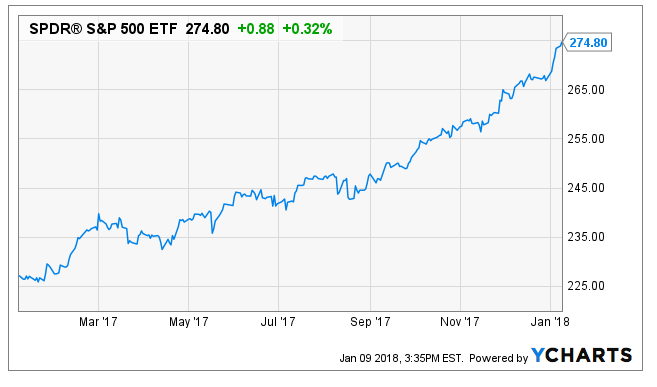
While others fretted in the beginning of 2017 that the market had peaked and was ripe for a deeper correction, I maintained my focus. Leaving the market in the beginning of 2017 would have cost an investor 20% of gains in that year and about 8 percent in the New Year before the recent correction.

Corrections market-wide and company specific continued to bring opportunities for income investors to enhance their income with higher dividend yields.

Since I"m an income investor, I"m always on the look-out for these types of opportunities. Though I strongly adhere to the notion that time in the market is crucial and necessary to see the fruits of a compounding dividend investment strategy blossom, I also adhere to the large benefits that can accrue to the income investor if a dollop of timing the market is layered on top.

Developing And Refining An Income Investing Strategy

My laser-focused strategy of buying temporarily depressed stock prices on investor panic has served me and my subscribers to "Retire 1 Dividend At A Time" well the past two years. Since the bottom of the financial crisis, which occurred on March 9, 2009, I have honed and refined the strategies I use to build, grow and protect income for retirement.

An important refinement to the strategy has been to rinse and repeat it as often as possible and as often as accumulated dividends become available for reinvestment. Though I think employing a DRIP strategy can be quite effective for less active investors, or those that don"t want to monitor their portfolios on an ongoing basis, I believe that accumulating dividends as they hit the brokerage account lets us take advantage, in a much more effective manner. This is especially true when panicked investors wish to dump perfectly good stock and sell it to us at undervalued prices, which happened two weeks ago when the market experienced a 10% correction.

source

Whenever this occurs, prices fall and yields will rise. It works the same way in the bond market. It is this simple mathematical relationship that gives rise to the extraordinarily higher yield and dividend dollar totals we are able to put up on the board.

Accumulation Of Dry Powder

Some detractors would criticize this approach to dividend accumulation. It is their contention that money should be put to work at all times so it can always generate income for us. They"ll throw all sheets to the wind and reinvest dividends no matter how high a price they pay.

It is my considered belief that holding some amount of accumulated dividends in cash allows us the choice to decide when to invest it, when it can get us the biggest bang for the buck. In this sense, we have often experienced that patience pays.

photo source

Staying 10% to 20% in cash most times allows for the deployment of cash when it can get us that biggest bang for the buck.

Dealing With Risk In The Market

In an effort to assuage the fears of readers, followers and subscribers, I counsel them to keep approximately three years of cash or cash equivalents in reserve. This allows the investor to realize that even if a large correction or crash occurs, just at the time they might want to begin drawing down funds for retirement spending, no stocks need to be sold to accomplish this goal. At such times, the cash hoard can be relied upon to pay the bills. This strategy will allow plenty of time for stock prices on high quality companies to rebound and reinvigorate the investor"s courage. The average large correction lasts about eighteen months.

Average length of Corrections

So, keeping a cash cushion that will last twice as long can only bring more comfort and keep the investor from selling in a panic, depriving themselves of the income that that stock created in the first place.

A decent cash pile can go a long way towards holding the investor"s hand and walk them calmly through any correction, even one as big as the one we experienced as recently as the Great Recession and financial crisis of 2008-2009.

Preparing For 2018

Preparation for 2018 revolves around the theme that interest rates are most certain to continue to rise in an increasingly strong economy, one that is gathering steam and will get an extra boost from a large tax cut for corporations. Buying those companies bound to benefit more from a huge tax cut will give greater certainty to the overall outcome of an investment in the year to come.

Companies with large net operating loss carry forwards will benefit less than companies who don"t have them. Citigroup (C), for instance, currently has $ 16 to $ 20 billion of these NLCs. With the corporate tax rate reduced from 35% to just 21%, Citigroup will save that much less on their tax bill and operating income will suffer.

Here"s an example to help illustrate:

A $ 10,000.00 loss at a 35% tax rate can save $ 3500 on a company"s tax bill. But at 21%, a $ 10,000 loss will be worth just $ 2100 in tax savings. This will necessarily negatively impact a company"s bottom line.

Net Deferred Tax Assets

Companies with net deferred tax assets - those with significant net operating loss carry forwards (NOLs) or those with substantial deductions taken for tax before book (e.g., litigation expenses, loan loss accruals, etc.) - will see the value of those net deferred tax assets decline. Very simply, a $ 1,000 NOL is worth $ 350 under the current tax law"s 35% corporate rate, but would only be worth $ 210 with the new corporate rate cut to 21%.

As discussed earlier, Citigroup has said that such a change would cost it $ 16-17 billion. As a consequence, some corporations were exploring how they might accelerate earnings more quickly into 2017 so as to apply those NOLs under the current higher tax regime while they are worth more. Using these NOLs would lower a company"s taxable income for 2017 and, by reducing current tax due, increase its cash.

In contrast, firms with a net deferred tax liability stand to benefit from the new lower 21% rate.

The banking theme offers opportunity in two distinct areas. The first is represented by the hunt for financial firms that have low NOL carry forwards and stand to benefit more than their high NOL carry forward competitors.

Additional Opportunity in 2018

Additional opportunity comes with the realization that with a Fed rate rise already promulgated at the December, 2017 FOMC meeting, and two or three additional hikes coming down the pike in 2018, the financials stand to gain from a widening of the spread. They"ll be able to still borrow at competitively low rates if their balance sheets are strong while at the same time being able to charge more for the loans they make and the auto loans, home equity loans and credit card fees they charge to consumers.

The sweet spot will be finding those banks that stand to gain from both phenomenon. The regional banks, like Regions Financial (RF), or BB&T Corporation (BBT) doing all their business domestically, would appear to represent a good starting place to explore these possibilities.

Best Ideas For 2018: What"s The Story?

I recently wrote, "Shopping At Tanger Outlets Bought Us A Bargain" to emphasize the benefits of contrarian investing. Along with other REITs and mall REITs in particular, this company lost around 40% of its market value as millions of investors decided, wrongly I think, that brick and mortar was dying. I strongly believe that news of the death of brick and mortar has been greatly exaggerated, and Tanger Outlets (SKT) serves a high-end niche market that will do well.

It is well for investors to realize that, though online retailing continues to grow by leaps and bounds, it still accounts for only about 15% of all shopping. It"s also wise to remember that consumer spending accounts for 70% of U.S. GDP.

photo source

Just a few weeks ago, we recommended purchase of SKT to our subscribers at $ 22.67. As I write this, it is changing hands at $ 25.26. This 11.4% gain in so short a time illustrates the capital appreciation that can be captured by going against the grain and executing on a solid idea with a high-quality company.

We obtained a high yield of 6.04% for our subscribers. Today"s buyer must settle for a much lower 5.4%. Because there"s always a sale somewhere in the market, this type of market timing can be employed multiple times throughout the year in any number of names.

source

We took another contrarian position on AT&T (T) recently and continue to believe it will play out well for investors in 2018, regardless of the outcome of the planned merger with Time Warner (TWX).

After the suits are finished litigating the lawsuit with the Department of Justice, if AT&T prevails, they"ll be able to handle the additional debt to do the deal. If the DOJ prevails, AT&T will simply move on to another friendly target that will aid in its adaptation to the future. Investors worried about the debt load will breathe easier and have new justification to buy the stock again, pushing its price ever higher. Author Michael Wolff wrote a best-selling book about the goings-on at the White House. He contends that numerous high-level White House advisors and staffers have said, "No way, this deal is not going to be approved". Take that for what it"s worth.

In the meantime, we recommended AT&T to subscribers and followers in recent posts, at $ 32.60 per share. We guided readers and subscribers to a solid 6.01% yield on a stalwart that normally yields closer to 5.00%.

As I write this, AT&T is currently trading for $ 39.19, just weeks after our purchase. Today"s income investor will have to settle for a dividend yield of just 5.10% as it reverts to that 5% mean just discussed. Again, this compares to the hefty yield we received of 6.01%. Once T raised its annual dividend to $ 2.00 a few weeks later, our yield on cost rose to 6.13%.

For those capital gainers out there, we"ve also scored capital appreciation of 20.2% on this new position.

Time In The Market Vs. Timing The Market

Income investors often say that "time in the market is more beneficial than timing the market". Because I"m a long-term investor, I subscribe to the first part of that statement. Because I"m also an opportunistic investor, I can also enhance my dividend stream by adhering to the second part as well. There is always a sale in the stock market, somewhere. You just need to know where to look for it.

Got A Pension?

Today, only 24% of workers are covered by traditional, defined benefit pensions at work. The rest of us must fend for ourselves. Big corporations who used to provide pensions now save enormous sums by no longer offering them. Instead, the other 76% have been encouraged to find ways to fill the gap between the meager amounts we’ll receive from Social Security and the actual spending needs we’ll all have in retirement. This was the genesis of the Fill-The-Gap Portfolio.

The Fill-The-Gap Portfolio

The FTG Portfolio contains a good helping of dividend growth stocks, like AT&T. It was built with the express purpose of benefiting from this and other strategies.

Three years ago, I began writing a series of articles on December 24, 2014, to demonstrate the real-life construction and management of a portfolio dedicated to growing income to close a yawning gap that so many millions of seniors and near-retirees face today between their Social Security benefit and retirement expenses.

The beginning article was entitled, "This Is Not Your Father"s Retirement Plan." This project began with $ 411,600 in capital that was deployed in such a way that each of the portfolio constituents yielded approximately equal amounts of yearly income.

The FTG Portfolio Constituents

Constructed beginning on 12/24/14, this portfolio now consists of 22 companies, including AT&T Inc (T)., Altria Group, Inc. (MO), Consolidated Edison, Inc. (ED), Verizon Communications (NYSE:VZ), CenturyLink, Inc. (NYSE:CTL), Main Street Capital (MAIN), Ares Capital (ARCC), British American Tobacco (BTI), Vector Group Ltd. (VGR), EPR Properties (EPR), Realty Income Corporation (O), Sun Communities, Inc. (SUI), Omega Healthcare Investors (OHI), W.P. Carey, Inc. (WPC), Government Properties Income Trust (GOV), The GEO Group (GEO), The RMR Group (RMR), Southern Company (SO), Chatham Lodging Trust (CLDT), DineEquity (DIN), and Iron Mountain, Inc. (IRM) and Kimco Realty Corp (KIM).

Because we bought most of these equities at cheaper prices since the inception of the portfolio and because most of our stocks have increased their dividends regularly, the yield on cost that we have achieved is 7.67% since launch on December 24, 2014. Current portfolio income, including recent dividend raises by AT&T and Realty Income, and our newest addition of AT&T shares, now totals $ 33,323.86, which is $ 2142.00 more annual income than the previous month. This represents a 6.5% annual income increase for the portfolio.

When added to the average couple"s Social Security benefit of $ 32,848.08, this $ 33,323.86 of additional supplemental income brings this couple annual income of $ 66,171.94. We note that the dividend income on this portfolio has now surpassed the amount coming from the Social Security benefit. This far surpasses the original goal set to achieve a total of $ 50,000.00, which is accepted as a fairly comfortable retirement income in many parts of the country. That being said, this average couple now has the means to splurge now and then on vacation travel, dinners out, travel to see the kids and grandkids and whatever else they deem interesting.

Taken all together, this is how the FTG Portfolio generates its annual income.

FTG Annual Dividend Income

Insert FTG 2018 Annual Dividend Income pic, here:

Chart source: the author

Your Takeaway

As discussed in “Even A Cloudy Crystal Ball Comes Into Focus Twice A Year”, paying too much attention to the everyday price swings, even with stodgy stalwarts like AT&T can drive investors to drink. But for those investors willing to be more proactive in their investing, there is a lot to be said for putting favored stocks on a watch list and exercising the patience to wait, and then pounce when others have thrown the stock out with the bathwater.

My aim was to demonstrate that great capital gains and enormous growth of portfolio income can be accomplished if an investor is willing to spice up his portfolio with a dash of market timing, now and then. AT&T’s yield, shooting up from its usual 5% range to 6.01% was something we could not ignore. We could not stand by passively and look that gift horse in the mouth. We acted, for ourselves, our readers who follow me, and subscribers.

With the ten-year Treasury rate convincingly smashing through a 2.2%-2.5% range that has held for quite some time, now is a good time for investors to sharpen their pencils and get their orders set up. Rising yields, as evidenced by the ten year Treasury bond ticking up to 2.95% last week, are already bringing down the prices of favored REIT investments for retirees who seek income. With each tick down in price, yields rise. It"ll be time soon to enter limit orders to grab some accidentally high yield once again and buttress our portfolios with additional income.

We all have mistakes we’ve made that we can learn from. The key is having the courage to look back upon them, learn from them, and then act upon the information learned.

In regard to our recent successful AT&T trade, we have been reminded, once again, “If AT&T trades down to a point where it yields 6%, I will buy it, I can buy it, and I did buy it”.

I continue to learn lessons, have tried to apply them and I try to share them with you.

Your Engagement Is Appreciated

As always, I look forward to your comments, discussion, and questions. Do you use DRIP investing? Have you occasionally employed market timing? What has been your experience and have you found it worthwhile towards your ultimate goal of growing income for retirement? Please let me know in the comment section how you approach these situations in your own portfolio and how you arrive at your decisions.

Author"s note: Should you be interested in reading any of my other articles detailing various strategies to enhance your returns on a dividend growth portfolio, you will find them here.

If you"d like to receive immediate notification as soon as I write new content, simply click the orange "follow" button at the top of this article next to my picture or at the bottom of the article, then click "Real time alerts."

Disclaimer: This article is intended to provide information to interested parties. As I have no knowledge of individual investor circumstances, goals, and/or portfolio concentration or diversification, readers are expected to complete their own due diligence before purchasing any stocks mentioned or recommended.

Disclosure: I am/we are long ALL FILL-THE-GAP PORTFOLIO STOCKS.

I wrote this article myself, and it expresses my own opinions. I am not receiving compensation for it (other than from Seeking Alpha). I have no business relationship with any company whose stock is mentioned in this article.


Tech