Gilead (GILD) is a biotech company with leading franchises in Hepatitis C, HIV, and emerging platforms in Oncology, Hepatitis B, and NASH. To an extent, Gilead is a victim of its own success. The company’s Hepatitis C (“HCV”) treatments cured the illness and for the last few years the company has seen its revenues fall as patient volumes have decreased. However, the decline of the company’s HCV franchise has masked significant progress the company has made in commercializing its HIV treatments. Furthermore, the company has generated a ton of cash which it has used to acquire companies with strong drug pipelines and engage in a number of clinical trials.
Because of all the investments that Gilead has made in its HIV franchise and in developing its pipeline, the company is strongly positioned for significant growth in new treatments. The HCV business has already declined to such a degree that it will be a much smaller driver of future earnings. This sets the stage for growth in 2019 and beyond. I expect investors to re-rate Gilead with a higher multiple once it returns to growth. Gilead’s current forward EV/EBIT multiple is 8.6x vs. the peer median at over 13x. Gilead could see its stock price rise over 50% in the next 18 months just from a valuation multiple re-rated to be in-line with peers as investors begin to appreciate the company"s new and emerging treatment franchises.
Gilead’s Hepatitis C Struggles
Gilead has had a storied history in the Hepatitis C market. The company entered the market through its $ 11 billion acquisition of Pharmasset which had late-stage clinical trials for its HCV treatments but was still pre-revenue.
Gilead’s Pharmasset acquisition was seen as risky at the time but proved to be very shrewd. By 2014, lead HCV drugs Harvoni and Solvaldi received US FDA approval. By 2015, Gilead’s HCV sales peaked at $ 19.2 billion, outselling all legacy treatments.
Gilead won the HCV market because its treatments were more effective; in fact, Gilead had a cure for the disease. As a result, beginning in 2016, the company saw HCV start to decline because patient volumes were falling due to a lack of repeat business. In addition to declining patient volumes, AbbVie and Merck have released new treatments with effectiveness on-par with Gilead and they have entered the HCV market at lower prices to aggressively take market share.
At its peak, Gilead generated $ 4.9 billion in HCV revenue per quarter. In the most recent Q2 2018 report, Gilead showed HCV revenue of just $ 1.0 billion.
Source: loncarblog.com Gilead’s HCV business is expected to continue declining, but the silver lining is that HCV represents a much smaller mix of Gilead’s overall business today than it did a few years ago. In 2016, HCV represented roughly 50% of total sales. In 2018E, HCV is expected to be less than 20% of total sales and HCV"s importance will only decline further in later years (source: SEC disclosures, Author’s estimate). What’s more is that the HCV declines may be more manageable from here. Future drug price declines and share losses will probably be less acute than what we have seen. At some point the sales will stabilize to some base level and will no longer be a headwind at all. Q2 2018 was actually encouraging in the sense that HCV sales did not significantly drop sequentially between Q1 and Q2, compared to prior quarters. All the drama from Gilead’s HCV business has taken everyone’s attention from Gilead’s blockbuster HIV business. Gilead has top-prescribed HIV drugs in both the US and Europe and is successfully transitioning from its earlier TDF treatments to its newer TAF treatments which are more effective and require patients to ingest fewer pills. Source: Gilead Q2 investor presentation. Based on the below table, Gilead has a 79% market share in US HIV treatments. Source: Gilead Q2 2018 presentation. Unlike Gilead’s HCV franchise, which was dominated by two drugs, the company has a dozen different HIV treatments, with several still in clinical trials, treating a wider range of variations on the condition. This makes the HIV franchise less reliant on single blockbusters and more durable in the face of competition. Gilead’s HIV business has grown from about $ 9 billion in 2013 sales to $ 13.6 billion in the most recent 12 month period (a roughly 10% annual growth rate). Over the next 10 years, Gilead’s HIV business is expected to grow sales at a mid-single digit annual rate (5% to 7% range). Estimates for Gilead’s HIV Treatment Growth Source: RBC Capital Markets. In recent years, the decline of HCV has masked the significant growth in HIV. Over the next few years, investors will better appreciate the growth as the HCV headwind fades in magnitude. Last year Gilead acquired Kite Pharma for $ 11 billion. This transaction was very similar to the Pharmasset acquisition Gilead made in 2011 which jump-started its HCV franchise. Kite was a pre-revenue oncology-focused biotech that is considered a leader in the emerging CAR-T treatment. CAR-T is a treatment which involves modifying a patient’s T-cells to make them more effective at fighting tumors. The Kite acquisition is already starting to pay-off. In October 2017 (just six weeks after the acquisition was announced), Kite received FDA approval for its first drug, Yescarta. Although Kite isn’t the only biotech working on CAR-T treatments, Yescarta was the second ever FDA approval for a CAR-T treatment and the first FDA approval for diffuse large B-cell lymphoma (“DLBCL”). Yescarta has generated $ 135 million in revenue since it was approved, $ 68 million of that was in the last quarter, clocking in 70% sequential q/q growth. Yescarta is currently undergoing regulatory review in Europe. Based on the early success of the drug and the large target market, Yescarta is expected to be a multi-billion dollar per year revenue generator by 2025 (source: PiperJaffray research report from May 30, 2018). In addition to Yescarta, Gilead has several oncology drugs acquired from Kite that are in stage 2 or stage 3 clinical trials. This is an encouraging sign that Gilead is developing a large cancer drug treatment franchise on par with or potentially even bigger than the company’s HIV business. As shown in the table below, Gilead has a couple dozen ongoing clinical trials at various stages. Some of these trials are in areas such as HIV, Hepatitis C, Hepatitis B, and oncology, where Gilead already has a presence and new drug approvals would be incremental to existing businesses or would simply extend a franchise. However, Gilead also has some exciting clinical trials in totally new drug markets such as NASH, solid cancer tumors, Rheumatoid Arthritis, Crohn’s Disease, and more. Specifically, treatments using the JAK1 inhibitor and related to liver diseases (NASH) and other forms of cancer, could each be multi-billion dollar annual revenue opportunities within the next 10 years. Today, Gilead trades for 8.6x EV / Forward EBIT. This compares to a peer median multiple of 14x. The obvious explanation for the discount in Gilead’s multiple is the comparison of its revenue declines vs. peers growing revenue at a double-digit rate on average. In other words, Gilead isn’t a sexy biotech story and has seen its stock price go nowhere for several years. Investors have simply given up on the stock after years of disappointment. However, Gilead is set to start growing again in 2019 and beyond. In fact, Gilead has a very exciting pipeline that could re-shape the entire company within the next few years. If certain pipeline events fall in line, Gilead’s revenue growth could significantly surprise to the upside. This has the potential to cause a re-rating in Gilead’s traded valuation multiple. If Gilead’s stock were to re-rate in-line with its peers, it could rise by over 50%. Furthermore, unlike many pharma pipeline bets, Gilead has real earnings supported by a thriving HIV business and a rapidly growing oncology business. Gilead’s earnings and its un-levered balance sheet provide solid downside in the event that the pipeline disappoints. Overall, I believe Gilead represents a very attractive risk-reward: little downside with significant potential upside. Management transition. In the most recent Q2 2018 earnings, the company announced that CEO John Milligan will be stepping down at the end of the year. Additionally, Board Chairman John Martin would also be stepping down. Successors have not yet been named and there is a significant risk that the next crop of leaders will not live up to the former leaders. Both Milligan and Martin are long-tenured executives with the company and their exits were a surprise to investors; however, they are leaving the company in good shape. Also, now that the company is diversifying into other treatment areas, it makes sense to bring in new leaders with broader pharma experience. Investors should keep a close eye on who the company chooses to succeed Milligan and Martin. Pipeline risk. Gilead’s pipeline presents significant future earnings possibilities, but the pipeline is not guaranteed to produce any major new drugs. To the extent that the ongoing clinical trials disappoint investors, Gilead’s stock price could suffer. However, given the current low valuation multiple placed by investors on the company, I would argue that investors haven’t placed extremely high value on the company’s pipeline. Therefore, to the extent the pipeline does produce exciting new drugs, the stock could significantly rise. Pharma pricing pressure. Perhaps the biggest unknown in the pharmaceutical space is how the regulatory and industry landscape will evolve. There is significant political pressure from both the Left and the Right to increase regulations over excessively high drug prices. Gilead has a reputation for high-priced drugs and could face reduced pricing power from current and future treatments. Additionally, PBMs and insurance companies are merging and are better positioned to negotiate lower drug prices. We simply do not know how much (or little) the industry’s pricing will change. Disclosure: I am/we are long GILD. I wrote this article myself, and it expresses my own opinions. I am not receiving compensation for it (other than from Seeking Alpha). I have no business relationship with any company whose stock is mentioned in this article.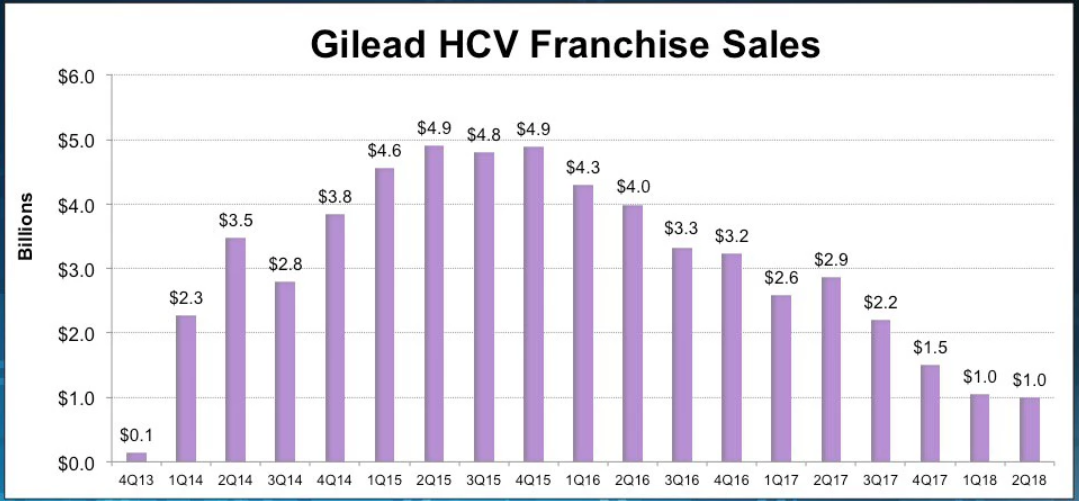
Gilead Has A World-Leading HIV Franchise
Gilead Is Developing A Premier Oncology Franchise
Gilead Has An Incredibly Robust Drug Pipeline
What Could Gilead’s Stock Be Worth?
Key Investment Risks
Tech
