Sunday, December 31, 2017

Free Web Hosting

by Ray Lam

Free web hosting can be very enticing to individuals and businesses that do not have enough money to afford good web hosting services. But is it something worth the time spent and efforts done?

Fortunately there are proven ways on how to determine the most suited web host for your requirements. First you have to do an extensive research. Gather as many information on free web hosting services. You can always do this by doing an online search at google or yahoo.

After compiling your list then decide the service that you want from a web host. Consider the advantages and disadvantages of availing the services of a particular web host. You might also want to ask around. Actually there are a lot of discussion forums on the Internet regarding free website hosting. Go around discussion boards and read. You can also ask people who have availed of free website hosting about their experiences in getting a free hosting service. This is a good way for you to learn about the pros as well as cons of getting such service.

Free web hosting also gave its users with sub domain name, making it almost impossible to be searched on in various search engines. This made most websites on free web host servers almost impossible to be found on search engines. Reliability was also a concern, troubling most business owners who availed of free website hosting. With all these problems arising, there"s little doubt that getting free website hosting is not that practical. It will not help websites particularly those selling products and services.

Remember, every free hosting firm will try to make money from your website. Look for a hosting firm, which is less intrusive and more reliable.

About the Author:


Facebook hires prominent artificial-intelligence expert to open Montreal lab

TORONTO (Reuters) - Facebook Inc plans to open an artificial-intelligence laboratory in Montreal, which will be run by prominent AI researcher Joelle Pineau, two people familiar with the plan said on Friday.
Tech

3 High-Yield Retailers To Benefit From Tax Reform

By Bob Ciura


The tax reform package that recently passed through Congress has major implications for investors. The tax plan is a major piece of legislation that will directly benefit large U.S. corporations, such as those that comprise the S&P 500. There are many components of the bill, perhaps the most significant of which is a permanent lowering of the corporate tax rate, from 35% to 21%.


A sharply lower corporate tax rate is a huge tailwind for large companies. Specifically, the retail industry is set to benefit, as many large U.S. retailers carry tax rates of 30%+. Meaningfully lower tax bills could result in much greater earnings to be distributed to shareholders, in the form of share repurchases and dividends.


With that in mind, we have identified 3 dividend-paying retail stocks that should benefit greatly from tax reform.


Retail Tax Winner #1: Target Corporation (TGT)


Dividend Yield: 3.8%


As previously mentioned, less money paid in taxes means more money available for shareholder distributions. Therefore, Target is an ideal choice for this list, because it is already a Dividend Aristocrat, which have increased their dividends for 25+ consecutive years You can see all 51 Dividend Aristocrats here.


Target has paid 200 quarterly dividends in a row, and has increased its dividend for 46 consecutive years. A corporate tax rate of 21% would greatly improve Target’s bottom line, since the company had an effective tax rate of 32%, according to ValueLine.


Target has had to spend aggressively to fight off online retail competition, led by Amazon (AMZN). As a result, Target’s earnings-per-share declined 6.2% over the first three quarters of 2017. The good news is, Target has surpassed analyst expectations for both revenue and earnings-per-share, in all three quarters to start the year. In the most recent quarter, Target’s comparable store sales increased 0.9%, while traffic rose 1.4%.


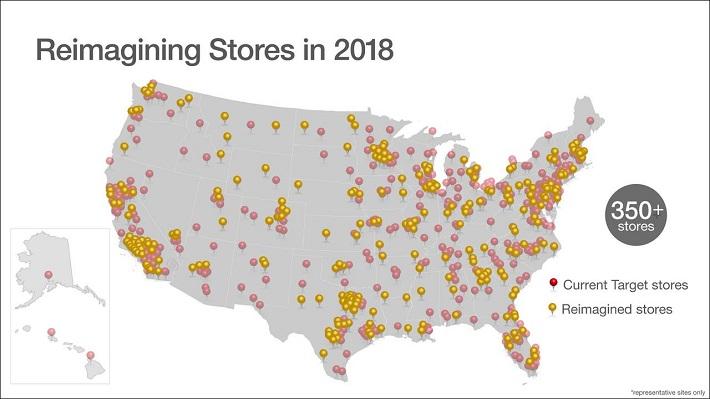
Target has launched several initiatives to return to growth. First, it is in the process of redeveloping hundreds of stores. To do this, it is modernizing layouts, and adding new product categories.


RenovationsSource: Earnings Presentation, page 84


Target expects it can achieve a 2%-4% lift in sales for each store it renovates. By 2018, the company expects to have completed reimagining on over 350 of its stores. By 2019, it will have reimagined over 600 stores, representing one-third of its total store count.


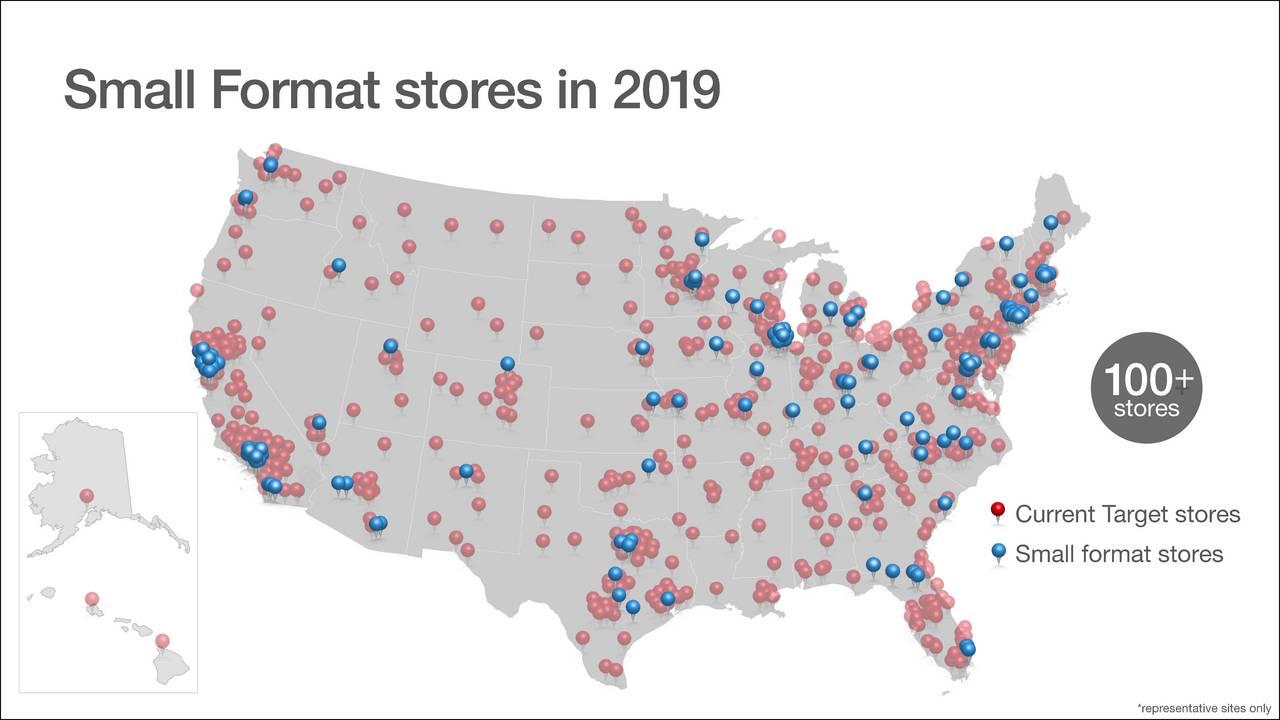
Another major growth catalyst for Target is its small stores, under the CityTarget and TargetExpress banners. These are stores with much less square footage, in places that cannot provide the necessary space to build a large store, such as urban areas and college campuses.


By 2019, Target expects to open over 100 small stores, triple the number of small stores currently in operation.


StoresSource: Earnings Presentation, page 77


Lastly, Target building its own e-commerce platform. Target’s comparable digital sales increased 24% last quarter. Target expanded its next-day delivery of essential items to eight new U.S. cities. And, Target recently acquired Shipt for $550 million in cash. Shipt is a same-day delivery service that will help Target improve its digital fulfillment, and compete better with Amazon.


Target has a secure dividend, with a 55% payout ratio using expected 2017 earnings. Its turnaround initiatives should return the company to growth, aided by tax reform. That means Target should have little trouble maintaining its Dividend Aristocrat status moving forward.


Retail Tax Winner #2: Macy’s (M)


Dividend Yield: 6.0%


Macy’s stock has declined approximately 30% year-to-date. This is no doubt a difficult period for Macy’s, but it has been through many ups and downs during its history. Macy’s has been in business since 1858. The combination of more than 100+ years in business, and a 3%+ dividend yield, earns Macy’s a spot on our list of “blue-chip” stocks. You can see our entire list of blue chip stocks here.


But with high dividend yield and low valuation, Macy’s could be a value and income opportunity for 2018. Macy’s declining share price has elevated its dividend yield to 6%. We believe stocks with 5%+ dividend yields to be especially attractive yields for income investors. You can see our entire list of all 397 stocks with 5%+ dividend yields here.


Macy’s would be a huge winner from tax reform, as it has a tax rate of 37% according to ValueLine. As a result, tax reform would be a major boost to Macy’s bottom line, and it could not come at a better time for the company. Department stores like Macy’s have been among the hardest-hit companies by the rise of e-commerce. In turn, Macy’s has had to invest huge sums of money into its core turnaround initiatives.


Macy’s earnings-per-share declined 38% in 2016. Over the first three quarters, adjusted earnings-per-share declined another 14%. For 2017, management expects comparable sales to decline 2% to 3%. However, the declines have slowed throughout 2017, which potentially positions Macy’s to return to growth next year.


Macy’s Backstage and Bluemercury stores are compelling growth catalysts. Last quarter, Macy’s opened eight new freestanding Bluemercury stores, bringing the total to 135. It also opened seven new Macy’s Backstage stores within existing Macy’s, and how has 45 locations. These store openings will help Macy’s expand in the beauty and off-price channels, which are growing categories.


In addition, Macy’s has a huge amount of real estate value on the balance sheet. Activist investor Starboard Value once pegged Macy’s real estate value at more than $20 billion. Starboard is no longer an investor, but even if its valuation was too aggressive, Macy’s could still be a bargain. The company has a current enterprise value of just $13.5 billion.


Macy’s annualized dividend payout of $1.51 represents a payout ratio of 48% to 52%, based on 2017 earnings guidance. As a result, Macy’s is appealing for value, and income.


Retail Tax Winner #3: Kohl’s (KSS)


Dividend Yield: 4.1%


Kohl’s has an attractive dividend yield slightly above 4%. Kohl’s is one of 674 stocks in the consumer cyclical sector that pays a dividend. You can see our list of all 674 dividend-paying consumer cyclical stocks here.


Like Macy’s, Kohl’s has a high tax rate, of 37.5%, which means it would also be a huge winner from a significantly lower tax rate. Kohl’s bottom line could use a boost—earnings-per-share declined by 10% in 2016.


Kohl’s has implemented several initiatives to restore growth, which appear to be gaining traction. With regard to Amazon, Kohl’s seems to have adopted a policy of “if you can’t beat ‘em, join ‘em.” In October, Kohl’s announced it will dedicate roughly 1,000 square feet inside its stores for Amazon smart-home spaces.


In these areas, consumers can purchase Amazon devices, such as the Echo and Fire tablets, along with accessories and smart home devices and services, directly from Amazon. The program initially launched in 10 stores, in Los Angeles and Chicago.


In addition, Kohl’s added Under Armour (UA) products to its active and wellness category earlier this year. This helped Kohl’s by adding one of the most popular brands, in a growth category.


As a result, Kohl’s results have improved over the course of 2017. Comparable sales declined 1% over the first three quarters of 2017, but this was far better than the 2.4% decline in the same nine-month period in 2016. Adjusted earnings-per-share were flat in the first three quarters of 2017. For the full year, Kohl’s expects adjusted earnings-per-share of $3.60 to $3.80, which easily covers the annualized dividend of $2.20.


Final Thoughts


Target, Macy’s, and Kohl’s all have dividend yields ranging from 3%-6%.


And, they all appear to be undervalued. They all have price-to-earnings ratios is the low teens. Investors became much more pessimistic toward these retailers over the past year, due to the intense competitive threats facing brick-and-mortar retailers.


However, Target, Macy’s, and Kohl’s are still highly profitable, and can easily cover their hefty dividends. Plus, they are each implementing strategic initiatives to return to growth moving forward. Tax reform could be just the catalyst needed to improve their valuations and earnings growth.


Looking for value stocks with even longer histories of dividend increases? Our service Undervalued Aristocrats provides actionable buy and sell recommendations on some of the most undervalued dividend growth stocks around. Click here to learn more.


Disclosure: I am/we are long TGT, M.


I wrote this article myself, and it expresses my own opinions. I am not receiving compensation for it (other than from Seeking Alpha). I have no business relationship with any company whose stock is mentioned in this article.

The Greatest Bubble Ever: Why You Better Believe It, Part 2

PART 2


As we explained in Part 1, the most dangerous place on the planet financially is now the Wall Street casino. In the months ahead, it will become ground zero of the greatest monetary/fiscal collision in recorded history.


For the first time ever both the Fed and the US treasury will be dumping massive amounts of public debt on the bond market---upwards of $1.8 trillion between them in FY 2019 alone---and at a time which is exceedingly late in the business cycle. That double whammy of government debt supply will generate a thundering "yield shock" which, in turn, will pull the props out from under equity and other risk asset markets----all of which have "priced-in" ultra low debt costs as far as the eye can see.


The anomalous and implicitly lethal character of this prospective clash can not be stressed enough. Ordinarily, soaring fiscal deficits occur early in the cycle. That is, during the plunge unto recession, when revenue collections drop and outlays for unemployment benefits and other welfare benefits spike; and also during the first 15-30 months of recovery, when Keynesian economists and spendthrift politicians join hands to goose the recovery----not understanding that capitalist markets have their own regenerative powers once the excesses of bad credit, malinvestment and over-investment in inventory and labor which triggered the recession have been purged.


By contrast, the Federal deficit is now soaring at the tail end (month #102) of an aging business expansion. And the cause is not the exogenous effects of so-called automatic fiscal stabilizers associated with a macroeconomic downturn, but deliberate Washington policy decisions made by the Trumpian GOP.


During FY 2019, for example, these discretionary plunges into deficit finance include slashing revenue by $280 billion, while pumping up an already bloated baseline spending level of $4.375 trillion by another $200 billion for defense, disasters, border control, ObamaCare bailouts and domestic pork barrel of every shape and form.


These 11th hour fiscal maneuvers, in fact, are so asinine that the numbers have to be literally seen to be believed. To wit, an already weak-growth crippled revenue baseline will be cut to just $3.4 trillion, while the GOP spenders goose outlays toward the $4.6 trillion mark.


That"s right. Nine years into a business cycle expansion, the King of Debt and his unhinged GOP majority on Capitol Hill have already decided upon (an nearly implemented) the fiscal measures that will result in borrowing 26 cents on every dollar of FY 2019 spending. JM Keynes himself would be grinning with self-satisfaction.


Moreover, this foolhardy attempt to re-prime-the-pump nearly a decade after the Great Recession officially ended means that monetary policy is on its back foot like never before.


What we mean is that both Bernanke and Yellen were scared to death of the tidal waves of speculation that their money printing policies of QE and ZIRP had fostered in the financial markets. So once the heat of crisis had clearly passed and the market had recovered its pre-crisis highs in early 2013, they nevertheless deferred, dithered and procrastinated endlessly on normalization of interest rates and the Fed"s elephantine balance sheet.


So what we have now is a central bank desperately trying to recapture lost time via its "automatic pilot" commitment to systematic and sustained balance sheet shrinkage at fixed monthly dollar amounts. This unprecedented "quantitative tightening" or QT campaign has already commenced at $1o billion of bond sales per month (euphemistically described as "portfolio run-off" by the Eccles Building) during the current quarter and will escalate automatically until it reaches $50 billion per month ($600 billion annualized) next October .


Needless to say, that"s the very opposite of the "accommodative" Fed posture and substantial debt monetization which ordinarily accompanies an early-cycle ballooning of Uncle Sam"s borrowing requirements. And the present motivation of our Keynesian monetary central planners is even more at variance with the normal cycle.


To wit, they plan to stick with QT come hell or high water because they are in the monetary equivalent of a musket reloading mode. Failing to understand that the main street economy essentially recovered on its own after the 2008-2009 purge of the Greenspanian excesses (and that"s its capacity to rebound remains undiminished), the Fed is desperate to clear balance sheet headroom and regain interest rate cutting leverage so that it will have the wherewithal to "stimulate" the US economy out of the next recession.


Needless to say, this kind of paint-by-the-numbers Keynesianism is walking the whole system right into a perfect storm. When the GOP-Trumpian borrowing bomb hits the bond market next October we will already be in month #111 of the current expansion cycle and as the borrowing after-burners kick-in during the course of the year, FY 2019 will close out in month #123.


Here"s the thing. The US economy has never been there before. Never in the recorded history of the republic has a business expansion lasted 123 months. During the post-1950 period shown below, the average expansion has been only 61 months and the two longest ones have their own disabilities.


The 105 month expansion during the 1960s was fueled by LBJ"s misbegotten "guns and butter" policies and ended in the dismal stagflation of the 1970s. And the 119 month expansion of the 1990s reflected the Greenspan fostered household borrowing binge and tech bubbles that fed straight into the crises of 2008-2009.


Yet the Trumpian-GOP has not only presumed to pump-up the fiscal deficit to 6.2% of GDP just as the US economy enters the terra incognito range of the business cycle (FY 2019); it has actually declared its virtual abolition. Ironically, in fact, on December 31, 2025 nearly all of the individual income cuts expire----meaning that in FY 2026 huge tax increases will smack the household sector at a $200 billion run-rate!


But not to worry. The GOP"s present-day fiscal geniuses insist that the current business expansion, which will then be 207 months old, will end up no worse for the wear. The public debt will then total $33 trillion or 130% of GDP---even as the US economy gets monkey-hammered by huge tax increase.


Alas, no harm, no foul. The business expansion is presumed to crank forward through FY 2027 or month #219.
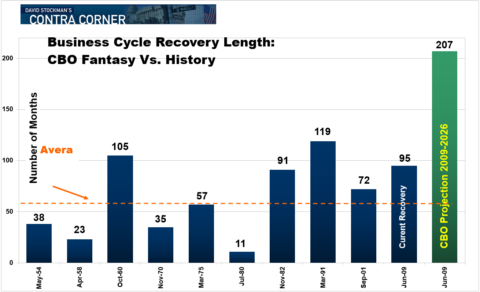


Needless to say, the whole thing degenerates into a sheer fiscal and economic fairy-tale when you examine the data and projections. But that hasn"t deterred the GOP"s fiscal dreamers.


Not only have they implicitly embraced an out-of-this-word 219 month business cycle expansion, but they have also insisted it will unfold at an average nominal GDP growth rate that has not been remotely evident at any time during the 21st century.


As shown in the chart below, the 10-year CBO forecast of nominal GDP (yellow line) is already quite optimistic relative to where GDP would print under the actual growth rate of the last ten-years (blue line). In fact, the CBO forecast generates $16 trillion of extra GDP and nearly $3 trillion more Federal revenue than would a replay of the last 10-years---and notwithstanding the massive fiscal and monetary stimulus during that period.


Still, the GOP/Trump forecast (grey line) assumes a full percentage point of higher GDP growth on top of CBO and no intervening recession and resulting GDP relapse.


Accordingly, the GOP assumes $30 trillion of extra GDP over the coming decade or nearly 23%more than would be generated by the actual growth rate (blue line) of the last decade; and consequently, $6 trillion of extra revenue.


That"s right. An already geriatric business cycle is going t0 rear-up on its hind legs and take off into a new phase of growth in the face of an epochal pivot of monetary policy to QT and a public debt burden relative to GDP that is approaching a Greek-style end game.
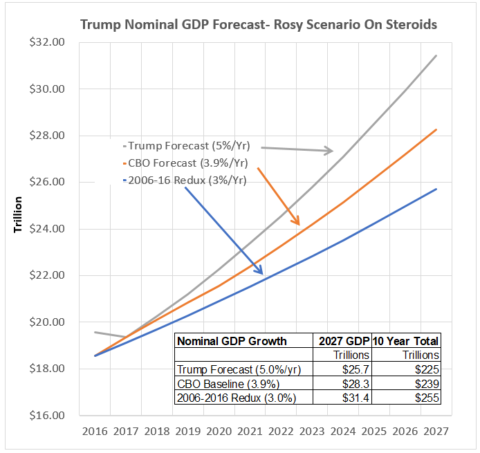


(Note: Figures in the box are inverted. First line should be 2006-2012 redux and third line should be Trump forecast.)


Stated differently, fiscal policy has descended into the hands of political mad-men at the very time that monetary policy is inexorably slouching toward normalization. Under those circumstances there is simply no way of avoiding the "yield shock" postulated above, and the cascading "reset" of financial asset prices that it will trigger across the length and breadth of the financial system.


As usual, however, the homegamers are the last to get the word. The unaccountable final spasm of the stock market in 2017 will undoubtedly come to be seen as the last call of the sheep to the slaughter. And owing to the speculative mania that has been fostered by the Fed and its fellow-traveling central banks, it now appears that the homegamers are all-in for the third time since 1987.


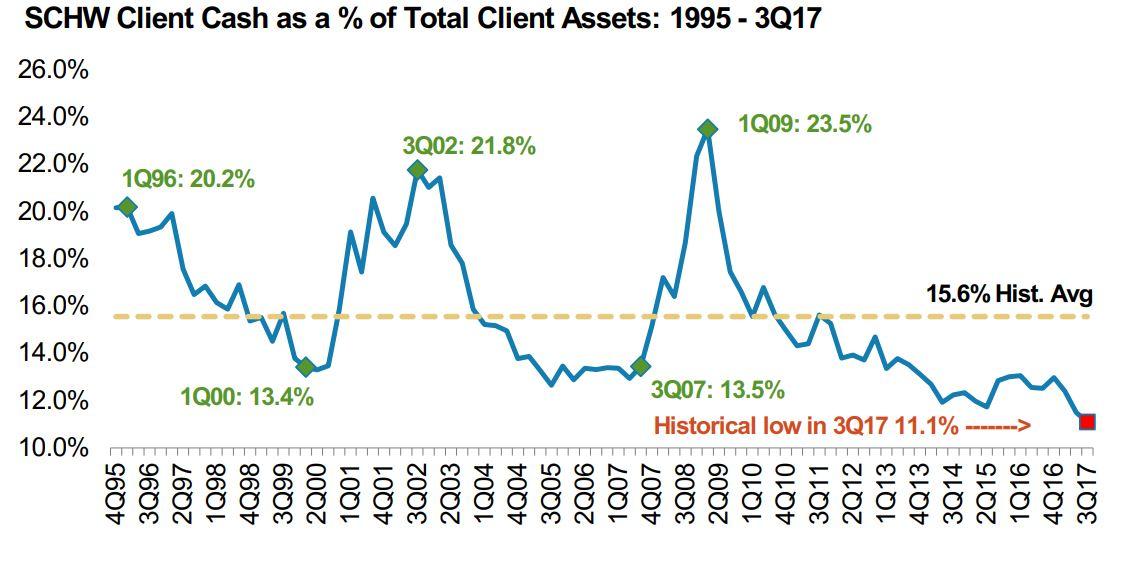
Indeed, Schwab"s retail clients have never, ever had lower cash allocations than at the present time---not even during the run-up to the dotcom bust or the great financial crisis.


But this time these predominately baby-boom investors are out of time and on the cusp of retirement---if not already living on one of the Donald"s golf resorts. When the crash comes they will have no opportunity to recover----nor will Washington have the wherewithal to stimulate another phony facsimile of the same.


The GOP-Trumpian gang has already blown their wad on fiscal policy and the Fed is stranded high and dry still close the zero-bound and still saddled with an elephantine balance sheet.


That is, what is fundamentally different about the greatest financial bubble yet is that there is no possibility of a quick policy-induced reflation after the coming crash. This time the cycle will be L-shaped----- with financial asset prices languishing on the post-crash bottom for years to come.


And that is a truly combustible condition. That is, 65% of the retirement population already lives essentially hand-to-month on social security, Medicare and other government welfare benefits (food stamps and SSI, principally). But after the third financial bubble of this century crashes, tens of millions more will be driven close to that condition as their 401Ks again evaporate.


That"s why the fiscal game being played by the Donald and his GOP confederates is so profoundly destructive. Now is the last time to address the entitlement monster, but they have decided to throw fiscal caution to the winds and borrow upwards of $1.6 trillion (with interest) to enable US corporations to fund a new round of stock buybacks, dividend increases and feckless, unproductive M&A deals.


Then again, what the GOP has not forgotten is the care and feeding of its donor class. That mission is being accomplished handsomely as it fills up the deep end of the Swamp with pointless, massive defense spending increases and satisfies K-Street with a grotesquely irresponsible tax bill that was surely of the lobbies, by the PACs and for the money.


At the end of the day, however, the laws of free markets and sound finance will out. The coming crash of the greatest bubble ever will prove that in spades.


The Greatest Bubble Ever: Why You Better Believe It, Part 2

PART 2


As we explained in Part 1, the most dangerous place on the planet financially is now the Wall Street casino. In the months ahead, it will become ground zero of the greatest monetary/fiscal collision in recorded history.


For the first time ever both the Fed and the US treasury will be dumping massive amounts of public debt on the bond market---upwards of $1.8 trillion between them in FY 2019 alone---and at a time which is exceedingly late in the business cycle. That double whammy of government debt supply will generate a thundering "yield shock" which, in turn, will pull the props out from under equity and other risk asset markets----all of which have "priced-in" ultra low debt costs as far as the eye can see.


The anomalous and implicitly lethal character of this prospective clash can not be stressed enough. Ordinarily, soaring fiscal deficits occur early in the cycle. That is, during the plunge unto recession, when revenue collections drop and outlays for unemployment benefits and other welfare benefits spike; and also during the first 15-30 months of recovery, when Keynesian economists and spendthrift politicians join hands to goose the recovery----not understanding that capitalist markets have their own regenerative powers once the excesses of bad credit, malinvestment and over-investment in inventory and labor which triggered the recession have been purged.


By contrast, the Federal deficit is now soaring at the tail end (month #102) of an aging business expansion. And the cause is not the exogenous effects of so-called automatic fiscal stabilizers associated with a macroeconomic downturn, but deliberate Washington policy decisions made by the Trumpian GOP.


During FY 2019, for example, these discretionary plunges into deficit finance include slashing revenue by $280 billion, while pumping up an already bloated baseline spending level of $4.375 trillion by another $200 billion for defense, disasters, border control, ObamaCare bailouts and domestic pork barrel of every shape and form.


These 11th hour fiscal maneuvers, in fact, are so asinine that the numbers have to be literally seen to be believed. To wit, an already weak-growth crippled revenue baseline will be cut to just $3.4 trillion, while the GOP spenders goose outlays toward the $4.6 trillion mark.


That"s right. Nine years into a business cycle expansion, the King of Debt and his unhinged GOP majority on Capitol Hill have already decided upon (an nearly implemented) the fiscal measures that will result in borrowing 26 cents on every dollar of FY 2019 spending. JM Keynes himself would be grinning with self-satisfaction.


Moreover, this foolhardy attempt to re-prime-the-pump nearly a decade after the Great Recession officially ended means that monetary policy is on its back foot like never before.


What we mean is that both Bernanke and Yellen were scared to death of the tidal waves of speculation that their money printing policies of QE and ZIRP had fostered in the financial markets. So once the heat of crisis had clearly passed and the market had recovered its pre-crisis highs in early 2013, they nevertheless deferred, dithered and procrastinated endlessly on normalization of interest rates and the Fed"s elephantine balance sheet.


So what we have now is a central bank desperately trying to recapture lost time via its "automatic pilot" commitment to systematic and sustained balance sheet shrinkage at fixed monthly dollar amounts. This unprecedented "quantitative tightening" or QT campaign has already commenced at $1o billion of bond sales per month (euphemistically described as "portfolio run-off" by the Eccles Building) during the current quarter and will escalate automatically until it reaches $50 billion per month ($600 billion annualized) next October .


Needless to say, that"s the very opposite of the "accommodative" Fed posture and substantial debt monetization which ordinarily accompanies an early-cycle ballooning of Uncle Sam"s borrowing requirements. And the present motivation of our Keynesian monetary central planners is even more at variance with the normal cycle.


To wit, they plan to stick with QT come hell or high water because they are in the monetary equivalent of a musket reloading mode. Failing to understand that the main street economy essentially recovered on its own after the 2008-2009 purge of the Greenspanian excesses (and that"s its capacity to rebound remains undiminished), the Fed is desperate to clear balance sheet headroom and regain interest rate cutting leverage so that it will have the wherewithal to "stimulate" the US economy out of the next recession.


Needless to say, this kind of paint-by-the-numbers Keynesianism is walking the whole system right into a perfect storm. When the GOP-Trumpian borrowing bomb hits the bond market next October we will already be in month #111 of the current expansion cycle and as the borrowing after-burners kick-in during the course of the year, FY 2019 will close out in month #123.


Here"s the thing. The US economy has never been there before. Never in the recorded history of the republic has a business expansion lasted 123 months. During the post-1950 period shown below, the average expansion has been only 61 months and the two longest ones have their own disabilities.


The 105 month expansion during the 1960s was fueled by LBJ"s misbegotten "guns and butter" policies and ended in the dismal stagflation of the 1970s. And the 119 month expansion of the 1990s reflected the Greenspan fostered household borrowing binge and tech bubbles that fed straight into the crises of 2008-2009.


Yet the Trumpian-GOP has not only presumed to pump-up the fiscal deficit to 6.2% of GDP just as the US economy enters the terra incognito range of the business cycle (FY 2019); it has actually declared its virtual abolition. Ironically, in fact, on December 31, 2025 nearly all of the individual income cuts expire----meaning that in FY 2026 huge tax increases will smack the household sector at a $200 billion run-rate!


But not to worry. The GOP"s present-day fiscal geniuses insist that the current business expansion, which will then be 207 months old, will end up no worse for the wear. The public debt will then total $33 trillion or 130% of GDP---even as the US economy gets monkey-hammered by huge tax increase.


Alas, no harm, no foul. The business expansion is presumed to crank forward through FY 2027 or month #219.


Needless to say, the whole thing degenerates into a sheer fiscal and economic fairy-tale when you examine the data and projections. But that hasn"t deterred the GOP"s fiscal dreamers.


Not only have they implicitly embraced an out-of-this-word 219 month business cycle expansion, but they have also insisted it will unfold at an average nominal GDP growth rate that has not been remotely evident at any time during the 21st century.


As shown in the chart below, the 10-year CBO forecast of nominal GDP (yellow line) is already quite optimistic relative to where GDP would print under the actual growth rate of the last ten-years (blue line). In fact, the CBO forecast generates $16 trillion of extra GDP and nearly $3 trillion more Federal revenue than would a replay of the last 10-years---and notwithstanding the massive fiscal and monetary stimulus during that period.


Still, the GOP/Trump forecast (grey line) assumes a full percentage point of higher GDP growth on top of CBO and no intervening recession and resulting GDP relapse.


Accordingly, the GOP assumes $30 trillion of extra GDP over the coming decade or nearly 23%more than would be generated by the actual growth rate (blue line) of the last decade; and consequently, $6 trillion of extra revenue.


That"s right. An already geriatric business cycle is going t0 rear-up on its hind legs and take off into a new phase of growth in the face of an epochal pivot of monetary policy to QT and a public debt burden relative to GDP that is approaching a Greek-style end game.


(Note: Figures in the box are inverted. First line should be 2006-2012 redux and third line should be Trump forecast.)


Stated differently, fiscal policy has descended into the hands of political mad-men at the very time that monetary policy is inexorably slouching toward normalization. Under those circumstances there is simply no way of avoiding the "yield shock" postulated above, and the cascading "reset" of financial asset prices that it will trigger across the length and breadth of the financial system.


As usual, however, the homegamers are the last to get the word. The unaccountable final spasm of the stock market in 2017 will undoubtedly come to be seen as the last call of the sheep to the slaughter. And owing to the speculative mania that has been fostered by the Fed and its fellow-traveling central banks, it now appears that the homegamers are all-in for the third time since 1987.


Indeed, Schwab"s retail clients have never, ever had lower cash allocations than at the present time---not even during the run-up to the dotcom bust or the great financial crisis.


But this time these predominately baby-boom investors are out of time and on the cusp of retirement---if not already living on one of the Donald"s golf resorts. When the crash comes they will have no opportunity to recover----nor will Washington have the wherewithal to stimulate another phony facsimile of the same.


The GOP-Trumpian gang has already blown their wad on fiscal policy and the Fed is stranded high and dry still close the zero-bound and still saddled with an elephantine balance sheet.


That is, what is fundamentally different about the greatest financial bubble yet is that there is no possibility of a quick policy-induced reflation after the coming crash. This time the cycle will be L-shaped----- with financial asset prices languishing on the post-crash bottom for years to come.


And that is a truly combustible condition. That is, 65% of the retirement population already lives essentially hand-to-month on social security, Medicare and other government welfare benefits (food stamps and SSI, principally). But after the third financial bubble of this century crashes, tens of millions more will be driven close to that condition as their 401Ks again evaporate.


That"s why the fiscal game being played by the Donald and his GOP confederates is so profoundly destructive. Now is the last time to address the entitlement monster, but they have decided to throw fiscal caution to the winds and borrow upwards of $1.6 trillion (with interest) to enable US corporations to fund a new round of stock buybacks, dividend increases and feckless, unproductive M&A deals.


Then again, what the GOP has not forgotten is the care and feeding of its donor class. That mission is being accomplished handsomely as it fills up the deep end of the Swamp with pointless, massive defense spending increases and satisfies K-Street with a grotesquely irresponsible tax bill that was surely of the lobbies, by the PACs and for the money.


At the end of the day, however, the laws of free markets and sound finance will out. The coming crash of the greatest bubble ever will prove that in spades.