Investment Thesis
In my last article, I took a dive into Digital Realty Trust (DLR) and discussed why Data Center Real Estate Investment Trusts (REITs) are a great way to invest in the tech sector while minimizing the risk associated with such a rapidly changing field. It was brought to my attention in the comments that CyrusOne (CONE) has recently received an upgrade from Ba3 to Ba2 by Moody"s. CONE is the second largest REIT holding in my clients" portfolio, and so I decided that this is a great opportunity to revisit CONE"s financials and examine what this debt upgrade might mean going forward.
Like DLR, I believe that CONE is a great investment for dividend and total return investors alike. The advantage CONE has over DLR is that it is approximately 25% the size of DLR, which means that any growth and acquisitions are likely to "move the needle" when it comes to total returns. CONE"s management has demonstrated its ability to balance shareholder returns through dividends and capital growth while also building what should soon be an investment-grade balance sheet.
Background
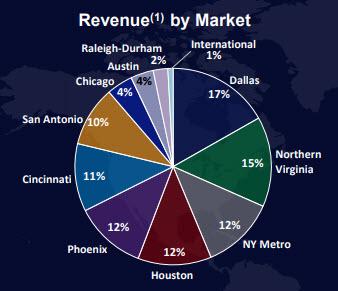
CONE is headquartered out of Dallas, TX, and has been in operation for more than 16 years but has been publicly listed since January 18, 2013. CONE"s data centers are primarily located in the US, but have begun to expand internationally (currently 1% of revenue is derived from international markets). CONE previously announced a strategic initiative for expansion in Europe and subsequently acquired Zenium which came with four data centers located in London and Frankfurt, both of which are considered Europe"s largest data center markets.
Size and Diversification
When it comes to data centers REITs, CONE comes in at the middle of the pack in regard to market capitalization and enterprise value.
- Equinix (EQIX) - Market capitalization of $33.3 billion and an enterprise value of $41.7 billion.
- DLR - Market capitalization of $21.8 billion and an enterprise value of $33 billion.
- CyrusOne - Market capitalization of $5.8 billion and an enterprise value of $7.8 billion.
- CoreSite Realty (COR) - Market capitalization of $5.2 billion and an enterprise value of $6.4 billion.
- QTS Realty Trust (QTS) - Market capitalization of $2.0 billion and an enterprise value of $3.5 billion.
Based on size alone, I would consider an investment in CONE to be slightly riskier than an investment in DLR or EQIX.
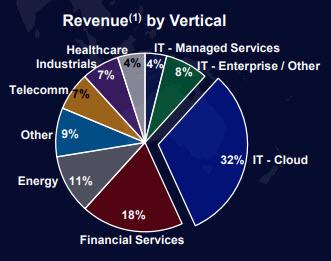
Given its size, CONE has taken measures to diversify its client base as it now provides services for 200 of the Fortune 1000 (3 of which were acquired in Q1-2018). Here is a snapshot of Q1-2018 revenues by industry type:
Source: CONE Q1-2018 Earnings Presentation
Source: CONE Q1-2018 Earnings Presentation
The primary concern I have with CONE in comparison to DLR is that it doesn"t have the size to service larger clients. While CONE may have the size of its larger competitors, it did boast a client profile that allowed it to generate 65% of revenues from investment grade clients. Additionally, my concern about CONE"s size was largely mitigated by the fact that the demand for data center services continues to grow which offers more certainty over the long run.
Moody"s Debt Upgrade
On June 22, 2018, Moody"s upgraded CONE"s Senior unsecured and corporate family ratings to Ba2 from a previous rating of Ba3. The last time CONE received an upgrade was on July 5, 2017, when Moody"s upgraded CONE from B1 to Ba3.
In reviewing both sets of upgrades, there were a number of common characteristics that were cited as reasons why CONE"s debt was worthy of an upgrade.
- A significant increase in portfolio scale
- Solid lease maturity schedule
- Improved debt maturity schedule
The lease maturity schedule is one of the better improvements (in my opinion) as the average lease maturity stood at 5.1 years at the end of Q1-2018. This compares to an average lease maturity of 4.4 years at the end of Q1-2017 and 2.9 years at the end of Q1-2016.
Here are some important figures that contributed to the upgrade:
- Net debt to EBITDA of 5.0x.
- Fixed charge ratio above 3.8x.
- EBITDA margins of 55.7%.
Moody"s points out that there could be another upgrade in the near future based on the following conditions (on a sustained basis):
- Net debt to EBITDA below 5.5x.
- Fixed charge ratio above 4.0x.
- EBITDA margins above 55%.
Consequently, CONE could see its rating outlook revised to stable if the same metrics exceed the following:
- Net debt to EBITDA exceeds 6.0x.
- Fixed charge ratio below 3.5x.
- EBITDA margins below 50%.
Given all of these factors, fixed charge coverage remains an area of concern as CONE has seen coverage drop from 4.4x in Q1-2017 to 3.8x in Q1-2018. While 3.8x still represents decent coverage, the concern about this metric comes from CONE"s high reliance on variable-rate debt (currently 45%) in a rising interest rate environment.
Debt
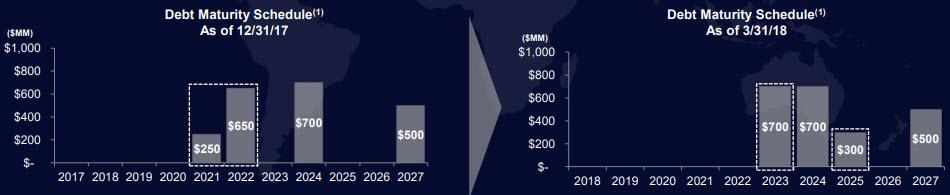
CONE restructured a significant portion of its debt at the end of March and extended its weighted average debt term to 6.5 years. Additionally, it has pushed its nearest debt maturity from 2021 to 2023, which ultimately provides extreme financial flexibility.
Source: CONE Q1-2018 Earnings Presentation
Here are some important details concerning CONE"s debt:
- $2.2 billion of long-term debt compared to gross assets of $5.3 billion.
- $1.7 billion available under its revolving credit facility.
- $228.7 million of cash and cash equivalents.
- $346 million remains available under CONE"s ATM equity program.
Overall, I believe that CONE has done an excellent job of balancing growth with responsible balance sheet management.
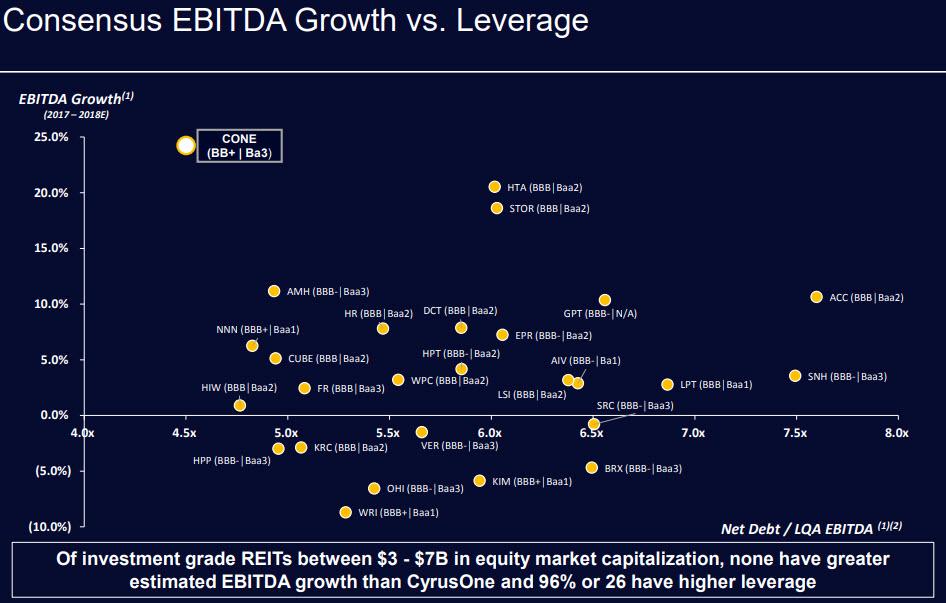
I found it extremely compelling that CONE offers EBITDA growth well above other REITs with similar market capitalization ($3-7 billion), while at the same time, continuing to maintain much lower leverage.
Source: CONE Q1-2018 Earnings Presentation
I admit that it can seem trivial to compare CONE against indirect REIT competitors, but I believe it offers meaningful insight into management"s ability to continue responsibly growing the company going forward.
Dividend
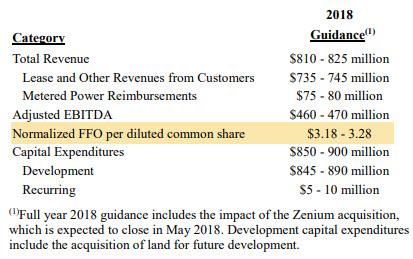
For those who may be unfamiliar with REITs, it is important to pay attention to Adjusted Funds From Operations (AFFO) and Funds From Operations (FFO) when determining the safety of the dividend payout ratio. In its most recent earnings report, CONE reaffirmed its earnings guidance for the full year of 2018.
Source: CONE Q1-2018 Earnings Presentation
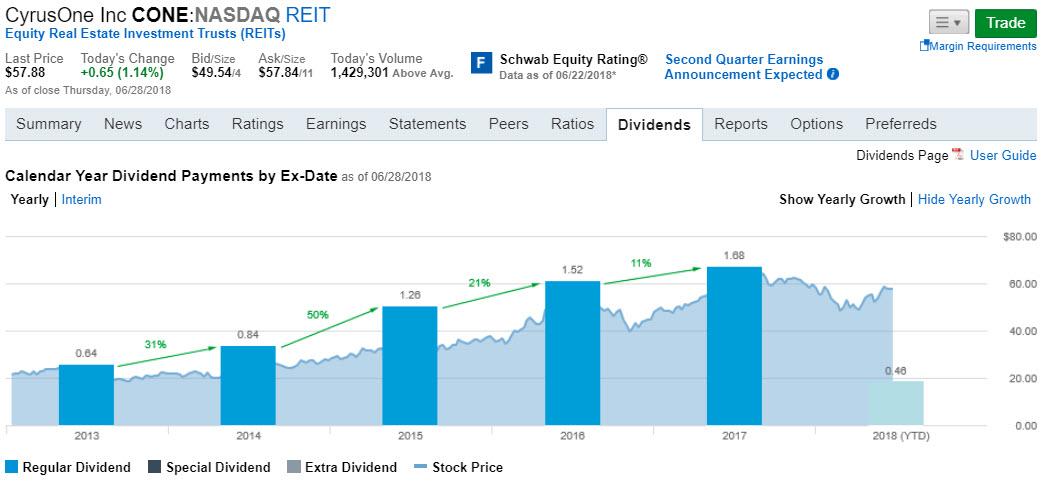
Assuming FFO comes in at the same level as guidance suggests, CONE would be looking at an FFO payout ratio between 56% and 58%. A low payout ratio increases CONE"s financial flexibility while also allowing it to continue passing on meaningful dividend increases to shareholders.
Source: Charles Schwab
Although the REIT doesn"t come with the same track record as DLR, it has proven that it is more than willing to reward shareholders as its success continues to grow.
Conclusion
CONE"s recent upgrade builds on the momentum that it has created over the last several years and should hopefully result in greater interest savings and increased financial flexibility. The latter is especially important going forward as we continue to explore uncharted territory when it comes to interest rates. It is also worth noting that the debt upgrade is likely to land CONE on the radar of prospective investors (or put it at least one step closer) since there are many who use investment grade rating as a cut-off. It is important to reiterate that there are still a number of significant risks that threaten CONE"s progress on growth and its continued improvement of the financial metrics mentioned in this article.
I personally rate CONE as a BUY at current prices and a Strong BUY at anything less than $52/share. Although CONE is considered riskier than its larger counterpart DLR, I assign CONE a higher price/FFO because of its potential for growth and continued improvement of financial metrics suggests that it will outperform DLR. Using a Price/FFO of 22x and an FFO of $3.18/share (based on 2018 guidance), I believe a fair long-term price for CONE is approximately $70/share or an upside of nearly 21% based on a closing price of $57.88/share.
Final Note: If you enjoy my articles, please take the time to follow me. While I enjoy performing analysis, following me is the best method for showing me that SA subscribers are finding my work useful. I welcome all meaningful feedback, and I enjoy using the Seeking Alpha platform to enhance and improve my own knowledge as well. My promise to readers is to be as open and transparent as I can be. The numbers presented are accurate as of the time I wrote this article.
Disclosure: I/we have no positions in any stocks mentioned, but may initiate a long position in CONE over the next 72 hours.
I wrote this article myself, and it expresses my own opinions. I am not receiving compensation for it (other than from Seeking Alpha). I have no business relationship with any company whose stock is mentioned in this article.
Additional disclosure: My clients are long the following: DLR, CONE
This article reflects my own personal views and is not meant to be taken as investment advice. It is recommended that you do your own research. This article was written on my own and does not reflect the views or opinions of my employer.

No comments:
Post a Comment