We hear a common refrain all the time, especially in comment sections here on Seeking Alpha. Readers and investors are in a constant state of fear whenever interest rates rise. They ask:
"Should I sell my REITs?"
Others retort:
"REITs are the worst equity class to own when rates rise".
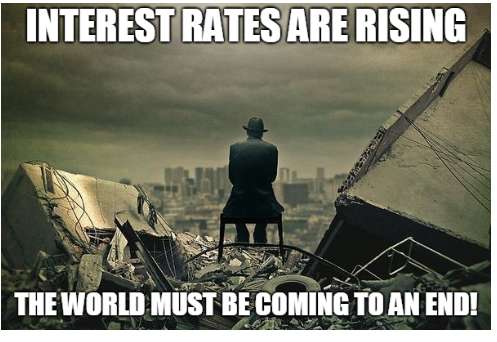
You"d think, with each bump-up of interest rates, the world is coming to an end.
The FOMC committee of the Federal Reserve announced on Wednesday that it had raised the benchmark Fed funds rate by .25%, the second such raise this year.
Not only that but also it pronounced the economy so healthy, so strong, that its intention is to raise this closely watched rate two more times before the end of this year.
The U.S. economy is in "great shape," the Fed indicated, and no longer needs the historically low interest rates that were put in place in the aftermath of the financial crisis to stimulate growth.
"The main takeaway is that the economy is doing very well," Fed Chairman Jerome H. Powell said in a news conference after the announcement. "Most people who want to find jobs are finding them, and unemployment and inflation are low."
Source: Washington Post
He continued:
The economy is very strong, the labor market is strong, growth is strong.
In its stance, the Fed signaled that it intends to do two more rate hikes this year, instead of just one. This now puts the Fed on track for a total of four rate hikes in 2018. The Fed hasn"t done this since 2006. So, we"re on notice. As long as the Fed continues to see strengthening in the economy, continuing job adds and lessening unemployment, we should expect slow but steady increases in the Fed funds rate in order to keep the economy from overheating and inflation getting out of control.
Mr. Powell is continuing in the same path as Fed chairs Ben Bernanke and Janet Yellen. Steady as she goes. Don"t rock the boat.
Market Reaction?
So, how did the markets react to this latest rise in the Fed funds rate? With a big resounding nothing burger, that"s how.
And the REITs? How did investors vote their REIT shares? Follow the red check marks in the following chart.
Fill-The-Gap Portfolio, mid-afternoon, June 14, 2018
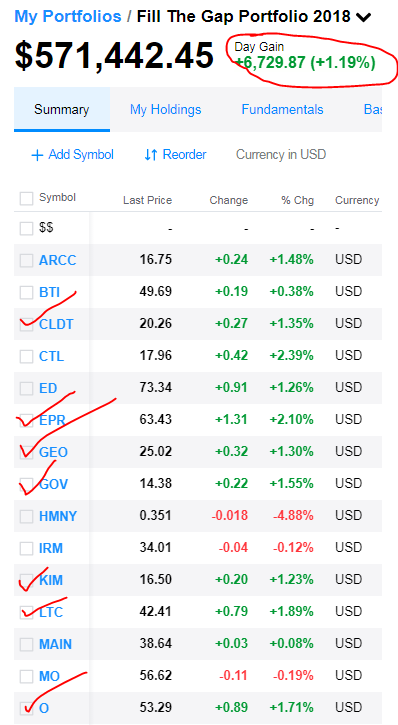
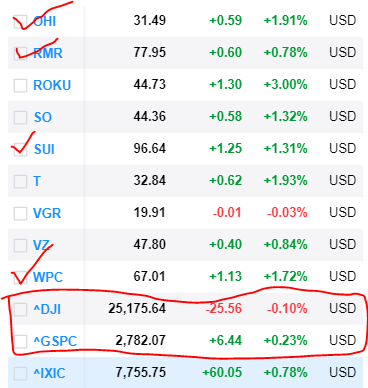
Source: Author chart, courtesy of Yahoo Finance data
At midday, on Thursday, June 14, just one trading day after the Fed raised that rate by 1/4%, every REIT but one in the FTG Portfolio was ahead smartly, most by substantially more than 1% each. These REITs are indicated by the red check marks shown in the above chart. While the Dow Jones Industrials (DJIA) was down .10% and the S&P 500 index (GSPC) was up .23%, the Fill-The-Gap Portfolio was buoyed in large part by its REITs, up 1.19%, five times as much as the S&P 500.
REIT Diversification
We own REITs that are very diversified as to their exposure to various aspects of the economy. They include:
1. Chatham Lodging (CLDT) leases properties to well-known hotel chains which can raise their rates to customers overnight if need be to deal with increased costs. Its dividend of $1.32 provides a current dividend yield of 6.50%.
2. EPR Properties (EPR) is itself intra-diversified, owning ski resort properties, specialized schools, and entertainment venues including movie complexes, restaurants and video game areas for the kids. Its hotel/resort/casino property in the Catskill Mountains of upstate New York is slated to open operations shortly, drawing on millions of potential customers from the New York, New Jersey, Connecticut and Pennsylvania metropolitan areas. Paying a monthly dividend that annualizes to $4.32, its current dividend yield amounts to 6.81%.
3. The GEO Group (GEO) benefits from building and leasing private prison and rehabilitation facilities to the federal government as well as State and municipal authorities. As the immigration issue takes center stage, more of GEO"s facilities will be pressed into service to serve this population. The GEO Group pays an annual dividend of $1.88, yielding 7.56%.
4. Government Properties Trust (GOV) leases office space to federal government, state and municipal government entities. Though the dividend has not increase in some time, its 11.95% dividend yield compensates us and way outperforms a lowly 2% inflation rate. GOV pays a dividend of $1.72 and yields 11.95%.
5. The death of retail has been greatly exaggerated. With last week"s report of a 4.1% increase in retail sales, I think we can feel pretty secure that Kimco"s (KIM) tenants will pay the rent and that our dividends are sustainable. The company pays $1.12 on an annual basis for a 6.78% yield.
6. LTC Properties (LTC) is in the business of leasing properties to long-term healthcare facilities and medical office buildings. Demographics works in favor of the longevity of this company, with 10,000 boomers entering retirement each day while the over-80 population continues to expand. They all need care of one sort of another. LTC pays an annual $2.28 dividend for a 5.38% yield.
7. "The Monthly Income Company", Realty Income (O), is a widely diversified REIT with its fingers plugged into many sectors of the economy. Owning this one REIT provides great diversification to the sector all on its own. And it pays a monthly dividend that grows like a slow-growing weed, offering smooth and consistent cash flow to the retiree that needs it. Realty Income pays a monthly dividend which currently comes to $2.63 per year, or 4.96%.
8. Omega Healthcare (OHI) focuses on the skilled nursing niche. Again, demographics helps assure a dividend payment from this company. It recently kept the dividend steady rather than increase it due to workouts it"s involved with some of its tenants. It"s offered concessions to some, no rent increases to others. The skilled management of OHI is working to replace some non-payers with other, more financially healthy health-management companies. This company pays a dividend of $2.64, for a yield of 8.45%.
9. RMR Group (RMR) owns pieces of other REITs and is involved in offering them management services for a fee. It"s another diversification play. RMR pays a $1.00 per year dividend, for a 1.28% yield.
10. Sun Communities (SUI) owns trailer parks and makes housing available to lower economic segments of the population that prefers this lifestyle to apartment living. Sun pays out $2.84 annually for a 2.93% yield.
11. W.P. Carey (WPC) is yet another diversified REIT with interests in various segments. The company provides long-term sale-leaseback and build-to-suit solutions primarily for companies in North America and Europe. Over 45 years of operation, it has a long history of providing capital to publicly traded and privately-held companies, developers, private equity firms and their portfolio companies. W.P. Carey pays a dividend of $4.04 for a current dividend yield of 6.04%.
Heavy REIT Concentration
Occasionally, a reader will venture that the Fill-The-Gap Portfolio is too heavily weighted toward REITs. I believe that you can see that within this REIT concentration is a well-diversified strategy, invested in many areas of the economy. This diversity, in itself, helps mitigate risk to the portfolio and its overall income component.
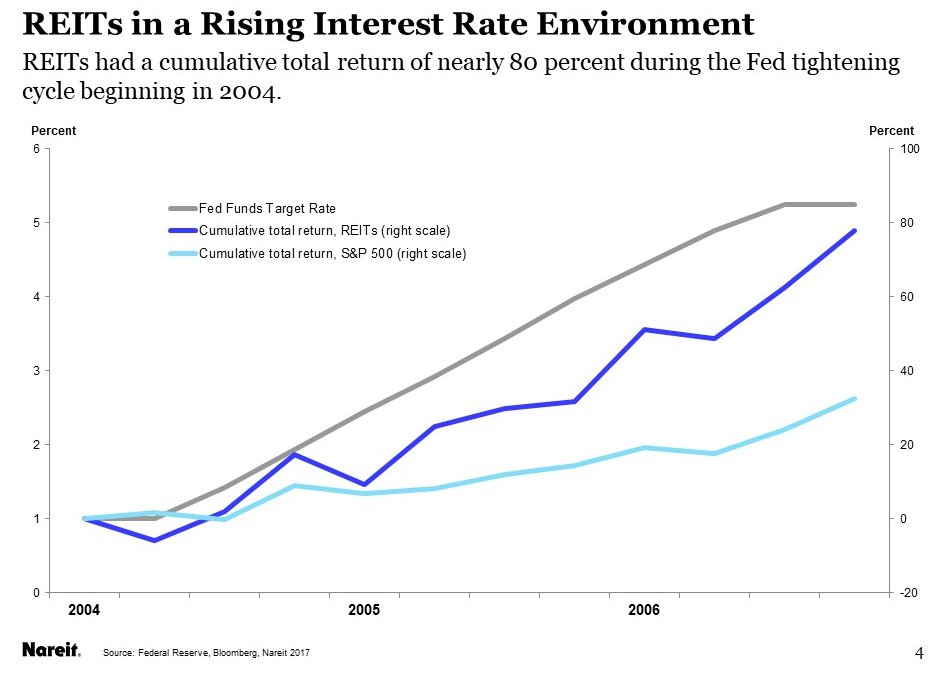
Rising interest rates and expectations of future changes in monetary policy have at times impacted the share prices of stock exchange-listed equity REITs. However, increases in interest rates often are driven by economic growth that may support the growth of REIT earnings and dividends in the future. Research shows that REITs have often outperformed the S&P 500 in periods of rising interest rates.
Source: Nareit
Will My REITs Lose Value As Rates Rise?
The common refrain continues like a drum beat. "When rates rise, the stock price of REITs will decline". "I"ll lose more in equity value in one year than I collected in dividends over the last 5 years".
According to Nareit"s research, this hasn"t been the case. In fact, the opposite has been the case. In addition, total return on REITs has substantially surpassed the total return of the S&P 500.
REIT Earnings and Dividends are Growing
As it has in the past, today"s economic growth is helping to drive earnings growth for REITs. In 2017"s fourth quarter, total REIT industry net operating income increased 9.8 percent from the same quarter in the prior year, according to the Nareit T-Tracker. And the increase in earnings translated into higher dividends for REIT investors. In the fourth quarter of 2017, total dividends paid by equity and mREITs increased 4.5 percent over the prior quarter and 3 percent over 2016"s fourth quarter to $13.7 billion.
Source: Nareit
Will My REIT Continue To Grow The Dividend?
That"s a fair question. We all want to know if our income will keep up with inflation. Take a look at this chart.
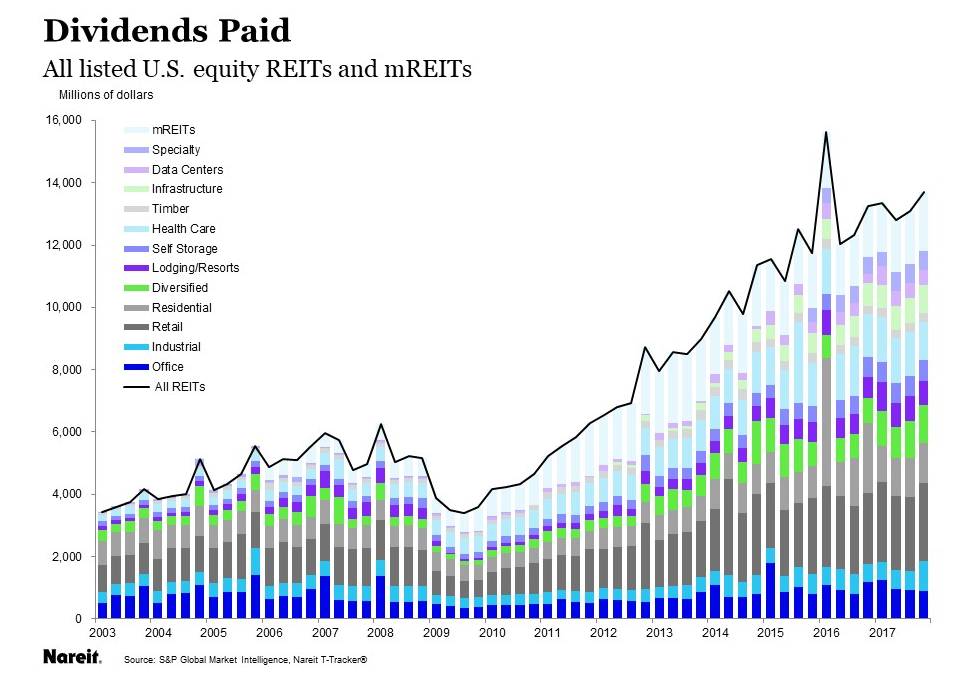
Well, you have your answer. Over the long term, the trend is quite clear. Over shorter periods, some groups of REITs will show some diminution of dividend growth. However, over longer periods, as a group, the REITs demonstrate a definite pattern of consistent payment of dividends and growth of those dividend payments.
There has also been a decline in leverage used by REITs in general. This means the cost to fund interest expense is now taking a smaller bite out of REITs" earnings. Interest expense was 22.3 percent of net operating income in the fourth quarter, down from 38 percent prior to the financial crisis of 2008-2009.
Total Return Concern?
So, if you"re an investor concerned about total return, and focused on stock price, it would appear that your total return, over the long term, will not be harmed by a period of rising rates, especially when proffered at a go-slow approach taken by Jerome Powell.
Dividend Income Concerns?
And, if you"re an income investor, worried that your dividend income will suffer the slings and arrows of dividend cuts or eliminations during periods of rising rates, calm your fears. History shows you can rest easy on this.
This is not to say that one or more of your REITs may not one day fall victim to a cut. There are always company specific or sector specific issues that could affect your holdings. In other words, don"t simply buy and forget. Always monitor the goings on at your companies on an ongoing basis and equal weight the income in your portfolio.
Equal Weight Income To Reduce Risk
I am a strong proponent of the strategy to equal weight your income in your dividend portfolio. Doing so will guard against catastrophic damage to income if one of more your equities reduces or eliminates the dividend.
Think of this scenario:
If you overweight a particular portfolio constituent so that it provides 20% of your total income, how will you pay your mortgage or real estate tax when your income has been reduced by 20% by just one company that decides to eliminate the dividend?
Protect yourself from such a situation by owning perhaps 30 stocks and construct your share holdings so that you will expect 3.33% of income from each one. If one stock eliminates the dividend entirely, you won"t be out on the street overnight. You"ll have time to adjust, to cut back spending a bit in other areas. You can use the time to assess which new stock to buy to replace the income you just lost from the dividend cutter. Before you know it, you"ll be back to the income level you were before the cut occurred.
Monitor Your Holdings Closely
Satisfy yourself, in your due diligence, that your company continues to grow revenue and profits. See that free cash flow is not endangered and that it too is in growth mode. Be aware of any specific threats to your company or sector and be informed if your company is taking proper steps to deal with those threats.
The Fill-The-Gap Portfolio
The FTG Portfolio contains a good helping of dividend growth stocks, like AT&T, which has been in the portfolio for a good length of time. The portfolio was built with the express purpose of benefiting from this and other strategies.
Three and a half years ago, I began writing a series of articles on December 24, 2014, to demonstrate the real-life construction and management of a portfolio dedicated to growing income to close a yawning gap that so many millions of seniors and near retirees face today between their Social Security benefit and retirement expenses.
The beginning article was entitled, "This Is Not Your Father"s Retirement Plan." This project began with $411,600 in capital that was deployed in such a way that each of the portfolio constituents yielded approximately equal amounts of yearly income.
Constructed beginning on 12/24/14, this portfolio now consists of 23 companies, including AT&T Inc., Altria Group, Inc. (MO), Consolidated Edison, Inc. (ED), Verizon Communications (NYSE:VZ), CenturyLink, Inc. (NYSE:CTL), Main Street Capital (MAIN), Ares Capital (ARCC), British American Tobacco (BTI), Vector Group Ltd. (VGR), EPR Properties (EPR), Realty Income Corporation (O), Sun Communities, Inc. (SUI), Omega Healthcare Investors (OHI), W.P. Carey, Inc. (WPC), Government Properties Income Trust (GOV), The GEO Group (GEO), The RMR Group (RMR), Southern Company (SO), Chatham Lodging Trust (CLDT),Iron Mountain, Inc. (IRM), Roku (NASDAQ:ROKU), Helios and Matheson (NASDAQ:HMNY) and LTC Properties (NYSE:LTC).
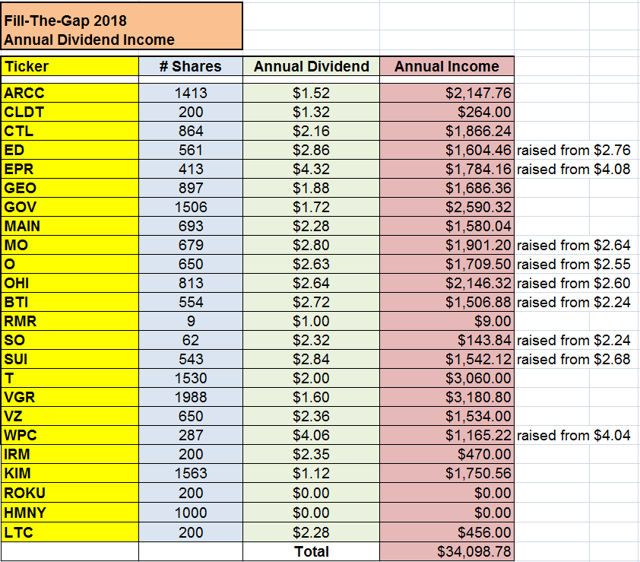
Because we bought most of these equities at cheaper prices since the inception of the portfolio and because most of our stocks have increased their dividends regularly, the yield on cost that we have achieved is 8.28% since launch on December 24, 2014. Current portfolio income, including recent dividend raises by AT&T and Realty Income, and our newest addition of AT&T shares, and LTC Property now totals $34,098.78, which is $1,162.92 more annual income than the previous month. This represents a 3.53% annual income increase for the portfolio.
When added to the average couple"s Social Security benefit of $32,848.08, this $34,098.78 of additional supplemental income brings this couple annual income of $66,946.86. This far surpasses the original goal set to achieve a total of $50,000.00, which is accepted as a fairly comfortable retirement income in many parts of the country. That being said, this average couple now has the means to splurge now and then on vacation travel, dinners out, travel to see the kids and grandkids and whatever else they deem interesting.
Taken all together, this is how the FTG Portfolio generates its annual income.
FTG Annual Dividend Income
Source: Author"s chart
Dividend data source: Yahoo Finance
Strategy Session
If you have been shying away from REITs because you feared the loss of market value when rates rise, give them a second look. These fears have helped depress the price of many REITs and some are on sale by 30% or more.
If you have stayed away from REITs, concerned that they would cut their dividends, take a look at how much their yields have increased due to these fears held by other investors. Lower prices contain the seeds of higher capital gains down the road. Higher current yields promise higher immediate current income. Dividend increases in the future will build your income for you, when you need it in retirement.
Takeaway
Fears attendant to rising interest rates always cause the same knee-jerk reaction. Investors less conversant with the data are prone to sell off their quality, interest-sensitive stocks when rates are increased.
The historical record gives us facts that we can act upon to take advantage of others" fears. As they sell, we can accept the opportunity to take their shares off their hands at discounted prices.
Fears, not based on fact and the historical record, have opened the door to higher total return and higher current and future income for all investors.
Your Engagement Is Appreciated
As always, I look forward to your comments, discussion, and questions. What is your position on REITs? Does your plan allow for buying more REITs when prices decline? Do you follow FOMC meeting announcements for clues to enhance your income? Please let me know in the comment section how you approach these situations in your own portfolio and how you arrive at your decisions.
Author"s note: Should you be interested in reading any of my other articles detailing various strategies to enhance your returns on a dividend growth portfolio, you will find them here.
If you liked this article, please click the "like" button at the bottom of this article.
Only real-time followers will receive immediate notification whenever I write a free article, blog or stock talk. If you enjoyed this article and would like to receive immediate notification as soon as I write new content, simply scroll up and click the orange "follow" button at the top of this article next to my picture, then click "Real-time alerts." If you liked this article, please click the "like" thumbs-up icon at the end of this article. Thank you.
Disclaimer: This article is intended to provide information to interested parties. As I have no knowledge of individual investor circumstances, goals, and/or portfolio concentration or diversification, readers are expected to complete their own due diligence before purchasing any stocks mentioned or recommended.
Thanks for reading. Interested in more dividend strategies and ideas?
I run Retire 1 Dividend At A Time to help investors stay focused on their portfolio income and long-term goals.
My promise to you: With every exclusive article, email, instant-text, and chat, I"ll help guide you to:
- Increased income for retirement, one dividend at-a-time.
- Under-valued stocks for a greater margin of error and higher capital appreciation.
- Methods to safely diversify your portfolio.
- Strategies to build, grow and protect your income for retirement.
Join today with a two-week free trial to get started on the next step of your investing journey!

Disclosure: I am/we are long ALL FILL-THE-GAP PORTFOLIO STOCKS.
I wrote this article myself, and it expresses my own opinions. I am not receiving compensation for it (other than from Seeking Alpha). I have no business relationship with any company whose stock is mentioned in this article.
Editor"s Note: This article covers one or more stocks trading at less than $1 per share and/or with less than a $100 million market cap. Please be aware of the risks associated with these stocks.

No comments:
Post a Comment