I"ve been spending a lot of time on AT&T (T) lately. Honestly, I"ve spent a lot more time thinking about and doing work on this name that I ever thought I would for what should have been a fairly no frills, defensive investment. T is a top-5 position of mine, so when its waters get rough, I have to make sure that I"m not missing something (because if I am, it could potentially have large implications on my financial future). T"s Time Warner (NYSE:TWX) acquisition has been one of the main talking points in the financial world for some time now due to the fact that the government appears to be trying to buck a ~50-year trend in terms of precedent regarding the acceptability of vertical mergers, and the outcome on the T/TWX court case will likely create strong shockwaves across the rest of the media world that is raring to consolidate, so I guess I can"t blame the media/market for latching on to T"s troubles. However, as my recently articles about T have pointed out, I view much of these goings on to be noise that"s best off ignored.
At the end of the day, fundamentals rule, and although I"m not particularly surprised about it, I have been happy to see T"s previous support levels hold. Calling a bottom is always a pretty speculative thing. I don"t have any idea what the future holds (no one does). With that being said, I continue to feel comfortable holding my large T position here in the $32/$33 area because of my belief that downside is fairly limited from these levels. This piece will be much shorter than my prior two focus ticker articles on T; more than anything, this is a bit of a follow-up and is meant to solidify the arguments that I"ve already made.
So, first and foremost, let"s return to the F.A.S.T. Graph. I"ve edited the graph below to highlight eight dips that T has experienced during the last 20 years. I"ve color coded them in terms of their severity (not in percentage dropped, but with regard to the fundamental level that they bounced off of). The worst three of those dips are circled in red. They occurred after the dot-com boom/bust and in the immediate aftermath of the Great Recession. During the periods of time highlighted in red, the trailing twelve-month multiple on AT&T shares fell into the high single digits. The dips circle in orange represent multiples that fell to the 10-11x range. And lastly, the dips circled in yellow represent dips into the ~12x range.
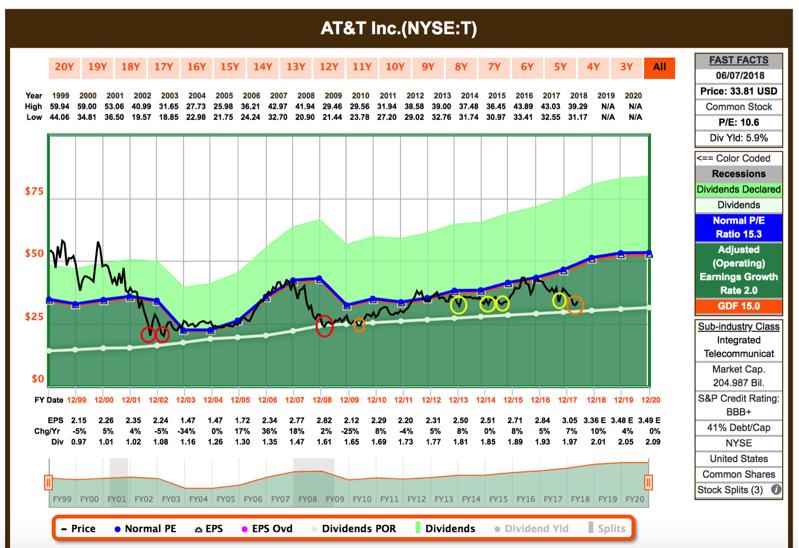
Source: F.A.S.T. Graphs; since edited.
As you can see, T"s recent dip was coded orange. During the worst of the recent selling, T"s shares were priced at a ~10.2x premium. This isn"t quite as bad as things got during actual recessionary periods, but it"s pretty bad the same and certainly falls within the perimeters of the bottom end of this company"s long-term valuation range. Speaking of this range, the graph above also makes the top end fairly clear as well. AT&T hasn"t traded above the ~16x range since 2002. This range is fairly clearly defined, and I think investors should pay attention to it. I"ve heard quite a few investors who bought above $40 in the recent past bashing this stock for its terrible performance, yet if these investors had paid attention to T"s past, they would have known that they were likely buying shares with limited upside. Obviously, all of this work is related to the past, and we always hear about how dangerous it is to drive using the rearview mirror; however, as non-soothsayers, this is about as good as it gets without involving too much speculation in the evaluation process.
I have to admit that it is concerning to see T making lower lows in terms of its fundamental bottoms more recently. As previously stated, the company"s most recent dip has thus far bottomed out in the ~10.2x area. Well, if we look back a few months, in October of 2017, AT&T had another dip, from ~$39 down to ~$33, but shares bottomed out in the ~11.2x area then. From July of 2016 to October of 2016, we saw AT&T shares fall from $43 to just below $37. This was a significant dip for a relatively low beta company, but the stock bottomed out far above its current valuation, bouncing off of the ~13x area. The fact that the market is willing to push T towards lower and lower lows shows a growing concern (likely surrounding the company"s increasing debt load).
Judge Leon is suspected to make an announcing regarding the T/TWX merger sometime in the next week or so, and this should shed light on T"s debt situation. If the deal is allowed to proceed, T will be adding quite a bit of debt to its balance sheet; however, it will also be adding a highly profitable segment (TWX"s operating income was ~$8.4b and its free cash flow/share was $5.70 in 2017). TWX cash flows should help T deleverage in the present and the assets give the company the potential flexibility to differentiate its pipes with an OTT platform of its own as we move into the 5G future which could end up destroying the traditional television market as we know it. Not only could this lead to increased wireless subs for T, but it could also bolster its wireline business, as well as add a digital/targeted advertising revenue stream to its current business model.
Personally, I like adding content to the portfolio in this media environment. The way I see it, the demand for content to consume is going nowhere but up, though the distribution means are ripe for disruption. I don"t want to go too far off into right field when talking about the media environment of the future, but my point here is that I think AT&T is being very forward-thinking with this acquisition as it moves into a new world where it"s not only competition against other telco companies but also big tech companies whose business models rely on eyeballs and will do/spend seemingly anything to get them.
There aren"t that many gems available for purchase in the content creation space and AT&T is probably getting the best one. It"ll be interesting to see how the market views Judge Leon"s decision whichever way it goes. I haven"t discussed the possibilities of a "no" by the Judge because I really don"t see how he could go against the established precedent, though if he does, I suppose that could also be a bullish signal for T regarding its debt load and the likelihood that it will use tax reform benefits to buy back a ton of stock at these bargain barrel multiples (retiring shares that are paying a 6% yield in this interest rate environment seems like a pretty easy asset allocation decision to me). Soon enough we"ll get clarity of the deal. I wouldn"t be surprised if that created volatility in the name in the very short-term, but afterwards, things would calm down a bit with a major question mark removed.
Either way, I think it"s important to focus on the fundamentals surrounding T at the moment and realize that the time to panic isn"t when shares are trading at the bottom end of their long-term historical range because at that point in time, barring some sort of systemic collapse, most of the risk has been taken out of the stock.
Disclosure: I am/we are long T.
I wrote this article myself, and it expresses my own opinions. I am not receiving compensation for it (other than from Seeking Alpha). I have no business relationship with any company whose stock is mentioned in this article.

No comments:
Post a Comment