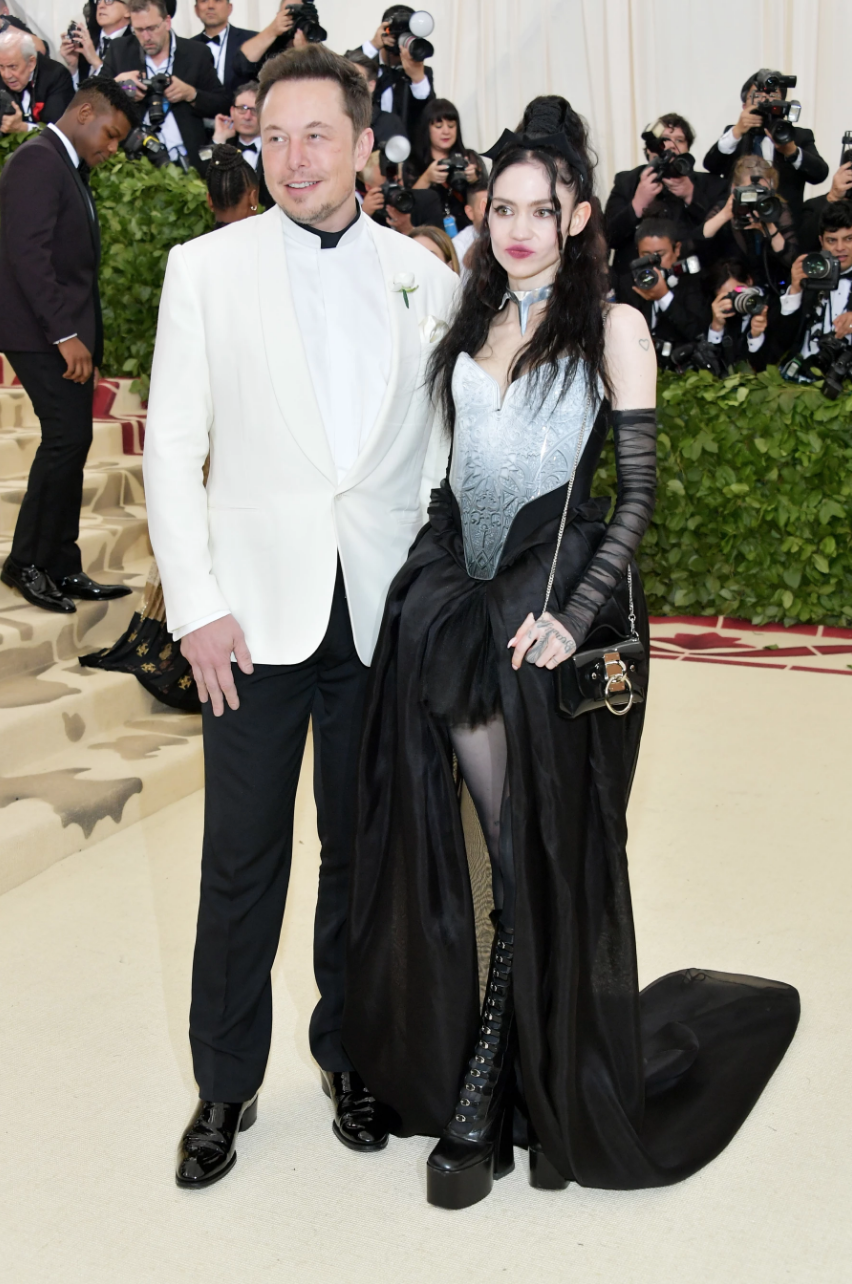
(Elon Musk and Grimes yesterday evening. Because nothing says laser focus on Model 3 production like a celebrity appearance at the Met Gala. Nothing boring about those boots. Or that Tesla logo choker. Photo credit: thefader.com)
Lower Per-Car Op-Ex - Always Promised, Never Achieved
One of the most resilient themes about why Tesla (TSLA) will eventually achieve profitability is that, in time, economies of scale will cause its per-car operating expenses to shrink.
The idea comes into sharp focus any time a commenter here notes that the more Tesla produces, the more money it loses. That really should not be true. And indeed, in the final two quarters of 2017, there finally emerged a bit of evidence Tesla might finally be growing into its operating expenses, causing them to shrink on a per-car basis.
How about in Q1? Has it continued to happen?
Here’s the answer from our Twitter friend, Tesla Charts:
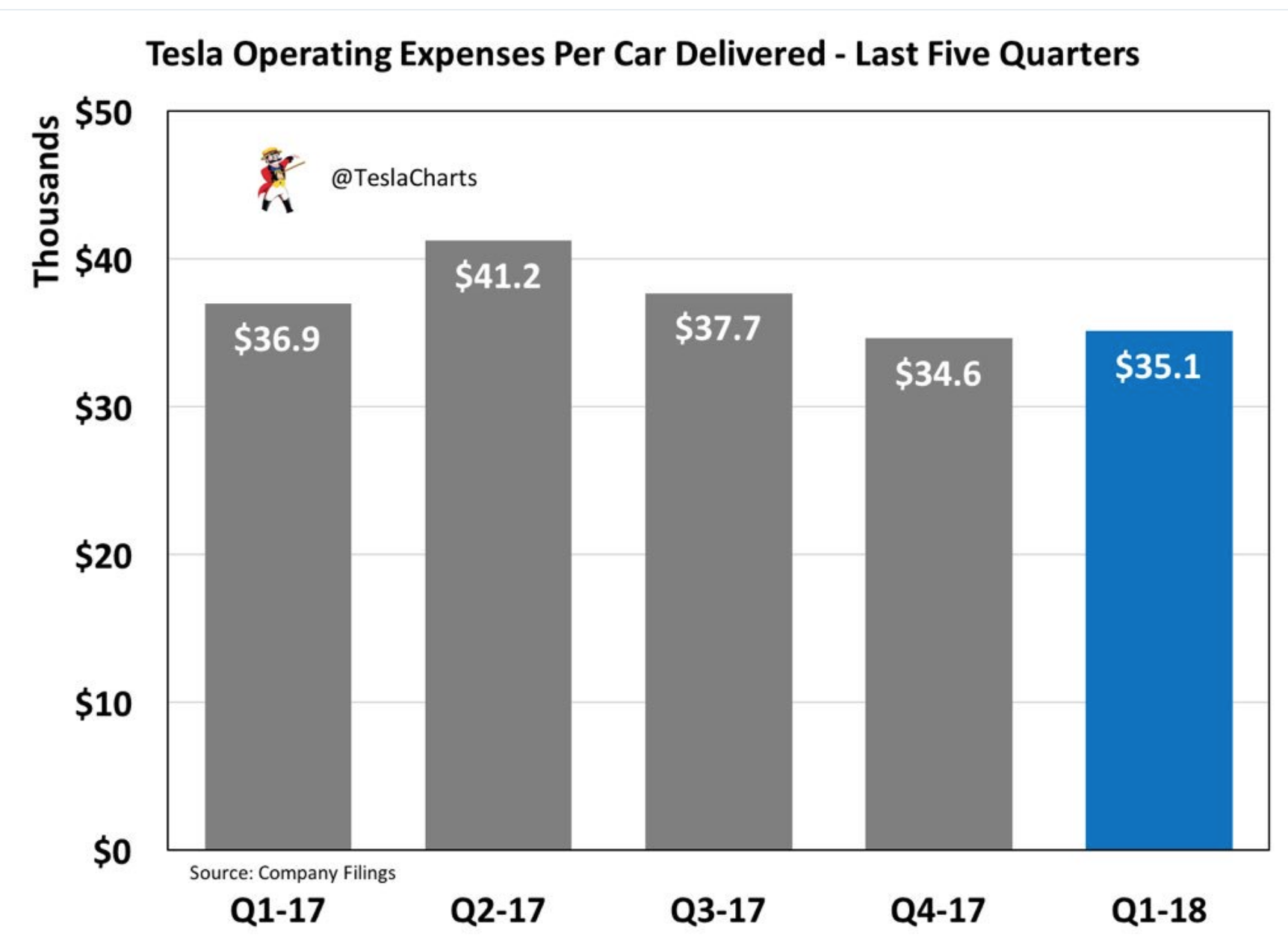
The chart goes back only five quarters because, before that, Tesla had not taken aboard the SolarCity enterprise.
What we see is that per-delivery operating expenses actually rose slightly in Q1 relative to Q4 of 2017. The Q1 figure was a whopping $35,100.
Add that $35,100 to the $36,000 that Munro & Associates suggests is the Model 3"s COGS, and each Model 3 now rolls off the line with a total cost of about $70,000.
Can Tesla squeeze down the per-delivery operating expenses figure? Surely it can. Surely it must. Surely it will. But, how much reduction?
Even if Tesla were able to cut the op ex figure in half (a highly improbably scenario for the next several quarters), its cost per vehicle would still be $53,000. Barely enough to eke out a profit on the high-margin Model 3s now being sold, and a catastrophic number for the $36,000 versions that have been promised.
Per CoverDrive, Q2 Is Going To Be a Doozy
Those of you who regularly read my articles know that my engineer friend, CoverDrive, is my frequent collaborator. He does an impressive job of forecasting Tesla"s financial results, invariably besting most of the analysts.
CoverDrive had forecast a GAAP loss of $900 million in Q1, but had emphasized that his forecast assumed no ZEV credits and did not attempt to determine how the change in lease accounting methodology would affect the results.
The recently published 10-Q shows that, factoring out the ZEV credits and accounting changes, CoverDrive"s forecast was almost spot on.
CoverDrive is now refining his forecast for the rest of 2018 to take account of the accounting change and other information revealed in the 10-Q. I expect he’ll be back soon to share the update.
In the meantime, he has changed his mind on an important issue. Earlier, he was convinced Tesla would hit 200,000 U.S. deliveries during Q2, and thus exhaust the full $7,500 federal income tax (or FIT) credit at the end of Q3. He could not imagine Tesla would try to hold back Q2 deliveries in order to game the result because the financial consequences would be too dreadful.
However, over the weekend, I recently received this note from CoverDrive:
Here"s what I"m seeing in early May. Based on the best information I found on the TMC forums, Tesla ended 2017 with 161,000 US sales eligible for the FIT credit. Add another 18,000 (per InsideEVs) in Q1 for a 179,000 total as of March 31st.
Every cloud has a silver lining (or maybe lemonade out of lemons would be a more appropriate metaphor). Tesla’s impossibly slow ramp-up has practically ensured it won’t reach the auspicious 200,000 U.S. sales figure until after Dominion Day. Using InsideEVs’ numbers, April added only 6,150 units, which brings the total to 185,150.
For May, I expect another 1,250 MS, 1,050 MX, and 5,000 M3. Total at the end of May: 192,450. If June is anything like March, they’ll add another 6,000 MS/MX. But most of the M3 June deliveries will be diverted to Canada. Safe at the plate!
Now, the other side of the coin is that very few Model 3s will be delivered in Q2. The 2,000 per week burst was a counterproductive bust. Right now, I"m thinking 20,000 max., 18,000 likely. Of course, it"s still early in the quarter.
If CoverDrive is right, or close to right, then Q2 is likely to set another GAAP loss record, and may even feature even more cash burn than in Q1. It could create some real capital raise drama as we head into the second half of the year.
The 10-Q: How Is This Week Different from Last Week?
The Q1 GAAP loss reflected in Tesla’s Quarterly Update was a new record. But, as this week"s 10-Q reveals, the quarter was an even bigger disaster than reflected in the Quarterly Update.
Several others already have written insightful pieces about the 10-Q. Let’s summarize the key points:
1. The Increase in Automotive Revenues Is Illusory
Without the change to its lease accounting methodology, Tesla’s automotive revenues would have been $130 million lower than reported last week. In other words, rather than the $30 million increase that appeared in last week’s Quarterly Update, the apples-to-apples number would have reflected a $100 million decrease.
I am not saying the old accounting method is preferable to the new one. I am saying, rather, that using the same method across the most recent two quarters, whether old or new, it"s clear that Tesla’s automotive revenues have actually slipped.
2. Gross Margin Is Lower than Tesla Boasted
Tesla had this boast in one of its Quarterly Update headlines:
Q1 Auto GAAP gross margin up sequentially by 80 bp and non-GAAP by 500 bp
Well, not exactly. As Liam Denning wrote in a sparkling piece at Bloomberg, the only fair way to compare gross margins quarter to quarter is to factor out the accounting change and strip away the ZEV and other regulatory credits.
When one performs that analysis, then the 18.4% headline gross margin number shrinks to 14.3%. (And, let’s not forget how hugely misleading Tesla’s gross margin metric is to begin with.)
As Denning shows, stripping away the regulatory credits, it is clear that Tesla’s automotive gross margins have been below 15% for the past three quarters, and significantly lower than the gross margins achieved in the first half of 2017:
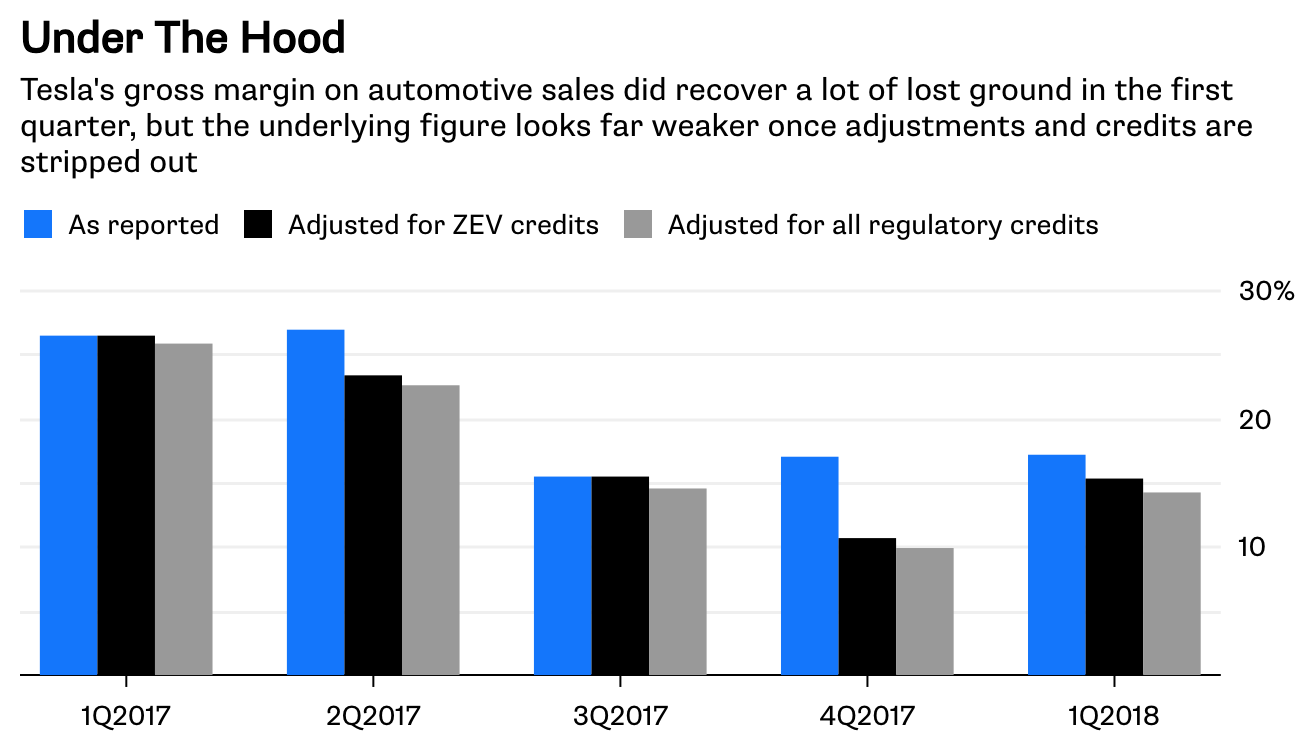
(Courtesy of Bloomberg Opinion analysis. If you are on Twitter, you might consider following @liamdenning for some of the smartest Tesla pieces out there.)
3. Higher Customer Deposits Do Not Mean More Reservations
The $130 million jump in Tesla’s customer deposits also was at least partly illusory. As Bill Maurer wrote yesterday, $59 million of the increase resulted from shifting certain prepayments (principally for vehicle maintenance plans) from deferred revenue to customer deposits.
What about the other $70 million? As I mentioned last week, I suspect a good chunk of that can be traced to the abnormally high number of Model S and X cars in transit at quarter end.
4. Tesla May Mortgage the Fremont Factory
As both Denning and Maurer reported, the 10-Q also discloses two more amendments to Tesla’s $2 billion secured revolving credit facility, the so-called ABL. One of them permits Tesla to include the Fremont factory as part of the collateral for the ABL.
This means Tesla can mortgage the factory to include 75% of its appraised value as part of the “Borrowing Base” under the ABL. This would not give Tesla a larger loan line. It would simply add collateral support to the existing line.
This ABL amendment suggests Tesla will not be able to tap the Fremont factory as another source of secured debt.
As for borrowing against the last remaining material unencumbered asset, the Nevada Gigafactory, it might be a nice idea except for the fact that it"s more Panasonic"s factory than Tesla"s. (For more, see: No, Tesla Can"t Borrow Much Against the Gigafactory.)
5. Hello, Moody’s
The italicized language in the 10-Q risk factors is new:
Accordingly, in order to build and maintain our business, we must maintain confidence among customers, suppliers, analysts, ratings agencies and other parties in our long-term financial viability and business prospects.
Given the recent Moodys downgrade of Tesla"s junk bonds, and the threat of another such downgrade unless things improve soon, the addition would seem timely.
6. Good-bye, Lyndon
The 10-Q also reveals that in February, Tesla repaid Lyndon Rive $17.5 million of debt owed by SolarCity. That’s debt Rive would not have been repaid had SolarCity been allowed to fail.
So, yet another goal of Tesla’s acquisition of SolarCity has been accomplished.
[Author"s note: the original version of this article said $18.5 million. I apologize for the error.]
Bonus Question
How many of the six 10-Q items I just discussed did Tesla reveal in last week"s Quarterly Update or during the conference call?
OK, you all know the answer.
None of them.
A Second Discussion with the Raven
This weekend, Quoth the Raven rang me up a second time and we had a bit of a chat about some of the recent Tesla craziness, including the remarkable conference call and the “short squeeze” tweets.
If you"re in the mood for a Tesla-talk podcast and decide to stop by listen (here), feel free to let us know what you thought of the format and the content. All comments will be read and considered.
Ploutos Shines a Light on Tesla Credit Default Swaps
The Tesla world seems to be spinning out of control lately. What with cutting off analysts during the conference call, tweeting all weekend about a short squeeze, and then noisily buying more Tesla stock yesterday, Elon Musk has made it almost impossible to keep up with the accelerating pace of astonishing developments.
As things whirl by in a blur, I hope you didn"t miss this fascinating piece from Ploutos.
The financial instruments called credit default swaps often convey vital market information. They are the canaries in the coal mine, chirping when catastrophe, otherwise undetected or ignored, makes its tiptoe approach.
Are credit default swaps now telling an premonitory tale about Tesla? Ploutos has come upon some market data that any investor, long or short, will want to consider.
Disclosure: I am/we are short TSLA.
I wrote this article myself, and it expresses my own opinions. I am not receiving compensation for it (other than from Seeking Alpha). I have no business relationship with any company whose stock is mentioned in this article.
Additional disclosure: I am short Tesla via long-dated options

No comments:
Post a Comment