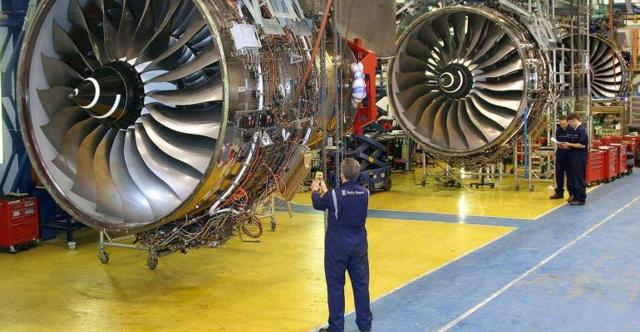
In March, Rolls Royce (OTCPK:RYCEF) announced that it would be recognizing charges in the amount of $315 million related to problems on its Trent 1000 Package C turbofans. In April, Boeing (BA) pushed out a statement after Rolls Royce disclosed it would be recognizing additional charges to facilitate the checks required on the Trent 1000 Package C turbofans currently in service.
Source: IndustryWeek
Of course, this gives the impression that Boeing’s delivery profile for the Boeing 787 program might be dented to the extent that it will miss the full-year delivery target. There have been around 30 aircraft grounded that used to be in revenue service with two-thirds of required inspections already being completed. The focus on getting these aircraft back in the air obviously is top priority since each hour an aircraft sits idle on the ground means no revenues for Rolls Royce’s power-by-the-hour contracts and possible additional costs for Rolls Royce. In this report, we have a look at how we think Boeing shipments have been impacted so far and present our findings on potential slippage of deliveries into the next year.
Engine selection
For the Boeing 787, customers can select propulsion systems from General Electric (GE) or Rolls Royce. For this year, 147 deliveries are scheduled which are either equipped with GEnx 1B or Rolls Royce turbofans. It is likely that most deliveries mounted with Rolls Royce turbofans, will be the Trent 1000 TEN variant. This variant differs from the Package C variant which requires additional checks and fixes, but we do expect that the additional checks, replacements and fixes on the Package C turbofans do impact Trent 1000 TEN deliveries to Boeing as some existing operators will also be swapping from Package C turbofans to Trent 1000 TEN.
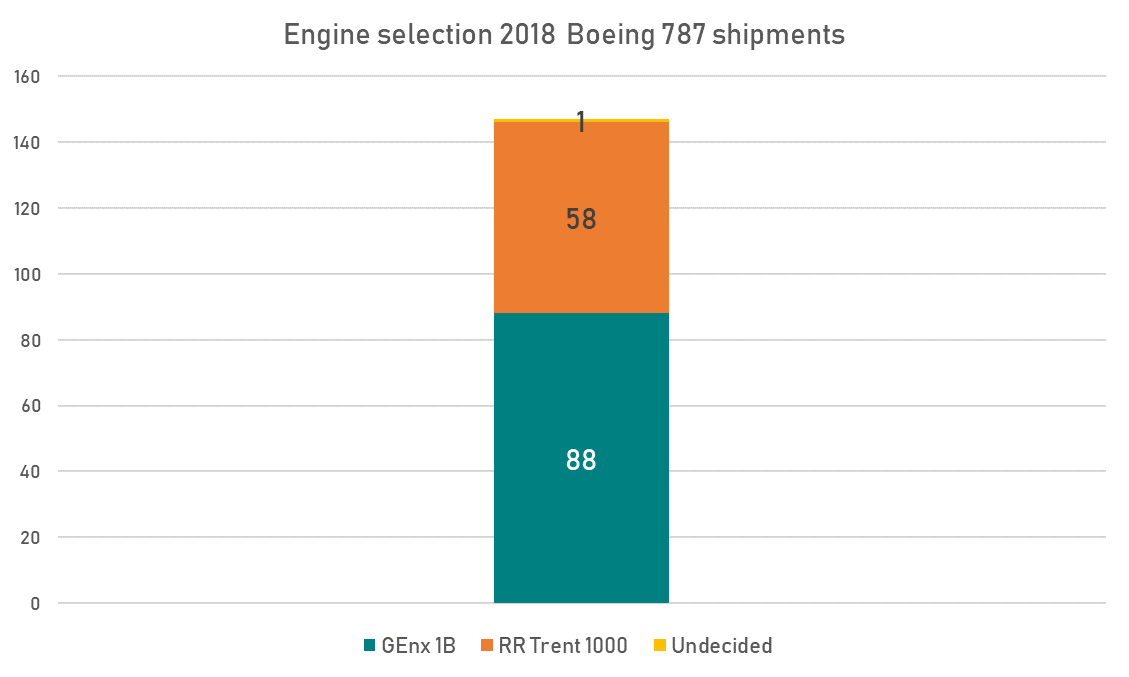
Figure 1: Engine selection Boeing 787 2018 deliveries (Source: AeroAnalysis)
What puts the problem somewhat in perspective is the fact that customers, at least for their 2018 deliveries but likely going forward as well, have selected General Electric’s GEnx 1B propulsion system for their Dreamliners. GE has a 60 percent share in the 2018 deliveries, with the remaining 40 percent going to Rolls Royce and 1 customer being undecided.
In 2018, 58 deliveries with Rolls Royce propulsion systems are scheduled for delivery. Some of the 58 RR equipped Dreamliners have already been delivered to customers. Removing these aircraft, we are left with 36 RR equipped Dreamliners yet to be delivered. So the absolute maximum pain for Boeing seems to be 36 aircraft, meaning that in the worst case 36 deliveries could slip, which are all aircraft that have yet to receive their Rolls Royce propulsion systems. That is significant, since we would be talking about several billions worth of aircraft deliveries.
Leeham News & Comment reported that 6 aircraft have been at Everett seen with weights mounted underneath the wings to balance the aircraft in the absence of turbofans providing the counterbalance.
We ran some calculations on the time between roll out and delivery for the GEnx 1B equipped Dreamliners and the one with Rolls Royce propulsion systems. What we found is that it takes 41 days from roll out to delivery for GEnx 1B equipped aircraft and 44 days for Rolls Royce equipped aircraft. So it takes slightly longer for the RR equipped aircraft to be shipped to the customer, though it is not a big difference, but there indeed is an indication of delays for RR equipped aircraft, since ideally the number of days between roll out and delivery would be uniform for the GEnx 1B and the Trent 1000. We found that roughly a third of the already delivered frames with RR turbofans took longer than average to be delivered while 46% of the aircraft delivered or currently on the flight line will take longer than the average of 41 days, this percentage would indicate 26 aircraft being affected in the full year, 12 of which already have been affected. In terms of revenues, these 26 aircraft are worth between $2.5B and $3.75.
Source: Ainonline
We don’t believe that this is a strong indication that Boeing will be missing its delivery target for the full year. During the year, some deliveries could shift from one month to the other or from one quarter to the other, and if Rolls Royce does not manage to deliver enough turbofans, some might slip into 2019. We are not so much concerned about intra-quarter or intra-year slips. It would be nice to have all deliveries occur timely within the quarter so the quarter results are smooth and not impacted by delays and we think Boeing is also aiming for that, but what is more important is to be meeting the full-year target.
For the Rolls Royce Trent 1000 equipped aircraft to roll over to the next year, we need the time from roll out to delivery to go from the current 44 days on average to 88 days, since the last Trent 1000 equipped delivery of the year is expected at the start of November. All remaining deliveries for November and December are GEnx 1B equipped aircraft. So a lot of possible slippage is already contained by the delivery schedule, and if we look at how many aircraft did have roll-out-to-delivery timelines in excess of 88 days, then we see it was just 1 out of the 26 aircraft equipped with Rolls Royce turbofans (excluding aircraft undergoing rework). Apply this to full-year deliveries, 1-2 deliveries could potentially slip so far that they would end up being delivered in 2019 and these would have to be some deliveries planned in either August or September.
Conclusion
For Rolls Royce, the problems with the Rolls Royce Trent 1000 Package C deliveries do pose a big problem with financial implications. The manufacturer of turbofans has to fix or replace turbofans that are currently forcing airlines to ground part of their fleet while it also has to keep the delivery stream to Boeing going. We’ve seen on the Airbus A320neo program what happens to aircraft deliveries when turbofans that are already in commercial service need to be replaced. If not contained, something similar could happen to the Boeing 787, but not quite to the same extent. In total, about 30 aircraft have been grounded due to issues with the Rolls Royce turbofans. You could say that the 30 aircraft that require modification will put an equal pressure on Boeing’s delivery profile.
We indeed found that the average time to go from roll out to delivery is longer for the Rolls Royce turbofans, which is somewhat of a confirmation that there are indeed delays. What we also found is that most Rolls Royce deliveries are scheduled for the second and third quarter, which means that the delivery schedule already is somewhat mitigating the chances of deliveries slipping from 2018 to 2019, and if deliveries do slip, then there is the highest chance that delivery slip from the one quarter to the other. At the end of the year, there are still 44 days left for Rolls Royce to eliminate any slippage.
Assessing the existing slippage, 15 aircraft are in the zone where the longest slippage we observed would put delivery this year at risk. Multiplying this by the percentage of how many times this occurred so far this year, we figured that 1-2 deliveries might experience a severe slippage, pushing the deliveries into 2019.
What is important to notice is that at first it seems around 36 deliveries could see severe delays in deliveries, but we can narrow this down to 26 to 15 to 1-2 deliveries. In the end, delivery delays could occur and are occurring, but if they are contained, there is a small chance that a lot of deliveries would actually slip into 2019.
If you enjoyed reading this article, don’t forget to hit the Follow text at the top of this page (below the article title) to receive updates for my upcoming articles.
Disclosure: I am/we are long BA, GE.
I wrote this article myself, and it expresses my own opinions. I am not receiving compensation for it (other than from Seeking Alpha). I have no business relationship with any company whose stock is mentioned in this article.
Editor"s Note: This article discusses one or more securities that do not trade on a major U.S. exchange. Please be aware of the risks associated with these stocks.

No comments:
Post a Comment