Thesis
Ventas (VTR) is a very popular healthcare REIT with a strong history of dividend growth. With the share price tumbling in recent months, many authors have come out in strong defense of the stock. While VTR does have a strong operational history, current valuations are still not compelling for me to make a purchase, as I believe there may be more downside risk to forward guidance.
Tale of the tape
VTR, in its own words, is a "provider of capital to leading senior living and healthcare operators and research institutions" (2018 Investor Presentation). It is perhaps the most well-known healthcare REIT, and for good reason. It has absolutely crushed the market since its IPO, delivering over 46 times in total return:
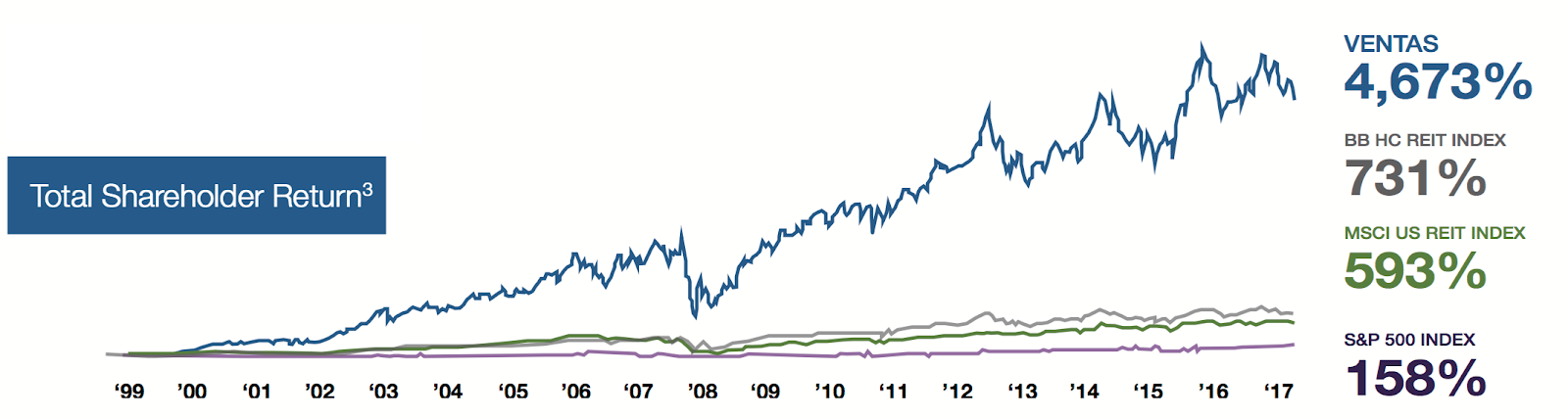
Recent returns have been disappointing
VTR has nonetheless fallen far since June of last year when it was trading above $70: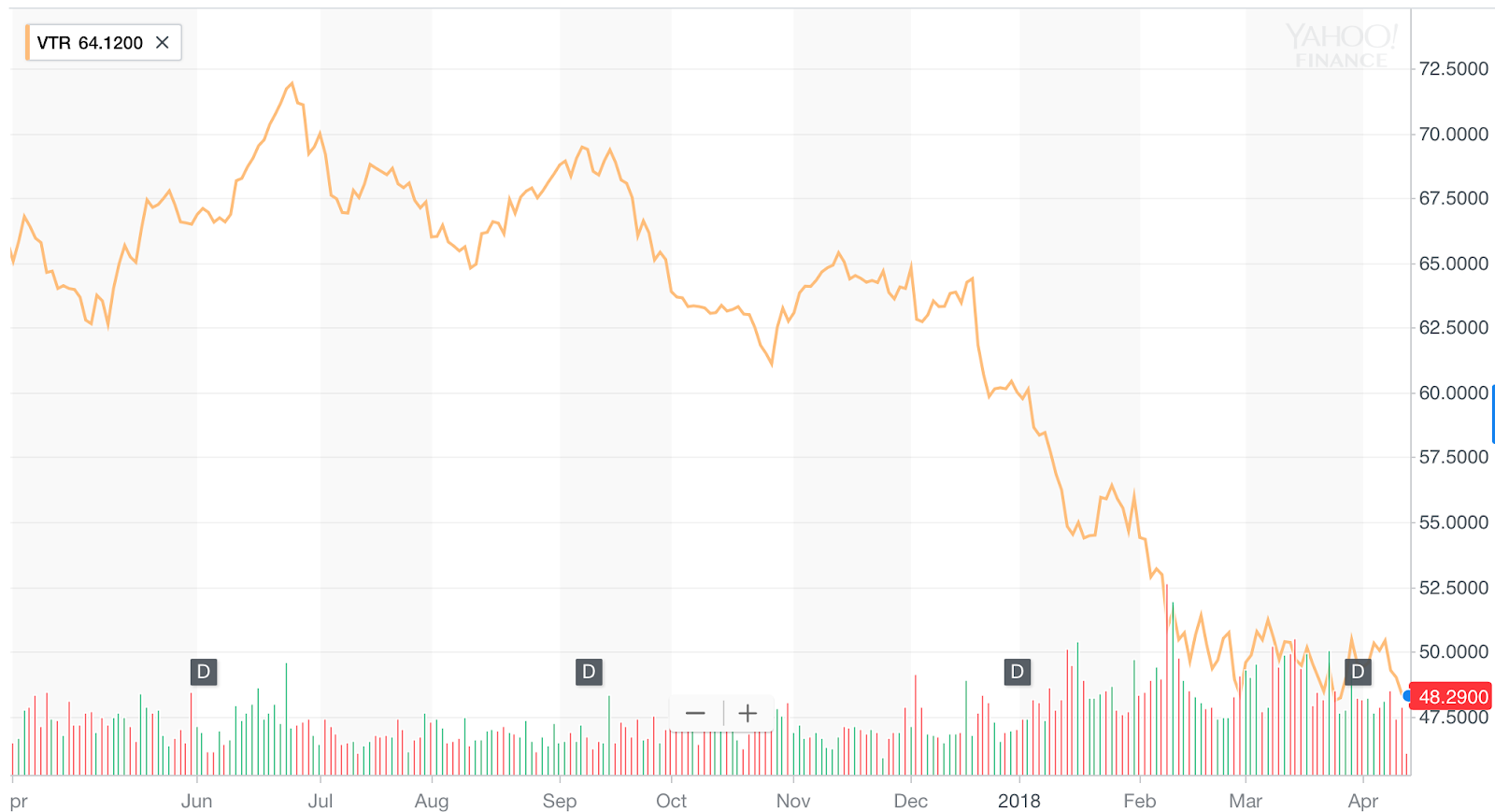
Whenever a market leader drops so far, it raises the question: is this a chance to buy the dip? Should one buy with conviction? These two questions direct the decision to buy as well as how to size the position.
Business Overview
VTR derives the majority of its revenues from senior housing (both operating and triple net) and medical office buildings.
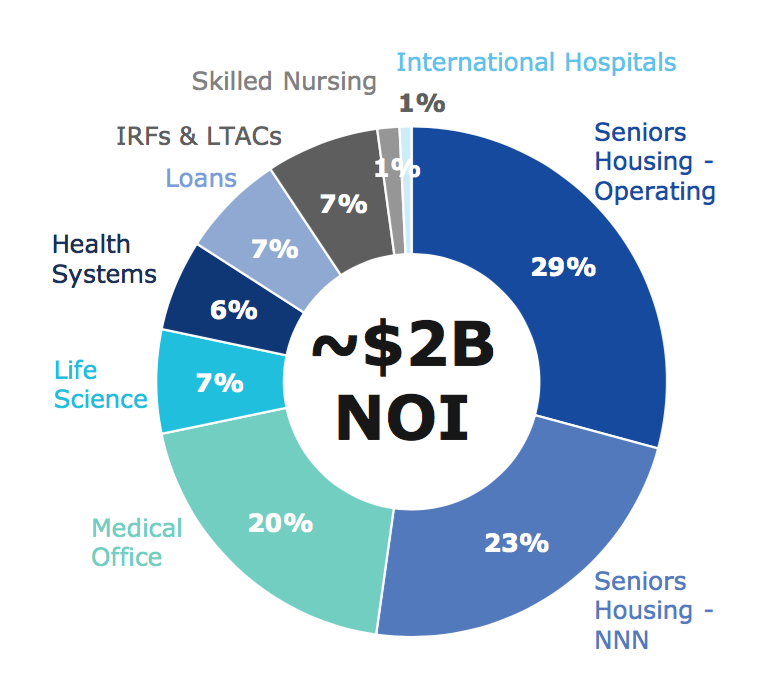
(2018 Investor Presentation)
31% of its owned properties and 38% of net operating income ("NOI") are triple-net. Triple net lease means that the tenant pays for real estate tax, building insurance, and maintenance (these are the three nets). VTR refers to its operating senior housing portfolio as "SHOP," and this was made possible due to the passing of "RIDEA" in 2007. Before RIDEA, healthcare REITs would typically buy properties and rent it out. RIDEA has enabled companies like VTR to take up more financial operating responsibility in return for greater participation in the financial success. Kevin Mackie wrote a brilliant article explaining the implications for VTR and Welltower (WELL).
Strong operational history
VTR has a strong history of outperformance, growing its normalized FFO/share at a much higher pace than peers:
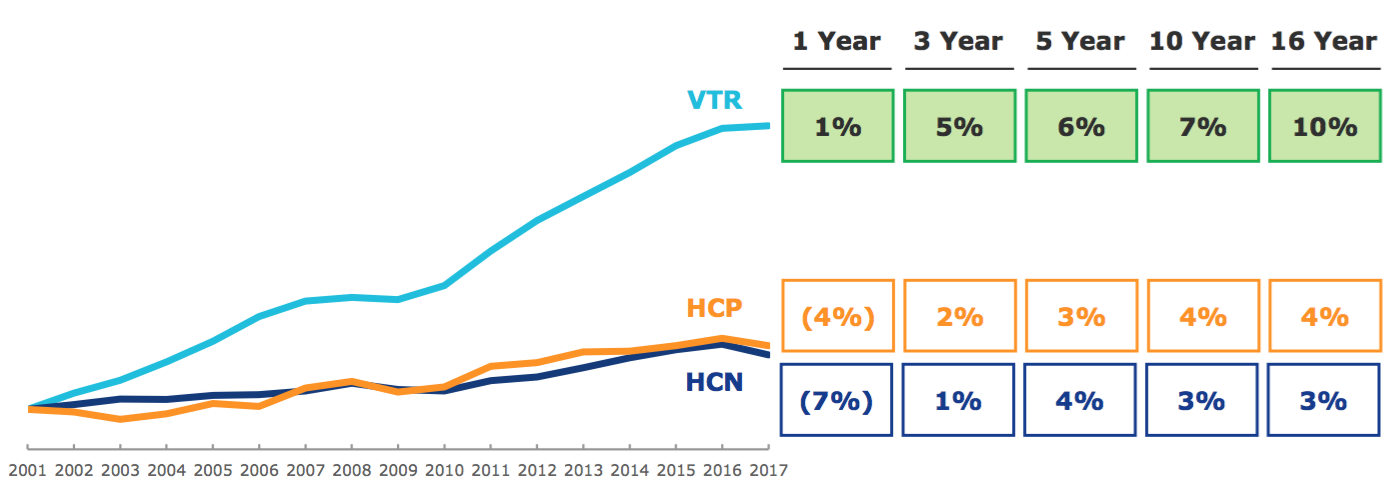
(2018 Investor Presentation)
This has led to very impressive dividend growth (note the drop in 2015 was due to the spinoff of the majority of its senior nursing facilities into Care Capital Properties):
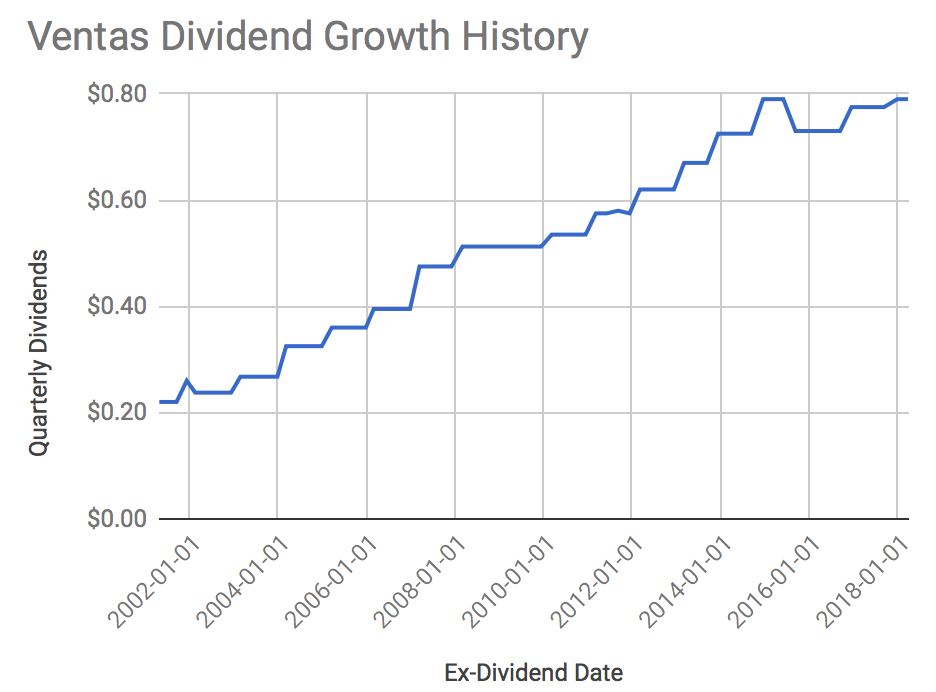
(Chart by Author, data from Dividend.com)
Balance Sheet
With a conservative net debt to EBITDA of 5.7 times and credit rating of BBB+, VTR does have a reasonably leveraged balance sheet. I have found that debt to EBITDA anywhere between 5.5 and 6.5 to be very normal. This gives it the flexibility of debt-fueled acquisitions as its equity valuations remain low.
2017 results came in strong
In 2017, VTR reported 2.5% same-store ("SS") NOI growth and increased its dividend by 5%. Looking at the numbers, it would appear to be just business as usual. The company also has given 2018 guidance for SS NOI growth to be between 0.5 and 2 percent. It has broken down these expectations below:
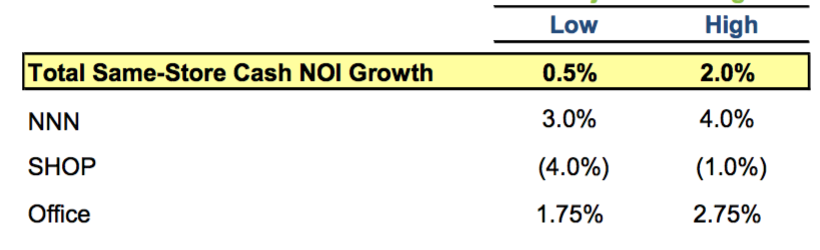
This is where things start to get less clear. As we can see, a large portion of the SS NOI growth is supposed to come from strong NNN growth between 3 and 4 percent. Let"s now take a look at the metrics for this segment.
Low NNN rent coverage
The NNN portfolio for the most part is made up of the senior housing assets, IRFs and LTACs, and health systems.
We can see the rent coverage for each of these segments below: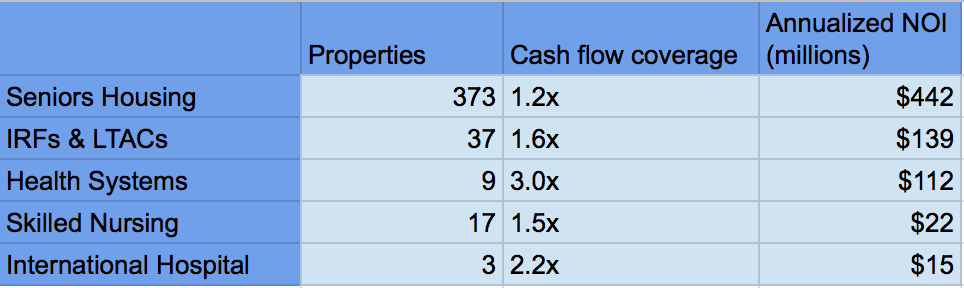
(Chart by Author, data from 2017 Q4 Supplemental)
Cash flow coverage is defined to be EBITDARM, or in other words, "earnings before interest payments, tax, depreciation and amortization, rent, and maintenance expenses." To say that the 1.2 times coverage for senior housing (and I should note the 1.6 times coverage for IRFs and LTACs isn"t much to brag about either) does not allow for much cushion for rent coverage is an understatement. For reference, the corresponding rent coverage ("4-wall") at retail standalone peer STORE Capital (STOR) is 2.7 times. Further, the problem with EBITDARM as rent coverage is that maintenance and interest are real recurring expenses. VTR does not disclose the "fixed charge coverage," which would include interest expense. For reference, STORE Capital"s fixed charge coverage is at 2.1. How much cash after maintenance and interest payments is there for the lease payment? While in theory the lease payments may come ahead of interest payments in the event of a bankruptcy, often times NNN REITs end up just giving rent concessions to avoid restructuring, as seen with Omega Healthcare (OHI) in the past year.
Sure, STORE Capital and VTR own different types of real estate properties, but at the end of the day, rent comes from cash flow. Rent coverage is the ultimate barometer of a tenant"s ability to pay current and increasing rent. Yes, VTR has managed to aggressively increase rents in the past in spite of the low rent coverage, and for the most part, senior housing has maintained rent coverage around 1.3 times annually. But will this continue into the future? Will its senior housing continue to be able to afford such aggressive rent increases? From the looks of it, there is not much margin of error. Should its senior housing tenants fail to keep improving profitability, EBITDARM may continue trending towards 1 and put pressure on future rent increases.
A large amount of NNN leases will be expiring in the near future: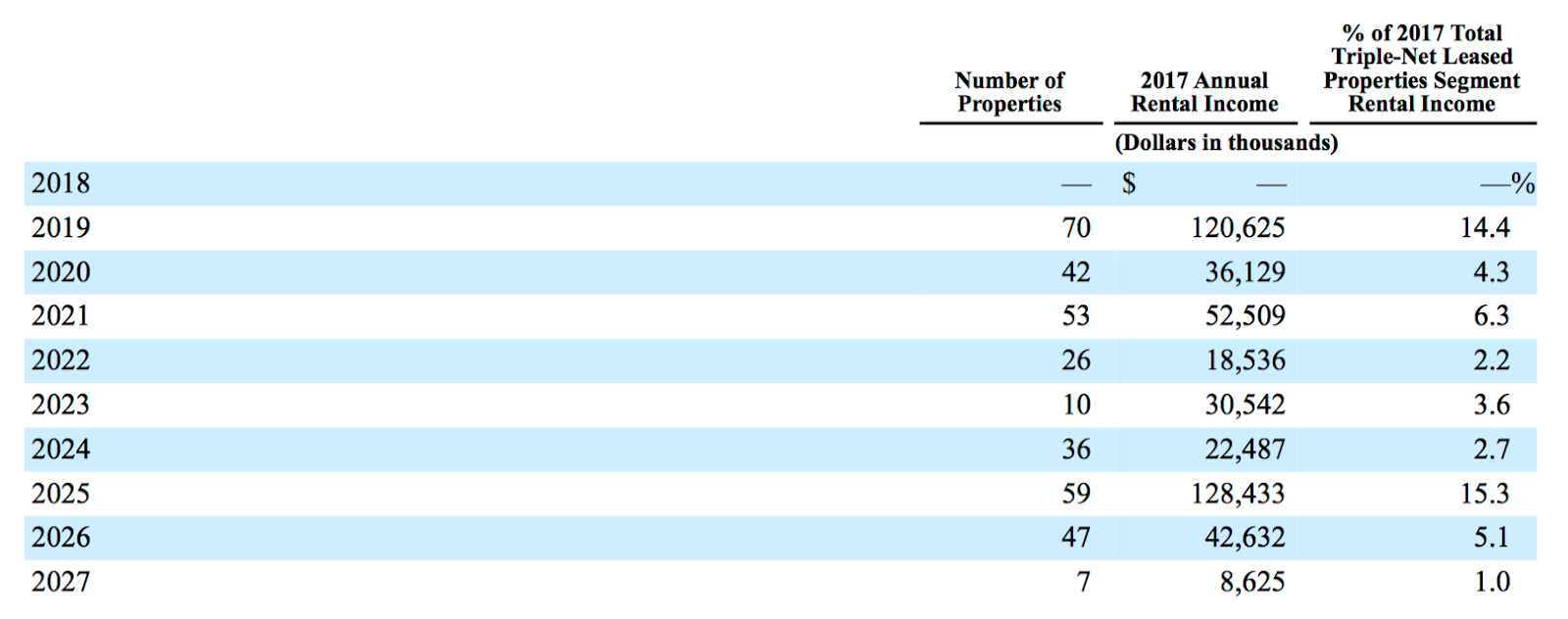
(2017 10-K)
It seems to me that the guidance for NNN NOI growth is quite aggressive, and if there are any downside surprises this year, it would likely come from this segment.
Those contending that VTR might make up for any potential weakness in its NNN segment with the SHOP would be disappointed, as it has given 2018 guidance as follows: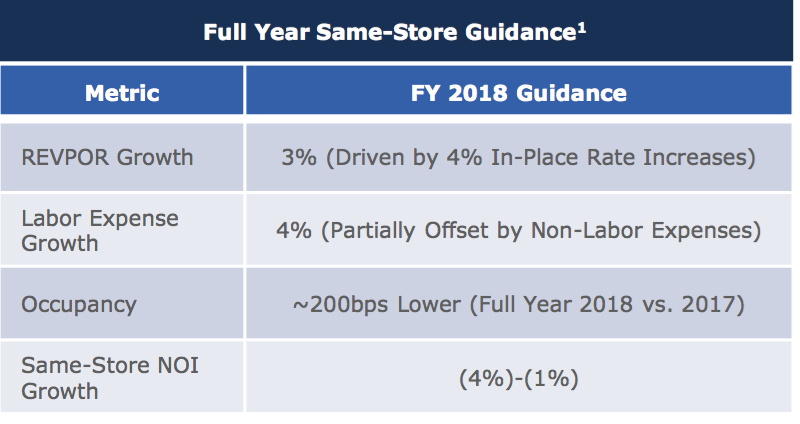
(2018 Investor Presentation)
VTR needs its office portfolio to continue outperforming and avoid any bombshells in the senior housing portfolio to achieve its aggressive guidance.
Watch the capex
Due to the increasing move away from triple net leases, the company has seen capital expenditures as a proportion of funds from operations increase gradually (note: VTR did not report % NNN for the years 2010-2012; figures are reported in 000s)

(Chart by Author, data from 2010-2017 Q4 supplementals)
While this is not necessarily a red danger flag, investors should keep an eye out on this as these capital expenditures eat into distributable cash flow.
Valuation
VTR pays a $3.16 annualized payout and has guided for 2018 FFO of $4 at the midpoint. At recent prices of $48.50, this is a 6.5% dividend yield and FFO multiple of around 12. Looking at the low rent coverage of its tenants, in my opinion, this does not adequately compensate for the risk. For a 6.5% yield to be considered "deep value" in this market, this would be implying solid and reliable dividend growth for years to come. This is something that I am having a hard time convincing myself due to the low rent coverage. Buying at these prices requires a strong conviction that the healthcare sector will remain strong. For my risk tolerance, I would need to see share prices of around $31 before considering to buy.
Conclusion
While I can understand the enthusiasm for shares due to the strong operational history, VTR just doesn"t cut it for my personal portfolio. With a large amount of NNN leases expiring in the coming years, will this be business as usual or will this be a nightmare? Because I like to have a strong understanding in what drives future rent growth, the low rent coverage in its senior housing and NNN properties is a deal breaker. As Warren Buffett once said (paraphrased): there are no called strikes in investing.
If you liked this article, please scroll up and click "follow" next to my name to not miss any of my future articles. If you didn"t, then leave a comment below saying why not, and follow me anyways.
Disclosure: I am/we are long STOR.
I wrote this article myself, and it expresses my own opinions. I am not receiving compensation for it (other than from Seeking Alpha). I have no business relationship with any company whose stock is mentioned in this article.
Additional disclosure: I am working with Rida Morwa of High Dividend Opportunities, who has covered Ventas in the past. This article is my opinion only and does not reflect the opinion of Rida Morwa or High Dividend Opportunities.

No comments:
Post a Comment